For most beers you want about 0.75 to 1.0 ounce (21 to 28 grams) of priming sugar per gallon, and for a standard five-gallon batch that works out to roughly 3.5 to 4 ounces (100 to 115 g). That range assumes dextrose or table sugar and a normal target carbonation of about 2.2 to 2.6 volumes. Change the number and the answer changes with batch size, sugar type and how fizzy you want the beer, so the tables below break all three apart.
There is no single magic number, and that is why the same question gets argued about on every homebrew forum. A one-gallon batch and a fifteen-gallon batch cannot share a number, and a 750 mL bottle needs a completely different figure from a keg. Get it slightly wrong in either direction and you learn about it the next time you open a bottle.
Table of Contents
- How Much Priming Sugar per Gallon of Beer?
- What Is Priming Sugar and Why Does It Matter?
- How to Calculate Priming Sugar for Any Batch Size
- Priming Sugar Amounts by Target Carbonation
- Corn Sugar vs. Sucrose: Which Amount Should You Use?
- How to Add Priming Sugar Without Overcarbonating
- How Much Sugar for Kegs, Bottles, and Different Beer Styles?
- Troubleshooting Too Much or Too Little Carbonation
- Frequently Asked Questions
- How much sugar do I add to beer before bottling?
- What is the best priming sugar for beer?
- How long does bottle conditioning take?
- What happens if I use too much priming sugar?
- How much priming sugar for a 750ml bottle?
- Does priming sugar raise the ABV of my beer?
How Much Priming Sugar per Gallon of Beer?
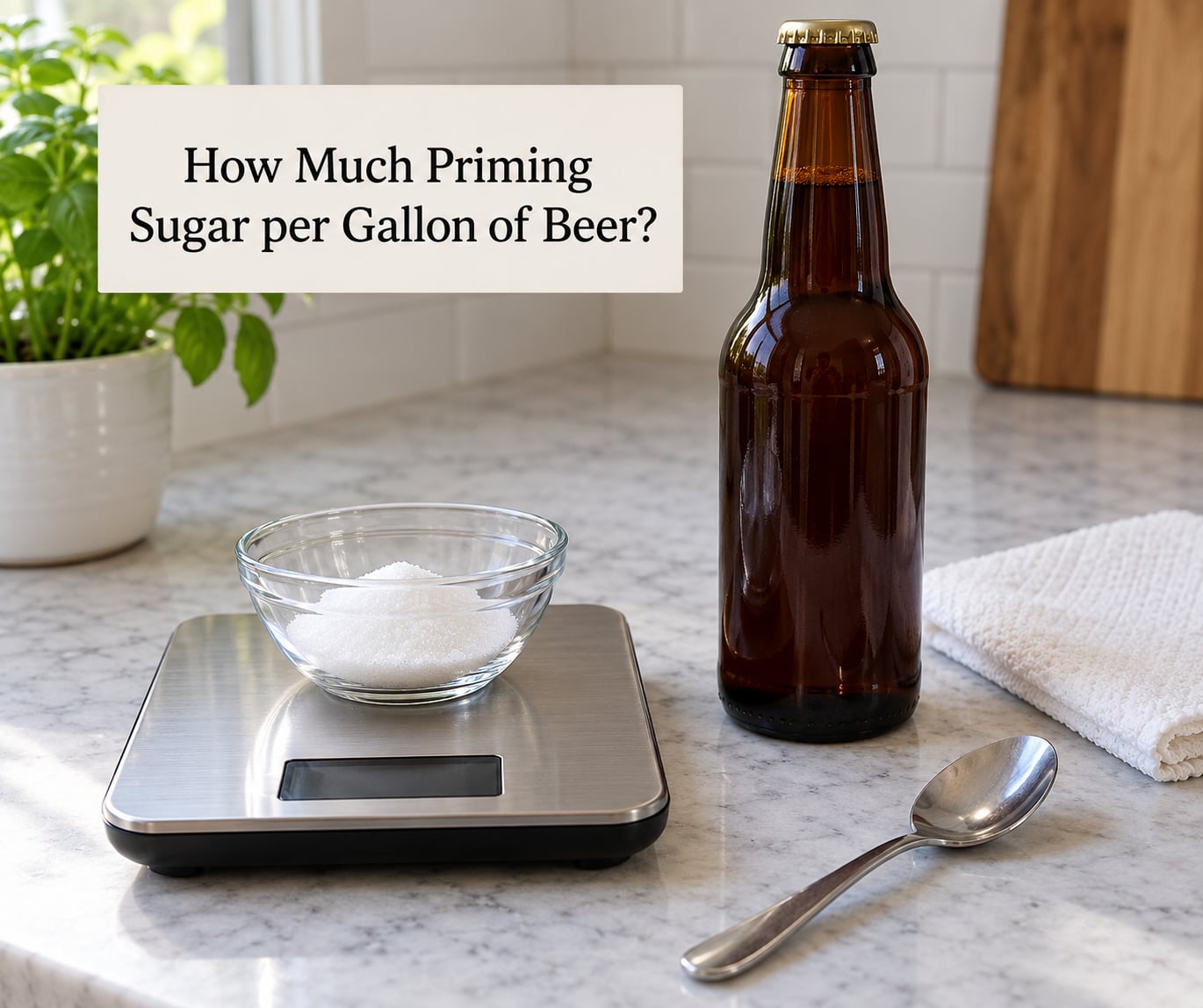
Use this as the short version: 0.75 to 1.0 oz (21 to 28 g) of dextrose per gallon gives you standard carbonation. Scaled to a five-gallon batch, that is 3.5 to 4 oz (100 to 115 g), which is the number most brewery calculators land on for a clean, moderate sparkle.
Low carbonation means about 1.5 to 2.0 volumes, and there you want less sugar: roughly 0.3 oz (9 g) of dextrose per gallon. High carbonation at 2.7 to 3.3 volumes takes more, around 1.1 oz (32 g) per gallon.
Here is how much priming sugar per gallon to use at each level, with the matching five-gallon figure so you do not have to do the multiplication yourself.
| Carbonation level | Volumes of CO2 | Dextrose per gallon | Dextrose for 5 gallons | Typical styles |
|---|---|---|---|---|
| Low / flat-style | 1.5 to 2.0 | 0.3 oz (9 g) | 1.5 oz (45 g) | British bitter, porter, dry stout, old ale |
| Standard | 2.2 to 2.6 | 0.8 oz (23 g) | 4.1 oz (116 g) | Pale ale, amber ale, Irish red, brown ale |
| High | 2.7 to 3.3 | 1.1 oz (32 g) | 5.6 oz (160 g) | IPA, hefeweizen, Belgian dubbel or tripel, pilsner |
Those figures assume the beer is packaged cool, which is where most homebrewers start. If you bottled warm, or if you want to pour a very fizzy beer, move up a row. When in doubt, aim for the middle of a row rather than its ceiling.
What Is Priming Sugar and Why Does It Matter?
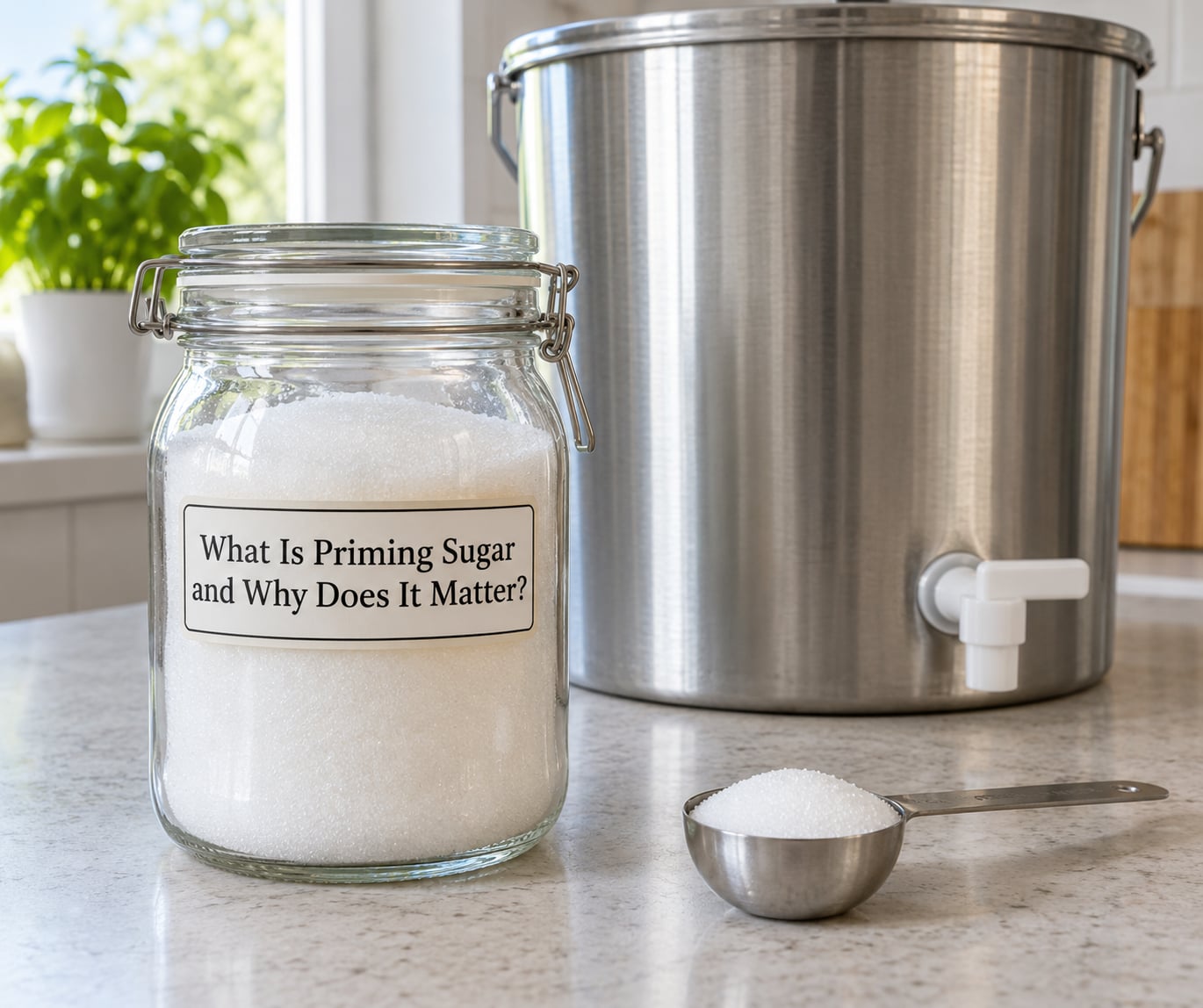
Priming sugar is a small, measured amount of fermentable sugar added at bottling time. Living yeast left over from fermentation eats that sugar and produces carbon dioxide, which has nowhere to escape once the bottle is sealed. The result is natural carbonation, the same process a brewery runs on a much larger scale.
It also matters because your beer is already partly fizzy before you add anything. Homebrewers commonly report somewhere around 0.8 to 1.2 volumes of dissolved CO2 sitting in the beer straight out of the fermenter, and the exact figure depends on how warm the beer got during fermentation. That leftover carbonation is called residual, and it is the reason a flat-looking beer can still turn out decently fizzy.
The whole method rests on one relationship that is worth memorising: residual carbonation plus priming carbonation equals your target carbonation. Every calculation in this guide is just that equation rearranged, and once you see it, the tables stop feeling arbitrary.
Two things priming sugar does not do are worth stating plainly. It does not meaningfully raise your alcohol by volume, because the sugar becomes gas rather than ethanol. And it is not required if you force-carbonate a keg, which is covered further down.
If you want the full picture of what the yeast is doing before and after bottling, what yeast does during fermentation covers the biology side.
How to Calculate Priming Sugar for Any Batch Size
The formula is short enough to do on a scrap of paper. Measure your finished beer in litres, subtract the residual carbonation from the carbonation you want, then multiply by 4.7 for dextrose.
Priming sugar (g) = litres of finished beer × (target volumes − residual volumes) × 4.7
Worked example, one gallon, standard carbonation. One gallon is 3.785 litres. Target is 2.3 volumes and residual is 1.0, so you need an extra 1.3 volumes. Multiply 3.785 by 1.3 by 4.7 and you get about 23 g of dextrose, which is 0.8 oz. That lands inside the standard band in the first table, which is a good sign the formula matches the published guidance.
Residual is the variable people skip, and it is worth a moment. A beer fermented cool and packaged cool can hold closer to 1.2 volumes. One fermented hot, say around 80 °F, may come out of the fermenter with only about 0.6. Same batch, same formula, but the hot version needs noticeably more priming sugar to land where you wanted it.
Once you have the figure for one gallon, batch size is just multiplication. Here is the scaling table for dextrose at standard carbonation.
| Batch size | Litres | Dextrose at 2.3 volumes | Dextrose at 1.7 volumes | Dextrose at 2.8 volumes |
|---|---|---|---|---|
| 1 gallon | 3.8 | 0.8 oz (23 g) | 0.3 oz (9 g) | 1.1 oz (32 g) |
| 2 gallons | 7.6 | 1.6 oz (46 g) | 0.6 oz (18 g) | 2.3 oz (64 g) |
| 3 gallons | 11.4 | 2.4 oz (69 g) | 1.0 oz (27 g) | 3.4 oz (96 g) |
| 5 gallons | 18.9 | 4.1 oz (116 g) | 1.6 oz (45 g) | 5.6 oz (160 g) |
| 10 gallons | 37.9 | 8.2 oz (231 g) | 3.1 oz (89 g) | 11.3 oz (319 g) |
| 15 gallons | 56.8 | 12.2 oz (347 g) | 4.7 oz (133 g) | 16.9 oz (478 g) |
| 20 gallons | 75.7 | 16.3 oz (462 g) | 6.2 oz (177 g) | 22.5 oz (638 g) |
Small batches are where published rules of thumb fail hardest, since almost all of them assume five gallons. If you have never brewed more than a gallon at a time, how to make a one gallon batch of beer covers the rest of that process.
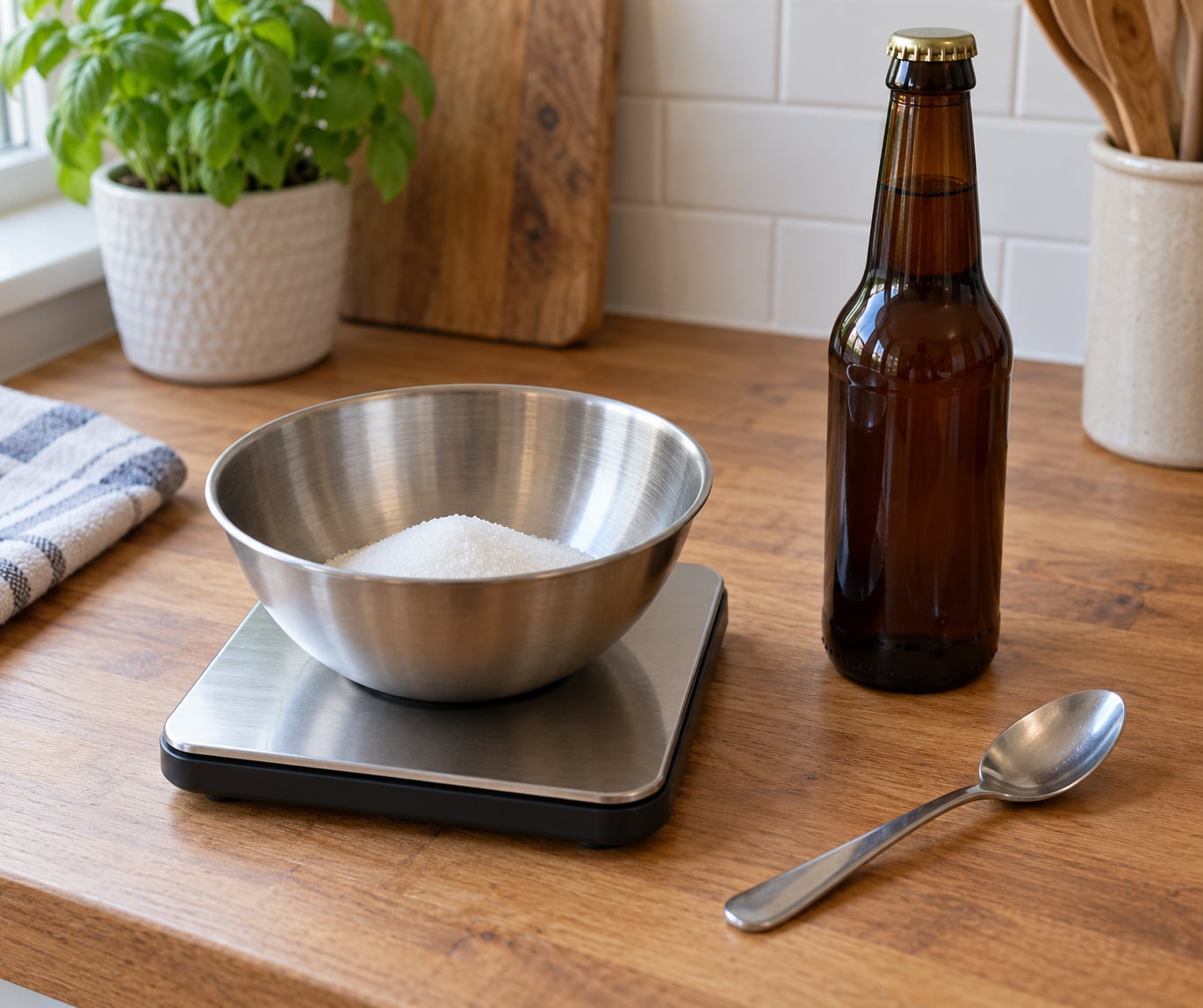
Measuring cups are the other trap. They trap air, they vary between brands, and a packed cup of dextrose and a fluffed cup can differ by twenty percent. A kitchen scale that reads to a gram costs almost nothing and removes an entire category of error. Weigh the sugar, add it, and move on.
Priming Sugar Amounts by Target Carbonation
The unit you will meet most often is volumes of CO2, simply the volume of gas held per volume of beer at a given temperature. Two volumes means the beer holds about twice its own volume in dissolved gas. A 355 ml bottle at 2.5 volumes contains roughly 890 ml of CO2, even though none of it is visible.
For people who think per bottle rather than per batch, here is the conversion at standard carbonation.
| Container | Volume | Dextrose | Table sugar | Notes |
|---|---|---|---|---|
| 12 oz bottle | 355 ml | 2.2 g | 2.0 g | The everyday standard |
| 500 ml bottle | 500 ml | 3.1 g | 2.9 g | Common in UK and EU markets |
| 22 oz bomber | 650 ml | 4.0 g | 3.7 g | Double the 12 oz figure |
| 750 ml bottle | 750 ml | 4.6 g | 4.3 g | Standard wine-style bottle |
| Swing-top 750 ml | 750 ml | 4.6 g | 4.3 g | Same dose, less headroom for over-priming |
| 1 gallon batch | 3.8 L | 23 g | 22 g | About ten 12 oz bottles |
| 5 gallon batch | 18.9 L | 116 g | 108 g | About fifty 12 oz bottles |
Style is the other half of the target, and matching carbonation to style is what separates a beer that tastes like itself from one that just tastes fizzy.
| Style | Target volumes | Dextrose per gallon |
|---|---|---|
| British ordinary bitter | 1.5 to 2.0 | 0.3 oz (9 g) |
| Porter and dry stout | 1.6 to 2.0 | 0.4 oz (11 g) |
| American pale ale | 2.2 to 2.6 | 0.8 oz (23 g) |
| West coast IPA | 2.4 to 2.8 | 1.0 oz (27 g) |
| Hefeweizen and wheat beer | 2.6 to 3.0 | 1.1 oz (32 g) |
| Belgian dubbel | 2.4 to 2.8 | 1.0 oz (27 g) |
| Belgian tripel | 2.6 to 3.0 | 1.1 oz (32 g) |
| German pilsner and lager | 2.5 to 2.9 | 1.0 oz (29 g) |
| Fruit beer and smoothie beer | 2.0 to 2.4 | 0.7 oz (20 g) |
| Cider and sparkling specialties | 2.8 to 3.4 | 1.3 oz (36 g) |
Serving temperature pulls in both directions, and it confuses people. Cold beer holds more gas, so a beer bottled at 68 °F and served at 35 °F tastes foamier and more volatile than the same beer bottled warm and served cold. Keep packaging and serving temperatures in the same neighbourhood, and treat cold serving temperature as a reason to trim back slightly, not add.
One caution on the high end. Anything above about 12% ABV has less of the yeast activity left in it, so the priming sugar may ferment slowly and unevenly. Sweet styles such as mead or strong ale need both more sugar and more time, and that is a separate calculation from ordinary beer.
Corn Sugar vs. Sucrose: Which Amount Should You Use?
Both work. They differ slightly in the number on the scale, a little in flavour, and quite a lot in convenience. The multiplier changes with the sugar, so swap the 4.7 above for the right one: 4.7 for dextrose, 4.4 for sucrose, about 5.6 for dry malt extract and roughly 5.8 for honey.
| Sugar type | Per gallon at 2.3 vols | Per 5 gallons | Fermentability | Character |
|---|---|---|---|---|
| Corn sugar (dextrose) | 0.8 oz (23 g) | 4.1 oz (116 g) | About 91 percent | Neutral, very clean, easy to find |
| Table sugar (sucrose) | 0.8 oz (22 g) | 3.8 oz (108 g) | About 100 percent | Neutral, dissolves more slowly in cold beer |
| Dry malt extract | 1.0 oz (28 g) | 4.9 oz (138 g) | About 82 percent true | Adds a faint caramel note |
| Honey | 1.0 oz (29 g) | 5.0 oz (143 g) | About 80 percent | Can add fruit and floral notes |
Corn sugar is the default choice for most brewers because it ferments cleanly, dissolves readily and carries no flavour. Sucrose costs a little less and needs slightly less by weight, but it is fussier to dissolve and can leave a gritty feeling if dumped straight into cold beer. Dry malt extract is the option when you want a hint of malt character, and it also comes in handy as a blend with dextrose.
Honey is the wildcard. It works, and it is a traditional choice for styles that suit it, but honey varies enormously in how much of its sugar your yeast will actually eat. Treating it like sucrose often leaves bottles under-carbonated, which is why the table lists a higher weight. If you use honey, stir it into a cup of hot wort or water first so it disperses instead of settling to the bottom.
The dry sugar volume correction matters more than most guides admit. Adding 4 oz of dry sugar straight into five gallons raises your final volume slightly and nudges the ABV up by about 0.1 percent, which is negligible for beer but noticeable in a delicate saison. If you care about that detail, dissolve the sugar in about half a cup of the beer first, then return that beer to the batch. You get the same carbonation with a fraction less disruption.
How to Add Priming Sugar Without Overcarbonating
Over-priming is the one error with real consequences, so the procedure matters as much as the number. This takes about ten minutes.
- Make sure the beer is finished. Stable gravity for three days in a row means there is enough yeast to carbonate and not enough sugar left to worry about. Bottling early and adding priming sugar on top of fermenting wort is how bottles become dangerous.
- Siphon the beer off the sediment. Move it into a bottling bucket or another clean vessel. The yeast you want is suspended in the liquid, not packed at the bottom.
- Weigh the sugar. Use your calculated figure and a scale that reads in grams. Do not scoop with a measuring cup.
- Dissolve it first. Stir the sugar into roughly 150 ml of the beer, taken from the batch itself, until it has fully disappeared. If it will not dissolve, use a little warm water and let it cool before adding.
- Add and mix gently. Pour the solution into the bucket and stir once with a sanitised spoon. You want it distributed, not aerated.
- Fill, cap and wait. Bottle or cap immediately, then leave the bottles undisturbed at room temperature for two weeks before moving them somewhere cool.
Before you bottle the whole batch, fill three bottles at a lower dose and leave the rest at the calculated dose. Open one after a week and one after a month. If the trial bottles are flat, the rest are under-primed and you can still correct it with a small second addition; if they gush, you have learned something for very little money.
Priming tablets and carbonation drops are the no-math route. A tablet dissolved in a small amount of beer at bottling gives the same result with no weighing and no calculation, and because the dose is per bottle it cannot be accidentally scaled up. Many brewers keep them for exactly that reason. The trade-off is that you handle each bottle separately.
Over-priming shows up as swollen caps, foam shooting out of the bottle, leaking seals, or in the worst case a glass bottle failing. Swing-top and corked bottles have the least headroom of anything you will fill, so treat them as the containers where precision matters most. If a bottle is swollen, do not open it, chill it first, and handle it away from your face.
How Much Sugar for Kegs, Bottles, and Different Beer Styles?
Force-carbonating a keg is the exception worth stating plainly: add no priming sugar at all. The gas you force in with your CO2 tank does the same job with far more control, and unprimed beer in a forced keg will not gush or over-carbonate. Many brewers use this for pale ales and anything they want to adjust later.
Naturally carbonated kegs are the middle path. The beer gets its priming sugar as usual, you fill the keg without purging all the CO2 out of the headspace, and you let it condition under pressure for one to two weeks before serving. Same dose as bottling, different timeline.
For bottles, the per-container table earlier is the one to work from. A 12 oz bottle at standard carbonation takes about 2.2 g of dextrose, and a 750 ml wine bottle takes about 4.6 g. Brewing a few bottles for yourself is much easier than it looks, especially if you weigh each dose individually.
A few outside-the-normal cases:
- Hard seltzer and other neutral bases. Use the standard carbonation figure for the finished volume, roughly 0.8 oz of dextrose per gallon at 2.3 volumes, and expect it to taste sharper than beer because there are no malt and hop compounds softening the perception.
- Cider. Fermented dry cider handles 2.4 to 2.8 volumes comfortably. Sweet cider is lower, and still cider is usually force-carbonated instead.
- Mead. Not a beer and not calculated the same way, but the same logic holds: more sugar means more pressure, so work up gradually and refrigerate before the terminal sweetness stage.
Whatever the style, the style tables give you a defensible starting point rather than a final word. If the beer is your own recipe, you already know the yeast and the fermentation temperature, so you can do better than any general table.
Troubleshooting Too Much or Too Little Carbonation
Signs of too much: a popping cap or a broken crown cap, foam spraying from the bottle on opening, visible gush when the bottle is tilted, a beery smell in the air before you have poured anything, or a faint plastic or soda character. If bottles are swollen, do not open them at room temperature; chill them first and open them over a sink.
Signs of too little: a beer that tastes dull and thin with no bite, no aroma lift when poured, and a flat finish. Beer opened weeks after bottling and still showing none of this was under-primed, not under-fermented.
The usual causes and their fixes:
| Symptom | Likely cause | What to do |
|---|---|---|
| Gushing, swollen caps | Too much sugar, or bottled before fermentation finished | Chill and open carefully. Next batch, verify stable gravity and dose a little lower. |
| Flat after 3 weeks | Not enough yeast activity, or beer bottled too warm | Warm the bottles to room temperature for a few days and wait. |
| Flat after 3 months | Under-primed, or all yeast had settled out before bottling | Add a small amount of priming sugar to the remaining bottles and condition warm. |
| Inconsistent between bottles | Sugar not fully dissolved, or dose was guessed by volume | Dissolve fully in a measured amount of beer and weigh every batch. |
| More fizz than the plan called for | Warm fermentation left little residual CO2, so the dose overshot | Subtract actual residual CO2 next time rather than assuming 1.0. |
| Fizzy but thin and harsh | Priming sugar added to beer that had not finished fermenting | Wait for stable gravity before bottling; this one cannot be corrected after the fact. |
A dull beer is not a failure, and neither is a slightly fizzy one. Adjust the target volumes by about 0.2 in either direction on the next batch and write the number on the brew sheet. That is how you end up with a house recipe you can repeat rather than one you keep guessing at.
If you also want to check the alcohol figure after all this, how to calculate ABV at home is worth a read.
Frequently Asked Questions
How much sugar do I add to beer before bottling?
For a five-gallon batch of normal-strength beer aiming at 2.2 to 2.6 volumes of carbonation, use about 4 oz (115 g) of dextrose or 3.8 oz (108 g) of table sugar. Per gallon that works out to roughly 0.8 oz (23 g). Dissolve it in about 150 ml of the beer first, add it, and let the bottles condition warm for about two weeks.
What is the best priming sugar for beer?
Corn sugar, also called dextrose, is the most reliable choice for most brewers. It ferments cleanly, dissolves easily, adds no flavour, and costs about the same as the alternatives. Table sugar works nearly as well and needs slightly less by weight. Dry malt extract and honey suit brewers who want a little malt or honey character in the finished beer.
How long does bottle conditioning take?
Two weeks at room temperature is the usual minimum before bottles are safe to handle as normal stock, and most brewers wait three to four weeks before drinking. A week is enough to judge whether carbonation happened if the bottles are kept warm. Cold bottles carbonate slowly, so move them somewhere cool only once they are properly conditioned.
What happens if I use too much priming sugar?
Excess sugar becomes excess CO2. Expect foam shooting out on opening, swollen or popped caps, and beer that tastes thin and harsh. With swing-top or corked bottles there is very little headroom, and a failing bottle is a genuine hazard. Chill bottles before opening any that look swollen, and never point one at your face.
How much priming sugar for a 750ml bottle?
About 4.6 g of dextrose or 4.3 g of table sugar per 750 ml bottle gives standard carbonation of 2.2 to 2.6 volumes, assuming beer packaged cool with about one volume of residual CO2 already dissolved in it. A 12 oz bottle needs roughly half that, at 2.2 g of dextrose.
Does priming sugar raise the ABV of my beer?
Not meaningfully. The yeast converts the priming sugar into carbon dioxide and alcohol, and almost none of that alcohol survives in the bottle because it is converted again during conditioning. Dosing five gallons with 4 oz of dextrose adds roughly 0.1 percent ABV before that loss, which is far too small to taste.
Work out your residual and target figures before you weigh anything, then start at the low end of the standard range rather than the high end. Write the number and the temperature on the brew sheet so the next batch is a small adjustment instead of a guess.