A kegerator pouring flat beer is almost never a mystery, and that is the good news. The dissolved CO2 in the keg simply has nowhere to stay: the pressure is too low, the beer is too warm, the line is too short to restrict the pour, or gas is escaping through a loose fitting or a failed coupler seal. Those four account for nearly every case, so when you ask why is my kegerator pouring flat beer, work through them in that order and you will usually find the fault in under ten minutes.
Most of this comes down to one thing people tend to forget. Carbonation is not a property the beer keeps on its own. CO2 stays dissolved only while the keg is sealed, pressurized, and cold. Break any one of those and the gas leaves the liquid, which is exactly what a flat pour tells you.
The frustrating part is that a flat pour usually means the balance is off somewhere, and the same balance produces a gushing, all-foam pour when it tips the other way. Fixing flat beer without understanding that tends to mean buying a new regulator, and then buying a new faucet.
Table of Contents
- What You Need
- Step-by-Step Troubleshooting: Why Is My Kegerator Pouring Flat Beer?
- 1. Confirm the beer is actually under pressure
- 2. Check the CO2 source and gas connections
- 3. Keep the beer and keg at the right temperature
- 4. Clean the beer line and faucet
- 5. Check for a faulty coupler, seal, or pin
- 6. Pour correctly and let the beer settle
- 7. Determine whether the beer itself is flat
- 8. Reconnect, repressurize, and verify the result
- Common Mistakes
- Frequently Asked Questions
- Can I recarbonate beer that has already gone flat in the keg?
- What PSI should I set my kegerator to?
- How long does it take for beer to carbonate in a keg?
- Why does my beer go flat again after the first pour?
- Is beer still good if it goes flat in the keg?
- What causes foam in a kegerator, and how do I fix it?
- Conclusion
What You Need
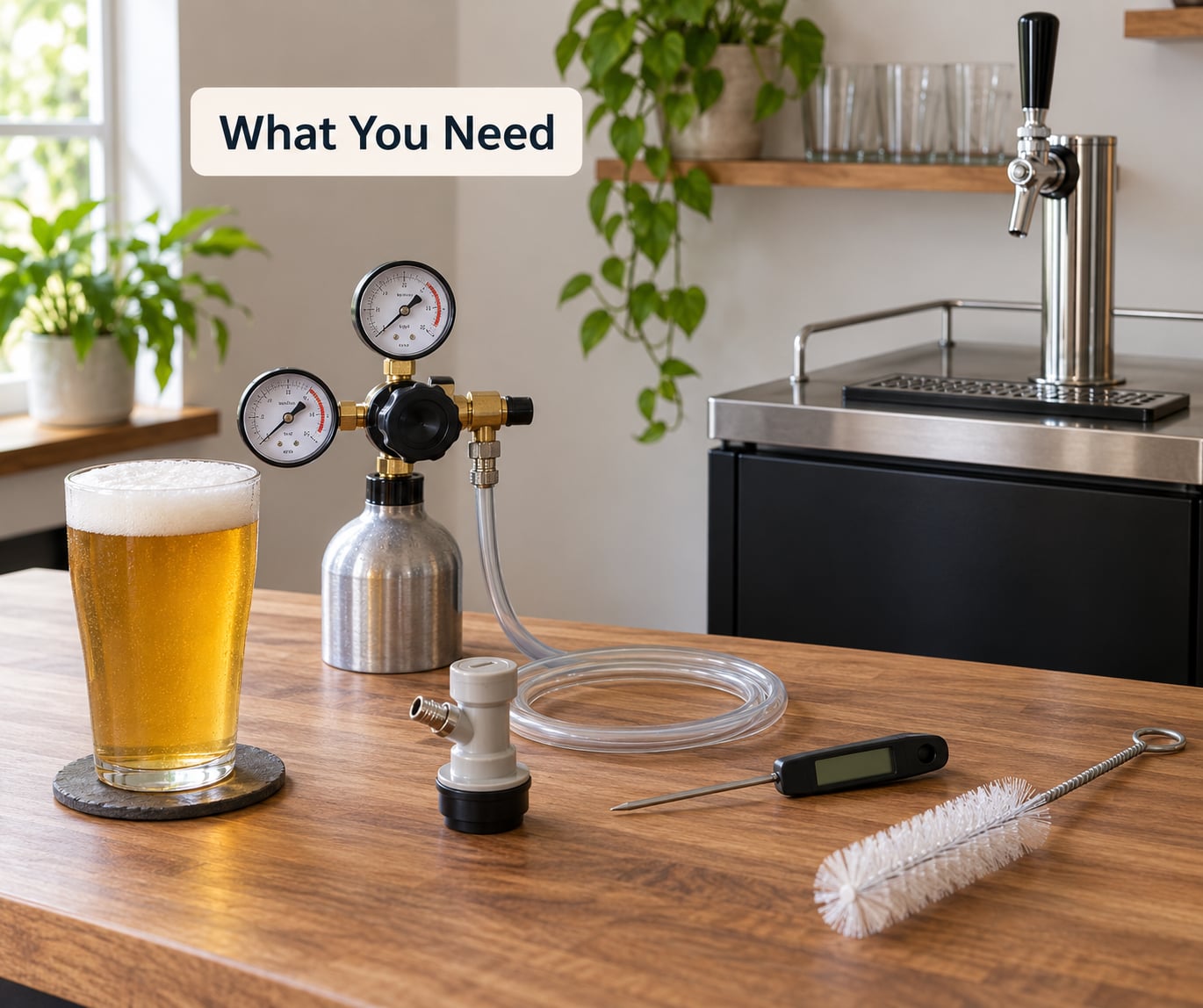
You do not need much, and most of it you probably already own. A refrigerator thermometer is the most useful item on this list, because the number printed on your kegerator’s dial is a guess about the air inside, not the liquid in the keg.
Next is a way to read the CO2 pressure. A dual-gauge regulator shows you both the cylinder pressure and the pressure actually reaching the keg, which tells you instantly whether gas is leaving between the tank and the coupler. If your regulator has one gauge, you can still work, but you are guessing half the time.
Add a length of replacement coupler hose and a spare coupler seal, since those are cheap and they fail more often than people expect. A faucet-cleaning brush or a disassemblable faucet and some food-grade cleaner handle the line and tap. KegLube or a food-safe silicone coupler lubricant is worth having on hand too.
Keep a clean towel and a bucket nearby. Working on a coupler indoors with a pressurized keg is a good way to learn what 12 PSI of gas sounds like when it vents across a room, and the first lesson is to do it over a bucket, not your shoes.
One safety note before you start. Never cut into or heat a CO2 cylinder, and never try to catch a leaking coupler with your hands. If the gas hisses persistently after you shut the cylinder off, vent the keg outside or in a well-ventilated space before disconnecting anything.
Step-by-Step Troubleshooting: Why Is My Kegerator Pouring Flat Beer?
The order below is deliberate. Temperature first because it costs nothing and changes everything, then pressure, then the gas path, then hardware, then technique. Skipping to the regulator because it is the part you can see usually means you fix the wrong thing. Most of the questions about why is my kegerator pouring flat beer get answered fastest by working down the list instead of swapping parts.
1. Confirm the beer is actually under pressure
Put a glass under the faucet and pull it. Then look at the gauge on your regulator, not at the number you set last month. A regulator that reads 12 PSI at the tank and near zero at the keg is telling you there is a leak somewhere in between, and turning the dial up will not fix it.
If the gauge shows pressure and the pour is still flat, the number is probably wrong for your beer and your line. That is the point most guides bury: pressure only works in combination with restriction. A keg pushed through a short, fat line at 12 PSI will foam wildly, then go flat as the headspace empties. The same keg through a properly restricted line at lower pressure pours clean. If you have already confirmed your pressure and still want to know why is my kegerator pouring flat beer, restriction is the next thing to look at.
Here are the ranges that work for most setups, assuming a correctly sized line:
| Beer style | Serving temperature | Target CO2 pressure |
|---|---|---|
| Light lager, pilsner | 34-36 F (1-2 C) | 9-13 PSI |
| Standard lager, pale ale | 36-38 F (2-3 C) | 8-12 PSI |
| Stout, porter | 38-40 F (3-4 C) | 6-10 PSI |
| Wheat, Belgian-style ale | 38-42 F (3-5 C) | 7-11 PSI |
| Homebrew ale | 38-42 F (3-5 C) | 8-12 PSI |
These are starting points, not rules. One Homebrew Talk poster serves at 43 F and 3 PSI and reports a perfect head, which tells you how much personal preference is mixed into this. If your pour is flat at 8 PSI, raise it in 2 PSI steps rather than jumping to 20.
A successful result looks like a steady stream that stops when you stop pulling, with about an inch of foam on top. A pour that gushes, hisses, and settles into something flat is a restriction problem, not a pressure problem.
2. Check the CO2 source and gas connections
Start at the tank. Weigh it if you have a scale, or listen for the hiss at the valve. A cylinder that is nearly empty still pushes gas at first, which sends people looking everywhere except the most obvious place.
Confirm the cylinder valve is fully open. A quarter-turn cylinder is the single most common thing I see in home setups, and the regulator gauge will still read fine because the outlet is upstream of the restriction.
Work down the gas side methodically: tank to regulator, regulator to keg coupler. Tighten every fitting by hand plus a quarter turn. Listen for a hiss at each joint. If the keg is disconnected and the gas side hisses, the problem is upstream of the keg and your beer is not involved at all.
One useful isolation test: disconnect the CO2 entirely, then pull a beer. If the flatness changes noticeably, the fault is on the gas side. If the pour looks the same, the fault is on the liquid side, the line, the faucet, or in the beer itself. It takes thirty seconds and saves you an afternoon of swapping parts.
Also check the gas type. Draft systems want food-grade CO2 blended for beer service, not welding-grade CO2 straight from the cylinder. Wrong gas changes the pour behavior and can carry off-flavors, and cheap single-stage regulators are a common reason a set of couplers never feels right.
3. Keep the beer and keg at the right temperature
Cold beer holds carbonation. Warm beer lets it go, and the same keg that poured fine in January pours flat in July in a warm garage. Put a thermometer inside the fridge next to the keg rather than trusting the fridge’s own dial, and check it on a hot afternoon when the compressor cycles hardest.
There is a twist people rarely expect. The Keg King lists temperature as too cold as a cause of flat beer, and they are right that freezing a keg does not help. Somewhere below about 36 F the dissolved gases start coming out of solution at the faucet, the pour goes thin, and cold, flat beer is worse than warm, properly pressurized beer. Do not set the fridge to its coldest setting and assume colder is better.
Settle time matters too. If you just moved a keg, dropped it into a cold fridge, or bumped the pressure, give it at least a few hours before judging. A keg that has been rocking around needs to sit still so the CO2 can re-dissolve. Pouring immediately after moving it gives you foam, then flat beer, then it settles on its own.
Check the temperature at the tap, not just in the fridge. A warm spot near the door, a glass that has been sitting out, or a long pour that lets the glass warm as you drink will all read as a flat beer that isn’t actually flat in the keg.
4. Clean the beer line and faucet
A dirty line is the most under-diagnosed cause of a bad pour, and it produces both foamy and flat beer depending on what is growing in it. Biofilm, mold, and grease change the inside diameter of the line, so restriction becomes unpredictable, and they give the beer nucleation sites that make it pour thin.
Take the coupler off and look at the outlet with a flashlight. If the inside of the coupler’s liquid passage is brown, furry, or tacky, that is your answer. Run a cleaning solution through the line and disassemble the faucet completely, including the removable hop plate if your faucet has one.
Then check the line itself. A kinked, sharply bent, or pinched section of tubing restrains flow unevenly, and a section that was crushed during a move or a tight cabinet run is a classic cause of a pour that changed without anyone touching a setting. Feel along the full length of it.
Also look at line length and diameter, because this is the piece of the puzzle most written guides skip. The line has to be long enough to restrict the pour at the pressure you are running:
| Line inside diameter | Approximate line length | Notes |
|---|---|---|
| 1/4 inch | around 10 ft | Common cheap tubing; needs more length |
| 3/16 inch | around 6 ft | Shorter run for the same pour |
| 3/32 inch | around 3 to 4 ft | Specialty tubing, common in multi-tap towers |
| Very long runs | 15 ft of 3/16 inch | One poster reported needing 22-25 PSI at this length |
The reason this matters is that a short line and a low pressure produce the same symptom. A keg with 5 feet of line at 10 PSI will foam first, and once the headspace is stripped the pour goes flat. On Homebrew Talk, several people reported going from roughly 5 feet of line to roughly 10 feet and watching persistent foam-then-flat pours disappear, one of them after replacing both a regulator and an entire tavern head first. Longer line beats higher pressure, every time.
If you cannot add length, a flow control faucet or a jockey box gives you the same effect by restricting the pour on demand. A successful result here is a clean, visible interior and a pour that fills the glass in about eight seconds instead of one.
5. Check for a faulty coupler, seal, or pin
Disconnect the gas, release the pressure, and then pull the coupler apart. On a ball-lock, the gas inlet sits above the liquid outlet with a seal between them, and that seal is the one people blame for foam but the one that most often causes a slow, silent loss of carbonation when it hardens or cracks.
Look at the coupler seal and the keg’s spear gasket. Both should be supple and intact, not flat, not brittle, not white and chalky. Feel the coupler pin too, the part that locks into the keg valve, and confirm it is straight and springy. A pin that will not seat fully leaks gas no matter how good the seal looks.
Check the Sankey version differently. A Sankey keg uses a separate spear gasket on the keg neck, and a worn one pushes the spear down far enough that the gas and liquid passages can mix inside the coupler. A cotton swab run through the coupler passages is a fast way to see if a passage is blocked with dried residue.
Clean and reassemble with a thin coat of KegLube on the seals, then hand-tighten only. Keg couplers seal mechanically, and over-tightening crushes the seal and shortens its life. A successful result is a coupler that clicks into place and holds pressure on the gauge for an hour with no drop.
6. Pour correctly and let the beer settle
Technique accounts for more flat pints than people expect. Tilt the glass to about a 45 degree angle, start the pour at an angle to let carbonation escape along the side, then straighten up as the glass fills. Pouring straight down into an upright glass pounds the beer into the bottom and drives gas out of solution.
Pour slowly and stop before foam reaches the rim. Cold glasses help noticeably, because a warm glass lets the beer warm in the pour and releases the CO2 you paid for. A quick rinse under cold water is enough.
Watch the pattern across two or three pours. A strong first pour followed by a weak second one usually means the headspace is too large, which lets the pressure over the liquid drop as you pour. That happens with a partly empty keg connected with a lot of gas volume, and it is not something a higher pressure setting fixes on its own.
If the second pour is flat while the first was good, the keg is near empty and the headspace is doing the work now. Finish it or plan on the next keg. A successful result is a stream that stops when you stop, with a small dense head that stays on the glass.
7. Determine whether the beer itself is flat
Everything above is equipment. If the settings are right, the gas is connected, the line is clean, and the pour is still thin, the carbonation has already left the beer in the keg and no regulator setting will bring it back instantly. This is the step most people skip, and it is where the honest answer to why is my kegerator pouring flat beer turns out to be the beer.
Common reasons: the keg sat warm for a long stretch, the coupler seal leaked slowly for weeks, the gas ran out and nobody noticed, or the keg was tapped before it finished conditioning. If you homebrew your own, the same symptom usually traces back to fermentation not finishing or a transfer that picked up oxygen, which is worth understanding separately in why homebrew goes flat.
Then decide whether the beer is still drinkable. Flat but fine tastes flat and maybe a touch stale, with a normal smell and no cloudiness. Flat and spoiled smells like nail polish remover, wet cardboard, or vinegar, or it is cloudy with a faint film, and it is not worth drinking. A keg of finished beer kept cold and sealed usually stays good for a couple of months, longer than most people assume.
For contrast, a growler is a very different clock. Exposure to oxygen starts working on it immediately, which is a good reason to read how long beer stays fresh in a growler before filling one with the leftovers.
8. Reconnect, repressurize, and verify the result
Once you have made the fix, put it back together in order: coupler seated and lubricated, gas connected, cylinder valve fully open, regulator set to your target pressure, faucet and glass rinsed cold. Then let the keg sit undisturbed.
If the beer has genuinely lost its carbonation, you can force it back rather than drinking it flat. Set the regulator to roughly 30 PSI, leave the keg sealed for 24 to 48 hours, then drop it to serving pressure and let it settle a few more hours. A staged timeline looks like this:
| Stage | Pressure | Time | What to expect |
|---|---|---|---|
| Force carbonation | 28 to 32 PSI | 24 to 48 hours | Not a guarantee, but usually adds noticeable fizz |
| Settle | Serving pressure | 4 to 12 hours | Beer re-equilibrates, foam calms down |
| Serve | Style target | Ongoing | Steady pour, one inch of head |
Rocking the keg on its side for about a minute is a step some people use to speed this up, but do it gently and let it settle afterward. Violent agitation just strips the CO2 you are trying to add, and the next pour foams badly for no reason.
Verify with a full pour into a cold glass, then a second glass. What you want is a stream that stops when you stop, a head that holds, and a gauge that has not dropped noticeably between pours. If the pressure falls while you are not pouring, you still have a leak, and that is the thing to keep chasing.
Common Mistakes
Cranking the regulator to 30 PSI to fix flat beer. This is the most common over-fix, and experienced posters push back on it hard. High pressure through an unrestricted line gives you a foaming keg first, then a flat keg once the headspace is gone. Use 30 PSI only for a short force-carbonation window with the keg sealed and no faucet pulls.
Turning the fridge to its coldest setting. Very cold beer releases dissolved gas at the faucet and pours thin. The target is a narrow band, not the lowest number available.
Tapping a keg with the CO2 turned off. With no gas pressing down on the headspace, the liquid foams on the way out, the headspace fills with air, and you have just stripped carbonation from the beer you paid for. Connect the gas first, and purge the empty keg before filling it if you are transferring by hand.
Replacing parts in the wrong order. Most of the expensive pieces, regulators and faucets included, are rarely the culprit. Line length, temperature, and coupler seals account for the overwhelming share of flat pours, and they are the cheap things to test.
Cleaning with something that leaves a film. Household detergent and standard line cleaner can leave residue that holds onto gas. Use a beer-line cleaning product as directed and rinse thoroughly, and keep grease off the glassware. The Keg King puts it plainly: grease is the enemy of carbonation.
Judging the pour from a warm, soapy glass. Soap residue kills head retention and a warm glass releases CO2 during the pour. Fix the glass before you go swapping the regulator.
One habit that catches more problems than any other: write down the pressure, the fridge temperature, and the line length when a pour is right. Six months later, when something is off by a small amount, you can return to a known good combination instead of guessing in the dark.
Frequently Asked Questions
Can I recarbonate beer that has already gone flat in the keg?
Yes, usually. Seal the keg, set the regulator to about 30 PSI, and leave it for 24 to 48 hours without drawing any beer. Then drop back to your normal serving pressure and let the keg sit for another 4 to 12 hours before pouring. It will not fully return to a freshly conditioned keg, but most people notice a real difference. If the gas is leaking, fix that first or the CO2 simply escapes again.
What PSI should I set my kegerator to?
For most ales and lagers served through a correctly sized line, 8 to 12 PSI at 36 to 38 F is the range most people land on. Pilsners and light lagers often pour best at 9 to 13 PSI, while stouts and porters do fine at 6 to 10 PSI. Pressure only produces a clean pour when your beer line is long enough to restrict the flow. A short line at 12 PSI will foam, and the keg will go flat once the headspace empties.
How long does it take for beer to carbonate in a keg?
A keg that was properly conditioned and has gone flat can usually be brought back with 24 to 48 hours at 28 to 32 PSI, followed by several hours to settle at serving pressure. A keg that has been slowly losing pressure because of a coupler leak needs that repair first, or carbonation will keep escaping. If you are force carbonating homebrew from scratch rather than restoring a keg, allow two to three days at moderate pressure, longer for higher pressure targets.
Why does my beer go flat again after the first pour?
It usually means the headspace is too large. As you pour, gas expands into the headspace and the pressure over the liquid drops, so later pours come out thinner than the first one. It is common with a partly emptied keg and a small cylinder with lots of gas volume. Check that the regulator is still reading where you set it, and expect the effect to be less noticeable in a full keg. Slower pours help.
Is beer still good if it goes flat in the keg?
Flat and fresh is still drinkable. It just tastes thin, has less aroma, and lacks the bite that carbonation provides, and it is not dangerous. Flat and spoiled is a different thing. If it smells like nail polish remover, wet cardboard, or vinegar, or it is cloudy with a film, discard it. Keep finished beer sealed and cold and it usually stays good for a couple of months, though styles with a lot of hop character fade sooner.
What causes foam in a kegerator, and how do I fix it?
Foam comes from too much pressure for too little restriction, beer that is too warm, a line that is too short or too fat, or a coupler seal that has failed and lets gas push into the liquid side. The fix is to work the balance in order: confirm the fridge is at 36 to 38 F, check the coupler seal, then check line length and diameter. Lowering pressure and adding restriction together usually solves it. Flat beer and foamy beer are the same problem pointing in opposite directions.
Conclusion
Start with the two free checks. Put a thermometer in the fridge and confirm the beer is sitting between 36 and 38 F, then look at the pressure on the gauge at the keg rather than at the tank. If both check out, the odds are good that the line is too short for the pressure you are running, or a coupler seal is leaking slowly.
Make one change, then pull a full glass and let it sit for a few minutes to see what it does. Fixing flat beer is a controlled test rather than a parts swap, and it takes far less time than replacing a regulator you did not need. Once the pour is right, save the numbers so the next keg starts from the same known good place.
And if you are running this as part of a wider tasting setup, our guide to running a beer tasting at home covers the glassware and pacing side that makes a clean pour worth the effort.