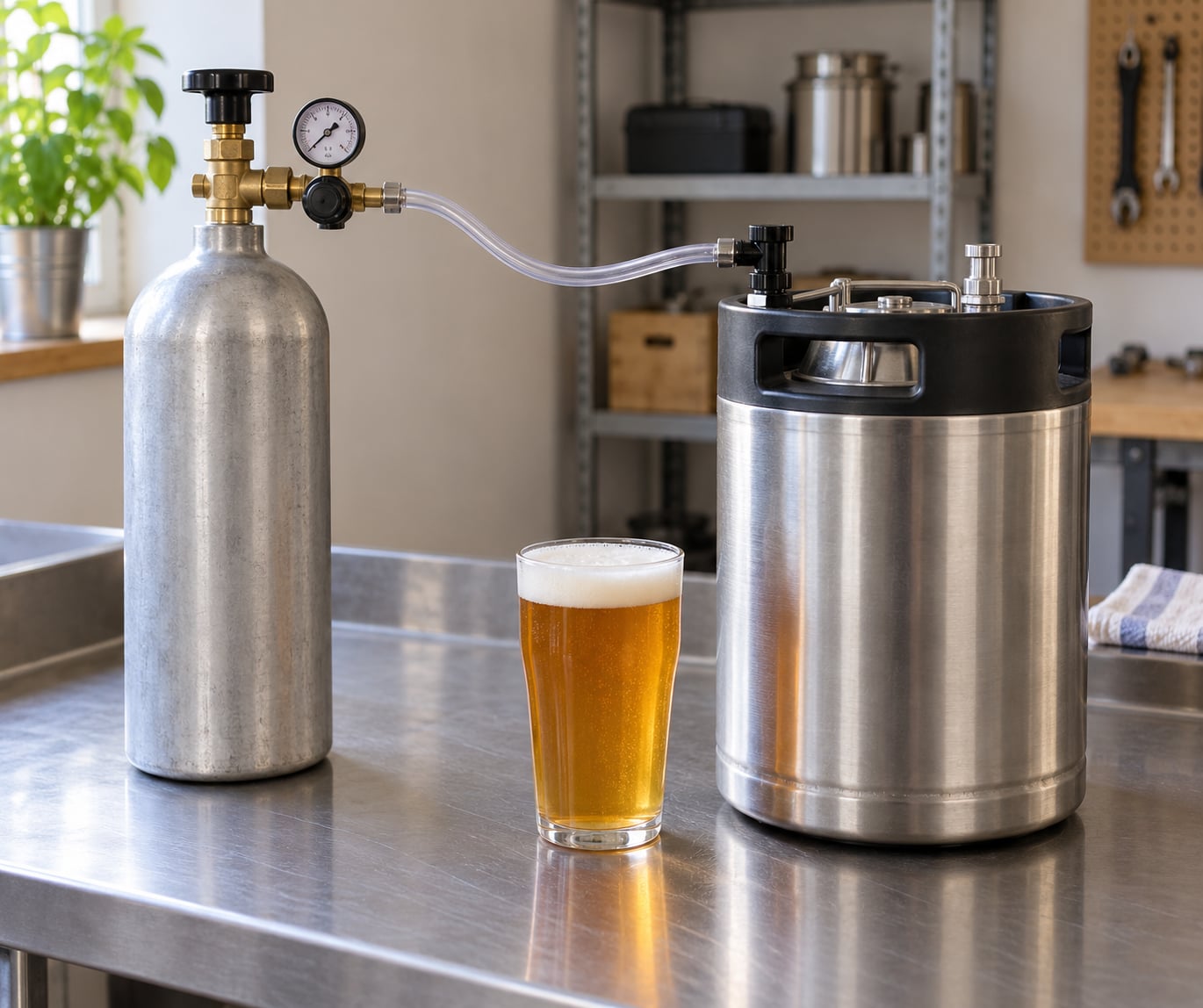
A 5 lb CO2 tank lasts roughly 4 to 10 kegs on a kegerator, or about 3 to 10 months depending on how hard you push it. Dispensing only and you get more; force carbonating every batch and you get less. Most homebrewers land somewhere in the middle and refill a few times a year.
The reason there is no single number is that a cylinder does not empty evenly. The last pound of gas gets hidden inside liquid that your regulator can no longer pull. Understanding that is the difference between guessing and planning.
Table of Contents
- How Long Does a 5 lb CO2 Tank Last?
- 5 lb CO2 Tank Life at a Glance
- How Much CO2 Does Beer Use?
- Tank Pressure and the Regulators That Matter
- Dispensing Habits That Drain a 5 lb Tank Faster
- How to Tell When a CO2 Tank Needs Replacing
- Ways to Extend the Life of a 5 lb CO2 Tank
- Frequently Asked Questions
- How long does a 5 lb CO2 tank last when serving one keg?
- Does a CO2 tank last longer at 10 PSI than at 20 PSI?
- How many beers can a 5 lb CO2 tank carbonate or dispense?
- Can I refill a 5 lb CO2 tank at home?
- Why does my CO2 tank pressure drop even when the beer is not being served?
- Is it better to use a 5 lb or 20 lb CO2 tank for a homebrew setup?
- Bottom Line
How Long Does a 5 lb CO2 Tank Last?
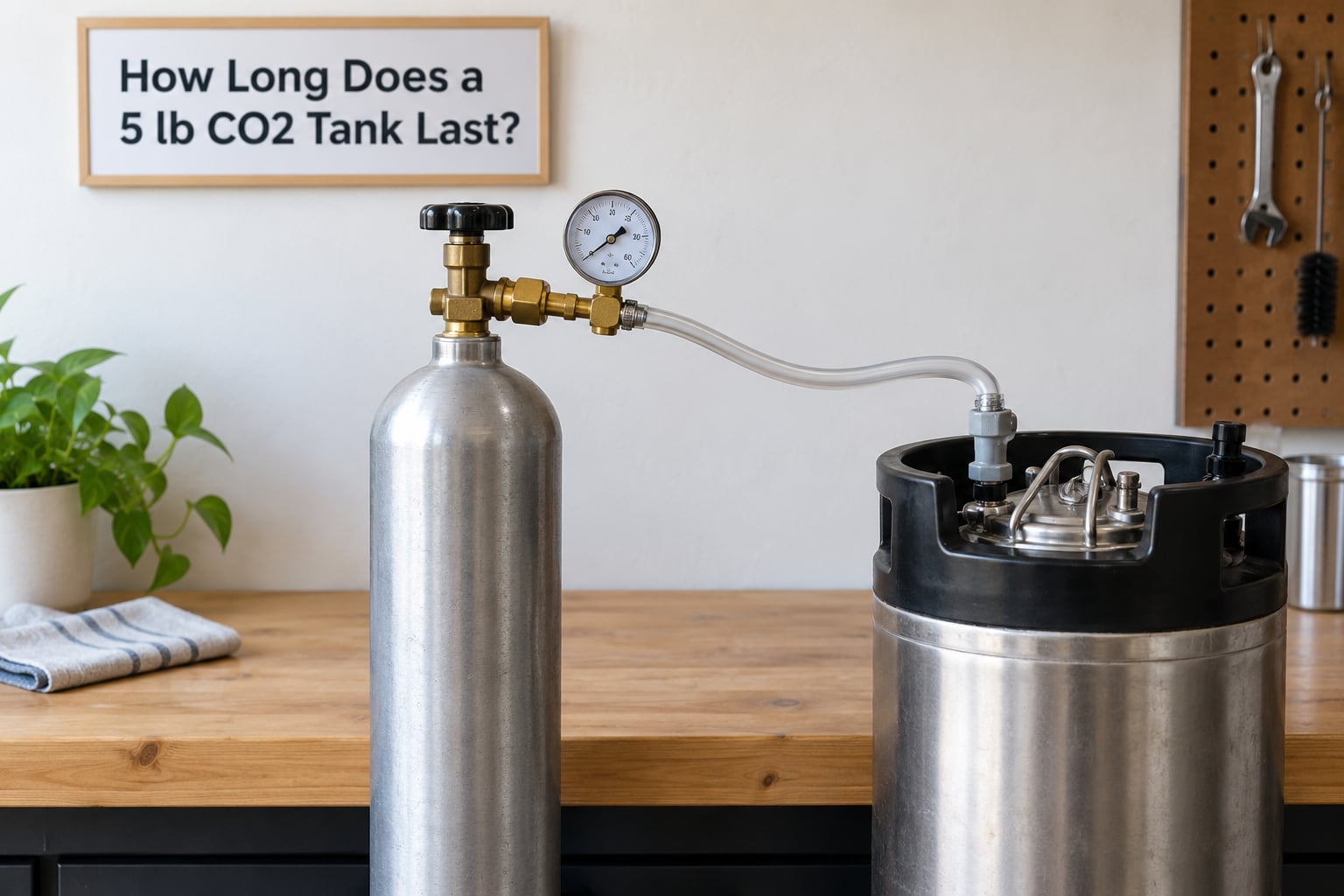
Plan on 4 to 10 full kegs from one 5 lb cylinder, or roughly 3 to 10 months for typical home use. Dispensing a chilled keg takes far less gas than force carbonating it, so a tap-only setup stretches a tank while a brew-every-month routine shortens it. A leak will do more damage than either.
Brewers commonly land on 5 to 7 corny kegs per 5 lb when they only dispense, and once force carbonating is included the figure settles closer to 4 to 6 kegs. A commercial supplier puts a single cylinder at 6 to 8 half barrels. On a three-tap keezer running normally, one fill typically covers 4 to 5 months.
5 lb CO2 Tank Life at a Glance
These are planning estimates, not guarantees. Your beer, your temperature and your regulator all shift the number.
| Use case | What a 5 lb tank covers | Typical duration |
|---|---|---|
| Dispensing one chilled keg | 5 to 7 corny kegs | 3 to 5 months |
| Dispensing plus force carbonating each batch | 4 to 6 kegs | 2 to 4 months |
| Three-tap keezer in regular service | Continuous pours, no force carbonating | 4 to 5 months |
| Soda or sparkling water | About 250 liters at 2.5 volumes | Several weeks |
| Planted aquarium at 4 to 5 bubbles per second | A 55 to 58 gallon tank | 4 to 5 months |
Bigger cylinders do not last proportionally longer, but they last longer per swap. You make fewer trips to the refill shop and you stop running out during a party.
| Cylinder size | Dispensing only | With force carbonating |
|---|---|---|
| 5 lb | 5 to 7 cornys | 4 to 6 kegs |
| 10 lb | Roughly twice the 5 lb | Roughly twice the 5 lb |
| 20 lb | About 20 to 28 half barrels | Plan around 14 to 20 kegs |
| 50 lb | Best for a busy bar or a shop | Minimal stops |
How Much CO2 Does Beer Use?
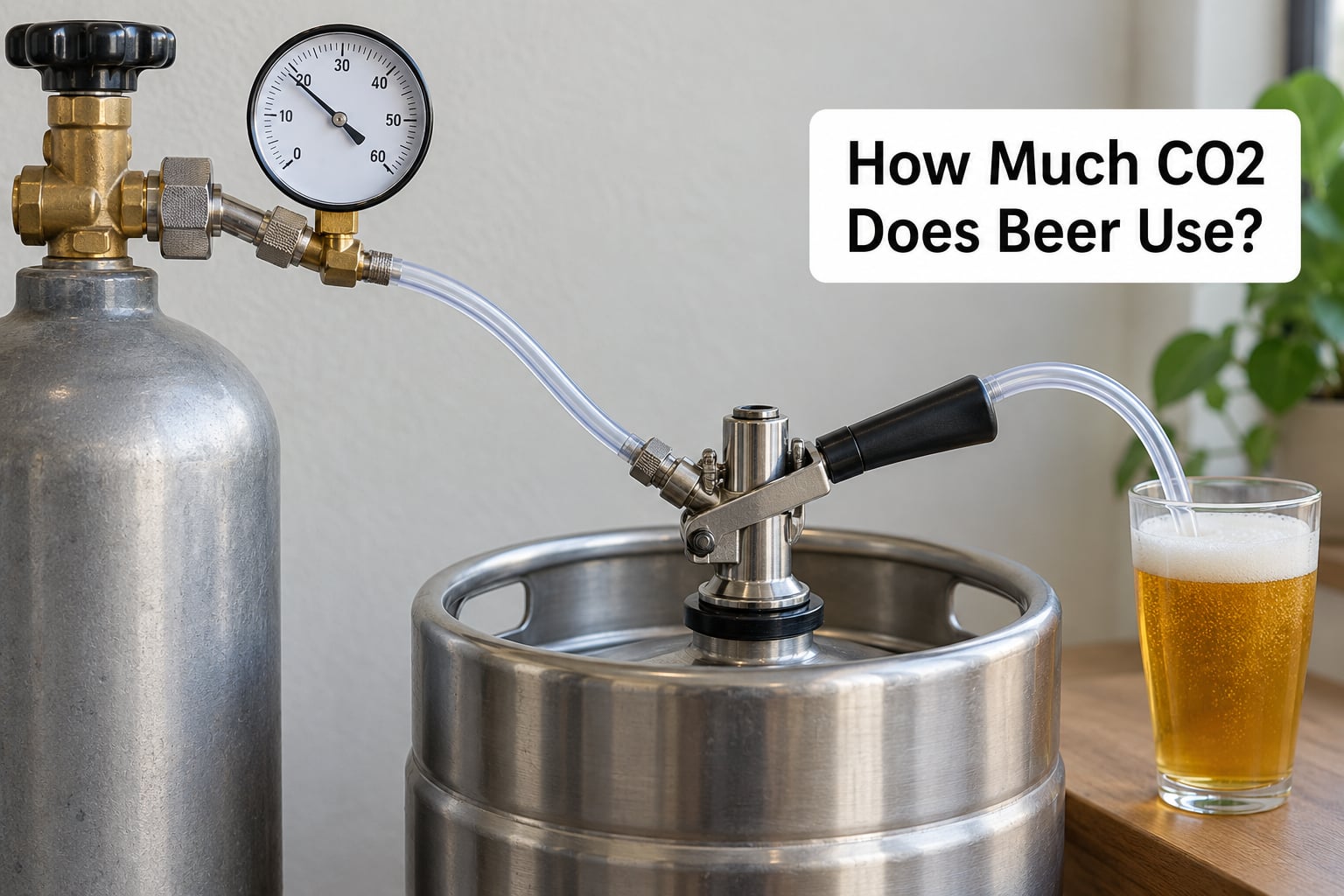
One pound of CO2 works out to about 8.741 cubic feet, which is roughly 247.5 liters. That single conversion makes every other estimate on this page checkable.
Beer absorbs gas in two separate ways, and they cost very different amounts. Dispensing pushes a little CO2 into solution at the tap. Force carbonating drives gas into the whole volume of liquid at once, and warm beer takes more of it than cold beer.
Here is where a tank seems to lie to you. A 5 lb cylinder still feels heavy and the gauge still shows pressure, but the gauge only reports the pressure of the vapor space above the liquid. Once liquid CO2 cannot vaporize fast enough to keep your regulator at its set pressure, the useful gas is gone even though the cylinder is not empty. That last half pound or so is stranded.
Cold helps twice. Beer holds more dissolved CO2 at a lower temperature, and you set lower pressure to hit the same carbonation level, which means less gas moving through the regulator. If you are curious about what fermentation is doing in the glass before it ever reaches a tap, what yeast does in beer covers that side of the process.
Tank Pressure and the Regulators That Matter
Your cylinder sits around 800 to 2000 PSI and drops toward the 10 to 15 PSI your keg wants. A regulator exists to make that jump smooth and repeatable, and the output end of it is what actually determines how fast you use gas.
A high-flow regulator feels better when you are filling a 5 lb tank or purging a keg, but at tap pressure it can pull liquid out of the cylinder faster than the cylinder likes. That stranded-liquid effect gets worse. A restrictive or chattering regulator does the opposite: it starves a keg, forces you to open the bottle valve wider than intended, and makes your pressure setting unpredictable.
Follow the pressure settings in your equipment manual, then check them twice a month with the gauges unplugged from the keg. Inconsistent regulators are the quiet cause of a tank that empties twice as fast as it should. Nothing about the cylinder changed, but the delivery does.
Dispensing Habits That Drain a 5 lb Tank Faster
If your tank never lasts as long as the numbers above, one of these is usually responsible.
- Serving pressure set too high. Every extra PSI pushes more gas into solution than the beer needs, and you are paying for it in cylinder weight.
- A keg left connected with the coupler engaged. Gas keeps feeding headspace and eventually pushes product out. Shut the coupler when you stop serving.
- Taps open for long stretches. A line left flowing while nobody is drinking wastes gas at full rate.
- Warm serving temperature. Warm beer demands more pressure and less carbonation, so you get more foamy pours and more wasted gas.
- Frequent purges. Purging a coupler with CO2 instead of using an argon or nitrogen mix pushes a slug of gas each time. Cheap in money, expensive in cylinder life.
- A leak. Brewers consistently name leaks as the thing that eats cylinders faster than anything else, including cases of half a cylinder disappearing while force carbonating a single keg.
- A 5 lb cylinder on a high-volume event. It is simply the wrong tool for a wedding or a taproom.
Line length and serving style matter too, and it is worth knowing how your setup behaves before you blame the tank. If you are pouring something you will not finish in one sitting, how long does beer stay fresh in a growler is the better question.
How to Tell When a CO2 Tank Needs Replacing
Watch the high-pressure gauge needle rather than the low-pressure gauge. The low side only tells you what the regulator is delivering, which can look perfectly normal right up until the cylinder runs dry.
Warning signs, roughly in order:
- Output pressure sags and will not hold while a keg is connected.
- You find yourself turning the regulator up more each week.
- The high-pressure needle drops noticeably faster than it used to during a single pour.
- The cylinder neck or valve area feels unusually cold or frosted under load. That is the liquid converting to gas, and it is normal in small doses, but heavy frost while idle means you are near the end.
- The cylinder weighs far less than when you filled it.
Aquarium hobbyists have a useful shortcut here. A clear sudden drop in the high-pressure needle, often several PSI in a short window, commonly means roughly two weeks of gas remain. It is not a precise measurement, but it is enough to order a refill before a big brew day.
Handle cylinders upright and secure them so they cannot tip. Never shake one, never weld on it, never try to repair a valve or a dented neck. Refill and requalification belong to a shop that is set up for pressurized cylinders.
Ways to Extend the Life of a 5 lb CO2 Tank
Small habits add up faster than most people expect.
- Keep the beer cold. Cold beer absorbs less pressure to reach the same carbonation, and cold dispensing cuts the volume of gas you push through the line.
- Set pressure once and stop fiddling. Follow the guidance that came with your regulator or kegerator rather than adjusting by feel.
- Test for leaks monthly. Mix dish soap and water, brush it on every connection, and watch for bubbles at the tank, the manifold, the coupler posts and the keg seal.
- Disconnect couplers when you are done. This single step saves gas on any setup with more than one keg.
- Purge with cheaper gas. Argon or a premixed blend costs far less per pour than pure CO2, and it protects the taste of light beers.
- Stop force carbonating every batch. Natural carbonation in the bottle uses no cylinder gas at all.
- Size the cylinder to real volume. If you brew on a schedule and drink steadily, a 10 lb or 20 lb cylinder plus a scheduled refill date removes the mid-pour panic.
- Keep reserve before an event. Swap in a full cylinder the day before a gathering rather than the morning of it.
Frequently Asked Questions
How long does a 5 lb CO2 tank last when serving one keg?
A 5 lb CO2 tank typically covers 5 to 7 corny kegs when you dispense a chilled keg and do not force carbonate it. With force carbonating included, most homebrewers get 4 to 6 kegs per fill. Calendar time depends on how often you pour: a three-tap keezer running normally uses about one cylinder every 4 to 5 months.
Does a CO2 tank last longer at 10 PSI than at 20 PSI?
Yes, meaningfully. Halving the pressure on the low side cuts the gas your regulator delivers and reduces how much CO2 dissolves into the beer on each pour. It also slows the rate at which liquid CO2 in the cylinder vaporizes, which leaves less gas stranded in the tank. Set pressure to what your equipment manual specifies rather than running the gauge wide open.
How many beers can a 5 lb CO2 tank carbonate or dispense?
For dispensing, expect 5 to 7 corny kegs, or about 6 to 8 half barrels, since a full half barrel holds roughly 15.5 gallons. Add force carbonating and that drops to 4 to 6 kegs. For carbonating soda, one pound of CO2 equals about 8.741 cubic feet or 247.5 liters, so a 5 lb cylinder makes roughly 250 liters at 2.5 volumes of carbonation.
Can I refill a 5 lb CO2 tank at home?
No. A standard steel cylinder needs a commercial filling machine that pressurizes liquid CO2 into it, and that equipment is not something a homebrew shed should have. Take the cylinder to a welding supply house, fire equipment shop, homebrew store or beverage distributor. They weigh the tank, swap it, inspect the valve and collar, and send it for requalification when its hydrostatic test date is due.
Why does my CO2 tank pressure drop even when the beer is not being served?
Common causes are a coupler left connected so gas keeps feeding the keg headspace, a slow leak at the tank, manifold, coupler post or keg seal, or a failed solenoid that bleeds pressure when it should be closed. Watch the high-pressure gauge over an hour with no beer being poured. A gauge that falls without a pour points to a leak, and the soapy water test will find it in minutes.
Is it better to use a 5 lb or 20 lb CO2 tank for a homebrew setup?
A 5 lb tank is convenient to store and swap, and it is fine for occasional pours or a single-tap kegerator. A 20 lb tank suits steady drinking or multiple taps, because it holds roughly four times the gas and cuts the number of refill trips by the same margin. Many homebrewers run a 5 lb for the keezer and a 20 lb for force carbonating batches.
Bottom Line
Start by doing one thing: watch your high-pressure gauge during a normal pour and note where it sits. That single reading tells you how much usable gas you really have, and every other adjustment follows from it.
Keep the beer cold, disconnect couplers when the taps stop, and run the soapy water test on your connections once a month. If your tank is empty faster than 4 kegs, the leak test will usually find the reason. And if you are curious about keeping what you pour tasting fresh between sessions, how long does an opened beer last covers the storage side.