Yes, you can use table sugar to prime beer. Corn sugar and table sugar both carbonate a batch the same way: the yeast wakes up, eats the sugar and turns it into carbonation. The real difference between them is a few grams on the scale, not the taste in the glass.
That is the short version of corn sugar vs table sugar for priming beer, and it is the answer I give every brewer who asks. Brewers argue about the choice anyway, usually because of a warning that table sugar makes cider-flavored beer. That warning was never really about a four-ounce priming dose.
I have primed batches with both, weighed both, and run the same recipe side by side. Once the dose is right for the carbonation level you want, the sugar type stops registering in the bottle. Below is what actually differs, how to convert between them, and where the choice does matter.
Table of Contents
- Corn Sugar vs Table Sugar for Priming Beer at a Glance
- What Is Corn Sugar and What Is Table Sugar?
- What supermarket sugar to buy if you use it
- How Do They Compare for Fermentation?
- Dextrose is one step ahead of sucrose
- What a priming dose does to gravity and alcohol
- Conditioning temperature and time still beat sugar choice
- Corn Sugar vs Table Sugar: Flavor and Beer Style
- Where a difference is measurable
- Head retention and bubble size
- Styles where the sugar type matters more
- How Should You Measure Priming Sugar?
- The conversion rule most guides get backwards
- Priming sugar for a 5-gallon batch
- Weigh it, do not scoop it
- Dry addition or priming syrup
- CO2 targets worth remembering
- Other priming sugars, ranked by usefulness
- Which Should You Choose?
- Frequently Asked Questions
- Can I use table sugar instead of corn sugar when priming beer?
- Which sugar gives better carbonation in bottles?
- Does corn sugar make beer taste like corn?
- How much priming sugar should I use in a five-gallon batch?
- Can I use either priming sugar when kegging beer?
- Conclusion
Corn Sugar vs Table Sugar for Priming Beer at a Glance
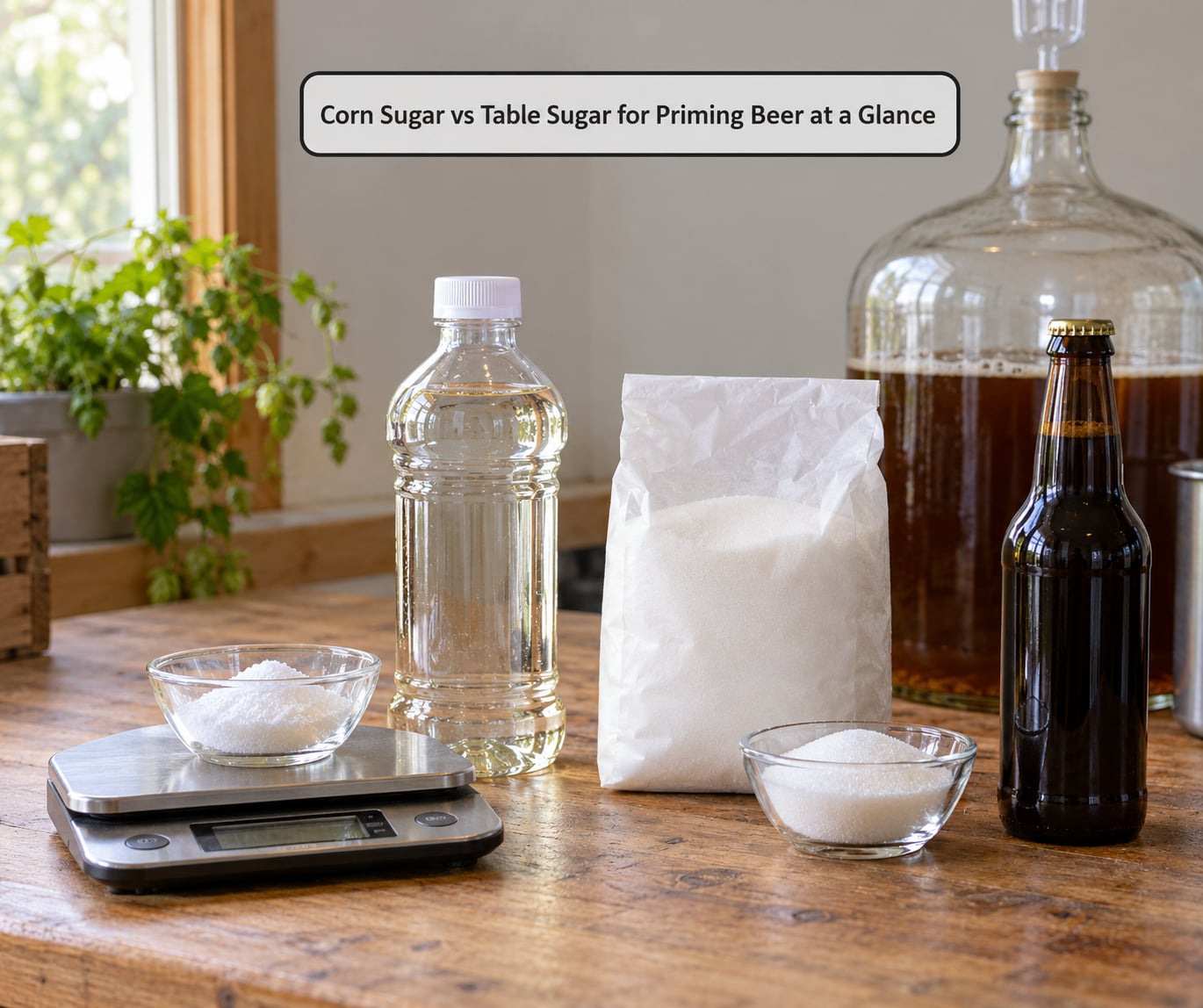
| Factor | Corn sugar (dextrose) | Table sugar (sucrose) |
|---|---|---|
| What it is | A monosaccharide glucose made from corn starch | A disaccharide made from sugar cane or sugar beets |
| Sugar molecule | One glucose unit | One glucose unit plus one fructose unit |
| Solids | About 95% sugar, roughly 5% water (dextrose monohydrate) | 100% sugar, no water |
| Fermentability | 100% | 100% |
| Work for the yeast | None, glucose is used directly | Yeast makes invertase first to split the molecule |
| Sweetness left in the bottle | None at a priming dose | None at a priming dose |
| Flavor at a 4 oz priming dose | Neutral | Neutral |
| Dose for 2.5 volumes in 5 gallons | About 4.25 to 4.75 oz (120 to 135 g) | About 4 to 4.5 oz (113 to 128 g) |
| Handling | Pours evenly, packs tight in the bag | Free-flowing, easy to level off in a cup |
| Best for | Calculators that ask for dextrose, dry finishes | Pantry substitute, mixing into syrup |
If you read one row, read the solids row. Everything else on this list is either identical or a rounding error dressed up as a difference.
What Is Corn Sugar and What Is Table Sugar?
Corn sugar is dextrose, a single sugar molecule that yeast can eat without any preparation. Homebrew dextrose is normally sold as dextrose monohydrate, which is dextrose attached to one molecule of water. That is the whole reason the two sugars are not gram-for-gram identical.
Table sugar is sucrose, a molecule made of glucose joined to fructose. In the kitchen the bag says granulated sugar. On a brewing label you will see cane sugar, sucrose, or priming sugar. Same molecule either way.
Neither one is a brewing sugar in the sense that wort sugar is. A pound of cane sugar in a boil is a flavor and gravity decision. Four ounces at bottling is carbonation only, and that difference is the entire debate.
What supermarket sugar to buy if you use it
Plain granulated white sugar is the right pick. It is nearly pure sucrose and it dissolves without leaving a gritty bottom in your bottling bucket.
Powdered sugar works too, but check for anti-caking agents. A starch-based anti-caking ingredient is not going to hurt a beer at four ounces, yet it is one more unknown sitting in your fermenter for no reason.
Demerara and raw turbinado carry more moisture and a trace of molasses. The flavor is irrelevant at a priming dose, but the extra weight per cup throws off a volumetric measurement, so use a scale if you go that route.
How Do They Compare for Fermentation?
Sucrose has to be broken apart before yeast can use it. Yeast secretes invertase, an enzyme that splits sucrose into glucose and fructose, and then it ferments both halves. Dextrose arrives already in the form yeast wants.
At a priming dose, does that extra step change the beer? Practically, no. The yeast has weeks to work, the dose is small, and both sugars are 100% fermentable, so neither leaves residual sweetness behind.
Dextrose is one step ahead of sucrose
The practical difference between the two is efficiency, not flavor. Sucrose is slightly more extract-dense, roughly 46 points per pound per gallon against about 42 for dextrose, because it carries no water. Dextrose makes up that gap with a shorter path for the enzyme. What yeast does in beer covers the rest of that machinery and is worth reading before you troubleshoot a stuck batch.
Neither effect is something you will taste in a bottle conditioned beer. In a wort fermented to dryness they matter a good deal more, which is the point where the argument stops being about priming.
What a priming dose does to gravity and alcohol
Four ounces of dextrose in five gallons adds about two gravity points at most, and under a percentage point of alcohol. Nobody has ever picked a beer apart over that. If you want the arithmetic behind the numbers on your label, how to calculate ABV at home walks through it with no equipment.
Priming sugar does one job. Dissolved oxygen, stressed yeast and a warm fermentation do far more damage than a sugar swap, which is why flat beer is nearly always a temperature or timing problem rather than a sugar choice.
Conditioning temperature and time still beat sugar choice
Keep bottled beer above 65 F (18 C) for one to three weeks. Below that the yeast wakes slowly or not at all, and the batch stays under-carbonated no matter which sugar you used. If you cold-crashed before bottling, condition warm from the start rather than starting cold.
Corn Sugar vs Table Sugar: Flavor and Beer Style
At priming quantities, neither sugar tastes like anything. The cider-flavor warning comes from an older brewing tradition, and it has outlived the evidence behind it.
Homebrew Talk thread after Homebrew Talk thread says the same thing. One regular, beergolf, uses table sugar in every Belgian and Saison he brews and reports no cider character at all. Another, rustym, puts it plainly: if you are picking up cidery notes from table sugar, the problem is almost certainly fermentation temperature control rather than the sugar.
That matches the chemistry. Acetylaldehyde, the compound behind green apple and bruised-apple notes, is produced by stressed or unhealthy yeast and by green, under-conditioned beer. It also cleans up with time. Sugary, characterless adjuncts can raise the stress level in a big ferment, but four ounces at bottling does not.
Where a difference is measurable
Brulosophy’s exBEERiment in 2026 tested sucrose against dextrose in a Double IPA, with sucrose at 12% of the grist and dextrose at 14% so both batches hit an identical 1.071 original gravity. Ten semi-blind triangle tests found tasters picked the correct beer seven out of ten times, and the sucrose version read as sharper in bitterness. That is a real result from a well-built experiment.
Now look at the dose. Twelve to fourteen percent of the grist in a five-gallon batch is a multi-pound boil addition, several times the weight of an entire priming dose. The experiment tells you what happens when sugar is a major part of the recipe. It does not tell you what happens at bottling.
Head retention and bubble size
One recurring comment on the diybeer community is that dextrose batches show a more compact head with smaller, tighter bubbles. It is anecdotal and nobody has run a controlled test on it, but the direction matches how people describe a well-carbonated bottle-conditioned beer.
Styles where the sugar type matters more
Light ales, pale ales and session beers are the least sensitive. The priming dose is small and the beer has nothing delicate going on.
Dry, strong beers are the most sensitive category, but the reason is that these brewers use sugar heavily in the recipe, not heavily at bottling. A Double IPA or a Belgian strong ale built with cane sugar in the kettle will show the sharper bitterness from the Brulosophy test. Priming that same beer with either sugar changes nothing you will notice. Most of the character in that glass comes from the grain anyway, which is what what malt does in beer flavor breaks down in detail.
How Should You Measure Priming Sugar?
Pick your target volumes of CO2, run that batch through a priming calculator, and weigh what it tells you. That single habit fixes more flat batches than any sugar decision.
The calculators disagree with each other because they handle dextrose monohydrate and pure sucrose differently, and because several of them default to a sucrose figure while the label in your hand says dextrose. That disagreement is the source of most of the confusion brewers complain about.
The conversion rule most guides get backwards
Homebrew dextrose is about 95% sugar solids. Sucrose is 100% solids and fully fermentable. So for the same amount of fermentable extract, you need slightly less table sugar by weight than corn sugar, not more.
Take the dextrose amount your calculator gives you and multiply by about 0.95. Ask for 4.5 ounces of corn sugar and use roughly 4.25 ounces of table sugar. The spread between that and the other direction is under half an ounce per batch, which is why kit instructions saying three quarters of a cup keep sailing through.
Priming sugar for a 5-gallon batch
| Target carbonation | Corn sugar (dextrose) | Table sugar (sucrose) |
|---|---|---|
| 2.0 volumes of CO2 | 3.5 to 4 oz (100 to 115 g) | 3.25 to 3.75 oz (92 to 106 g) |
| 2.5 volumes of CO2 | 4.25 to 4.75 oz (120 to 135 g) | 4 to 4.5 oz (113 to 128 g) |
| 3.0 volumes of CO2 | 5 to 5.5 oz (140 to 155 g) | 4.75 to 5.25 oz (135 to 149 g) |
These are ranges because your final gravity, temperature and yeast all nudge the result. A calculator with your actual numbers beats any table, including this one.
Weigh it, do not scoop it
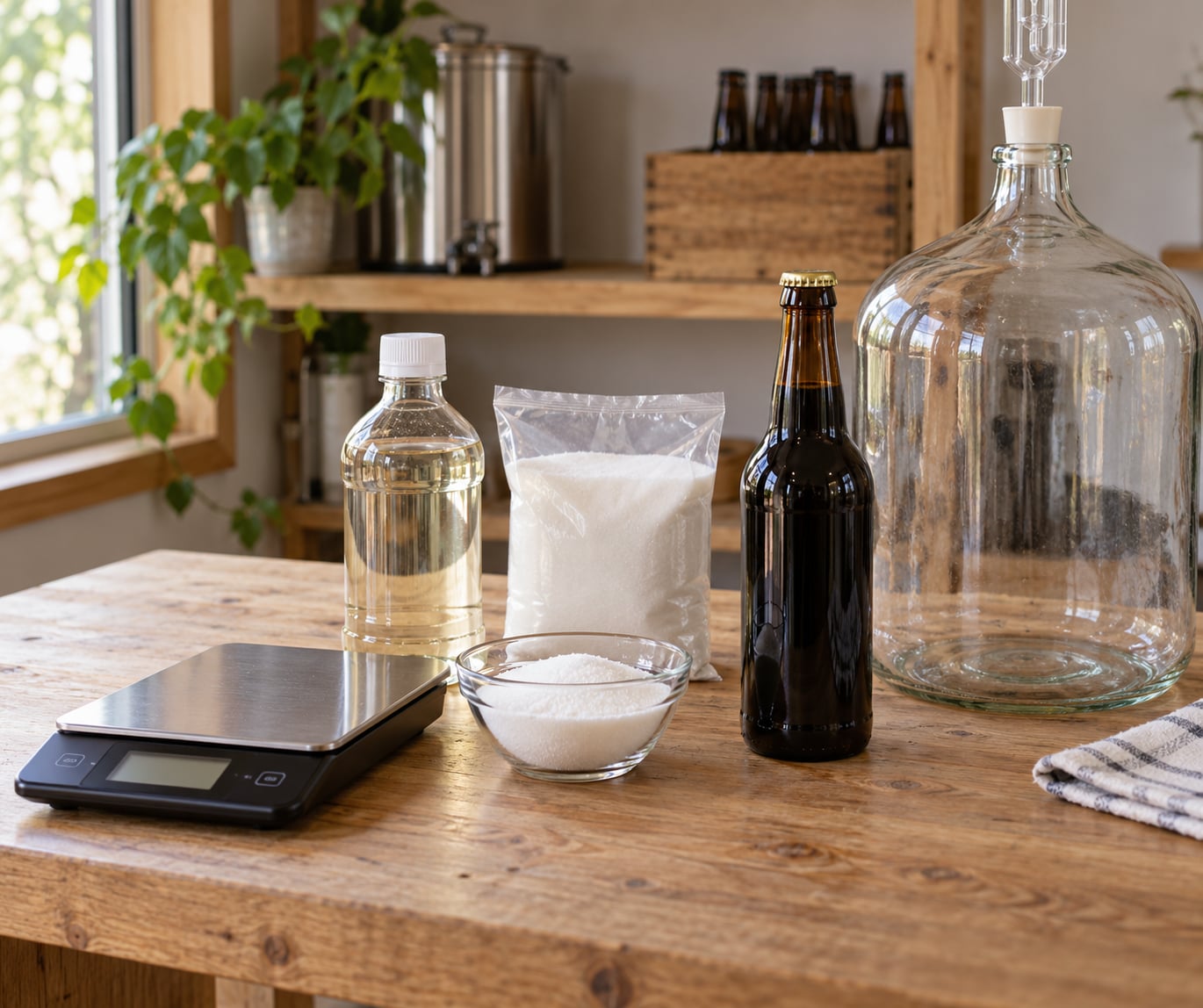
A cup of granulated sugar is roughly 7 ounces by weight. Packed dextrose is closer to 6. If a kit tells you three quarters of a cup, that is somewhere around 4.5 ounces of dextrose, which lands most brewers near 2.3 to 2.5 volumes rather than the 3.0 some kits imply.
The gram-per-serving line on a nutrition label is a perfectly good dosing tool for syrups and honey, since it tells you how many grams you are actually pouring in.
Dry addition or priming syrup
For a five-gallon batch, dry addition is fine. Stir the sugar into a liter of the wort you pulled from the fermenter or into a little cool water, add it to the bottling bucket, and give the batch a gentle stir before you fill.
For larger batches or when you want even distribution, make a syrup: warm equal weights of sugar and water, dissolve, cool to room temperature, then add. No need to boil it. A warm, undissolved layer at the bottom of the bucket is the one way to get uneven carbonation.
CO2 targets worth remembering
| Beer style | Typical volumes of CO2 |
|---|---|
| Light lager | 2.1 to 2.4 |
| Pale ale and amber ale | 2.3 to 2.6 |
| IPA | 2.5 to 3.0 |
| Stout and porter | 2.0 to 2.5 |
| Belgian strong ale | 2.5 to 3.0 |
Other priming sugars, ranked by usefulness
| Sugar | Fermentability | Notes |
|---|---|---|
| Corn sugar (dextrose) | 100% | The default, neutral and cheap |
| Table sugar (sucrose) | 100% | Same job, different molecule, same result at this dose |
| Candi sugar syrup | 100% | Works fine, costs several times more |
| Honey | About 95% | Can leave a faint honey character in delicate beers |
| Dry malt extract | About 75% | Leaves body and sweetness, can ring the bottle neck |
| Lactose | 0% | Never ferments, so it will not carbonate anything |
Which Should You Choose?
Choose corn sugar when your calculator asked for dextrose, when you are chasing a bone-dry finish on a strong beer, and when you would rather not think about the swap. Choose table sugar when it is already in the cupboard, when the homebrew shop is out of dextrose, or when you like that it levels off in a measuring cup without packing down.
For beginners, pick one and stay with it for a season. The sugar type is not where your beer gets better, and bouncing between them while troubleshooting is a good way to convince yourself the sugar was the problem all along.
On larger batches, scale by weight rather than by cup. Ten gallons needs roughly twice the mass of a five-gallon batch at the same target carbonation, and a doubled volume measure of packed dextrose will come in light.
Whichever you pick, use it within a few days of bottling, dissolve it fully, and store the finished bottles somewhere warm for a couple of weeks before you judge them.
Frequently Asked Questions
Can I use table sugar instead of corn sugar when priming beer?
Yes. Both are 100% fermentable, so the yeast produces the same carbonation from either one. The only adjustment is weight: homebrew dextrose is about 95% sugar solids, while table sugar is 100% solids, so use roughly 5% less table sugar than the dextrose amount your calculator gives you. Dissolve it fully and condition the bottles warm.
Which sugar gives better carbonation in bottles?
Neither one. At a priming dose both are fully fermented, so the carbonation level comes down to how much sugar you dissolved and how warm the bottles were, not what kind it was. Users on Homebrew Talk and Brewer’s Friend report years of successful priming with plain table sugar. If a batch came out flat, check temperature, timing and final gravity before blaming the sugar.
Does corn sugar make beer taste like corn?
No. Dextrose is heavily refined and used in a wide range of foods, and at a four-ounce priming dose it ferments out completely. If you detect corn or cider notes in a bottle, the usual causes are stressed yeast producing acetylaldehyde, a cold fermentation, or beer that has not finished conditioning. Give it time at 65 F or warmer and the character usually drops away.
How much priming sugar should I use in a five-gallon batch?
For 2.5 volumes of CO2, most brewers land on about 4.25 to 4.75 ounces (120 to 135 g) of corn sugar, or about 4 to 4.5 ounces (113 to 128 g) of table sugar. A cup of granulated sugar weighs roughly 7 ounces, so weigh it rather than scooping it. Run your own final gravity and target carbonation through a priming calculator for the most accurate figure.
Can I use either priming sugar when kegging beer?
You do not need to. Force carbonation at serving pressure handles the job, and adding priming sugar to a keg simply leaves sweetness behind once the yeast is done. Some brewers add a small priming sugar charge to a keg and let it naturally condition at room temperature for a couple of weeks before serving cold. Use a reduced dose for that approach, since pressure is already part of the equation.
Conclusion
The verdict on corn sugar vs table sugar for priming beer is short: use either one, weighed correctly, and let temperature and time do the carbonation. If you want a repeatable number, buy dextrose and trust your calculator. If you want to use what is in the cupboard, use table sugar and shave about 5% off the dextrose weight.
Do this first on your next batch: pick your target volumes of CO2, run the numbers, weigh the sugar, dissolve it completely, and keep the bottles above 65 F for two weeks before you open one. Everything else about this choice is noise, and the differences you were arguing about will be gone by the time the cap comes off.