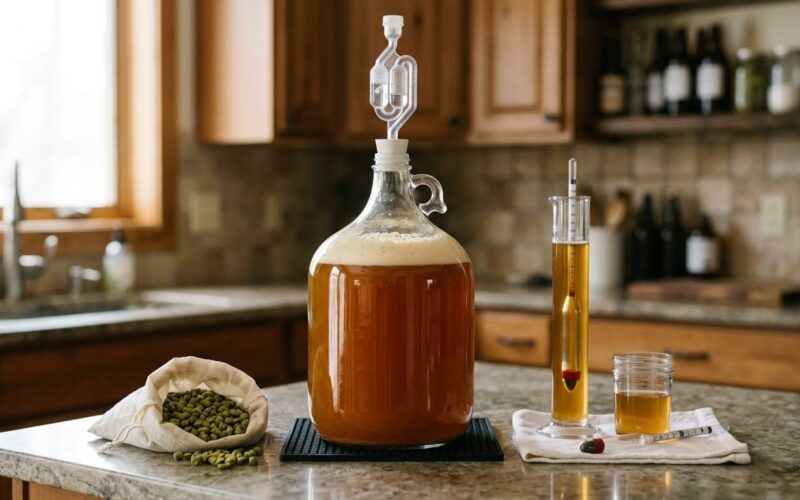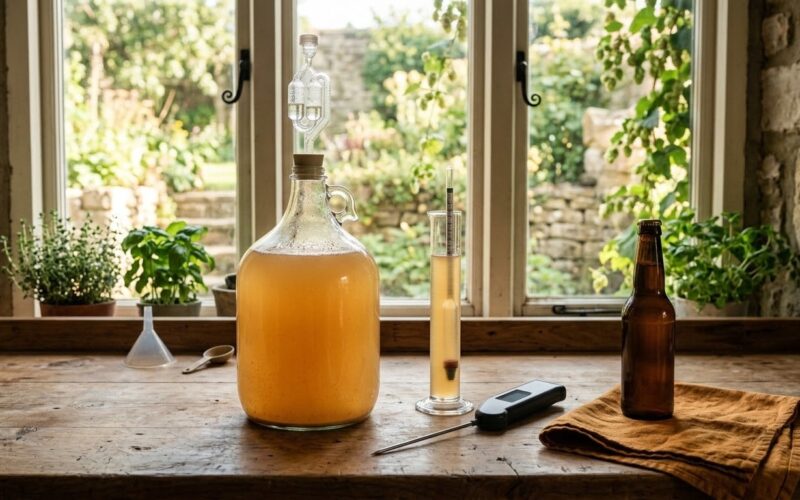
Most of the time you can fix low original gravity before the yeast goes in. Stir the wort properly, check your hydrometer in plain water, look hard at your post-boil volume, then close the gap with dry malt extract, a longer boil, or simply accept a miss of a few points.
A reading that comes in low is usually one of three things. Your gear lied to you, your process left more water in the kettle than the recipe assumed, or the wort really is thin and needs sugar added before pitching.
Start with the reassurance, because most brewers who find this guide are worried: a beer that lands 4 or 5 gravity points under target is a normal batch, not a ruined one. That is roughly 0.5% ABV, and most drinkers would never notice. If you missed by 8 or more, you have options worth taking.
The path below runs in the order that saves the most time. Work through it in order and stop as soon as the reading makes sense, because every extra step on brew day is another chance to make things worse.
Table of Contents
- What You Need
- Step-by-Step
- How to Fix Low Original Gravity in Homebrew by Verifying the Measurement
- How to Fix Low Original Gravity in Homebrew by Finding the Cause
- How to Fix Low Original Gravity in Homebrew During Fermentation
- How to Fix Low Original Gravity in Homebrew Before Packaging
- Common Mistakes
- Frequently Asked Questions
- Can I fix low original gravity after I already pitched the yeast?
- How much dry malt extract do I add to raise original gravity?
- Why is my original gravity lower than the recipe says?
- Should I dilute with water or boil off wort to fix gravity?
- Is a low gravity beer ruined?
- How many gravity points off target is acceptable?
What You Need
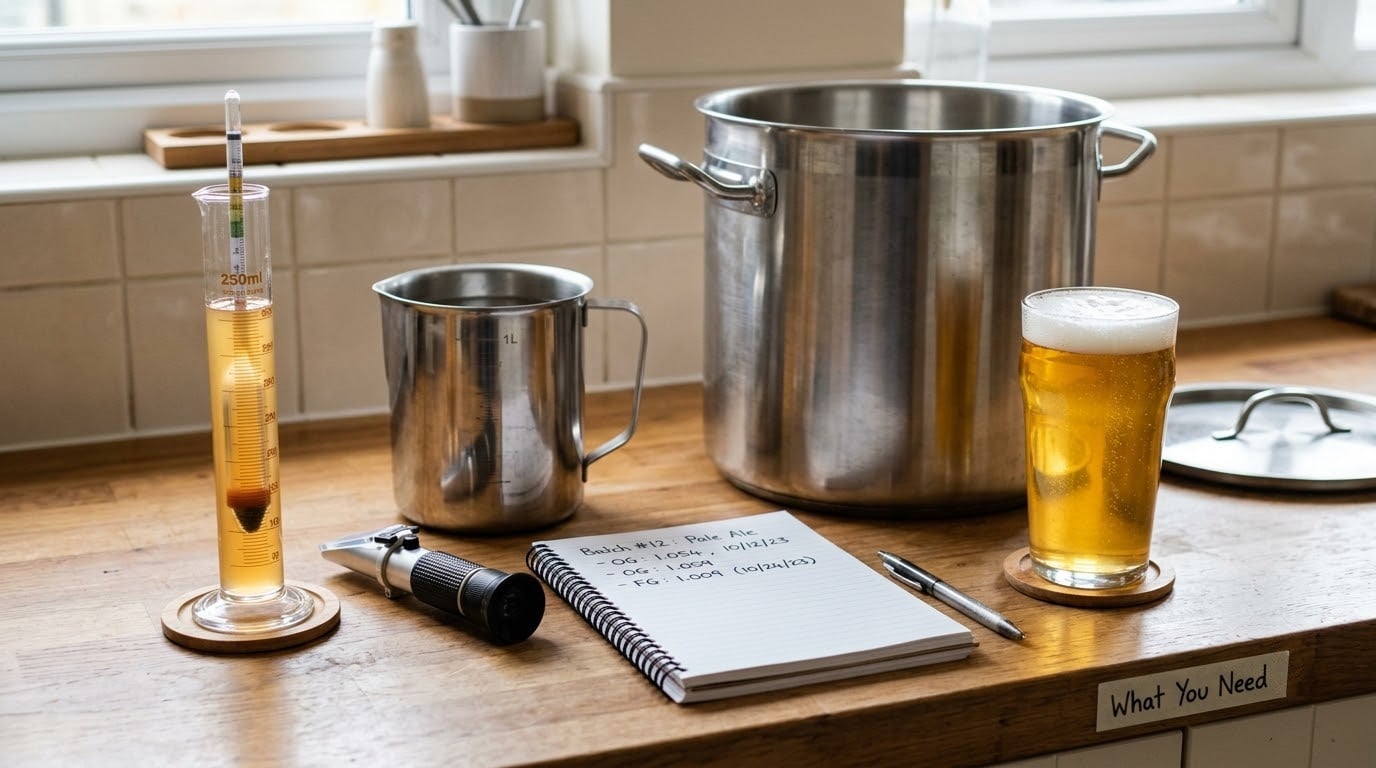
You do not need much, and most of it you already own. What you do need is a way to take the same measurement twice and get the same number.
- A hydrometer you trust. Drop it in a cylinder of distilled or filtered water at calibration temperature. It should read 1.000. If it does not, everything downstream is wrong.
- A thermometer for the sample, because most hydrometers are calibrated at 68F (20C) and read low on a hot wort.
- A refractometer if you use one, mainly to sanity-check a hydrometer result above 1.060, where the instrument is at the edge of its useful range.
- A sample vessel you can pour back from. A cylinder, a thief, or the sidearm on your kettle. You will be mixing the wort and re-reading it more than once.
- Your post-boil volume in gallons. Not the volume you boiled, the volume that is in the kettle when the boil ends. This is the number most low readings trace back to.
- Your recipe’s target OG and pre-boil gravity from BeerSmith, BrewFather or whatever you brew with.
- Some dry malt extract in the freezer if you have room for a bag. This is the cheapest insurance in homebrewing.
- A notebook. Post-boil volume, post-boil gravity, and mash efficiency for every batch. You cannot fix a system you have not measured.
If one item is missing, buy nothing until the measurement is settled. Most low readings turn out to be a tool problem, and a bag of extract does not fix a broken hydrometer.
Step-by-Step
How to Fix Low Original Gravity in Homebrew by Verifying the Measurement
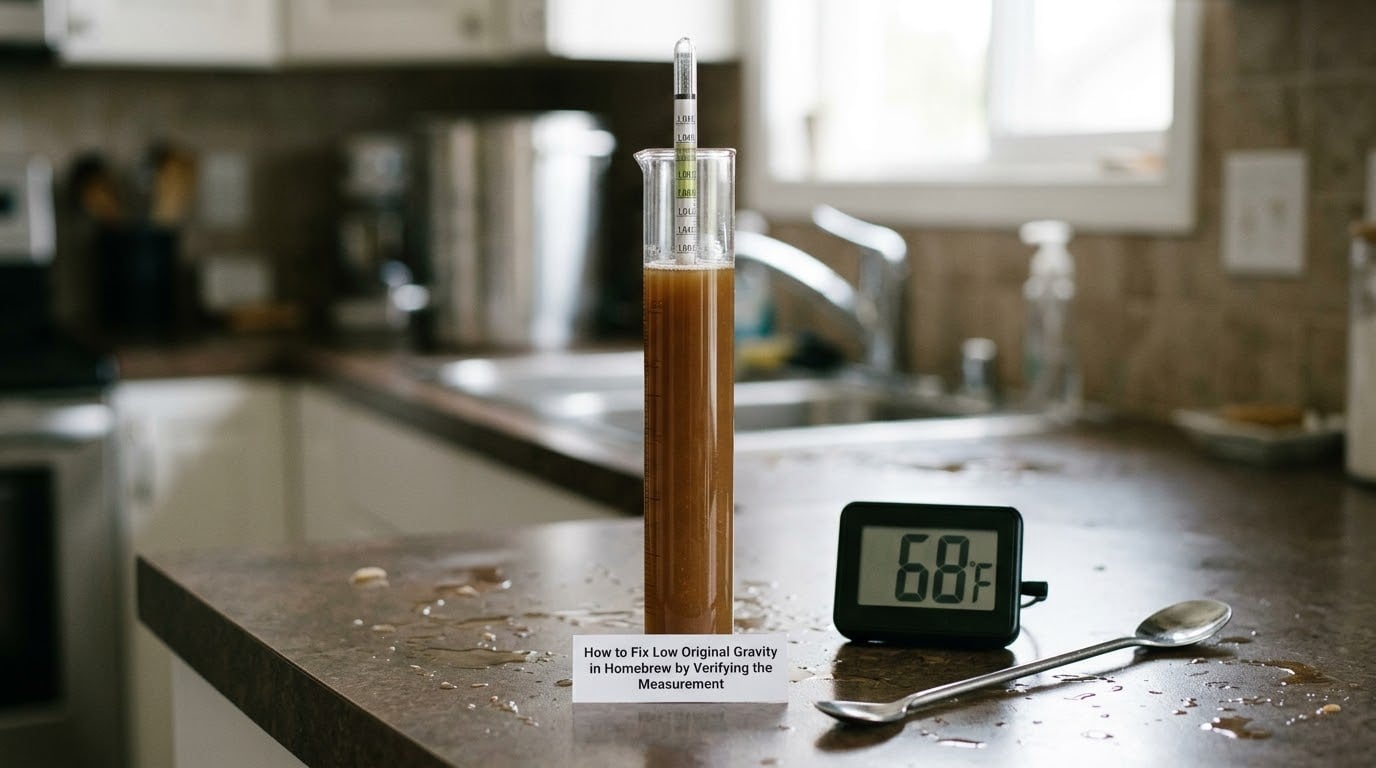
Do this before anything else, because everything else depends on it. Take the wort sample, get it to 68F, mix it, and read it. Then mix it again and read it a second time. If the two numbers differ, the wort was not mixed, and that alone explains most of the gap.
Mixing is the single most repeated fix on the brewing forums. Wort that has been sitting in a kettle is stratified, with sugar-rich wort sitting on top of the more dilute liquid underneath. Draw a sample from the top, or from the sidearm, and you pull the weaker reading every time. Stir the whole kettle with a paddle for a full minute, or siphon from the bottom of the fermenter back up into the kettle and back down, then read.
Next, check the temperature. Almost every hydrometer sold for homebrew is calibrated at 68F (20C). A sample read at 80F can come in 2 or 3 points low, and a very hot sample near boiling can be off by more than that. Let the sample sit until it matches the calibration mark on the stem, or use the maker’s correction table.
Then look at the instrument itself. Dropped hydrometers drift, sometimes by as much as 6 gravity points, because the paper scale inside shifts. A hydrometer that has been fumbled in a bucket of wort or dropped in a fermenter is no longer trustworthy. Soak it in warm water to clean off the wort, dry it, and drop it in distilled water. Anything other than 1.000 and it gets replaced.
A refractometer introduces its own problem at the other end of the range. Most hobby refractometers read accurately up to about 1.060 and then flatten out, showing a gravity that is too low on strong wort. A reading of 1.048 on the refractometer when your target is 1.062 may not be a mash problem at all, it may be the instrument running out of scale. When the two tools disagree above 1.060, trust the hydrometer.
How to know it worked: two consecutive readings from the same sample, taken after mixing, at 68F, land within half a point of each other, and the hydrometer reads 1.000 in plain water. Move on to step two with the number you now trust.
How to Fix Low Original Gravity in Homebrew by Finding the Cause
With a verified number in hand, the question becomes why the wort is thinner than the recipe expected. Work down this list in order, because the first two causes account for most batches.
Post-boil volume is the biggest single cause. Gravity and volume are a pair, so adding water drops gravity, and boiling it off raises gravity. If your recipe called for 5.5 gallons into the fermenter and you have 6 gallons in the kettle, the same sugar is now spread across more liquid. Measure the actual volume after the boil ends, before the chill, and write it down. Forum moderators on the American Homebrewers Association board keep pointing at this one, and they are right.
Next, check the grain. Weigh it. Scales drift, bags get shorted, and a 10 pound bill that is really 8.5 pounds is an easy 15% loss of gravity that no mash technique can recover. Brewers have also reported homebrew shops shorting orders, so it is worth a second look at the bill. If you crush your own grain, the crusher gap matters more than anything else on this list. Start around 1mm (0.04 inch) and tighten until the grist looks like coarse sand with a little flour in it. BeerSmith forum regulars pair a finer crush with a couple of handfuls of rice hulls, which keeps the mash bed loose and stops the sparge from gumming up and strapping your conversion.
Then the mash. Temperature sets the balance between fermentable and unfermentable sugars. Around 149F gives a drier, thinner beer, 152F sits in the middle, and 155 to 159F leaves more residual sugar and more body. A mash that ran an hour at 152F is not your problem. A mash that finished in 20 minutes because the heater ran out is. Mash pH in the 5.0 to 5.4 range keeps the enzymes working, and grain to water ratio below about 0.3 gallons per pound is thick enough that enzymes struggle to move through it.
Wort can also leave the system in places that never show up in a log: sparge water held back in the grain bed, wort stuck in the mash tun, sparge water that ran into the boil late, or extract that clumped in the bag and went down as sludge. Any of those quietly lower the volume and the gravity together.
Here is the pattern, in the order I would check it:
| What you see | Most likely cause | What to do |
|---|---|---|
| OG low by 1 to 3 points, clean tasting wort | Small volume error or an uncalibrated hydrometer | Calibrate, stir, measure post-boil volume, then accept it |
| OG low by 5 to 10 points, wort tastes thin before pitching | Too much water in the kettle | Boil off water, or add dry malt extract |
| OG low by 15 points or more, wort tastes like weak tea | Grain bill short, extract clumped, or crush too coarse | Add extract to close most of the gap and brew the next batch tighter |
| OG fine at pre-boil, low after the boil | Evaporation ran higher than the recipe assumed | Top off with hot water in small amounts, re-reading as you go |
| OG reads high on the refractometer, low on the hydrometer | Refractometer out of range above 1.060 | Trust the hydrometer |
| FG stuck high, not the OG | Under-pitched, too warm, or too cold yeast | See the fermentation section below |
Once you know how many points you are short, you have two honest routes. Boil longer to remove water, which concentrates the sugar you already have, or add fermentable sugar to raise the gravity directly.
Boiling is the slower option and it costs you hop character. A wort that already got its 60 minute charge cannot un-receive those bittering additions, so concentrating the wort leaves you with a beer that tastes more bitter relative to its new body. It is a good move for a heavily hopped style you are already behind on, and a poor one for a pale ale with a big late hop addition.
Adding extract is faster and keeps the balance more honest. Dry malt extract is roughly 40 to 45 potential points per pound in a gallon of water, so a pound of DME in one gallon of finished wort raises the original gravity by about 10 points. That works out to roughly 1.6 ounces of DME per gallon for every gravity point you need to add. Liquid malt extract is about 75% as potent, so scale it up accordingly.
| Points below target | 1 gallon batch | 3 gallon batch | 5 gallon batch |
|---|---|---|---|
| 2 points | 3 oz DME | 10 oz DME | 16 oz DME (1 lb) |
| 4 points | 6 oz DME | 19 oz DME | 32 oz DME (2 lb) |
| 6 points | 10 oz DME | 29 oz DME | 48 oz DME (3 lb) |
| 8 points | 13 oz DME | 38 oz DME | 64 oz DME (4 lb) |
Look at that last row and you can see why extract is not always the answer. Four pounds of DME in a five gallon batch costs a lot of money and pushes your gravity well past what an ordinary yeast can hold. If you are more than about 6 points short, a longer boil is usually the better move.
If you do add DME, make a slurry. Mix the extract with a cup or two of wort from the kettle in a saucepan, heat it gently until it is thin and fully dissolved, then pour it back and stir the whole kettle. DME dumped straight onto the surface of hot wort scorches onto the bottom of the pan and leaves gritty, burnt sugar behind, which is unpleasant no matter how good the rest of the beer is.
Add the extract with the hops still unhopped if you can, then re-check gravity before your first hop addition. Pre-boil gravity adjustments are common practice precisely because hop utilization depends on the gravity of the wort at the moment the hops go in.
How to Fix Low Original Gravity in Homebrew During Fermentation
If the yeast is already pitched, you still have some room, but less of it. The procedure is the same slurry, the same stirring, and the same re-reading, with two extra cautions.
The first is yeast stress. Raising gravity in the fermenter means asking the yeast to handle more sugar in the same amount of time, and going much past 1.070 in an ordinary ferment tends to produce a beer that tastes solventy or hot rather than strong. Small additions with time between them work better than one large dump. A rule of thumb many brewers use is no more than 4 points of added sugar after pitching unless you have pitched extra yeast or added a nutrient.
The second is oxygen. Dry malt extract added after pitching needs a little aeration to ferment cleanly, so add it early in the fermentation when there is still headspace and stir gently with the lid off for a few minutes afterwards. Adding it on day six to a beer that has already been sealed off from air is where off-flavours come from. Our guide to fixing off flavors in homebrew covers how to tell whether what you are tasting is fusels or something else.
The other fermentation questions get confused with original gravity constantly, so separate them. A warm ferment, a cold ferment, an underpitch, or old yeast all produce a high final gravity, and no amount of added sugar will fix that. Signs of a stuck fermentation are an unchanged reading over several days, a lack of activity in the fermenter, and a sweetness that does not move. If your OG was on target and only the finish is wrong, you have a different problem entirely, and pitching healthy fresh yeast is the fix rather than more sugar. The strain and how you store it matter too, and dry yeast and liquid yeast behave differently under a heavy gravity load.
How to know it worked: a stable final gravity a full point or so above where the sugar would have taken you otherwise, no solvent aroma, and a beer that tastes stronger rather than thinner. If the aroma is sharp and hot, you went too far, and nothing pulls that back out.
How to Fix Low Original Gravity in Homebrew Before Packaging
Sometimes the reading was low, the wort is already fermented, and what you have in the fermenter is a thin but clean beer. You cannot raise the alcohol now. You can still improve what it feels like.
Fermentable sugar gives you gravity and takes away body, which is why dextrose in a pale beer can make it taste emptier than doing nothing. Dry malt extract leaves roughly 30% of its weight behind as unfermentable sugars, so a small late addition of DME adds a little strength and a little fullness at the same time. The honest ceiling is a few ounces, added at or near the end of fermentation, and anything past that starts to read as cloying rather than malty.
For body specifically, lactose and dextrin are the two tools. Lactose is a sugar that yeast will not touch, so it stays in suspension and adds viscosity without adding alcohol or making the beer any heavier to drink. A quarter ounce per gallon is a common starting point. Dextrin or maltodextrin powder works similarly and adds a little sweetness that lactose does not. Both must go in during fermentation, never at packaging, or they will drop out of solution.
Watch the bitterness. If you corrected the gravity after the boil, the ratio of bitterness units to gravity just went up, and a beer that is now 6 points stronger will taste noticeably more bitter than the recipe intended. You cannot remove hops that are already in the wort, so plan to serve it a little colder, or blend it with a batch that was not short.
Blending is underrated. If a friend brewed a strong batch in the same week, combining a thin beer with a stronger one lands you closer to a drinkable middle than either alone. If nothing else works, the more honest answer is that you let this one age and drank it while it was young, knowing why it was thin. Nothing is ruined here.
Some batches should not be packaged at all. If the reading came in very low and the beer also tastes sour, solventy, or dirty, the problem is not gravity, it is contamination or a stressed ferment, and packaging it risks bottles that gush. Our guide to flat homebrew walks through the flavors that come from an under-attenuating ferment, which is worth reading before you decide this one is drinkable.
How to know it worked: the beer goes down the glass with some weight behind it, the aroma is clean, and the low strength reads as a lighter style rather than a mistake. If it still tastes like weak tea, no amount of body powder will hide that.
Common Mistakes
Reading a hot sample. This is the most common error and the easiest to fix. Cool the sample to the calibration temperature on the hydrometer, every time.
A stale or dropped instrument. A hydrometer that has been dropped, boiled, or left crusted with wort is unreliable, and a refractometer needs calibrating in water before each session rather than once a year. The zero test takes ten seconds.
Taking one sample from a kettle that was never stirred. The top of a settled wort is the weakest part of it. Stir, or recirculate, then read.
Confusing original gravity with final gravity. These are two different problems with two different fixes. Low OG is a brewing day issue you can correct. High FG is a fermentation issue, and the answers are temperature, yeast health, and patience. A batch whose FG is too high will not be rescued by adding sugar.
Not knowing your post-boil volume. Kettles rarely have volume markers, so brewers eyeball it. Eyeballing is how a five gallon batch becomes six, and how a 70% mash efficiency quietly becomes 60%. Mark your kettle with a permanent marker at your true pre-boil volume, then measure after the boil every time.
Chasing an uncalibrated system. If your efficiency sits at 62% every single batch, that is your equipment, not a mistake you keep making. BIAB without a sparge commonly lands around 60%, and plenty of experienced brewers never see better than 65%. Log three or four batches before you start blaming your process, then correct for the system you actually have. A brewing calculator that shows your real efficiency on every batch is how you find this out.
Trying to dilute a flawed batch back to target. If the beer tastes wrong, raising or lowering gravity will not fix it, it just changes how wrong it tastes.
Adding sugar as the first move. Dextrose raises gravity and strips body. Trying it before you have ruled out a bad reading or excess water means you spent money making a thinner beer.
Two habits prevent most of this. Log the post-boil volume and post-boil gravity of every batch, and keep 5 pounds of DME in the freezer. Not the DME, the habit of measuring before you act.
Frequently Asked Questions
Can I fix low original gravity after I already pitched the yeast?
Yes, though the options narrow. Make a slurry of dry malt extract in a cup of wort, add it to the fermenter early while there is still headspace, and stir gently with the lid off for a few minutes. Keep additions small, roughly 4 gravity points at a time, because more sugar than the yeast can finish produces solvent or hot off-flavours that never come back out.
How much dry malt extract do I add to raise original gravity?
A pound of DME in one gallon raises original gravity by about 10 points, which works out to roughly 1.6 ounces per gallon for every gravity point short. So a five gallon batch that is 4 points low needs about 32 ounces, or 2 pounds. Past about 6 points, boiling off water is usually cheaper and does not thin the finished beer the way simple sugar does.
Why is my original gravity lower than the recipe says?
Three usual reasons. Too much water in the kettle after the boil, which spreads the same sugar thinner. Insufficient conversion from a coarse crush, a short or skipped mash, or a mash pH outside 5.0 to 5.4. And an inaccurate reading from a hot sample, an uncalibrated hydrometer, or wort that was never stirred. Check the volume and the instrument before you change anything about the recipe.
Should I dilute with water or boil off wort to fix gravity?
To raise gravity, boil off water. To lower it, add water, which is the fix when a reading comes in high rather than low. Boiling concentrates the sugar already in the wort without adding anything new, but it cannot recover hops that were bittered earlier, so a heavily hopped beer will get more bitter relative to its body. Adding water is free, instant and does no damage to hop character.
Is a low gravity beer ruined?
No. A miss of 5 gravity points works out to roughly half a point of ABV, which is inside normal batch to batch variation and most drinkers would not identify as a flaw. A thin beer with a clean finish simply tastes like a lighter style. The batch is only in real trouble if it is also sour, solventy or contaminated, and that is a different problem with a different answer.
How many gravity points off target is acceptable?
Within about 5 points is completely normal, and many experienced brewers would not correct it. That range covers ordinary variation in grain, evaporation rate, and measurement error. A miss of 8 or more points is worth a correction with extract or a longer boil. If your batches consistently land low, fix the process instead of the batch and note that BIAB without a sparge running near 60% efficiency is a system characteristic, not a mistake.
Start by doing the boring part. Stir the wort, cool a sample to 68F, drop the hydrometer in plain water and make sure it reads 1.000, then read the wort twice. If the reading holds, measure your post-boil volume, because that is where most of the missing gravity is hiding. Close a gap under 6 points with a DME slurry at 1.6 ounces per gallon per point, or take it off the heat until the volume drops, and leave it alone if you are within 5 points of target.