A crowler is a 32-ounce aluminum can that a brewery or taproom fills from a draft tap and seals on demand, so you can carry fresh draft beer home in something that pours and travels like canned beer. Ask what is a crowler at any taproom and you get the same short answer: it is the tall, single-use can sitting in the cooler behind the bar.
The format exists because growlers were giving breweries trouble. Glass broke, light hit the beer, and take-home fills went flat faster than anyone wanted to admit. The crowler fixed most of that, and it is now the default to-go container for draft beer in a lot of taprooms.
Table of Contents
- What Is a Crowler?
- Crowler Size, Material, and Design
- Why Breweries Use the Crowler Format
- What Is a Crowler in Brewing and Packaging?
- How a Crowler Differs from a Growler
- How a Crowler Compares with Cans and Bottles
- How to Buy, Chill, and Store a Crowler
- Are Crowlers Worth Buying?
- Frequently Asked Questions
- How much beer is in a crowler?
- Are crowlers the same as growlers?
- How long does beer in a crowler stay fresh?
- Can you reseal a crowler after opening it?
- How can I tell if a beer can is a crowler?
- Conclusion
What Is a Crowler?
A crowler is a 32-ounce aluminum can filled directly from a draft tap line and sealed on demand with a small can-seaming machine, then sold to you as a fresh take-home draft beer. It is single-use, airtight, and lightproof, and it is the container most taprooms hand over when you ask to take a pour home.
Quick answer, if you only need the shape of it:
- Size: 32 fluid ounces is the standard, though 16 oz versions show up at some breweries.
- Material: Aluminum with a seamed metal lid, usually with a pull tab or an opener tool.
- Seal: Double-seamed on a countertop seaming machine while you wait at the bar.
- Use: Fresh draft to go, plus seasonal, limited, and barrel-aged releases you will not find in six-packs.
- After opening: Drink it within a day or two, because a crowler cannot be resealed.
- End of life: It is curbside recyclable aluminum, the same as a soda can.
One thing worth knowing before you order: crowler availability is not universal. It depends on the brewery owning a seaming machine and on state law governing to-go fills, so a taproom in one town may have six on rotation while another a few miles away offers only bottles.
Crowler Size, Material, and Design
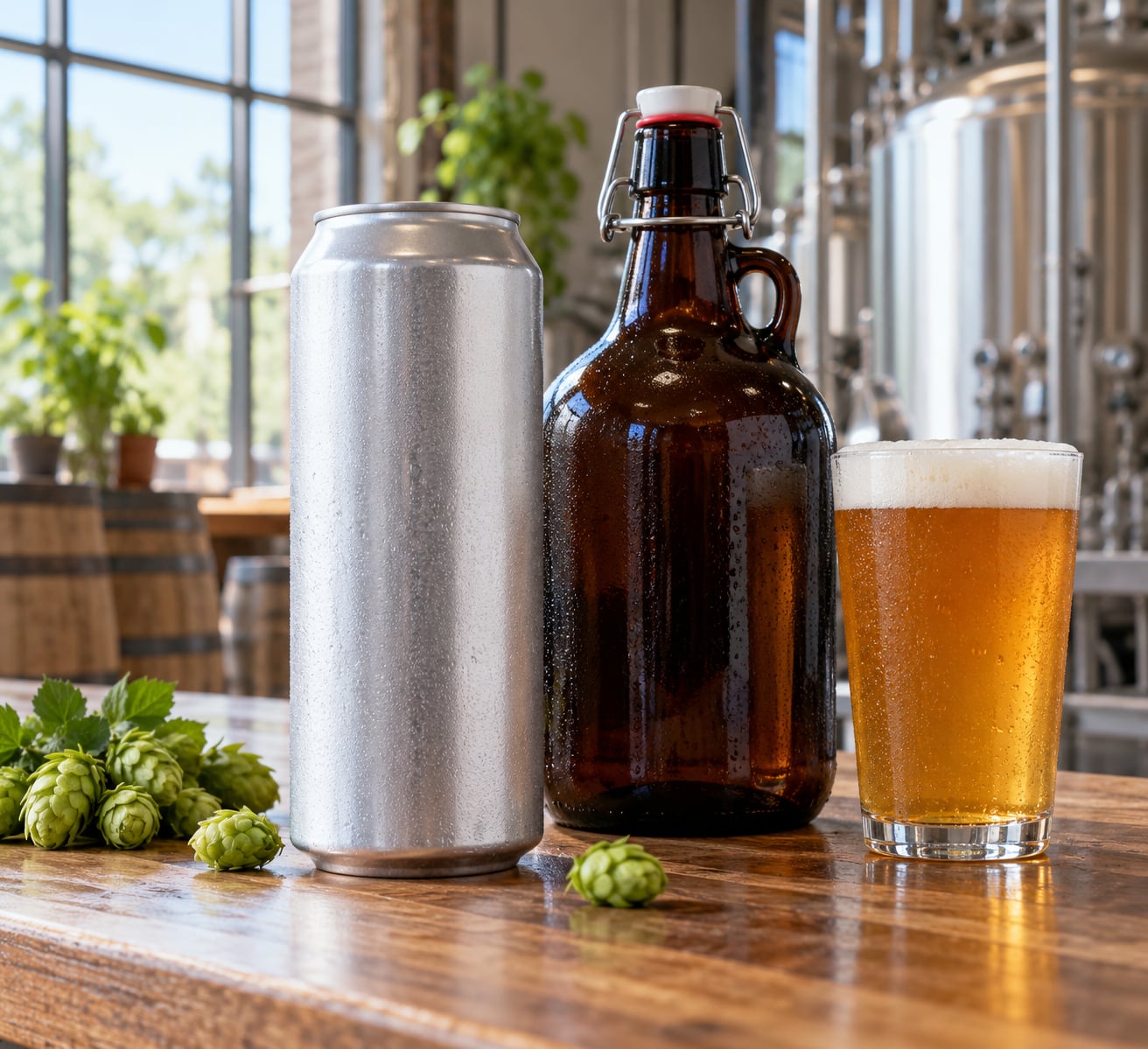
The 32-ounce crowler is a tall, narrow can, roughly twice the height of a standard 12-ounce beer can and shaped more like a large soda can than a beer can. That shape is not decoration. It is what lets a seaming machine apply a full can lid to a container that holds close to a quart.
Material matters as much as size. Aluminum blocks light completely, and light is one of the two things that ruin draft beer quickly, the other being oxygen. A glass growler lets light through. A crowler does not, which is a large part of why crowlers keep longer than people expect from a to-go container.
The opening is the part people ask about most. Older crowlers had no pull tab and needed a can opener or the small opening tool many taprooms hand you with the fill. Newer lids carry a ring, so the pour opens like a normal can. Either way, once the tab is pulled the seal is gone for good.
A standard 12-ounce can and a crowler share a material and a look but nothing else. The 12-ounce can is filled and sealed in a high-speed canning line days or weeks before you buy it, which is why it keeps for months. The crowler is sealed on a countertop machine one can at a time, minutes before it leaves the taproom.
Keep an eye out for the 16 oz crowler too. It is not a myth and not a different product, just a smaller can run on the same equipment, and it shows up mostly at breweries that push variety taps rather than a house pour.
Why Breweries Use the Crowler Format
Four reasons come up every time. Freshness, portability, cost, and flexibility.
Freshness comes down to the double seam. An empty can is purged with carbon dioxide to push out the air, filled from the tap line, and seamed shut in one pass. If the seal is good, oxygen stays out and carbonation stays in. Drinkers on beer forums still complain about crowlers arriving flat, and the usual suspects are a lazy purge at the bar and inconsistent seaming rather than the format itself.
Portability is the second reason. Aluminum does not shatter, so a crowler can go in a cooler, on a boat, into a cup holder at a ballpark, or through the mail without the breakage risk that comes with glass.
Cost is the third. A crowler seamer is a countertop machine, not a canning line. A brewery that wants to sell to-go draft can buy one machine and start filling the same day, which is why small taprooms adopted the format so quickly.
Flexibility is the fourth and the one drinkers care about most. Barrel-aged stout, a single-hop IPA on tap this month, a festival-only release. People in brewery and beer communities value crowlers for variety, for trying the one-off tap that will never be bottled, rather than for longevity.
What Is a Crowler in Brewing and Packaging?
It is simpler to think of a crowler as a six-pack that got sealed at the counter instead of the line. The brewery holds an empty crowler can, the bartender runs the seaming cycle, the can comes out double-seamed and filled, it goes into a fridge or an insulated cooler, and you take it home. You open it, you pour it, and the can goes in the recycling.
That is the whole reason to-go programs exist. Once a taproom can sell a fresh pour in something that survives the drive home, the money moves from glasses poured at the bar to containers carried out the door, and crowlers are the container that made that shift workable.
How a Crowler Differs from a Growler
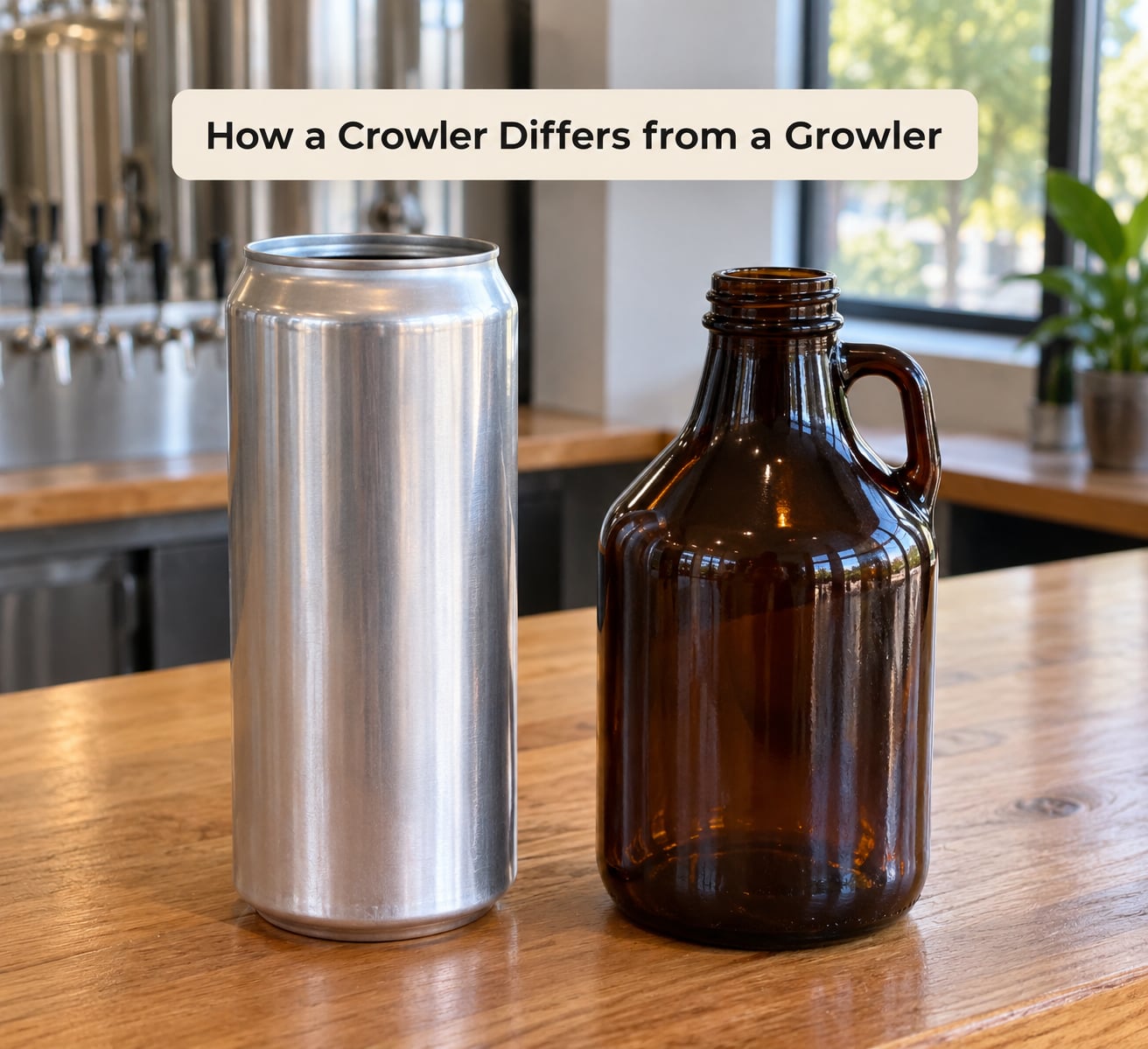
A growler is the 64-ounce, half-gallon glass jug you may remember from the last decade. A crowler is half the volume, in metal, sealed once. The other difference people trip over is the nickname: a 32-ounce growler is often called a howler, so the same glass jug gets two names depending on who is pouring it.
| Factor | Crowler | Growler |
|---|---|---|
| Capacity | 32 ounces | 64 ounces, the half-gallon standard |
| Material | Aluminum, lightproof and shatter-resistant | Glass, light-transmitting and fragile |
| Resealable | No, single-use once the lid is opened | Yes, screw top or swing-top lid |
| Freshness expectation | About one to three weeks unopened and refrigerated, depending on fill quality | Roughly a week or less, since glass and oxygen work against it |
| Portability | Light, drops safe, easy to mail | Heavy, breaks if dropped, awkward to ship |
| Cost context | Usually a higher price per ounce than canned beer | Often cheaper per ounce, but a bigger up-front commitment |
| Best use case | Trying a limited draft tap, portable format, shipping | Feeding a group at once, refillable over time |
| After opening | Finish within a day or two | Seal it back up and get a few more days |
If you need a large volume for one occasion, a growler still wins on arithmetic. If you need one interesting beer to survive a car ride, the crowler wins on everything else.
How a Crowler Compares with Cans and Bottles
Pour math first, because it settles most arguments. 32 ounces is about 2.7 twelve-ounce glasses, or eight four-ounce tasters. So a crowler serves two people properly, three if nobody is measuring, and it is not the same as handing out four cans.
Against a standard can, the crowler gives you fresher beer and a bigger pour at the cost of one trip to the fridge. Cans win on price per ounce, on shelf life measured in months, and on the fact that a half-finished can simply closes again. A crowler cannot do that, which is the single biggest practical difference for anyone drinking alone.
Against a bottle, the crowler is lighter, faster to chill, and better protected from light. Bottles win on shelf life, on cellaring, and on the ability to set one down and come back to it a week later.
Price context without a specific number: divide the fill cost by 32 and compare that per-ounce figure to a six-pack of the same beer. Many drinkers find the fill sits well above the packaged price per ounce, and decide it is worth paying for a beer that is not otherwise available. Others do the same math and take the six-pack.
How to Buy, Chill, and Store a Crowler
Look at the can before you pay. A properly seamed crowler has a smooth, even double seam around the top with no dents or raised edges. If the seam looks crooked, the lid is not fully seated, or the can looks swollen, ask for a refill or another can. That check takes five seconds and saves a flat 32 ounces.
Ask how it was stored. A crowler that has been sitting on a warm shelf all afternoon is not the same as one pulled from a fridge at 38 degrees. If the taproom lets you choose, take the coldest one.
Get it cold and keep it cold. Put it in the fridge on its side or upright, whichever your fridge fits, and treat the cold chain as important as the seal. Do not leave it in a parked car in October.
Open it over a glass or a sink, because the carbonation is real and the pour can foam over. Chill it thoroughly first if you want to control the head.
Now the part nobody tells you: you cannot put the lid back. If you have 10 ounces left, your options are to finish it, or to push it hard with the community workaround of wrapping the top tightly with two layers of plastic wrap and a rubber band, keeping it cold, and accepting that it will lose carbonation anyway. Best case is a day or two, not a week.
In the recycling bin, a crowler is just an aluminum can. Empty it, give it a quick rinse, and drop it in. If it went through a taproom pickup program, follow whatever instructions they gave you.
Are Crowlers Worth Buying?
Worth it when the beer is the point. Limited taproom releases, barrel-aged stout, a festival beer, or a style the brewery bottles only once a year are exactly what the format is for. It is also worth it when glass is a bad idea, at a beach, a park, or a stadium.
Also worth it when you are splitting it with one other person and neither of you wants to drive home from the taproom carrying glass.
Not worth it when you are drinking solo, when you plan to keep the leftovers for later in the week, or when the same beer is available in a six-pack you could drink cold for the next two months. A crowler is a freshness-and-convenience purchase, not a value purchase.
Frequently Asked Questions
How much beer is in a crowler?
A standard crowler holds 32 fluid ounces, which is one quart. That works out to roughly 2.7 twelve-ounce glasses, or eight four-ounce tasters, so it serves two people comfortably and three if nobody is measuring. Smaller 16 oz versions exist at some breweries, but 32 ounces is the format almost everyone means.
Are crowlers the same as growlers?
No. A crowler is a 32-ounce aluminum can sealed on demand with a single-use lid. A growler is a 64-ounce glass jug, the half-gallon standard, that takes a screw top or swing-top cap and can be resealed. Metal blocks light and cannot break, which is why most taprooms moved from glass to aluminum.
How long does beer in a crowler stay fresh?
Unopened and continuously refrigerated, expect somewhere between one and three weeks, with the difference coming down to how well the bartender purged the can and sealed it. Once you pull the tab, drink it within a day or two. Plastic wrap and a rubber band will slow the carbonation loss but cannot rebuild the original seal.
Can you reseal a crowler after opening it?
No. Crowlers are single-use and the seam is destroyed when you open the lid. A growler is the container you can open and close again, which is why it stays useful for two or three days instead of one. If you only want part of a crowler, plan the pours or bring a growler home instead.
How can I tell if a beer can is a crowler?
Check the volume and the shape. A crowler is a tall, narrow 32-ounce can, about twice the height of a standard 12-ounce beer can, usually with a pull tab or a lid that needs a small opener. A 16 oz crowler looks like a slightly oversized craft can. Anything labeled 12 oz is a standard can.
Conclusion
A crowler is a 32-ounce aluminum can filled from a draft tap and sealed on demand, built to give you fresh draft beer in a package that is light, shatterproof and airtight. Buy it chilled, glance at the seam before you pay, keep it cold from the moment you leave, and plan to finish it within a couple of days because there is no putting the lid back on. When it works best is when the beer is not available anywhere else, which is exactly what most taprooms are selling it for. Walk in, ask what is on the crowler seamer, and let the pour math decide.