IBU stands for International Bitterness Units, a scale that estimates how much bitterness a beer’s hops contribute. On a label it is usually a single number, and the only job it does is tell you how bitter that beer is likely to taste. It says nothing about strength, sweetness or quality.
The number is more useful than people give it credit for, mostly because the styles people already know span a much wider range than most drinkers realize. A Budweiser sits near the floor of the scale. A double IPA sits near the ceiling. Same label, same three letters, very different glass.
This guide covers what the number measures, how breweries arrive at it, why two beers at the same IBU can taste nothing alike, and what to do with it the next time you are standing in front of a tap list.
Table of Contents
- What Does Ibu Mean on a Beer Label?
- The short version of what IBU means on a beer label
- What IBU does not measure
- How Is Ibu Measured?
- What Does a Beer’s IBU Number Tell You?
- Is a Higher IBU Always Better?
- What Is the Typical IBU Range for Beer?
- Why Do Beers With the Same IBU Taste So Different?
- How Do You Choose a Beer Based on Its IBU?
- Frequently Asked Questions
- Does a higher IBU mean the beer is hoppy or stronger?
- What is the highest IBU beer you can buy?
- Which beers have the lowest IBU?
- Why do two beers with the same IBU taste different?
- Why do some breweries leave IBU off the label?
- How do I choose a beer when I know nothing about IBU?
- What to Take Away
What Does Ibu Mean on a Beer Label?
IBU stands for International Bitterness Units, a scale used to estimate a beer’s bitterness from hop-derived compounds. A higher number generally means more bitterness, though it does not measure how hoppy a beer smells, how strong it is, or how good it is. Only beer has a meaningful IBU.
The short version of what IBU means on a beer label
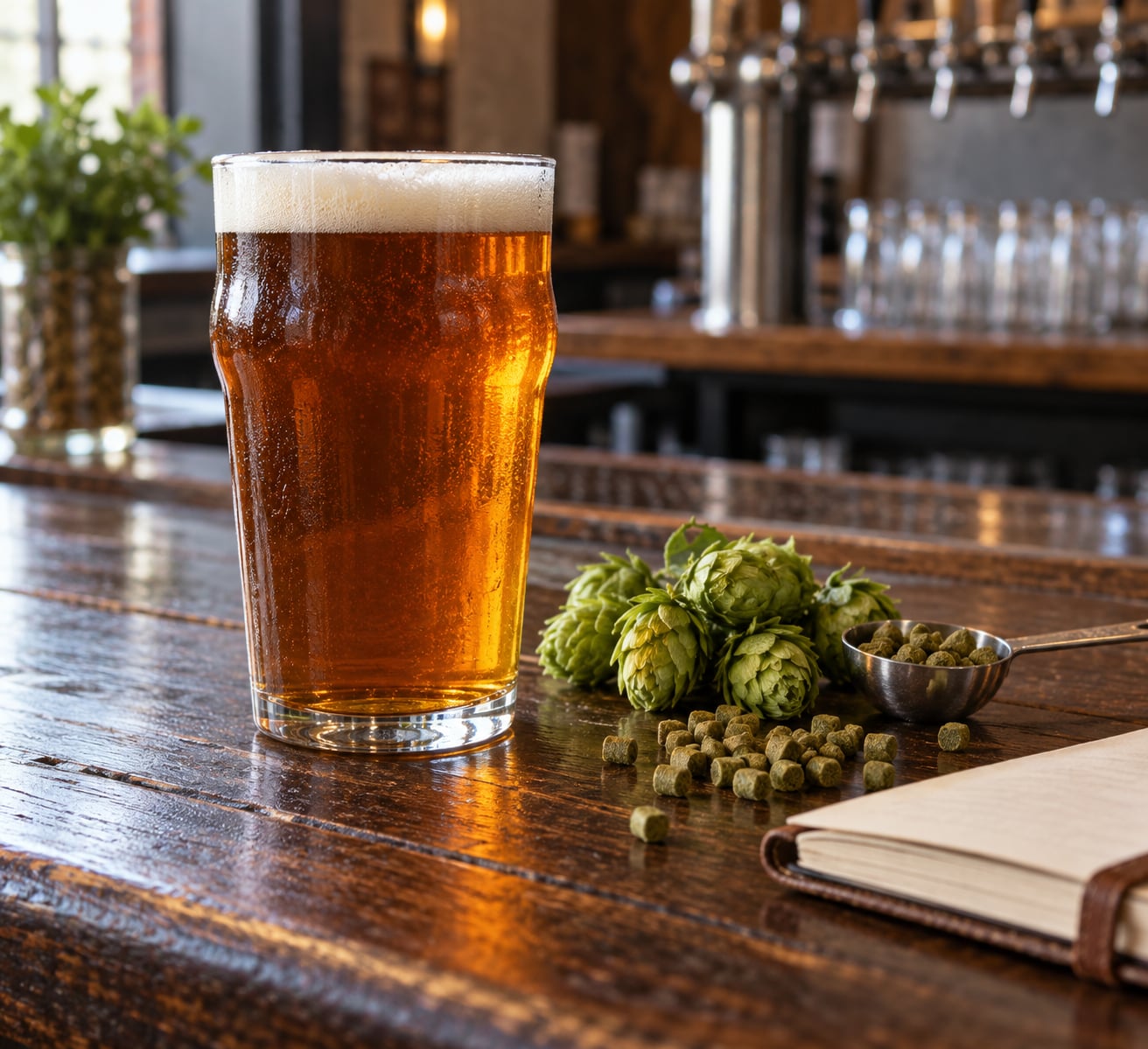
It is a hop measurement, not a flavor rating. The bitter compounds in beer are iso-alpha acids, which form when alpha acids in the hop cone are boiled during brewing and convert. IBU estimates how many of those compounds ended up in the finished beer, and the industry convention converts that to a concentration of roughly one milligram per liter per unit.
So a 40 IBU pale ale and a 40 IBU wheat beer share a measurement but not necessarily an experience. The wheat beer is usually lighter in body, sweeter through the finish, and less bitter on the palate despite matching the number.
What IBU does not measure
- Alcohol. A 10 IBU session lager can be stronger than an 80 IBU imperial IPA. The two numbers are unrelated.
- Hop aroma. Most aroma comes from dry hops and whirlpool additions added after the boil, which contribute scent without adding much measured bitterness.
- Color. That is the SRM number on the label, a completely separate scale.
- Quality. A tightly balanced 25 IBU beer can be more interesting than a badly executed 90 IBU one.
How Is Ibu Measured?
There are two answers to this: the number a brewer calculates before brewing, and the number a lab confirms afterward. They are frequently different.
Calculation. Before brewing, the brewer knows the alpha acid content of each hop lot and the timing of each addition. Charge hops go in at the start of the boil, first additions an hour in, whirlpool additions at the end, dry hops after fermentation. The brewer runs those numbers through a calculation, most homebrewers using the Tinseth method, and comes up with a target. That target is what usually ends up on the tap list.
Lab measurement. To confirm it, a brewery or contract lab pulls a sample, acidifies it, extracts the bitter compounds into a solvent, and reads ultraviolet absorbance at 275 nanometers. The reading is multiplied by 50 to produce the IBU figure. High-performance liquid chromatography gives a more exact result but costs more, so the UV method is the common one.
Because methods vary, and because dry hopping contributes aroma without measured bitterness, two breweries reporting 60 IBU can be describing genuinely different beers. Someone on r/Homebrewing put it plainly: IBU is a rough measure of perceived bitterness, especially since it was never formulated with large post-boil additions in mind.
What Does a Beer’s IBU Number Tell You?
It tells you roughly where a beer sits on a bitterness scale, and that is genuinely the most it tells you. Used that way, the number lets you compare two unfamiliar beers before you commit money or a whole pour.
| What the label says | What it measures | Where it comes from | What a higher number means |
|---|---|---|---|
| IBU | Bitterness | Hop-derived iso-alpha acids | More bitterness, up to a point |
| ABV | Alcohol by volume | Fermentation of sugars | More alcohol, more warmth and weight |
| SRM | Color | Malt and roast character | Deeper color, from pale gold to near black |
The pairing people get wrong most often is IBU and ABV. They are measured from different things and one does not drive the other. A hazy IPA at 8% and 40 IBU and an imperial stout at 10% and 55 IBU are both strong beers with different bitterness, and there are plenty of examples of high-ABV, low-IBU beers and low-ABV, surprisingly bitter ones.
Perceived bitterness is the real thing you taste, and it is not identical to the number. People drinking the same 60 IBU IPA will describe it differently depending on what they ate, how cold the glass was, and how much they enjoy bitterness.
Is a Higher IBU Always Better?
No. Bitterness is one ingredient in a balance, and a bigger number is not a better one.
Bitterness has to land somewhere on the palate that can carry it. More malt sweetness absorbs it. Higher alcohol rounds and smooths the edges. A heavy body cushions it the way a louder room cushions sound. Take those away and the same IBU reads as sharper and more aggressive, even if the number has not changed.
Style matters even more than balance. Nobody judges a pilsner by its hop bitterness, so a 40 IBU pilsner is not a failure, it is a pilsner that somebody over-hopped. The number only becomes a quality judgment inside a style that expects that kind of bitterness.
Serving temperature makes the comparison worse. A bitter beer tastes more bitter cold and softer warm. If one bottle at 45 IBU tastes sharper than a 60 IBU beer next to it, temperature is a good part of the explanation.
What Is the Typical IBU Range for Beer?
Use these as general reference points, not style rules. BJCP style guidelines set ranges, and breweries regularly land outside them on purpose.
| Beer style | Typical IBU range | What that range feels like |
|---|---|---|
| Light lager, macro light beer | 2 to 12 | Almost no bitterness, clean and crisp |
| Wheat beer | 8 to 20 | Mild hop bite at the finish |
| Blonde ale, cream ale | 12 to 25 | Low, sweet-leaning hop flavor |
| Pilsner | 25 to 45 | Spicy, dry, floral bitterness |
| Porter and stout | 25 to 60 | Roast and coffee absorb much of it |
| American pale ale | 30 to 50 | Noticeable but balanced hop flavor |
| American IPA | 40 to 70 | The reference point most people mean |
| Hazy or New England IPA | 40 to 60 | Soft, juicy, low perceived bite |
| Double IPA | 60 to 90 | Resin and citrus up front, real bite |
| Barleywine, imperial stout | 50 to 100 | Big numbers that taste smoother than they read |
So is 20 IBU high? High for a wheat beer, low for an IPA. Is 70 IBU high? Very high for a lager, roughly middle-of-the-road for an American IPA, and on the lower side of a double IPA. A number without a style attached is not a verdict.
For mainstream lagers, the commonly published figures sit very low. Budweiser is usually given as roughly 6 to 10 IBU, Coors Light around 6 to 9, Miller Lite about 4 to 7, Michelob Ultra around 2 to 6, and Heineken near 11. Treat these as approximations rather than lab-verified figures, because macro breweries rarely publish an IBU at all.
Why Do Beers With the Same IBU Taste So Different?
Same number, different beer. The reasons stack up quickly.
- Hop timing. Bittering hops early in the boil add IBU with almost no aroma. Late whirlpool hops add aroma. Dry hops add aroma and flavor with little measured bitterness, so the number understates what you smell.
- Hop variety and chemistry. Different cultivars carry different alpha acid levels and different resin profiles. Citra and Mosaic lean citrus and tropical fruit, Cascade and Centennial lean floral and piney, and those differences register on the palate regardless of IBU.
- Malt profile. A pale, dry malt bill lets bitterness stand alone. A caramel-heavy or high-dextrin wort rounds it off. Two 60 IBU beers, one dry and one honeyed, taste like different products.
- Yeast and fermentation. Yeast character, attenuation, and any conditioning additions shift how sharp the finish feels.
- Carbonation. CO2 sharpens the palate and can amplify perceived bitterness. A heavily carbonated beer at the same IBU tastes harsher.
- Water. Sulfate-forward water emphasizes bitterness and dryness. Carbonate-heavy water softens it.
- Oxidation and age. Old oxidized beer can taste stale and slightly bitter in a way no label number predicts.
- Serving conditions. Glass shape, temperature, and how long the beer has been sitting all move the experience.
This is why a 40 IBU hazy IPA tastes sweeter than a 60 IBU West Coast IPA even though the numbers suggest the opposite. Word spread around the 100 IBU mark partly because of perceived bitterness rather than measured bitterness, exactly the gap this list creates.
How Do You Choose a Beer Based on Its IBU?
Read the style first, ABV second, IBU third. Style tells you what the beer is trying to be, ABV tells you how it will hit, and IBU fine-tunes the last few degrees.
If you are new to beer, stay in the 5 to 35 IBU band for your first several months. You are learning what malt, hops and yeast do, and a high-IBU beer just blunts that learning. A pilsner, blonde ale or wheat beer teaches more per pint than an imperial IPA.
If you like hop flavor but not pain, aim for 35 to 55 IBU in styles built for it. That covers American pale ales, session IPAs and most hazies. You get grapefruit and pine without the astringency that makes people give up on the category.
If you want the full hop experience, go 60 to 90 IBU and expect it. Start with something that has malt to stand behind it, and give it a few sips before deciding.
When pairing with food, bitterness is your friend. It cuts fat, handles rich meat and cleans up fried food, which is why IPAs and stouts have outlasted most other styles on bar menus.
When the tap list has no IBU at all, the style is doing the work. It is common for breweries to leave IBU off because a calculated target for one beer is not directly comparable to another brewery’s, and some brewers simply do not think the number tells a drinker anything useful. That silence is a stylistic choice, not a mark against the beer.
One last practical habit. Before ordering something above about 70 IBU for the first time, ask the bartender what it is like. A bartender who knows the beer will give you an honest answer in ten seconds that no label number can.
Last updated: October 2026
Frequently Asked Questions
Does a higher IBU mean the beer is hoppy or stronger?
It means more measured hop bitterness, not more hop aroma and not more alcohol. Most aroma comes from hops added after the boil, which barely move the IBU number, so an aromatic hazy IPA at 45 IBU can smell far hoppier than a piney West Coast IPA at 65. Strength comes from ABV, which is a separate measurement entirely.
What is the highest IBU beer you can buy?
Commercial examples are usually quoted somewhere between 100 and 135 IBU, with heavily hopped imperial stouts and barleywines at the top of that range. Numbers above 100 often come from post-boil and dry hop additions that add aroma and perceived bitterness rather than measured IBU, so treat very high figures as marketing as much as measurement.
Which beers have the lowest IBU?
Light lagers and macro light beers sit at the bottom of the scale, commonly reported in the range of 2 to 12 IBU. Michelob Ultra is usually cited near the bottom of that band, and Budweiser a little above it. Wheat beers and cream ales follow at roughly 8 to 20 IBU, where you can start to taste the hops but nothing approaches intensity.
Why do two beers with the same IBU taste different?
Because IBU counts bitter compounds while your tongue reads the whole beer. Hop timing, hop variety, malt sweetness, yeast character, carbonation, water chemistry, oxidation and serving temperature all shift the perception without changing the measurement. A dry 60 IBU IPA and a honeyed 60 IBU IPA are genuinely different beers sharing one number.
Why do some breweries leave IBU off the label?
A printed IBU is often a calculated recipe target rather than a finished-beer measurement, and some brewers would rather it not be compared with another brewery’s target across a different process. Others find the metric too rough for consumers to use meaningfully. The absence is a stylistic decision, not a sign that the number is hidden or the beer is weak.
How do I choose a beer when I know nothing about IBU?
Start with style, not numbers. Pick a lager, blonde ale or wheat beer in the 5 to 35 IBU range to learn what beer tastes like without bitterness getting in the way. Once you know whether you enjoy hop flavor, use IBU to move gradually between 30 and 55 for approachable hops or 60 and 90 for the full expression.
What to Take Away
IBU is one number with one job: estimating hop bitterness. Treat it as a coordinate, not a verdict. Start with the style, check ABV if strength matters to you, and use IBU to pick a point on the bitterness spectrum that matches how you want the beer to feel.