How long does an opened beer last? An opened beer is at its best the same day you pour it. Sitting open on a warm counter, it stays drinkable for roughly 2 hours. Covered or resealed and kept in the fridge, it holds up for 24 to 48 hours. Past that window the carbonation fades and the flavor goes flat and papery, which happens long before the beer becomes unsafe to drink.
The gap between “tastes bad” and “makes you sick” is the whole point here. Beer is one of the few foods that quietly loses quality instead of growing dangerous, so a dull, flat pint is usually a disappointment rather than a health problem. The exceptions are few, and they are mostly about contamination rather than age.
Table of Contents
- How Long Does an Opened Beer Last?
- Opened Beer Storage Times at a Glance
- How Long Does an Opened Beer Last by Type?
- How Long Does an Opened Beer Last in the Fridge?
- How Long Does an Opened Beer Last at Room Temperature?
- What Changes After Beer Is Opened?
- How to Keep Opened Beer Fresh Longer
- How to Tell Whether Opened Beer Is Still Good
- Frequently Asked Questions
- Does beer go bad as soon as it is opened?
- Can I drink an open beer after 2 days?
- Can I reseal an opened beer bottle or can?
- How long does opened beer keep its carbonation?
- Can opened beer be frozen for later?
- Is warm opened beer unsafe to drink?
- Conclusion
How Long Does an Opened Beer Last?
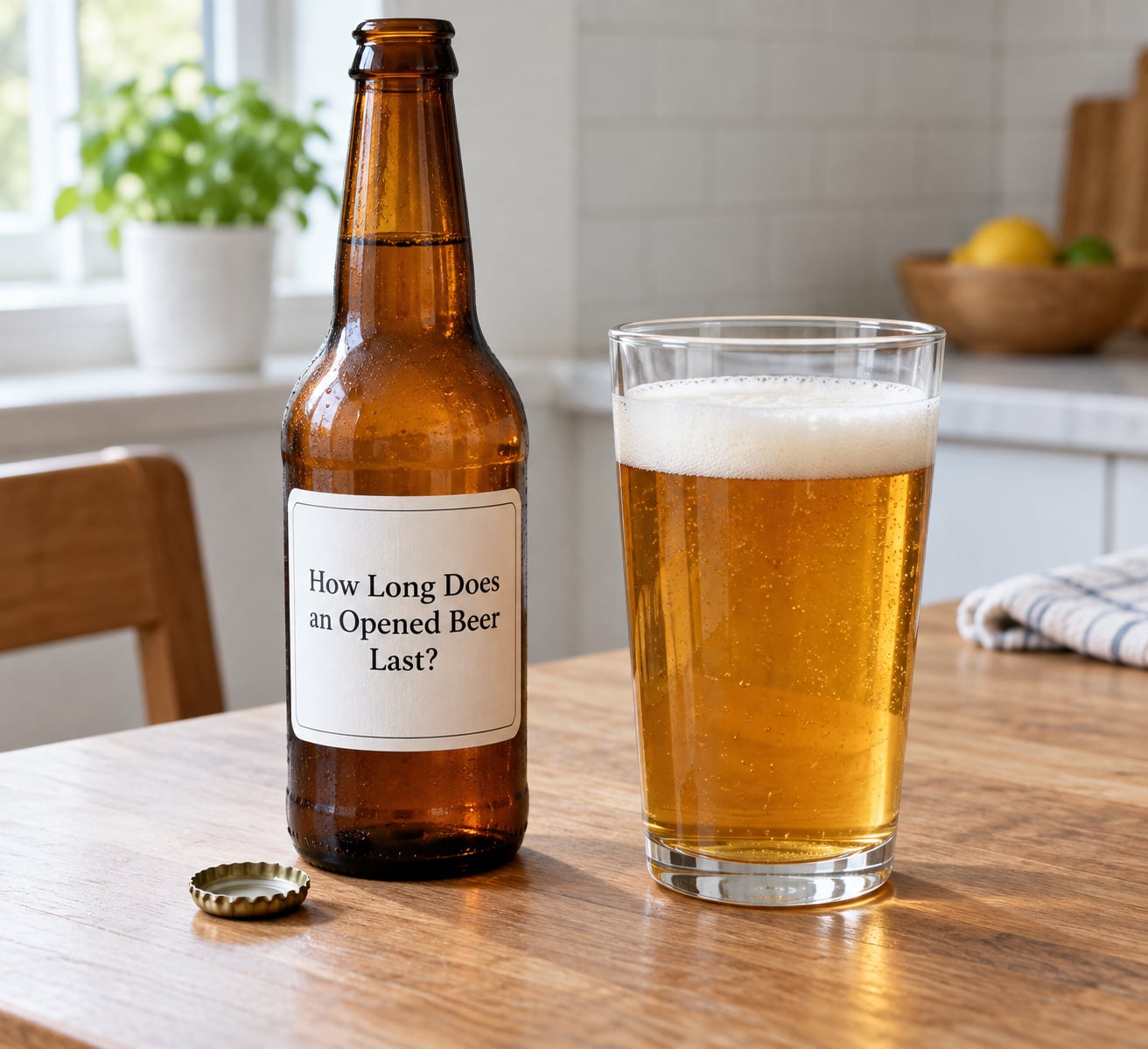
Two hours at room temperature, one to three days in the fridge if you reseal it. That is the short version, and the two numbers only make sense together, because temperature and sealing decide almost everything else.
Opening a beer breaks a seal that was doing two jobs at once. It let the carbonation pressure escape, and it let oxygen in. Both of those start immediately, but the second one is what actually ruins the flavor, and both of them run faster when the beer is warm.
So the practical order of quality goes like this. Fresh from the bottle or tap, a beer is cold, bright and full of aroma. A few hours open, it is still perfectly drinkable but starting to lose its sparkle. A day or two resealed and cold, it is drinkable with a slightly hollow, papery quality. Past a week, even in the fridge, the beer is a curiosity.
What does not really happen is the beer turning into something dangerous. A standard beer has an alcohol content and acidity level that make it inhospitable to the bacteria that spoil food, and hops add further antimicrobial compounds. That is why beer has no hard expiration date the way milk does.
Opened Beer Storage Times at a Glance
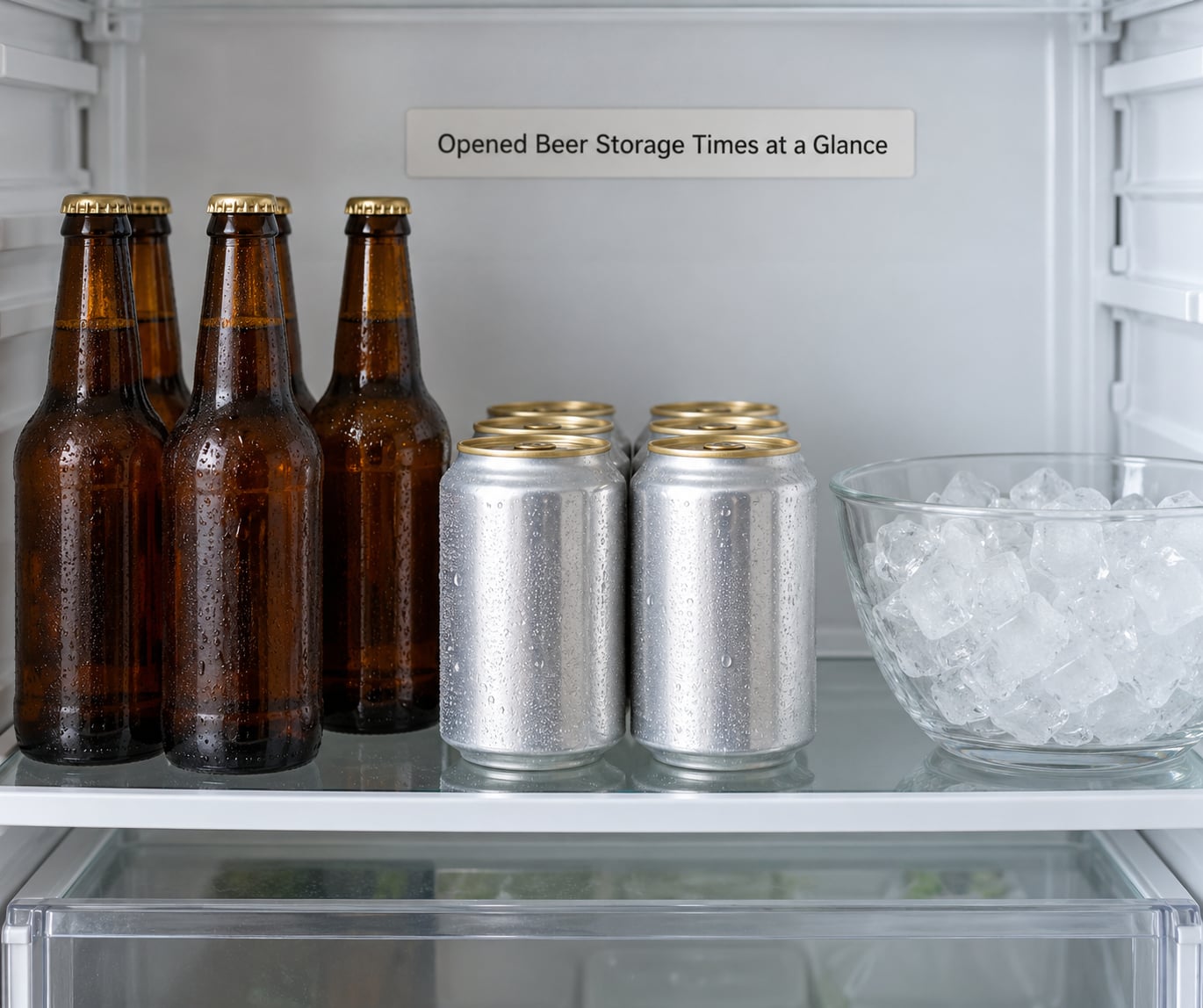
These are realistic drinkable windows, not a countdown to spoilage. Once a beer is flat and cardboard-tasting, drinking it is a matter of whether you care about the experience.
| Storage condition | Drinkable window | What it will taste like | Refrigerate? |
|---|---|---|---|
| Open on a warm counter (above 70°F) | About 1 to 2 hours | Quickly flat, then thin and papery | Yes, right away |
| Open on a counter in a cool room (under 65°F) | 3 to 5 hours | Flat before it turns stale | Still worth it |
| Open can, drinker pulled from it repeatedly | Under 2 hours | Very fast carbonation loss, especially on a warm day | Yes |
| Bottle or can resealed with cap or tape, in the fridge | 1 to 3 days, best within 24 hours | Most aroma lost, mild cardboard notes, carbonation partly returned | Yes, required |
| Plastic wrap and rubber band on a bottle, in the fridge | 1 to 2 days | Holds a little more pressure than tape, still noticeably softer | Yes, required |
| Growler with a proper stopper, in the fridge | 2 to 3 days | Foam holds better, hops stay brighter, less oxidation | Yes, required |
| Growler or crowler with no stopper, in the fridge | 6 to 12 hours | Goes flat within hours and picks up stale cardboard flavors quickly | Yes |
| Pour from a tap into a glass, left on the bar | 30 to 60 minutes | Warm, flat, then oxidized and dull | Yes, for a pitcher |
Read the last column as a summary rather than a rule. Warm and open is the one combination that gives you minutes, and cold plus sealed is the one that gives you days. Everything else sits between them.
How Long Does an Opened Beer Last by Type?
Packaging changes the numbers more than people expect, mostly because of how much air sits above the beer and how well the container holds pressure.
Bottles. A screw cap is a decent seal, and re-seating it is the simplest way to buy yourself a day. Corked bottles are more trouble, since a used cork is a poor seal and the bottle usually leaks into a sleeve. A 22-ounce bomber has a lot of headspace, so oxidation shows up faster than in a standard 12-ounce bottle.
Cans. The good news is that a pressed-in tab reseals well enough for short term, and cans have less headspace than growlers, so oxygen exposure is lower. The bad news is that a can has no neck, so a “screw cap on a can” trick does not exist. Most people improvise with cling film and a rubber band, which works for a day in the fridge.
Growlers. These are the frustrating case, because a 64-ounce growler is nearly full of empty space by the time you get it home. A growler bought full and sealed holds decently for two to three refrigerated days. A growler left partly full, with the cap screwed on but no pressure seal, is often flat within a few hours.
Crowlers. A crowler is a canned 22-ounce beer, so it behaves like a can and holds carbonation better than a typical growler. The clock still starts when the taproom hands it over, and it is still a fresh product, so plan on a day or two refrigerated.
Draft poured into a growler at a bar or taproom. This is the most common real-world instance of the question, and it is also the least forgiving. Unsealed or loosely sealed draft beer is a countdown from the moment you leave the building.
How Long Does an Opened Beer Last in the Fridge?
Resealed and refrigerated, expect 1 to 3 days, with the first 24 hours by far the best. Quality declines gradually rather than switching off at a precise moment, so there is no single deadline you can point to.
Aim for a refrigerator in the 35 to 40°F range. Colder is not better for this purpose: beer does not freeze easily at typical home fridge settings, and very cold dulls the perception of aroma when you pour it. If your fridge has a beer compartment in the door, move the bottle to a shelf inside instead, since door temperature swings as the fridge opens and closes.
Keep it away from the light. A clear bottle on a shelf in a lit fridge or on a counter will develop skunky notes from lightstruck compounds faster than it goes stale, and no amount of sealing reverses that.
How Long Does an Opened Beer Last at Room Temperature?
About two hours in a typical room, and considerably less in a warm kitchen or anywhere in direct sun. Carbonation leaves quickly once the beer warms, since gas is held in solution more readily in cold liquid.
A same-day drinking window is fine here. There is a real difference between a beer that was opened six hours ago and left overnight on the counter, and one that was opened, poured into a cold glass, and finished within a couple of hours. If beer has sat warm and open for a full day or two, expect it to taste stale, watery and faintly nutty rather than dangerous.
There is one case where warmth matters more than time: a bottle with a damaged or missing cap, or a growler that was never sealed. Warm liquid sitting in there also gives any stray bacteria a better chance to multiply, which is the scenario behind the rare reports of people feeling unwell after old beer. If a container was open and warm for many hours, treating caution as reasonable is fair.
What Changes After Beer Is Opened?
There is a predictable order to the damage, and recognizing the sequence tells you whether you are looking at normal deterioration or a real problem.
First: carbonation loss. The dissolved CO2 escapes through the open neck or the resealed seam, and the beer starts to feel thin. This is a texture change before it is a flavor change, and it happens within minutes at room temperature.
Second: aroma loss. Hop and yeast aromas are volatile. Once the head dissipates and the beer sits open, the first thing you lose is the smell, which is why a flat beer seems dull even before you sip it.
Third: oxidation. Oxygen reacts with compounds in the beer and produces papery, cardboard, nutty or acrid notes, similar to what old wine or stale nuts smell like. Warmth speeds this up considerably, and lightstruck flavor can develop at the same time in a clear bottle, giving a skunky character that tastes nothing like hops.
Fourth: mouthfeel changes. Body and creaminess thin out along with the carbonation, so the same beer feels less substantial in the glass.
That entire sequence is flavor and texture. Spoilage looks different: a vinegar or nail-polish sourness, a musty or moldy smell, a cloudy beer with fuzzy strands or sediment that does not settle, a leaking or bulging container, or a can whose seams are weeping. Those signals are about contamination, and that is when you pour it out rather than taste it.
How to Keep Opened Beer Fresh Longer
Ranked by how much each one actually buys you, from most effective to least.
Drink it now, honestly. The first method is finishing the bottle. A half-empty bottle opened 20 minutes ago is in far better shape than a full bottle opened ten minutes ago.
Refrigerate immediately. Cold slows both CO2 loss and oxidation, and it is the difference between two hours and two days. Do not leave a resealed bottle on the counter “until later in the evening.”
Reseal properly, and test what works. A screw cap re-seated firmly is the best everyday option. Cling film plus a rubber band, or a strip of tape pulled tight across the mouth, is the common workaround and does buy a useful day. A purpose-made bottle stopper or a swing-top gasket is better still if you have one. Pressing a can’s tab back down gives partial but real benefit.
Transfer draft beer into a container that seals. If you have a growler with a proper stopper or a crowler, pour into that rather than a mason jar with a screw lid. The mason jar will look sealed and behave like an open bottle.
Reduce headspace where you can. If a bottle is three-quarters full, pour the beer into a smaller jar with a tight lid. Less air means less oxygen available to react.
Keep it dark and cold, and do not shake it. Store it on an interior shelf rather than in the door or under a kitchen light. Agitation releases CO2 and speeds up whatever oxidation is happening, so let it sit still before you open it.
One aside on unopened beer, since people often mix the two questions. The 3:30-300 rule is the shorthand homebrewers use: from the date a beer is brewed, plan on around 30 days for many styles, roughly three months for many standard commercial beers, and around 300 days for strong, high-alcohol styles. It is a drinking-quality guide rather than a safety date, and it only applies to sealed beer.
How to Tell Whether Opened Beer Is Still Good
Work down this list in order, and stop as soon as something fails. Do not taste beer to test it if you suspect spoilage, since some contaminants are not detectable in a small sip.
Check the container first. A bulging or swollen can, a leaking seam, a cracked bottle, or a swollen cap that is pushing itself off all point to gas produced inside the container. Skip it and rinse it out carefully.
Look at the beer. Normal aging and oxidation do not turn beer hazy or produce floating strands, flecks or fuzzy white film. Sediment at the bottom of a bottle is not automatically a problem, since yeast from an unfiltered bottle can settle there, but anything stringy, cloudy or ropy is a reason to pour it out.
Smell it before you pour it. Expect the hop, malt, citrus or spice aromas to be much weaker than the same beer fresh. What is not normal is vinegar, acetone or nail-polish remover, mustiness, wet cardboard combined with sourness, or a distinctly rotten smell.
Pour and watch the foam. A flat beer will make very little foam, but that is a quality problem, not a safety one. Very vigorous, almost fizzy-cola foam that keeps rising on its own can indicate a fermentation problem in the bottle, which is a genuine reason not to drink it.
Taste only if the first four checks pass. If it tastes cardboard-like, nutty or flat but clean and not sour, it is a flavor problem. You are deciding whether you enjoy stale beer, not whether it is safe.
On the date printed on the bottle: a best-by date on beer is a quality window, not an expiration. Bacteria do not quietly multiply past that date the way they do in milk, and homebrewers routinely drink sealed bottles well beyond one year. On the opposite side, corked, high-alcohol styles such as barleywines and Scotch ales are routinely kept for years and improve on the way. A two-year-old standard lager is undrinkable; a two-year-old barleywine may be excellent.
Frequently Asked Questions
Does beer go bad as soon as it is opened?
No. Opening beer starts two processes immediately: carbonation escapes and oxygen gets in, which flattens the beer and dulls its aroma. It does not make it dangerous. Most beer is drinkable for about 2 hours at room temperature, and for one to three days if you reseal it and refrigerate it, with the first day clearly the best. The result is a softer, flatter, slightly papery tasting beer rather than a safety problem.
Can I drink an open beer after 2 days?
Usually yes, if it was resealed and kept cold the whole time. After 48 hours in the fridge, expect the carbonation to be mostly gone and a mild cardboard or nutty note in the aroma, but the beer is normally still clean and drinkable. Smell it first and stop if there is any sourness, mustiness or cloudiness. If it sat open and warm for those two days, pour it out instead.
Can I reseal an opened beer bottle or can?
Yes, and it makes a real difference. A screw cap re-seated firmly is the best everyday option. For a bottle without a cap, wrap cling film over the mouth and secure it with a rubber band, or pull a strip of tape tight across the opening. Both hold partial pressure and buy roughly a day in the fridge. Pressing a can tab back down also helps. None of these match a factory seal, and plastic wrap on a bottle is better than nothing, not perfect.
How long does opened beer keep its carbonation?
A few hours at room temperature and up to a day or two in the fridge, depending on the seal. A loose cover lets most of the CO2 escape quickly, and warmth speeds that up since gas stays dissolved better in cold liquid. The foam in the glass is the fastest way to judge it: if the beer pours flat, it is flat. You can partly recover carbonation by chilling it well and pouring it down the side of a clean glass, but the gas that has already escaped is not coming back.
Can opened beer be frozen for later?
You can freeze it, but the beer will not taste like beer again. Freezing drives the dissolved CO2 out of solution, so the bottle or can swells and may burst or push its seal apart. The ice crystals also damage the proteins and resins that give the beer its body and hop character, leaving a flat, watery, dull result after thawing. Freezing is a better fate for leftover beer used in cooking, where the freezing is not a problem.
Is warm opened beer unsafe to drink?
Generally no. Beer is not a hospitable environment for foodborne bacteria because of its alcohol content, its acidity and the antimicrobial compounds in hops, so warm beer is far more likely to taste bad than to make you ill. The exceptions are worth knowing: beer sitting warm and unsealed for a long time, a container that is bulging or leaking, or a cloudy beer with a sour or rotten smell. In those cases, do not taste it to check.
Conclusion
Drink opened beer as soon as you can. If that is not possible, cap it properly, put it straight in the fridge, and treat one to three days as your window, with the first 24 hours the best of them.
When in doubt, smell it before you pour it. Flat, papery and dull is a flavor problem you can live with. Vinegar, mustiness, cloudiness, a bulging can or a leaking seal means pour it out, and do not taste it to find out.