Sour beer is any beer deliberately fermented with lactic acid bacteria such as Lactobacillus and Pediococcus, and/or the wild yeast Brettanomyces, which produce lactic, acetic and other acids that give the beer its tart, puckering sourness.
That is the whole idea. Most beer is fermented by a single strain of Saccharomyces cerevisiae and comes out clean and predictable. Sour brewing puts other organisms into the mix on purpose, and those organisms eat the same sugars the yeast would, but excrete acids as they go.
I have spent more than a few years drinking, pouring and occasionally botching sours, and the single most useful thing I learned is that sourness is a process, not a style label. Once you can see the three or four ways breweries get there, the whole category stops being mysterious. This guide walks through what is actually happening in the glass, how the beer is made, which microbes do the work, how brewers keep it from going sideways, and the styles worth starting with.
Table of Contents
- What Is Sour Beer?
- How Is Sour Beer Made?
- The Three Main Ways Breweries Make Sour Beer
- Kettle souring: fast, sharp and repeatable
- Mixed culture barrel and foeder souring: slow, funky and alive
- Spontaneous fermentation and coolship: the oldest route
- What Microbes Create Sour Beer’s Tart Flavor?
- Lactic acid bacteria
- Brettanomyces
- Brewing yeast, and the line between sour and infected
- How Does a Brewer Control the Sourness?
- What Sour Beer Styles Should You Try?
- How Is Sour Beer Different From Bitter Beer?
- How Should You Taste Sour Beer?
- What’s the Best Way to Start Drinking Sour Beer?
- Frequently Asked Questions
- Is sour beer healthier than regular beer?
- Why are sour beers so hard to find?
- What is the most popular sour beer?
- How long does it take to make a sour beer?
- Can you add hops to a sour beer?
- Why does my sour beer taste like vinegar?
- Conclusion
What Is Sour Beer?
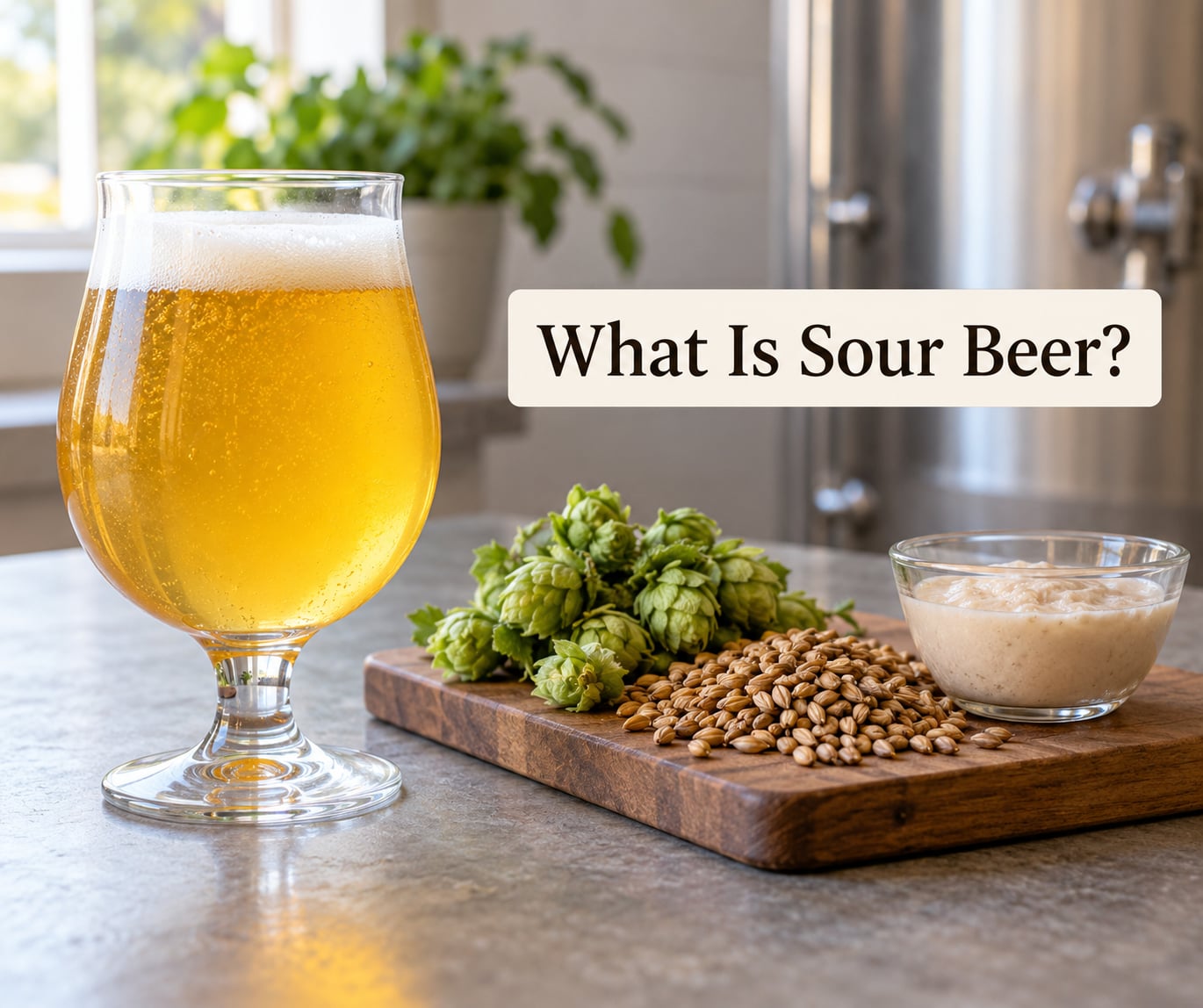
A sour beer is a beer whose tartness comes from controlled microbial activity rather than from anything a brewer adds afterward. The bacteria and wild yeast consume sugars from the wort and, in the process, produce organic acids. Lactic acid reads as a clean, yogurt-like tartness, acetic acid reads as sharp vinegar, and citric acid adds a lemon-lift.
Here is the part that surprises newcomers: sourness is measurable, and the numbers are ordinary. A typical clean ale or lager sits somewhere between pH 4.0 and 4.7. Sour beer usually lands between pH 3.0 and 3.5. Because the pH scale is logarithmic, that is a big shift in how the beer tastes and how it behaves in the bottle.
It also changes how the beer ages. At pH 3.5 or below, a well-made sour is a hostile environment for most spoilage organisms, which is why some sours improve for years instead of fading the way an ordinary pale ale does. A bottle of lambic or a foeder-aged sour that sat in a cellar for a few seasons is not a malfunction. It is the plan.
What you will notice in the glass usually falls into a few families. Sharp puckering acidity is the headline. Alongside it you may get fruity notes, strawberry or cherry or mango. You may get funk, the barnyard or horse-blanket or earthy note that people mean when they say wild. A dry, almost bracing finish is common, and a salty or mineral edge shows up in gose and lambic.
What you will not usually find is aggressive hop bitterness. That is a separate axis entirely, and I will come back to it, but it is worth saying up front: a sour beer is not a hoppy beer with a mistake in it.
How Is Sour Beer Made?
Every sour beer, from a two-week kettle sour to a three-year barrel-aged gueuze, runs through the same underlying sequence. What changes is where the souring organisms enter, how warm the beer is held, and how long nobody touches it.
- Mill and mash. Grain is crushed and mixed with hot water so enzymes convert starch into fermentable sugar. The liquid that runs off is wort, and its sugar content sets how much alcohol and how much acid the microbes can ultimately produce.
- Boil the wort. The wort is boiled, usually 60 to 90 minutes, to extract hop bitterness and aroma, sterilize the wort, and concentrate it. This matters for sours because a clean fermentable wort gives the bacteria a blank canvas.
- Cool and oxygenate. The wort is cooled to pitching temperature. In a spontaneous or mixed-culture fermentation the wort is then exposed to air, either poured into a shallow coolship or a foeder, which lets wild organisms and dissolved oxygen in.
- Inoculate. A brewery either doses a specific culture, such as a Lactobacillus culture or a packaged bacteria-free souring yeast, or it seeds the vessel with an existing living culture, a few gallons of beer pulled from an aging foeder, a bottle of dregs, or a coolship load pulled from the brewery roof.
- Sour, then ferment. Here the paths split. Kettle sours hold the wort warm, roughly 100 to 115F, for 24 to 48 hours with no yeast present, so the bacteria have the sugars to themselves. Barrel and foeder methods run a full fermentation first and let the bacteria work alongside yeast and Brett over months or years.
- Package. Sour beer may be bottled with live culture and a priming sugar for refermentation, force-carbonated and served from a keg, or blended with younger beer to pull the acidity back before packaging. Refermenting sours carbonate slowly and gently, which is why an aged sour usually pours with a soft, fine head rather than a gush.
- Condition and blend. Some breweries keep a solera running, drawing a portion out and topping it back up, so no two bottles are identical. Others blend barrels together at packaging to hit a target acid level.
The Three Main Ways Breweries Make Sour Beer
Nearly every sour on a tap list comes from one of three routes, and the route explains almost everything about how the beer tastes, how much it costs to make, and why batches differ.
Kettle souring: fast, sharp and repeatable
The brewer boils wort, cools it into a kettle or a fermenter, adds a bacterial culture, and holds it warm for a day or two before boiling again and pitching yeast. Because there is no wild population and no long aging, kettle sours are consistent, quick and cheap to produce. What you get is a clean, direct lactic tartness with a light body and almost no funk. It is the most common entry point, and it is what most American fruited sours on a draft list are built on.
Mixed culture barrel and foeder souring: slow, funky and alive
Here the brewery splits a batch. A portion goes to a clean fermentation with house yeast. The other portion, often unhopped or lightly hopped, gets pitched with a mixed culture of Brettanomyces, Lactobacillus, Pediococcus and Saccharomyces and goes into wood or a stainless foeder. Over months to years that culture evolves, and the beer gains funk, oak, fruit and a layered tartness that cannot be reproduced batch to batch. The foeder matters because it is a sealed, oxygen-controlled vessel, which makes it far more manageable than an open barrel.
Spontaneous fermentation and coolship: the oldest route
This is the traditional lambic method, and it is the least controlled of the three. Wort is cooled overnight in a shallow coolship on the brewery roof, where it picks up whatever the air brings, then it goes into a large wooden vat for a year or more before being blended with young lambic. The result is a wine-like, highly carbonated beer with serious complexity. Good brewers manage the risk with acidification, blending and an almost obsessive sanitation routine, but nobody controls it completely.
| Method | Time to sour | Microbes used | Flavor result | Consistency |
|---|---|---|---|---|
| Kettle sour | 24 to 48 hours | Pitched Lactobacillus or a bacteria-free souring culture | Clean lactic tartness, light body, no funk | High, repeatable |
| Mixed culture barrel or foeder | 6 months to 3 years | Brett, Lactobacillus, Pediococcus, brewing yeast | Funk, oak, layered fruit, soft acidity | Low, batch to batch |
| Spontaneous or coolship | 1 to 3 years | Whatever the environment supplies, managed by blending | Wine-like, dry, complex, high carbonation | Lowest, deliberately so |
| Blended or solera | Not a souring method on its own | Whatever the components already contain | Balanced acidity, vintage-dated character | Medium, varies by blend |
What Microbes Create Sour Beer’s Tart Flavor?
Three groups of organisms do most of the work, and each one contributes something different to the finished beer.
Lactic acid bacteria
Lactobacillus and Pediococcus are the acid engines. They convert sugars into lactic acid, which is the clean, round tartness most people picture when they think of a sour. Lactobacillus works fast and prefers warmth, which makes it the standard choice for kettle souring. Pediococcus is slower, tougher and a favorite in barrels and foeders, where it adds a sharper, more wine-like edge over time. One practical note for anyone who cleans brewery equipment: Pediococcus is unusually resistant to sanitizers, which is why it keeps showing up in vessels that were supposedly cleaned.
Brettanomyces
Brett is a wild yeast, and its name means British fungus, which tells you how it earned its reputation. It rarely produces obvious sourness on its own. What it does is eat the more complex compounds in aged beer and excrete the fatty acid esters and phenols behind the notes drinkers describe as horse blanket, leather, earthy funk, and, in riper examples, pineapple, tar and smoke. A Brett-heavy beer often tastes more barnyard than lemony, and it changes in a bottle for years.
There is also a yeast-only route that has grown popular. Packaged souring yeasts, including the American bacteria-free options, use selected yeast rather than bacteria to generate a milder, rounder tartness. The result is less wild, more controlled, and easier to drink at a bar.
Brewing yeast, and the line between sour and infected
House Saccharomyces does the alcohol and much of the fruit character in a mixed fermentation, and the balance between it and Brett is a large part of a brewer’s house style. It also matters to be honest about the line between a deliberate sour and a contaminated clean beer. A sour was intended, pitched, and managed. An infection shows up as a single bad bottle in an otherwise clean batch, or as unwanted funk in a pale ale nobody designed that way.
How Does a Brewer Control the Sourness?
Breweries cannot make a mixed culture behave, but they can shape it. The levers they pull are temperature, timing, pH, oxygen, and blending, in roughly that order of impact.
- Temperature. Bacteria work faster and hotter. A 100 to 115F kettle hold moves a batch along in a day and a half; barrel temperature and a slower inoculation stretch the same idea across a year.
- Timing and inoculation. Pitching a large healthy population of bacteria early gives a predictable acid climb. A small inoculation into a barrel gives more variation and more complexity.
- Starting pH. A lower starting pH gives the bacteria more room to work. Breweries also dose finished beer back toward a target pH with a small amount of lactic acid or a blend, which is a normal part of the process rather than a hack.
- Fermentation duration. The longer a mixed culture sits on its lees, the more Brett character and the more integrated acidity develop.
- Oxygen. Bacteria want a little air at the start. Too much oxygen in a barrel invites acetic Acetobacter, which produces the harsh vinegar note rather than a pleasant sour.
- Sanitation. A brewery that wants a sour keeps a strict clean side and a deliberately filthy sour side, and never lets the two share equipment mid-process.
- Blending. This is the last and often the most important lever. Blending an over-acidic batch with young beer pulls the acid back and rounds the flavor.
For homebrewers, the same levers are easier to trip over than to use. The recurring questions on r/Homebrewing and BeerAdvocate are consistent: is a split batch safer, how hot should the Lactobacillus go in, and when is it safe to bottle. The community answer is broadly the same. Sour a portion of the wort, keep the hold between 100 and 115F, resist boiling after pitching, and expect that a beer can taste pleasant on day twelve and sharper a week later, so packaging date matters.
Two failure modes come up again and again, and both are worth recognizing because you can usually smell them before you drink them.
| What you taste | Likely cause | What to do next time |
|---|---|---|
| Sharp vinegar or solvent | Acetic acid from too much oxygen exposure, or a sour that kept going too long | Limit headspace, keep barrels topped up, blend earlier |
| Harsh, puckering, no fruit | Soured too hot or too fast, or bacteria out-competed the yeast | Cool the hold, shorten it, pitch a healthy yeast culture |
| Flat or gushing bottles | Over- or under-carbonation from bottling with too much residual sugar | Prime conservatively, carbonate slowly, refrigerate before serving |
| Boring, no character | Clean fermentation with no Brett or no long aging | Add Brett early, or age on oak longer |
What Sour Beer Styles Should You Try?
Sour is a category, not a style, and acid levels inside a single style can swing wildly. Still, there is a rough order of how much trouble each style is likely to cause a first-timer.
| Style | Origin | Typical ABV | What you will taste | Example to look for |
|---|---|---|---|---|
| Gose | Germany | 4 to 5% | Sharp lactic tartness, coriander, sea salt, mineral finish | Any German-style gose, unfiltered if you can find one |
| Berliner Weisse | Germany | 2.5 to 4% | Thin, highly carbonated, bracing tartness, often flavored with raspberry or cucumber | A plain, unadulterated Berliner |
| Lambic | Belgium | 4 to 6% | Dry, sparkling, green-apple acidity, wine-like and highly carbonated | Cantillon or 3 Fonteinen bottles |
| Gueuze | Belgium | 4 to 6% | Blend of young and aged lambic, drier and more vinous, long finish | 3 Fonteinen Oude Geuze |
| Flanders Red and Oud Bruin | Belgium | 4 to 6% | Soft, rounded acidity, cherry and red fruit, drinkable at session strength | Rodenbach, or Orval for the hoppier take |
| American sour ale | United States | 4 to 7% | Bright kettle-sour tartness, heavy fruit additions, juicy and modern | Any domestic fruited kettle sour |
| Barrel-aged or foeder sour | United States | 5 to 9% | Funk, oak, dry finish, vintage-dated and cellar-worthy | New Belgium La Folie, or a local foeder blend |
If you want the shortest possible on-ramp, start at the gentle end. A plain Berliner Weisse or an Oud Bruin will teach you what clean lactic tartness tastes like without any funk to argue about. Gose sits right next to it with a salty edge. Everything from lambic onward is a deliberate move into funk and complexity, and there is no rule that says you have to make it on the same afternoon.
How Is Sour Beer Different From Bitter Beer?
Sour and bitter come from completely different places, and confusing the two is the most common mix-up at a bar. Sourness is a taste produced by acids, and it is measured on the pH scale. Bitterness is a sensation produced by iso-alpha acids extracted from hops during the boil, and it is measured in international bitterness units.
Because they are separate axes, a beer can be both. Orval is a famously hoppy sour. An intensely bitter kettle sour exists, and it tastes less like a pilsner than a lot of people expect. What you will not find is a sour that is bitter the way a heavily hopped IPA is bitter, because the two sensations do not sit on the same part of the palate.
Here is the practical shorthand. Bitter beer is sharp at the back of the tongue and often carries citrus, pine or resin aromas. Sour beer is sharp across the palate, often rounds out to a dry or puckering finish, and carries fruit, funk or salt instead of resin. If a beer reads as sour to you, acidity is doing the work, not the hops.
Confusion also happens on the label. Wild ale, farmhouse, and craft sour are not different things. They are regional or marketing names for overlapping sets of beers, and the only reliable signal is what the brewery says about the fermentation and what you taste in the glass.
How Should You Taste Sour Beer?
Sour beer rewards attention more than most beer, because the flavor moves as you drink it. I use a five-step pass, and it takes about two minutes.
- Look. Color, clarity and foam tell you about method. A hazy, pale beer with a fluffy head suggests kettle souring. A deep amber with a thin ring, or a cloudy bottle, suggests barrel or foeder aging.
- Smell. Start with the aroma before the first sip. Wilted hay, green apple, horse blanket, and dark cherry are the notes worth searching for. If it smells like nail polish remover or paint thinner, stop there and skip it.
- First sip. Note the acidity, not the flavor. Is it sharp and bright, or soft and rounded? Berliner Weisse sits bright and sharp. Oud Bruin sits soft and rounded.
- Mid-palate. Let it sit for a second and re-taste. A good sour changes: the initial puckering settles, and fruit, bread crust, or wood shows up behind it.
- Finish. The finish is where styles separate themselves. Dry and bracing points to lambic. Salty points to gose. Funky and earthy points to Brett. A long vinous finish usually means barrel aging.
Two serving details help. A tulip or flute shape gives you more headspace to catch the aromatics, and a wide rim keeps the carbonation from being all you taste. Serve cold but not ice cold, around 40 to 45F, because very cold beer mutes acidity and makes a sour taste flat and metallic.
Order sours at a bar from least to most aggressive. Gose or Berliner first, then a lighter American sour, then a gueuze or a barrel-aged blend last. Sipping a gueuze after a kettle sour makes the gueuze look tame, and tasting the reverse makes the kettle sour look like a fruit juice.
What’s the Best Way to Start Drinking Sour Beer?
The best first move is to buy three things in one sitting: one gose, one plain Berliner Weisse, and one American fruited sour. That covers clean lactic tartness, a salty variation, and the modern juicy style that most bars pour, and it costs you nothing except the willingness to try a fourth glass if one of them lands.
Then work outward. Move from kettle sours to Flanders red and Oud Bruin, which are soft enough that many drinkers who dislike sharp sours still enjoy them. After that, try a gueuze or a bottle of lambic, ideally something at least a couple of years old, so you taste what a fully aged version does compared with a young one.
Take your time with the aged stuff. Nobody expects a first-timer to like horse blanket, and a beer you finish because you decided to is a waste of a good bottle. If it is not for you, it is not for you, and that is a completely normal outcome after three hours of tasting.
For anyone homebrewing, lower the stakes. A split-batch kettle sour is the standard first attempt, and an unsanitized keg is genuinely not the way to start. Buy a culture, follow the temperature and timing, and accept that your first batch will be a learning batch. Most of them come out drinkable, and the funny ones are the ones worth keeping.
Frequently Asked Questions
Is sour beer healthier than regular beer?
Not in any meaningful way. Sour beer and regular beer carry roughly the same alcohol and calorie load for the same serving size, and neither is a health food. Low pH does inhibit some food-poisoning bacteria, which is a nice quirk of the process rather than a nutritional benefit. The probiotics people associate with sour beer are mostly gone once the beer is pasteurized or filtered, so treat it as a beer you enjoy, not a fermented food.
Why are sour beers so hard to find?
Four reasons stack up. Souring takes time and tank or barrel space that a brewery could fill with faster-selling beer, and barrel capacity limits output. Each batch is small because the vessel is small. Production is unpredictable, so breweries commit less volume. And because barrels or foeders are finite, a release sells out and the next one may be months away.
What is the most popular sour beer?
There is no single answer, and the answer changes by region. In the United States, the widest availability is generally in American sour ales, particularly fruited kettle sours, because they are quick to make and easy to distribute. In Belgium and among enthusiasts, lambic and gueuze are the reference points, especially Cantillon and 3 Fonteinen. Ask the people pouring where you are what sells fastest.
How long does it take to make a sour beer?
It depends entirely on the method. A kettle sour is ready in two to three weeks, including about 24 to 48 hours of warm bacterial hold. A mixed culture barrel or foeder beer runs six months to three years before packaging, and often longer in the bottle. Traditional lambic needs at least a year of aging in wood before it is blended and bottled.
Can you add hops to a sour beer?
Yes, and many breweries do. Orval is a famous dry-hopped lambic, and American brewers add Citra, Mosaic and Amarillo to kettle sours all the time. The catch is that hops added early or in large amounts will read as bitterness against the acidity, so sours use restrained, low-alpha hops or aged hops, which contribute aroma without adding sharp bitterness.
Why does my sour beer taste like vinegar?
Almost always acetic acid, and acetic acid comes from Acetobacter, which needs oxygen. Excess headspace in a barrel, a poorly topped fermenter, or a barrel left open too long lets it in. You can also get there by simply letting a sour keep acidifying past where you wanted it. Blend it back with young beer, and next time keep the vessel full and cool.
Conclusion
The takeaway worth keeping is that sour beer is ordinary beer with a different set of microbes doing more of the work. Lactic acid bacteria make the acid, Brettanomyces makes the funk, temperature and time decide how far it goes, and blending is how brewers pull it back before it turns into vinegar.
So do this next: get one plain Berliner Weisse or gose and one American fruited sour, drink them side by side, and pay attention to acidity, carbonation, fruit, funk, and the finish. If one of them surprises you, try the same style from a second brewery, because within a style the difference between a clean kettle sour and a three-year foeder blend is usually the entire story.