A Trappist beer is brewed inside the walls of a Trappist monastery, by the monks or under their direct supervision, with the profit going to the abbey and to charity. To carry the name, it must also hold the International Trappist Association’s hexagonal Authentic Trappist Product label.
That is the whole legal test. Everything else people argue about, from strength to style to which abbey is best, sits downstream of those three rules.
Table of Contents
- What Makes a Trappist Beer?
- The three rules that make a beer Trappist
- What makes a Trappist beer authentic on the label
- Which breweries hold the label today
- Why Does the Trappist Name Matter?
- How Is a Trappist Beer Brewed?
- What Makes a Trappist Beer Taste Different?
- What Is the Difference Between Trappist and Abbey Beer?
- How Do You Choose and Serve a Trappist Beer?
- Frequently Asked Questions
- Is every abbey beer a Trappist beer?
- Do monks make every Trappist beer themselves?
- What ingredients are allowed in Trappist beer?
- Why does Trappist beer sometimes taste sweet or fruity?
- Is Trappist beer always strong?
- How can I tell if a beer is authentically Trappist?
- Conclusion
What Makes a Trappist Beer?
The short answer is ownership and oversight, not recipe. The rules that define what makes a Trappist beer legitimate are written by the monks themselves, through an association they formed in the 1990s, and they deal with where the beer is made and where the money goes.
The three rules that make a beer Trappist
The International Trappist Association certifies a beer as an Authentic Trappist Product only when all three conditions are met:
- It is brewed within the walls of a Trappist monastery.
- It is brewed by the monks or under their supervision.
- Its profits go to the abbey and to charity.
If any one of those three is missing, the beer cannot be called Trappist, no matter how monastic the bottle looks or how abbey-like the name sounds.
What makes a Trappist beer authentic on the label
Look for the hexagonal Authentic Trappist Product mark around the neck of the label. That hexagon is not a marketing badge a brewer can apply for. It is granted by the association and it is the only reliable way to separate a monastery beer from a commercial one that borrows a monastery’s name.
Which breweries hold the label today
As of 2026, five Belgian abbeys still produce certified Trappist beer: Chimay at Scourmont, Orval, Rochefort, Westmalle and Westvleteren at Sint-Sixtus. Achel was the sixth for most of the last fifty years and lost the label in January 2023. Spencer, the English abbey, closed in 2022.
| Abbey | Country | Best known for | Status |
|---|---|---|---|
| Scourmont (Chimay) | Belgium | Chimay Blue, a soft 9% quadrupel | Certified |
| Orval | Belgium | A dry, hoppy 6.5% abbey ale with widespread natural yeast | Certified |
| Rochefort | Belgium | Numbered bottles from 6 to 10, including the sour-ish 8 | Certified |
| Westmalle | Belgium | Tripel, Dubbel and a monastic-style tripel aged in oak | Certified |
| Westvleteren (Sint-Sixtus) | Belgium | Westvleteren 12, sold from the abbey café and door | Certified |
| La Trappe | Netherlands | Dubbel, Tripel and quadrupels in a blond, light-bodied line | Certified |
| Engelszell | Austria | Marble-brewery ales from a baroque abbey | Production suspended |
| Mount Saint Bernard | United States | The only abbey outside Europe with a Trappist tradition | Certified |
| Achel | Belgium | Hamsel, an Oud Bruin brewed to a monastic recipe | Lost the ATP label in 2023 |
| Spencer | United Kingdom | Spencer Ale, made at Albourne | Abbey closed in 2022 |
Count the global total and you get anywhere from eleven to fourteen, depending on whether you count abbeys whose production is suspended or whose beer is contract brewed. The number moves, which is why the date matters more than the figure.
Why Does the Trappist Name Matter?
Because for most of the twentieth century anyone could put the word on a bottle. Breweries with commercial ambitions used Trappist names, imagery and even invented abbey histories to sell beer at a premium to shoppers who assumed monastic pedigree guaranteed quality.
Trappist monasteries belong to the Cistercian Order of the Strict Observance, a branch of the Cistercian order. Their rule book bans commercial activity, which meant monks could never answer a complaint from a distributor or chase a late retailer. Beer became an honest way to earn money without turning the abbey into a business, and the abbey cafés sold what the monks could not drink themselves.
The monks did not enjoy being quoted as warranties for other people’s beer. So they wrote a rulebook, formed the association in 1994, and began issuing the hexagonal mark. Anyone holding the mark has agreed to outside inspection and to profit reporting, which is why a Trappist label from an abbey nobody has heard of still means something.
How Is a Trappist Beer Brewed?
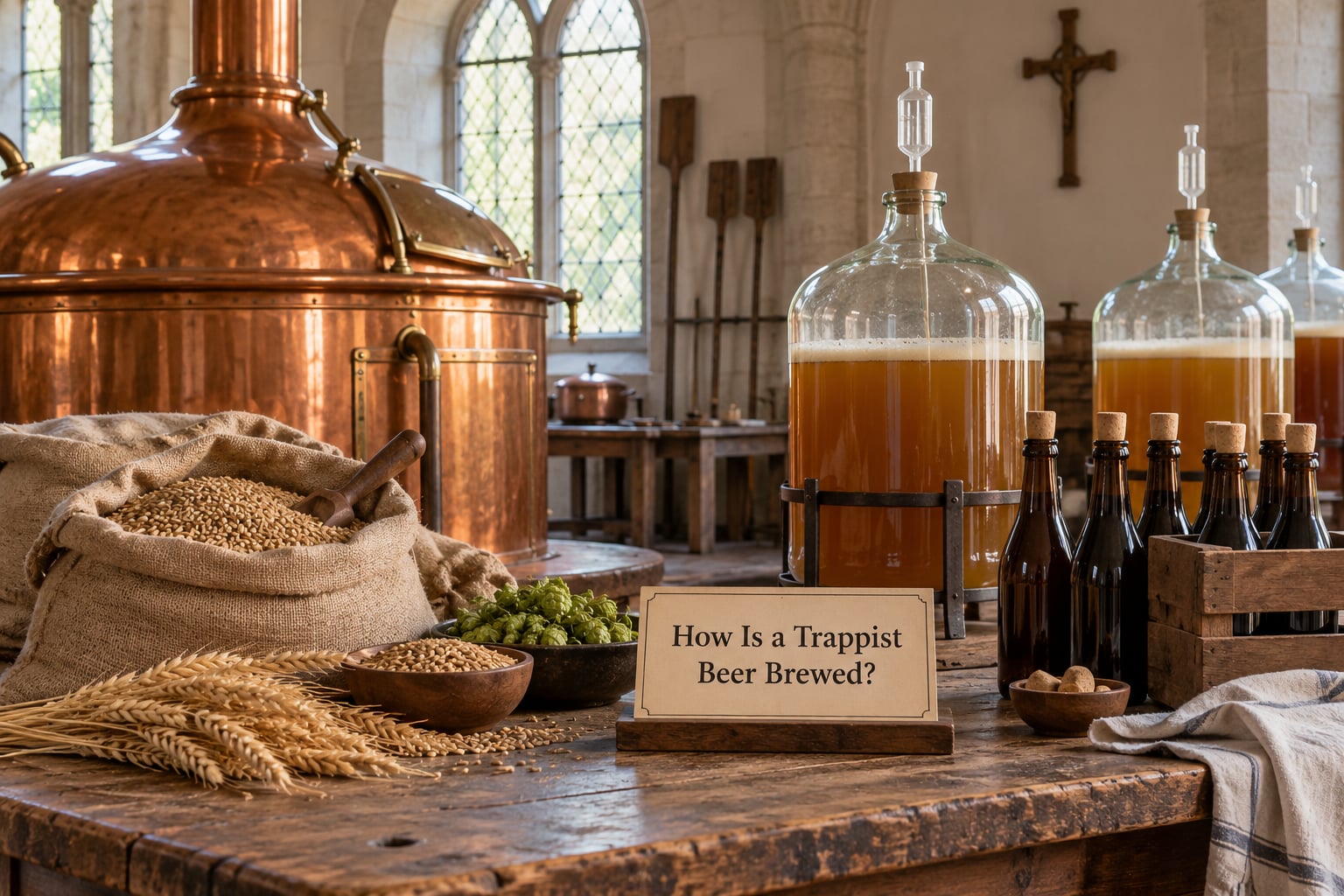
Top fermentation is the starting point, and it is the first thing that separates Trappist beer from lager. Beer in Belgium’s monastic breweries is fermented warm, at cellar temperatures well above what a lager house would use, by a culture of Belgian ale yeast.
That yeast is the flavor engine. It produces esters and phenols rather than the clean, neutral profile of a lager strain, and those compounds are where the banana, pear, clove, pepper and stone fruit in a Tripel or Dubbel actually come from. Nobody adds those flavors. They are a byproduct of the fermentation.
Strength comes mostly from sugar, not from more malt. Belgian brewers add a portion of cane or beet sugar to the boil, which raises the alcohol without raising the residual sugars the way an all-malt grist would. The beer lands dry and strong instead of thick and sweet, which is why a quadrupel at eleven percent still finishes clean.
Fermentation happens in the cellar, then the beer goes into bottle for a second fermentation with priming sugar. That final refermentation is what produces the fine bead of carbonation in a bottle-conditioned Trappist, and it means the beer is still evolving when you open it.
What monks actually do varies by abbey. Some employ their own brewers and run the full brewhouse. Others have a brewmaster on staff, buy hops and grain from outside the walls, and can even send production to a partner brewery, which happens only under abbey control and supervision. Forum regulars on r/beer make this point often: control and responsibility is what the rule requires, not that monks personally mash the grain. Older abbeys such as Zundert and Maria Toevlucht brewed for the commercial market at one point and stopped doing so, which shows how much of this history was fluid.
Production is capped by the same logic. A monastery brews what it can make in a building sized for monastic life, not what the market wants. Westvleteren’s ceiling of roughly 4,700 hectolitres a year is the extreme case, and that ceiling is the reason its reputation outruns its shelf presence.
What Makes a Trappist Beer Taste Different?
Everything distinctive in the glass traces back to three decisions: warm top fermentation, sugar for strength, and a second fermentation in the bottle. What makes a Trappist beer taste different from a standard Belgian strong ale is mostly the last two, plus time.
| Style | ABV | Colour | Typical character | Examples |
|---|---|---|---|---|
| Enkel / Patersbier | 4.5 to 5.5% | Blond | Light, dry, spicy, easy drinking | Westmalle Enkel |
| Dubbel | 6 to 8% | Dark amber | Malty, caramel, estery, medium body | Chimay Red, Rochefort 8 |
| Tripel | 8 to 10% | Deep gold | Fruity, peppery, dry finish | Westmalle Tripel, Chimay White |
| Quadrupel | 10 to 11.5% | Dark brown | Rich, warming, dried fruit, alcohol warmth | Chimay Blue, Westvleteren 12 |
Orval sits outside that ladder, and deliberately so. It is lighter in body, noticeably hoppy and dry, and ferments with wild yeast in the bottle, which gives it a leathery, almost lambic edge that no other certified Trappist shares.
Then there is time. A strong Trappist is not a fresh product. Give a quadrupel a couple of years in a cool cellar and the fruit character rounds out, the hop edge softens and the alcohol reads warmer rather than sharper. Collectors keep older bottles of Rochefort 10 and Chimay Blue well past the age you would expect and report drinking them happily.
What Is the Difference Between Trappist and Abbey Beer?
Abbey beer is a broader, older category with no single certifying body. Any brewery may call its beer abbey or monastic as a description of inspiration or affiliation, and many that do are large commercial operations.
| Point of comparison | Trappist beer | Abbey beer |
|---|---|---|
| Who owns it | A Trappist abbey of the Cistercian Order of the Strict Observance | Varies, including commercial brewers holding a licence |
| Who supervises brewing | Monks, or under their direct supervision | A brewery staff; monks may have no role at all |
| Where it is brewed | Within the monastery walls or abbey-controlled facility | Any brewery the brand owner chooses |
| Where profit goes | The abbey and charity, verified by outside audit | The brewery and its shareholders |
| Certification mark | Hexagonal Authentic Trappist Product mark | None required |
| Examples | Chimay, Orval, Rochefort, Westmalle, Westvleteren | Leffe, Grimbergen, Maredsous, Affligem |
Leffe, Grimbergen, Maredsous and Affligem are brewed by large operations for the commercial market and are excellent beers in their own terms. They are not Trappist products, and the distinction is about who is responsible for the beer rather than about how it tastes.
A third category causes more confusion: Trappist-style beer. That is a brewers’ description of a pale, hoppy, dry, warm-fermented ale that borrows the technique without any monastic connection. It is a legitimate homebrew recipe and a legitimate commercial style. It carries no rights to the name.
How Do You Choose and Serve a Trappist Beer?
Start with the hexagon. If it is not on the label, you are drinking something else, whatever the bottle art suggests. After that, read the number, because Trappist numbering is a strength ladder rather than a product code: within one abbey, 6 is lighter than 8, and 10 or 12 is the top of the range. Newcomers often assume the digits are a vintage or an index, and forum threads about it never really end.
If you are new to the category, begin low. An Enkel at around five percent shows you the yeast and the dryness without the alcohol. A Dubbel is the easy next step, and it is the style most people end up buying again.
Serve them warmer than instinct suggests. A Dubbel or Tripel does best around 45 to 50 degrees Fahrenheit, cool enough to keep the glass fogging, warm enough that the esters open up. Ice-cold Trappist beer is a waste of the bottle. A chalice or tulip glass gives the yeast sediment room to sit at the bottom and the aroma somewhere to go; a pint glass does neither.
Pour carefully and stop before the sediment. Bottle-conditioned beer carries a thick layer of yeast that looks alarming and is a normal part of the product. Some drinkers mix it in for the full bottle-refermented character, some pour it off for a cleaner cup. Both are defensible. What you do not want is to dump the last half-inch and then wonder why the bottle went flat in an hour.
On food, keep it simple. Abbey cheese, charcuterie, mussels and a rich stew all sit well against a quadrupel. A tripel handles a sharp aged gouda, and the drier Orval is the one that takes a pale ale-and-fried-food pairing better than most Belgian bottles.
For finding bottles, most Belgian-focused bottle shops and taprooms carry at least one or two, and the common tripels are the usual entry points. Reach for Westvleteren 12 through an abbey-bound source rather than a general marketplace listing, where the asking prices for a rare bottle climb fast and quality is never guaranteed.
Frequently Asked Questions
Is every abbey beer a Trappist beer?
No. Abbey beer is a descriptive term with no governing body behind it, so a brewery can use it freely. Trappist beer is the narrower, protected category: it must be brewed inside a Trappist monastery, under monk supervision, with profit going to the abbey and charity, and it must carry the hexagonal Authentic Trappist Product mark. Leffe, Grimbergen, Maredsous and Affligem are abbey beers brewed by commercial companies.
Do monks make every Trappist beer themselves?
Not personally, and the rules do not require it. What the association demands is that the beer be brewed by monks or under their supervision, and that the profit return to the abbey. Many certified abbeys employ professional brewers, buy hops and grain from suppliers, and in a few cases have production carried out by a partner brewery. Reddit beer regulars point out that control and responsibility, not hand-mashing, is what the rule protects.
What ingredients are allowed in Trappist beer?
The rules deliberately say nothing about ingredients. Belgian brewing tradition is the guide in practice: malted barley, hops, yeast, water and sugar, with cane or beet sugar added to lift alcohol without thickening the body. Spices such as coriander and orange peel appear in a few abbey recipes, and Orval uses hops and wild yeast, but no certification restricts any of it.
Why does Trappist beer sometimes taste sweet or fruity?
Most of it is fermentation, not sugar left behind. Warm top fermentation with Belgian ale yeast produces esters and phenols that read as pear, banana, apricot, clove and pepper. Using sugar instead of extra malt also raises the alcohol while keeping the beer dry. Bottle refermentation then adds carbonation and a faint sweetness of its own. A genuinely sweet finish usually points to a heavy all-malt grist, which some abbeys still use.
Is Trappist beer always strong?
No. Enkel and Patersbier styles sit around 4.5 to 5.5 percent and are sessionable, which surprises people who assume every Trappist bottle is a warming eleven-percent quad. Strength also varies within a style: the same abbey may release a 6, an 8 and a 10 from the same batch, with the sugar level adjusted. The certification governs responsibility, not alcohol.
How can I tell if a beer is authentically Trappist?
Look for the hexagonal Authentic Trappist Product mark around the neck of the label, then confirm the brewery is on the association’s current list. As of this year that includes Chimay, Orval, Rochefort, Westmalle and Westvleteren in Belgium, plus La Trappe in the Netherlands and Mount Saint Bernard in the United States. A bottle citing an abbey name, a monk on the label or the words monastic or abbey-style is not evidence of certification on its own.
Conclusion
Do one thing before your next Belgian buy: turn the bottle and look for the hexagon. Everything else in this guide is useful detail, but that mark is the whole system in one symbol.
Once you have it, start light. Pick up an Enkel or a Dubbel, pour it into a tulip glass at cellar temperature, and leave the sediment in the bottle unless you want it. You can work up to a quadrupel when you are ready for beer that warms you from the inside out.