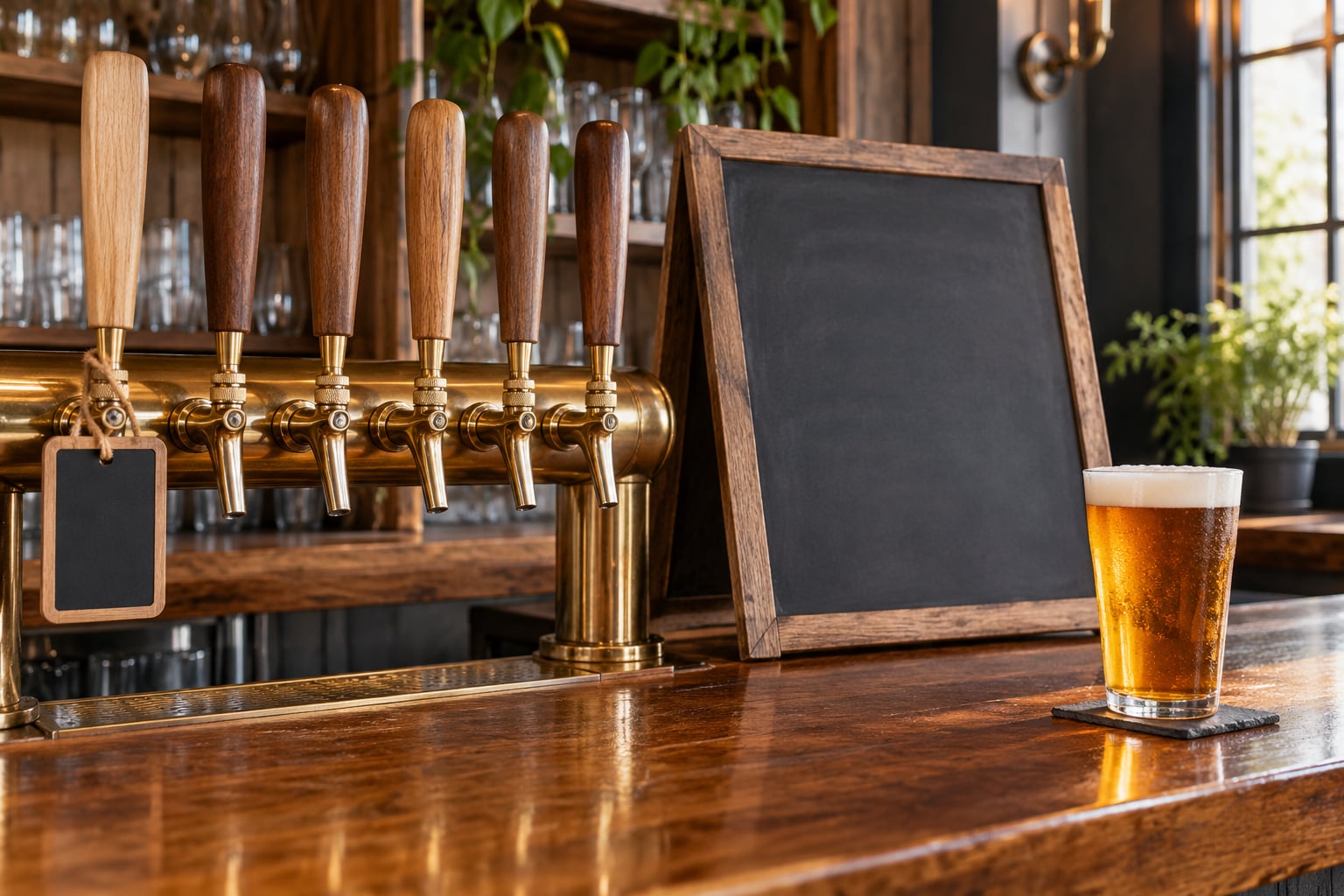
A guest tap is a tap that pours beer made by a brewery other than the venue’s own. Instead of the house beer you get on every visit, that handle carries an outside brewery’s beer, and it usually changes once the keg or cask runs out.
Most people first meet the phrase standing at the bar, scanning a tap list that tells them nothing useful. Ask around and you will get roughly the same sentence every time.
This guide covers what a guest tap means, why taprooms bother with them, how to spot one on a tap list, and what to ask the bartender when the label tells you nothing.
Table of Contents
- What a Guest Tap Means in Plain English
- So what a guest tap means, precisely
- Why Do Breweries and Bars Use Guest Taps?
- How Can You Tell What Is on a Guest Tap?
- Does a Guest Tap Mean the Beer Is Rare or Better?
- How Long Does a Beer Stay on a Guest Tap?
- What Should You Ask When You See a Guest Tap?
- How Does a Guest Tap Differ From a House Tap?
- Frequently Asked Questions
- Is a guest tap the same as a seasonal tap?
- Can a guest tap beer be an IPA?
- Why does a guest tap change every week?
- Does a guest tap mean the venue made the beer?
- Are guest tap beers usually more expensive?
- Can I ask for the beer that was on a previous guest tap?
- Conclusion
What a Guest Tap Means in Plain English
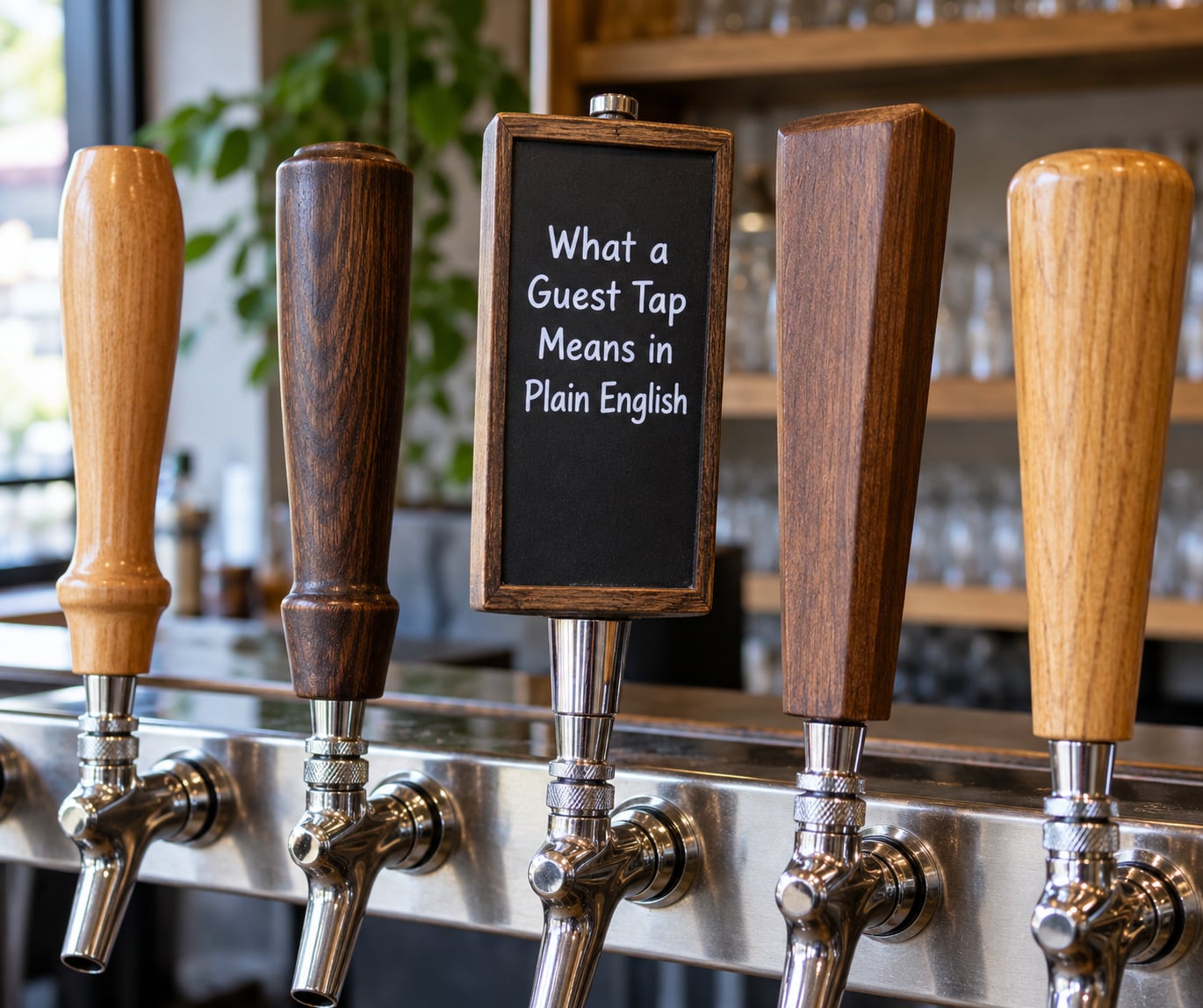
Start with the word tap itself, because half the confusion comes from there. At a bar, a tap is the faucet and valve assembly that releases draft beer from a keg or cask. You might also see it called a faucet, a spigot, or, in British pubs, a beer engine. The handle is the lever or ceramic lever you grab, and the tap list is the board or menu listing everything currently pouring.
So what a guest tap means, precisely
It means the beer on that handle comes from a producer other than the venue’s usual supplier or in-house brewery. The beer could be a rotating pour, a one-off collaboration, a limited release, or a seasonal drop from a nearby brewery. What all of them share is that the beer was brewed somewhere else.
The word guest is doing one specific job here: the brewery is the visitor, not the beer being special. That matters because older bar advice uses guest to mean a patron, as in do not grab someone else’s tap handle. Same word, different sense.
Two related terms get mixed in constantly. A guest beer is the liquid, the can or glass that comes from an outside brewery. A guest tap is the physical handle or faucet pouring it. People say guest tap when they mean either one, and honestly, at a bar, it rarely changes what you order.
Why Do Breweries and Bars Use Guest Taps?
Tap space is finite and expensive. A well-run taproom might have twelve to twenty handles, and each one is a promise to pour something worth coming back for. Filling that row with a single brewery’s core lineup wastes variety, so venues mix in outside breweries to keep the board interesting.
Beyond variety, there are a few practical reasons.
- Limited releases need somewhere to land. When a brewery has a barrel-aged batch or a single-batch experimental pour, there is no point bottling it. A tap gets it in front of people while it is still interesting.
- Collaborations are marketing and menu variety at once. Two breweries making a beer together gives both taprooms a reason to send regulars somewhere new.
- Small kegs make guest pours economical. A venue can commit to a few small kegs of something it does not have to sell many of, and swap them out fast if they do not sell.
- Styles the house cannot cover. A brewery that only makes pale ales can still pour a stout or a sour, sourced in, without building a second brewery.
- Keeps tap lines honest. A beer that stalls for weeks gets pulled, and a fresh outside pour takes the handle.
For the drinker, the practical upshot is simple: a guest tap is the venue’s most likely spot for something you have not had before.
How Can You Tell What Is on a Guest Tap?
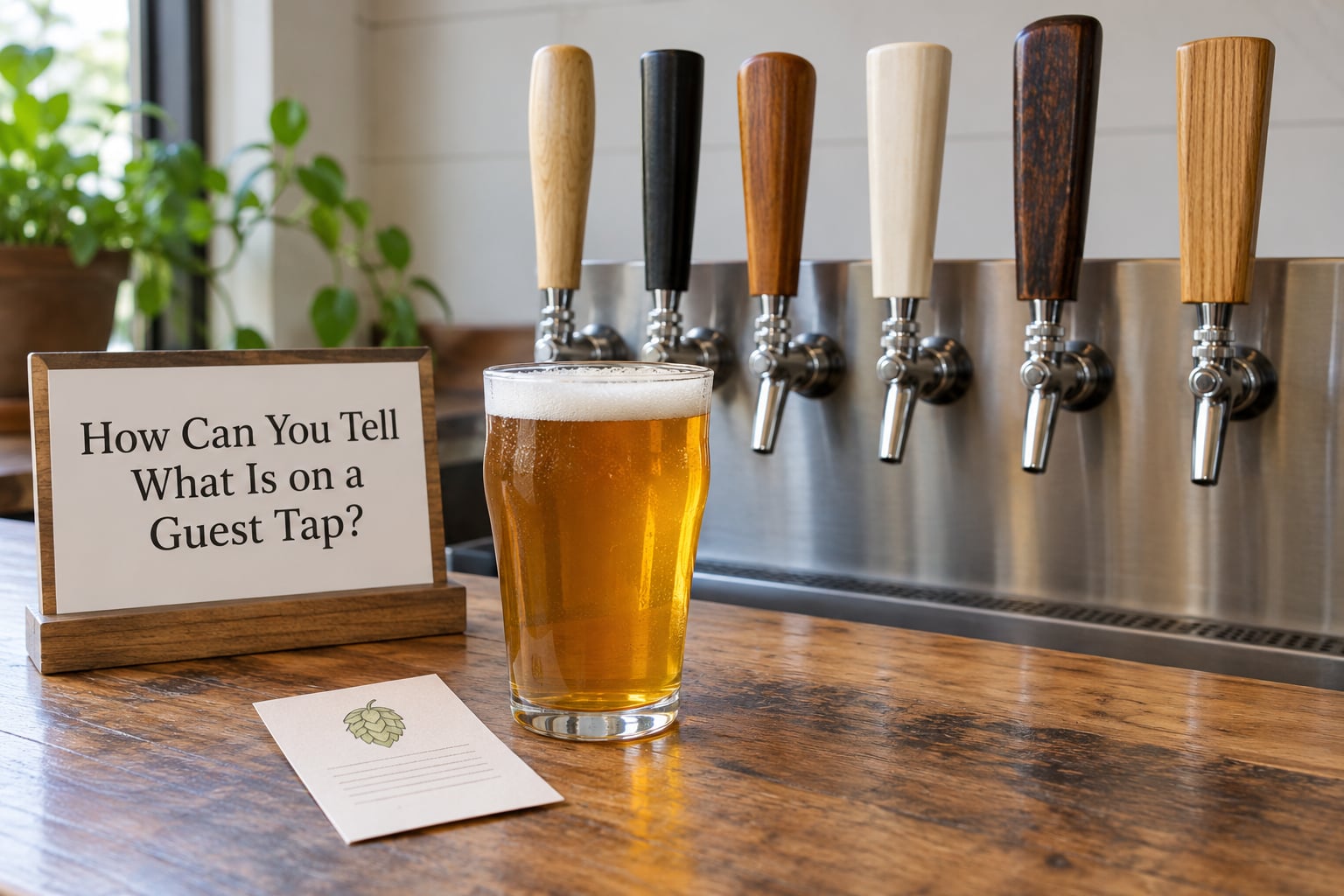
Most venues signal a guest pour by putting the brewery’s name first on the line, the way a tap list reads Two Hearted IPA rather than just IPA. That is your fastest read. After that, these are the labels worth knowing.
| Term on the tap list | What it tells you |
|---|---|
| Two brewery names, or a brewery name plus style | The beer came from outside the venue, so that handle is the guest tap |
| Collab, collab with, or two names joined by a hyphen | Two breweries brewed it together, and it may be on a guest handle |
| Tap takeover | A visiting brewery takes over several handles for a set period, often with its own staff |
| Limited, LTO, barrel-aged, or one-time | A single batch that will not come back, whatever handle it sits on |
| Seasonal | A recurring seasonal beer, usually from the house brewery |
| Draft only or keg only | Not bottled or canned, so it is poured here or nowhere |
| Nitro or N2 | Nitrogen-poured, creamier and lower carbonation than a standard pour |
| Growler or crowler fill | You can take the beer home in a sealed container |
If the tap list gives you nothing, ask. Nobody at a bar has ever been annoyed by the question who made this one.
Does a Guest Tap Mean the Beer Is Rare or Better?
No. Guest describes where the beer came from, not how good it is or how hard it was to get. Plenty of guest pours are ordinary lagers from a brewery down the road, and plenty of taprooms pour their own barrel-aged stout without ever calling it a guest tap.
There is a reasonable kernel of truth in the feeling, though. Outside breweries are often small, so the batch size is small, and a beer that took months in a barrel is genuinely worth queuing for. But that is a property of the beer, not of the tap type.
The distinction that actually matters is between rotating and permanent. A rotating guest tap is a changing slot, and so is the value. Anything marked limited or one-time is worth ordering on sight if it interests you, because that specific pour will not come back.
How Long Does a Beer Stay on a Guest Tap?
Until it runs out, or until the venue decides to pull it. Those are two different endings and both are normal. A popular guest pour on a half-barrel keg can disappear in a weekend at a busy taproom. A slow one might sit for weeks before anyone pulls it.
Casks work differently again. Real ale served through a hand pump in a UK or Irish pub is unfiltered, unpasteurized, and genuinely short-dated, often a matter of days. In Czech-style taprooms, side-pull taps serve unpasteurized beer at cellar temperature, so freshness there is measured in days, not weeks.
No venue commits to a rotation schedule in advance, because it depends on how fast the beer sells. Treat the tap list as the only reliable source of what is pouring right now.
What Should You Ask When You See a Guest Tap?
Beginners often stand at the bar hoping to avoid a question, and a guest tap is the easiest opening. These are ordinary, welcome asks.
- Who brewed this one?
- What style is it, and how much of it is there left?
- Is this a one-time pour or does it rotate?
- How strong is it, in ABV?
- Do you do a half pour here?
- Will the brewery be here to pour it at some point this week?
The half pour question is the one people skip and regret. On an unfamiliar high-ABV pour, a half pour tells you whether you like the beer before you commit to a full one.
How Does a Guest Tap Differ From a House Tap?
A house tap is a permanent slot for beer the venue regularly pours, often its own if it is a brewery. A guest tap is the flexible slot that takes beer from somewhere else. The two sit side by side on most tap lists.
| House tap | Guest tap | |
|---|---|---|
| Where the beer comes from | The venue’s own brewery or its standing supplier | Another brewery, usually local or regional |
| How often it changes | Rarely, except for a seasonal swap | As often as every few days to every few months |
| How it is labeled | Beer name, often with the familiar brewery styling | Outside brewery’s name leads the line, sometimes with collab or takeover noted |
| What it signals to you | The reliable pour, a safe order | Something new, possibly one of a kind |
| Menu placement | Usually in the main, permanent section | Often in a rotating or specials block |
One caveat on labels. Irish and British pubs treat rotating guest ales from other breweries as a staple of a decent house, so there the term carries less weight than it does in a US craft taproom. In Dublin, regulars treat guest taps as ordinary rather than noteworthy.
Frequently Asked Questions
Is a guest tap the same as a seasonal tap?
Not quite. A seasonal tap usually pours the house brewery’s own seasonal beer, on the same line for months at a time. A guest tap pours beer made somewhere else and tends to move more often. The two can overlap, since an outside brewery can put a seasonal pour on a guest handle, so read the brewery name rather than relying on the label alone.
Can a guest tap beer be an IPA?
Yes, and very often is. Style and source are separate questions. A guest tap can carry an IPA, a stout, a sour, a lager, or anything else a brewery makes. What makes it a guest tap is that a different brewery brewed it, not what style it belongs to. Plenty of taprooms keep an outside brewery’s IPA on a rotating guest handle for months.
Why does a guest tap change every week?
Because the beer ran out or the venue moved it. Guest pours are committed to in small kegs, often half-barrels, so a popular one disappears fast and a slower one gets replaced on the bartender’s judgment. Nobody publishes a rotation calendar in advance. If you want to catch a specific beer, check the tap list on the day you plan to go or call ahead.
Does a guest tap mean the venue made the beer?
No, it means the opposite. The venue is pouring a beer from a different brewery, which is why the brewery’s name usually appears first on the tap list line. If the venue brews the beer itself, that handle is a house tap even when the beer is a seasonal or a collaboration. Read the name before the tap and you will not mix the two up.
Are guest tap beers usually more expensive?
Often a step above the cheapest house pour, and the gap widens for barrel-aged, imperial, or imported beers. The reason is simple: the venue paid a wholesale rate for a smaller keg and may not sell enough of it to cover the cost quickly. It is not a rule, though. Plenty of taprooms pour a guest lager at the same rate as their own, especially when they want to move the keg.
Can I ask for the beer that was on a previous guest tap?
You can absolutely ask. Bartenders keep track of what came through, especially at a small taproom, and they may know whether more of that beer is available somewhere. Two questions help: whether the brewery has it in stock and whether the venue takes special orders or fills growlers to go. If the batch is gone, asking still gets you a recommendation for the closest thing currently pouring.
Conclusion
What a guest tap means comes down to one fact: another brewery made the beer, and the handle is temporary. Check the tap list for the brewery’s name, ask staff if the board says nothing, and order a small pour when the style or the strength is unfamiliar.