How to split the bill fairly in a big group comes down to three decisions you make before anyone orders: how shared dishes get divided, who records the order, and how tax and tip get added. Pick those, say them out loud, and the check becomes arithmetic instead of a debate. The whole process takes about ten minutes once you have a system.
Most disputes over a group bill are not about money. They come from one person quietly feeling overcharged and saying nothing, then resenting the group for a year. A fair split is simply the method everyone at the table would have agreed to if you had asked them before the food arrived.
Table of Contents
- What You Need
- Step-by-Step
- How to Split the Bill Fairly in a Big Group: Start With a Complete Order
- Assign Shared Items Clearly
- Calculate Tax and Tip Without Double-Counting
- Review the Split Before Anyone Pays
- Collect Payment and Handle Differences
- Common Mistakes
- Frequently Asked Questions
- Should we split the bill evenly if everyone ordered different amounts?
- How do we split a bill when several people shared food?
- What is the fairest way to divide tax and tip?
- What if one person paid for the whole group?
- Can the bar split one check into several separate checks?
- Conclusion
What You Need
You need four things, and only three of them are unusual. First, the complete itemized receipt or printed check, not a number someone read off a screen. Second, a list of everyone who is part of the table, including anyone who left early or arrived late. Third, a way to collect money, whether that is one card at the end or a payment request in the group chat. Fourth, something to calculate with: your phone calculator works fine, and a shared note or spreadsheet is better once you pass nine people.
What you do not need is for everyone to have ordered the same number of things. A group of twelve where four people ate sandwiches and two had the tasting menu is normal, and the method below handles it without anyone feeling shortchanged.
Set aside ten minutes of setup and two minutes at the table. If you are doing this for twenty people, budget twenty minutes.
Step-by-Step
There are five ways people split a group bill. Choose one deliberately rather than defaulting to an even split that nobody actually agreed to.
- Split evenly when everyone ordered about the same.
- Itemize it so each person pays for what they ordered.
- Ask for separate checks before ordering starts.
- Weight the split by what each person can afford.
- Have one person pay, then settle up by message afterward.
How to Split the Bill Fairly in a Big Group: Start With a Complete Order
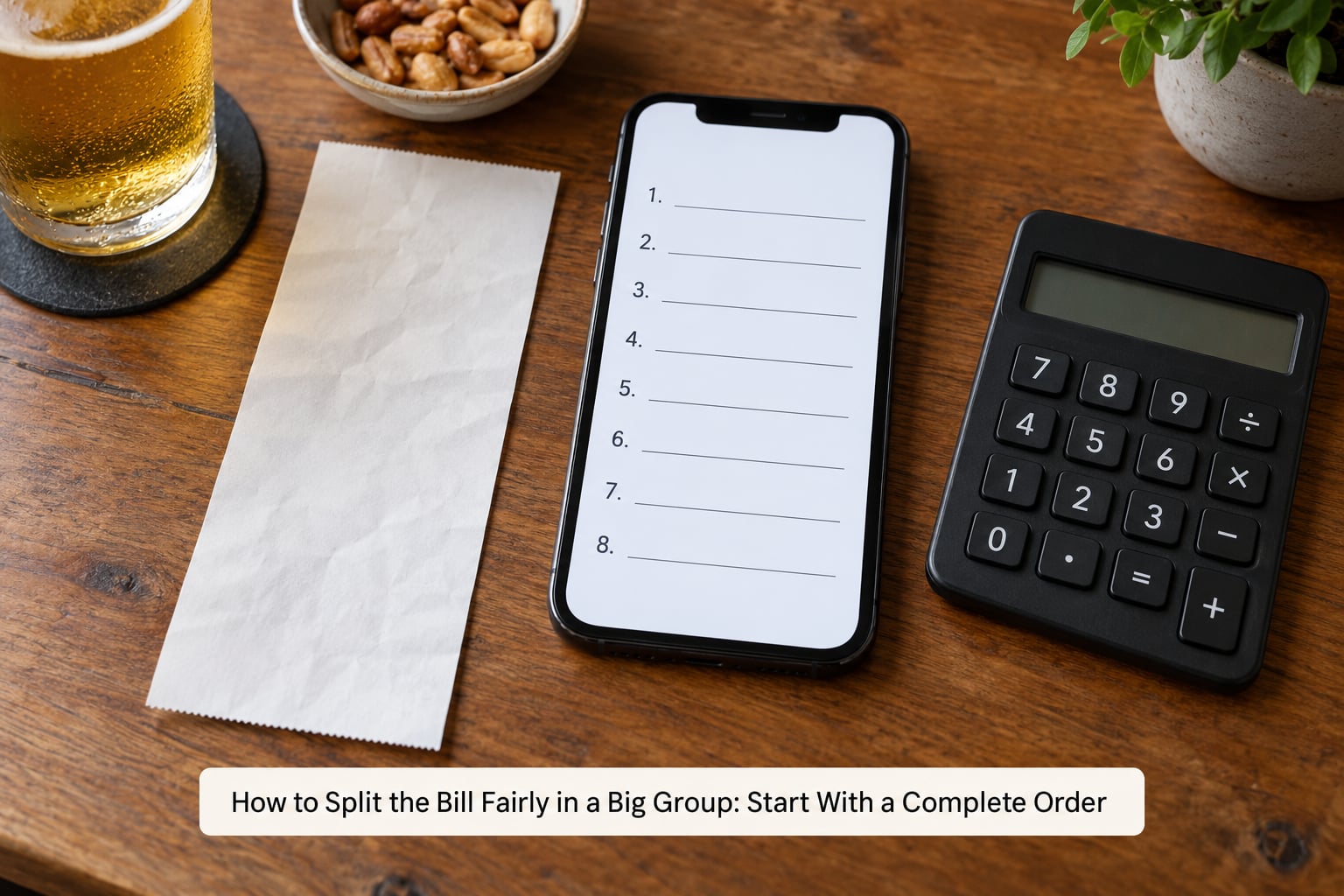
Record the order while it is happening, not after the check lands. For each person, write down their name, what they ordered, and any substitutions the kitchen made. Note substitutions separately because a swapped side can move a total by more than you would expect, and nobody wants to argue about it later.
A numbered list beats a memory game. Give yourself a row per person and a column for drinks, one for food, one for shared items. Even a phone note works, as long as every person can see it while they are still at the table.
The single most useful habit here is separating the original order from later adjustments. Someone who adds an appetizer in the last ten minutes should say so out loud, and you write it as a new line rather than editing the old one. That way nobody is blamed for a number they never saw.
Assign Shared Items Clearly
Shared items are where fairness arguments start, because consumption is rarely equal. Three methods work, and you should name which one you are using before the first shared plate lands.
| Shared item method | How it works | Fair when |
|---|---|---|
| Divide equally | Split every shared plate eight ways | Family-style service, similar appetites |
| Split by consumption | Name who finished what, divide those shares | Someone clearly ate more, or did not drink |
| Assign a buyer | One person owns the whole item and is not repaid | A bottle or flight one person ordered for the table |
Take a real example: an order of wings at 18.00, a shared fries at 9.00, and a beer flight of four glasses at 9.00 each, shared across eight people. Dividing equally costs each person 7.88. Splitting by consumption only makes sense if people actually say who ate what, and with wings on a table that conversation rarely happens honestly. Assigning a buyer works well for the flight if one person ordered it and nobody minds covering it.
The method matters less than announcing it. A group that knows the rule cannot argue about the outcome later.
Calculate Tax and Tip Without Double-Counting
Treat tax, tip, service charge and card fees as additions to the final total, never as items you divide separately and then tax again. The safe habit is to compute each person or each share of the food subtotal, then apply one combined multiplier to everything.
A service charge is not a tip. A mandatory service charge is a house fee that some restaurants add to large tables automatically, and it shows up before you tip. If the receipt shows an automatic gratuity line, that is your tip decided for you, and adding another 20 percent on top means you are tipping twice. Ask the server what the line covers before you assume it is a gratuity.
When the receipt does not break out a tip, pick a percentage, apply it once to the pre-tax food subtotal or to the total including tax, and say which one you used. Most groups land between 18 and 20 percent for table service, more if the server did something memorable.
Review the Split Before Anyone Pays
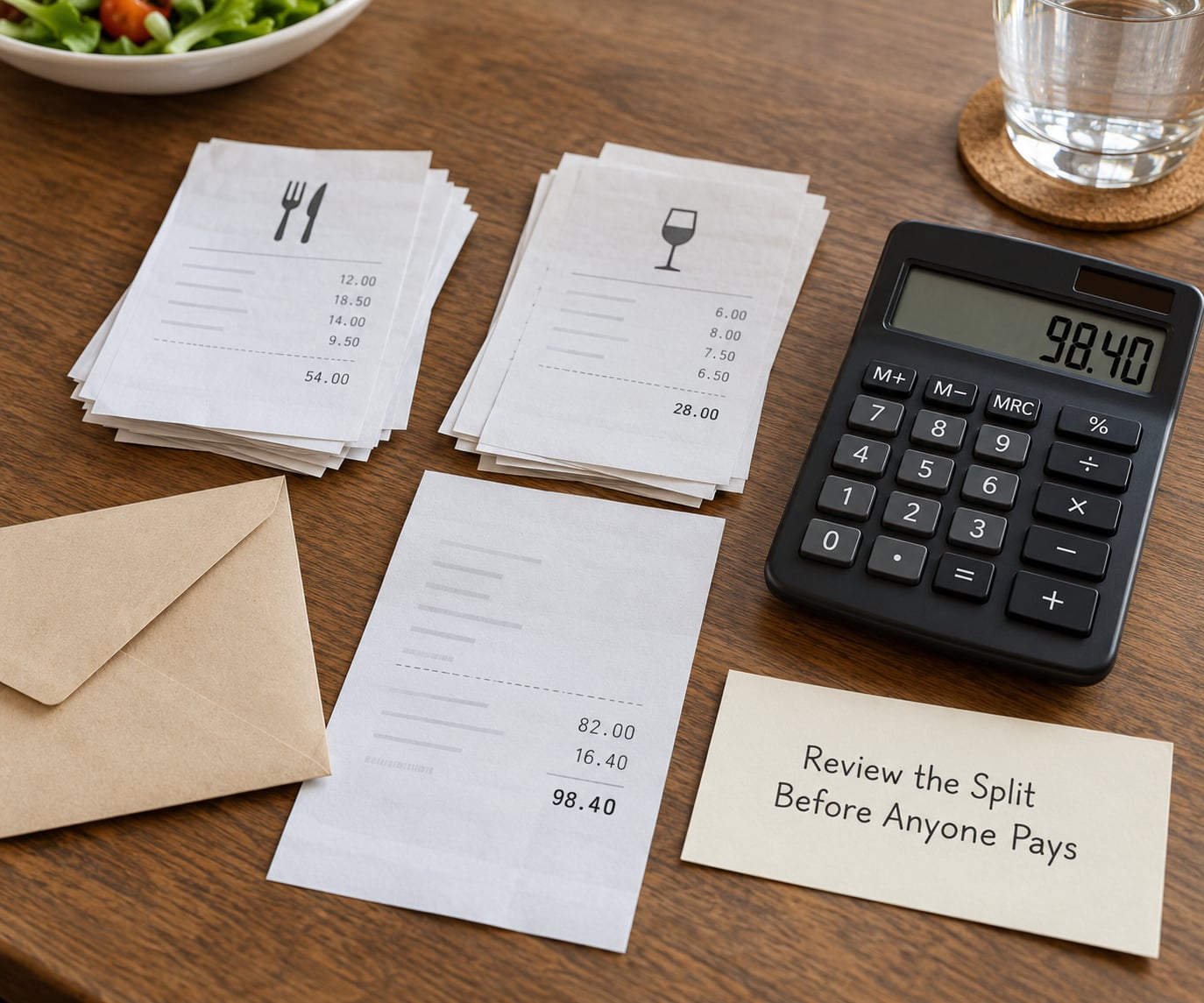
Sixty seconds of checking prevents the entire problem. Compare your item subtotals against the receipt line by line. Confirm the tax rate and the tip percentage. Check that shared items were divided by the method you announced. Confirm the rounding.
Then show everyone the final numbers before any money moves. The group gets one chance to object while the numbers are still adjustable.
Here is a full worked example for eight people. Individual entrees total 199.00 across the table. Shared wings, fries and the beer flight add 63.00, so food comes to 262.00. Tax at 8.875 percent is 23.25, bringing the check to 285.25. A 20 percent tip is 57.05, and the final total is 342.30.
Split three ways, the numbers look like this:
- Evenly: 342.30 divided by eight is 42.79 each, with a two-cent remainder that goes to whoever volunteers.
- Itemized: each person pays their entree plus 7.88 for shared food, then the combined tax and tip multiplier of 1.3065 is applied. That gives 44.26, 39.04, 54.72, 35.12, 41.65, 29.89, 46.88 and 50.74 for the eight entrees in order.
- Weighted: if two people in the group agreed to pay 70 percent of their share, their amounts become 20.92 and 29.16, and the remaining 320.84 divides evenly among the other six at 53.47 each.
Rounding always costs somebody a few cents. Decide in advance that the last name on the list absorbs the drift, so the totals reconcile exactly to the receipt.
Collect Payment and Handle Differences
Set one cutoff time and stick to it. Ten minutes after the check arrives is normal. Tell the group when requests go out, and do not chase anyone individually afterwards.
Handle rounding in one direction only: round down, and the small remainder stays with the organizer. If someone pays more than their share, return it. Letting an overpayment sit looks like you are keeping a hidden tab, and that is where resentment starts.
If someone questions a charge, stay factual. Something like this works better than defending yourself: “That is the tax and tip applied to your share, here is the line on the receipt, and I can change the rounding if you want.” Most objections are about unclear arithmetic, not about the amount.
A payment request message that closes things out cleanly: “Here is the group total and your share of it. If the split method changes before we pay, tell me by 8. After that I am sending payment requests.”
For bar and brewery tabs, the same rules apply with one addition. Tabs often run on a minimum per person or a card hold, so ask whether the tab has a floor before the first round rather than discovering it on the final receipt. Shared flights and growlers should be divided by who actually had them, not by who was standing nearby.
Common Mistakes
Running the total in your head. Fix: write every number down. Mental math is where the argument is born.
Forgetting tax and tip, then dividing the subtotal. Fix: apply one combined multiplier to food shares, or divide the final total by the agreed method. Never do both.
Splitting the whole bill evenly when orders differ widely. Fix: if the gap between the cheapest and most expensive entree is more than double, switch to an itemized split and say so early.
Overlooking shared items. Fix: assign them a method in advance. Plates that arrive in the middle of the night are the easiest thing to lose track of.
Paying from several phones without recording amounts. Fix: one person collects, or everyone writes down what they paid. Restaurant forums agree on a practical ceiling of two to four cards per table before servers start struggling, so a group of ten usually wants a designated collector.
Allocating a service charge as if it were a tip. Fix: read the line, ask the server what it covers, and tip on the pre-service-charge amount if you are still tipping.
Leaving the method unsaid. Fix: announce it in the first minute. Nobody can object to a rule they never heard.
Frequently Asked Questions
Should we split the bill evenly if everyone ordered different amounts?
No, not when the gap is large. An even split is fair when meals landed within roughly double of each other, because small differences get averaged out. When one person orders a salad and another orders a tasting menu, itemize it: each person pays for their own food plus an agreed share of anything shared. Announce the switch early rather than at the check, and nobody takes it personally.
How do we split a bill when several people shared food?
Name a method before the shared plates arrive. Divide equally when service is family-style and appetites are similar, split by consumption when someone clearly ate more or sat out the drinks, or assign one buyer for bottles and flights. Write the choice down and repeat it when the check lands. The method matters far less than everyone agreeing on the same one.
What is the fairest way to divide tax and tip?
Apply both once, to each person’s share of the food subtotal, using one combined multiplier. Tax plus a 20 percent tip works out to about 1.3065 times the food subtotal. Never divide the final total a second time on top of that. If an automatic service charge already appears, treat it as a house fee, not a tip, and tip on the amount beneath it.
What if one person paid for the whole group?
Thank them, then make settling up simple and immediate: one message listing who owes what, with a single cutoff time, and a reminder that nobody is expected to cover more than their own share. If they genuinely want to treat, say so plainly and do not let the group assume they owe it. Repeatedly offering to pay and never being settled up with is its own kind of debt.
Can the bar split one check into several separate checks?
Usually, and it is easier to arrange before anyone orders than after. Most bars are comfortable handling two to four cards per table, and some point-of-sale systems cap the number of splits on a single check. For ten people or more, ask the server what the limit is, then designate one person to collect payment for the rest. Larger venues may ask for a deposit or a minimum per person on the tab.
Conclusion
Start by capturing the complete order while you are still at the table, with each person name next to their items and any later additions written as new lines. Decide how shared plates, bottles and flights get divided, then say that decision out loud so nobody discovers a different rule at the check.
Add tax and tip once, check the numbers in sixty seconds, and send one clear total to every person with a single cutoff. That is how to split the bill fairly in a big group without anyone leaving the table unhappy. The method is fair when it is transparent and agreed upon before the food arrives, not because one formula beats another.