Finding local breweries while traveling comes down to two moves: search around your exact current location, then verify the strongest hits with official and recent sources before you leave. Maps and beer apps get you a list in under a minute. The verification step is what keeps you from walking across town to a taproom that closed for the season.
I’ve had both experiences. The version that ends well looks like this: you know what kind of beer you like, you know how you’re getting between stops, and you know roughly what time you’ll arrive. The version that ends badly is a saved list from three years ago, a venue that now pours other people’s beer, and a bus that stops running at six.
This guide walks through the whole routine, from the moment you land to the moment you order. It takes about ten minutes of research per city and works whether you have a full weekend or two free hours between trains.
Table of Contents
- What You Need
- Step-by-Step
- How to Find Local Breweries While Traveling With Google Maps
- Use Brewery and Beer Apps for Current Taproom Information
- Check Local Beer Directories and Tourism Websites
- Search for Breweries by Style and Location
- Verify Hours, Service, and Transportation Before Visiting
- Common Mistakes Travelers Make With Brewery Research
- Tips for Building a Local Brewery Route
- Frequently Asked Questions
- How do I find breweries in a city I am only visiting for one day?
- What is the best app for finding breweries?
- How do I know if a brewery is good before I visit?
- Can I bring beer home from another state?
- What if the town I am visiting has no craft breweries?
- How many breweries can I visit in one day without overdoing it?
- Conclusion
What You Need
You need four things before you open any app. Gathering them first turns a vague search into a filtered one, and filtering is what saves you time.
A phone with location services switched on. Every good search depends on your real position, not the name of the city. Location services also let beer apps sort venues by distance instead of by reputation, which is the difference between useful and useless results in a place you’ve never been.
A plan for getting between stops. Breweries tend to cluster in industrial edges of town and old warehouse districts, often a short drive or awkward walk from the tourist center. Before you pick a venue, decide whether you’re driving, riding transit, walking, or mixing all three. A car changes everything, because parking rules and lot size decide how many stops you can realistically make.
A short list of styles you enjoy. Craft beer is intensely regional. A brewery three hours away may make a style you’ll never find on a shelf at home, but it may also make nothing you care about. Two or three named styles is enough to search with.
A rough sense of timing. Taprooms open and close on schedules that don’t match restaurants. Many close on Mondays, some shut their taproom before dinner, and a few are cash-only for the first hour. Knowing your window of free time saves the worst kind of trip.
You’ll also want to remember the basics of venue entry: bring a government-issued ID, expect to hand over the whole card when paying, and check whether children can come into the taproom area. Those rules differ by brewery and by state, so a quick look at the venue’s own page beats assuming.
Step-by-Step
How to Find Local Breweries While Traveling With Google Maps
Search “brewery” or “taproom” from your actual location, then sort by rating and read the newest reviews, not the highest ones. A venue whose most recent review is from this month tells you far more than one with a 4.8 average built over three years.
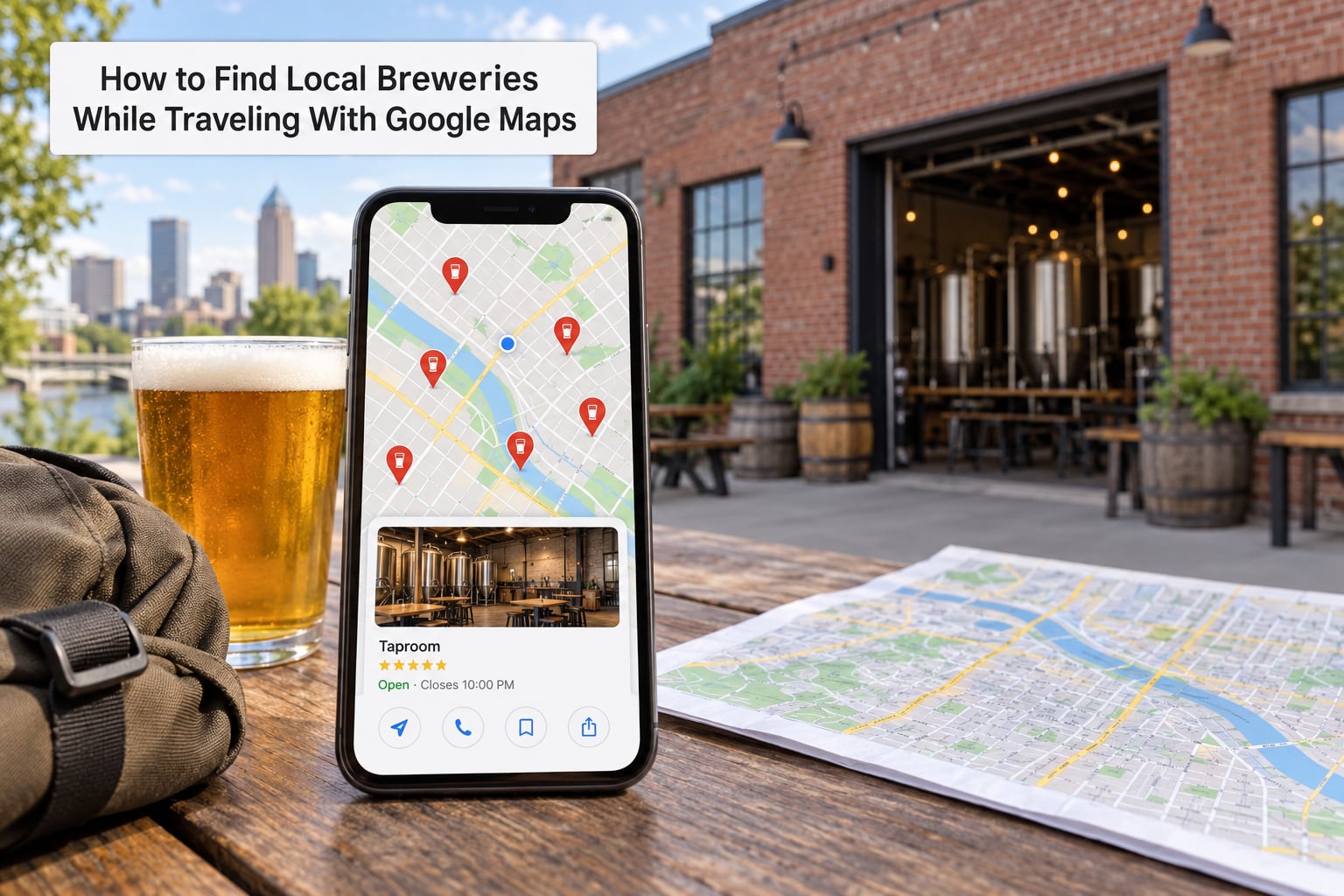
Maps is the most reliable starting point because it confirms something the beer apps often don’t: whether a place exists at that address right now. Closed businesses sometimes linger in listings for months, and a listing marked as permanently closed tells you immediately that your research just saved you a wasted trip.
Work through it in this order:
- Search while standing where you are, with location services on.
- Zoom out enough to see every result in the area, including the outskirts where most production breweries sit.
- Sort by rating, then open the newest one-star and one-star-to-three-star reviews. Complaints tell you about parking, hours, cash policies and service much faster than the four-star ones do.
- Look at the photos. You are checking for a beer garden, a patio, an actual taproom rather than a bar with a brewery sign.
- Note the address in a notes app so you can hand it to a ride or transit app later.
What worked for me: treat Maps as the truth filter, not the recommendation engine. It answers where and whether. What to drink is a different question, and that’s where the beer apps pick up.
Use Brewery and Beer Apps for Current Taproom Information
Untappd is the best app for finding breweries while traveling, because check-ins are tied to real visits and brewery staff recognize it. BeerAdvocate covers more of the beer itself, TapHunter is stronger for tap lists, and BeerMenus is the one to check what’s on tap at a bar that isn’t a brewery.
Users on r/Untappd are clear that Untappd’s Nearby Venues list is noisy, because it returns anything with a beer on tap, including mall bars and restaurants with one handle. The fix those regulars describe is to open a venue on the Untappd website and read the Top Beers panel before you go. It tells you what a place is actually known for, rather than what it’s serving incidentally.
There’s a second trick worth learning, and it solves a specific problem. If you want to know which breweries are headquartered near you rather than which venues are nearby, find a beer you already know, tap check-in, then use the locations search on that page and type your city. You’re filtering by brewery origin, not by geography of the tap handle.
Here’s how each one actually earns its place in your phone:
- Untappd — check-ins, venue history, and what a place is known for. The social standard in the craft world; staff see your check-in and it reads as normal, not intrusive.
- BeerAdvocate — deeper style and beer information, useful when you want to know what a West Coast IPA or a farmhouse sour actually tastes like before ordering one.
- TapHunter — tap lists for venues and bars, including places with no brewery of their own. Helpful in cities where the good beer is distributed rather than brewed.
- BeerMenus — current pour lists and what’s available in bottles or cans nearby, good for last-hour grocery or bottle shop stops.
One honest caveat. In a city nobody in your circle has visited, ratings and check-in counts carry almost no information. A venue with 400 check-ins in a town of 200,000 people may simply have been open longer. r/beer regulars say to weight recent activity far above volume for this exact reason.
Check Local Beer Directories and Tourism Websites
City tourism boards and regional beer trail maps find breweries that search engines miss, because they’re built from local knowledge rather than business listings. Search for the city name plus “beer trail,” “brewery map” or “beer guide,” and you’ll usually find a curated list with addresses grouped by neighborhood.
Regional subreddits point at the same kind of resource. r/DFWBeer sends readers to a dedicated local map of breweries, brewpubs and growler shops specifically because it’s a stricter filter than generic map search, which throws in every sports bar with a pint.
These lists are also useful for route building. A trail map usually clusters stops geographically, which means fewer wasted drives and an afternoon that actually works. Cross-check anything you find against the brewery’s own website before you commit, since trail guides often keep entries after a closure.
Event calendars are the other half of this. Brewery release parties, trivia nights, tap takeovers and food truck schedules tell you which venues are worth arriving at on a specific day. A brewery hosting a release on your one free evening will give you a far better night than three quiet taprooms.
Search for Breweries by Style and Location
Add a style to your search and results sharpen fast: try “hazy IPA brewery” or “sour taproom” instead of a plain brewery query. Pair it with the neighborhood or district name to narrow the field to somewhere you can actually reach.
The reason this matters is that “brewery” covers several different businesses. Knowing which one you’re walking into tells you what to expect, whether you can eat there, and whether the beer is brewed on site.
| Venue type | Brews on site | Usually serves food | Best for |
|---|---|---|---|
| Production brewery | Yes | Sometimes, sometimes not | Fresh beer straight from the source, often including beer not on shelves anywhere |
| Brewpub | Yes | Yes, full kitchen | A meal and a pint without leaving the building |
| Taproom | Yes | Snacks, maybe a food truck | Tasting the brewery’s own output, flights, growler fills |
| Taphouse or beer bar | No | Varies, usually yes | Wide selection from many breweries, and cocktails or food a taproom lacks |
| Nano brewery | Yes, small batch | Snacks at most | Rare limited releases, and finding them takes local knowledge |
| Beer garden | Sometimes | Usually yes | An easy afternoon with kids or a group, outdoor seating |
Ask locals and bartenders where the nano breweries are. They’re the ones with almost no web presence, and r/CraftBeer regulars note that staff will usually name one if you ask specifically.
Verify Hours, Service, and Transportation Before Visiting
Check the brewery’s own website or social posts for taproom hours, not just the map listing. Taprooms often keep separate hours from the production side of the business, and plenty of them close on Mondays or shut the tap early on weekends.
Then sort out getting there. Look at parking capacity, especially if you’re in an RV or a large vehicle, since production breweries often have small lots and no oversized parking. If you’re using transit, check the return trip before you leave, because brewery districts often have infrequent evening service. Then check how you would get from stop one to stop two, and whether that connection still exists when the last pour happens.
Accessibility is worth a minute of checking too. Look for step-free entry, restroom access, and whether seating is available rather than standing-only. If you’re traveling with kids, confirm whether the taproom allows minors inside, since some breweries offer a restaurant area but keep the taproom adults-only.
Low-alcohol and non-alcoholic options are increasingly standard on tap lists at larger breweries. Asking for them early means you are not stuck guessing at the end of the afternoon.
Common Mistakes Travelers Make With Brewery Research
Relying on old lists. A saved article from years ago may name venues that closed or changed hands. Fix: check the brewery’s own site and its recent social posts before you travel.
Confusing the brewery headquarters with the taproom. This is the most common error, and it regularly sends people to an industrial building with a production entrance and no public taproom. Fix: read the visit info page and confirm the taproom has its own public entrance and hours.
Ignoring tap schedules. A brewery’s best beer may only be on tap on a certain day. Fix: check recent posts for release days and tap takeovers.
Skipping events and reservation rules. Some breweries are ticket-only for tastings or tours, and some taprooms require reservations on weekends. Fix: reserve before you go.
Choosing venues without checking transportation. Four great breweries in a row is a great plan on paper and a bad afternoon if you can’t get between them. Fix: plan the transit between stops before the first pour.
Treating popularity as quality. In a new city, check-in counts reflect history and foot traffic, not beer. Fix: read recent one- and three-star reviews, where complaints are specific.
Assuming every brewery serves food. Many taprooms are snacks-only, sometimes cash-only at first. Fix: look for a food truck schedule or a kitchen before you arrive.
Forgetting age restrictions. Taprooms are commonly adults-only even when the attached restaurant isn’t. Bring ID and check the venue’s policy.
Tips for Building a Local Brewery Route
Group stops by neighborhood and cap the number at three or four. Beyond that, you’re traveling between breweries rather than tasting beer, and the transit time eats the day.
Start with a flight if the taproom offers one. Users on r/beer consistently describe flights and half-pours as the efficient way to cover a lot of breweries’ output in one place, and they’re better for you if you’re driving or pairing with something else later. Eat a real meal between stops rather than living on pretzels. Order water before your second beer, not after your fourth.
Finally, fit the route to your trip. If you have a flight the next morning, keep the route to two stops in one neighborhood. If you’re driving a loop with a hike or a museum in the middle, put the breweries on either side of it so the day still works if a stop is closed.
Frequently Asked Questions
How do I find breweries in a city I am only visiting for one day?
Search breweries around your current location, pick two in the same neighborhood, and check that the taproom serves the hours you have free. One day is enough for two solid stops. Add a third only if the first two are close together on foot or on the same bus route.
What is the best app for finding breweries?
Untappd is the best all-round choice because check-ins come from real visits and brewery staff recognize the app. Use TapHunter for current tap lists, BeerMenus for what is pouring in bars, and BeerAdvocate when you want detail on the beer itself. Maps is still the best check on whether a venue is open.
How do I know if a brewery is good before I visit?
Read the newest reviews rather than the top-rated ones, and look at what people complain about: parking, cash-only policies, slow service, or weak beer. Check the recent check-in dates on Untappd to confirm the venue is active. A brewery that posts events and rotates taps is usually a destination rather than an afterthought.
Can I bring beer home from another state?
Rules vary by state, and a lot of states limit how much alcohol you can transport across a border, so check your home state’s law before you buy. Most airlines allow alcohol in checked bags under the usual liquids limits, and the TSA requires it to be under 70 proof. Shipping by mail is restricted, so check with the brewery first.
What if the town I am visiting has no craft breweries?
Check a nearby town within a reasonable drive, because brewery clusters are regional rather than evenly spread. Look for taphouses and bottle shops instead, which stock beer from regional breweries. Beer gardens at restaurants are another option, and asking a bartender for what is brewed nearby usually turns up something local.
How many breweries can I visit in one day without overdoing it?
Most people do well with two full stops or three short ones, especially when flights and food are part of the plan. Eat between stops, order water before your second beer, and space the visits out rather than back-to-back tasting. If you are driving, keep the limit lower.
Conclusion
Start by opening a map at your actual location and searching for breweries, then run the same search in Untappd and read the newest reviews and check-in dates for anything that looks good. Before you leave, confirm the taproom hours and how you’ll get there. That short verification step is what separates a good afternoon from a long walk to a locked door.