How to pair beer with burgers is simpler than most guides make it sound: start with the topping, not the beef, then pick a beer that matches the burger’s weight and cuts through its fat. For a classic cheeseburger, reach for a pale ale or an amber lager; for pickles and mustard, a crisp pilsner; for bacon and blue cheese, a porter or stout. Everything else follows from those three anchors.
Yes, you can drink beer with a burger, and you have probably been doing it for years without thinking about it. Carbonation is the quiet reason the combination works so well. The bubbles and the hop bitterness scour the palate between bites, which is exactly what a fatty patty needs, and the malt in the beer echoes the browning on a grilled surface.
What most published advice gets wrong is that it stops at “pilsner is safe.” That tells you nothing when you are standing at the cooler with a blue cheese and bacon burger in one hand. This guide gives you a repeatable process and twelve specific matches, from a plain cheeseburger to a smoked brisket stack and a black bean burger.
Table of Contents
- What You Need Before You Start
- Step-by-Step: How to Pair Beer With Burgers
- Identify the burger’s dominant flavor
- Match the beer’s intensity to the burger
- Balance sweetness, acidity, bitterness, and richness
- Use the cooking method and toppings as tiebreakers
- Check how to pair beer with burgers in three bites
- Serve both at the right temperature
- Common Pairing Mistakes and How to Fix Them
- Frequently Asked Questions
- What beer goes best with a classic cheeseburger?
- Should a burger beer be lighter or stronger than the burger?
- What beer pairs with a spicy burger or hot sauce?
- Does a sour beer work with hamburgers?
- How do you keep beer from tasting too warm beside a hot burger?
- Conclusion: Start With the Topping
What You Need Before You Start
Nothing technical. You need the burger in front of you and about sixty seconds of attention.
First, read the burger honestly. Is the beef the story, or is it a delivery vehicle for caramelized onions, a smoky glaze, pickled jalapeños, blue cheese crumbles? A patty melt and a double smash with special sauce are not the same object, and they should never get the same beer.
Second, know the style name on the bottle or tap handle. You do not need to know the brewery, the IBU, or the hop variety. But knowing whether you are reaching for a pilsner, an amber ale, a brown ale, a stout, or a sour ale is what makes the rest of this work.
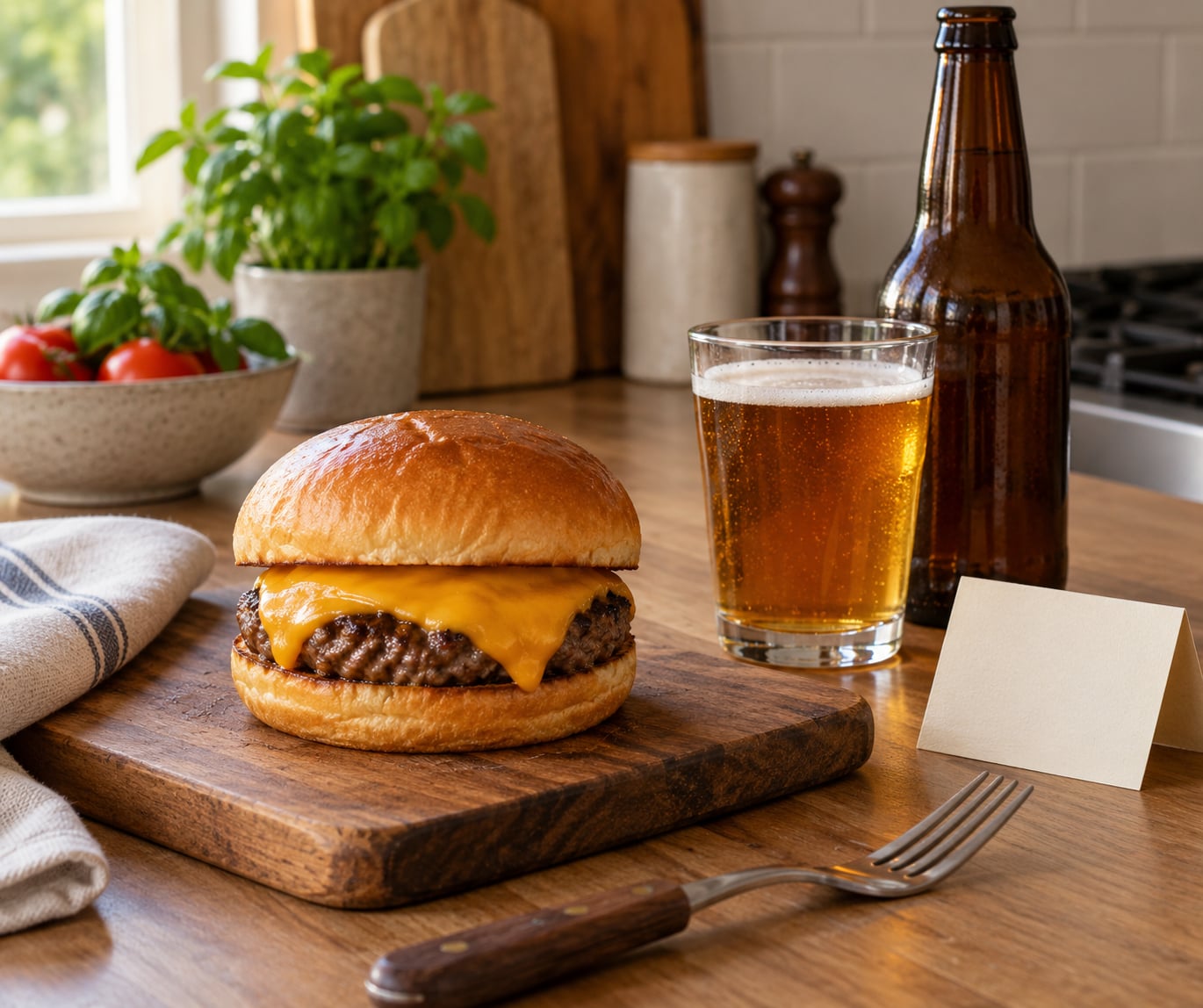
Third, if you want to get fussy about it, a fork, a small tasting glass, and a note card are genuinely useful. The fork lets you taste the burger without your hands, the small glass keeps a shared bottle from warming up while you deliberate, and the card stops you from forgetting that the second beer was better than the first.
That is the whole kit. Nobody needs a tasting mat and a wheel knife to eat a burger.
Step-by-Step: How to Pair Beer With Burgers
Identify the burger’s dominant flavor
Sort the burger into one or two of seven buckets: beefy, juicy, spicy, smoky, rich, tangy, or sweet-topped. Most burgers are two of these at once. A cheeseburger with caramelized onions is rich plus sweet. A brisket burger with pickled jalapeños is smoky plus tangy plus spicy.
Then decide what you want the beer to do about that dominant flavor. You have three honest options and only one bad one. You can complement it, letting the beer echo the same flavor. You can cut it, using bitterness and carbonation to clear the richness. Or you can contrast it, pairing something tart or light against something heavy or smoky.
The bad option is to ignore the dominant flavor entirely and pour whatever you happen to be drinking. That is how you end up with a hazy IPA beside a blue cheese burger and wonder why the cheese tastes sour.
Match the beer’s intensity to the burger
A simple patty with lettuce and tomato is a light meal, and a light beer suits it. Think pilsner, helles lager, weizen, or a session pale ale. The burger is the thing you are tasting, and the beer’s job is not to interrupt it.
A double patty with bacon, egg, and smoked gouda is a different situation entirely. Now you want body. An amber ale, a brown ale, a porter, or a rich ESB has the malt and weight to sit next to that burger without getting steamrolled by it.
The rule people get backwards is matching strength with strength. Two aggressive things rarely improve each other. A heavily seasoned burger wants a beer with enough malt and roast to hold its own, not a beer that is trying harder on bitterness. Balance beats volume on both sides of the plate.
Balance sweetness, acidity, bitterness, and richness
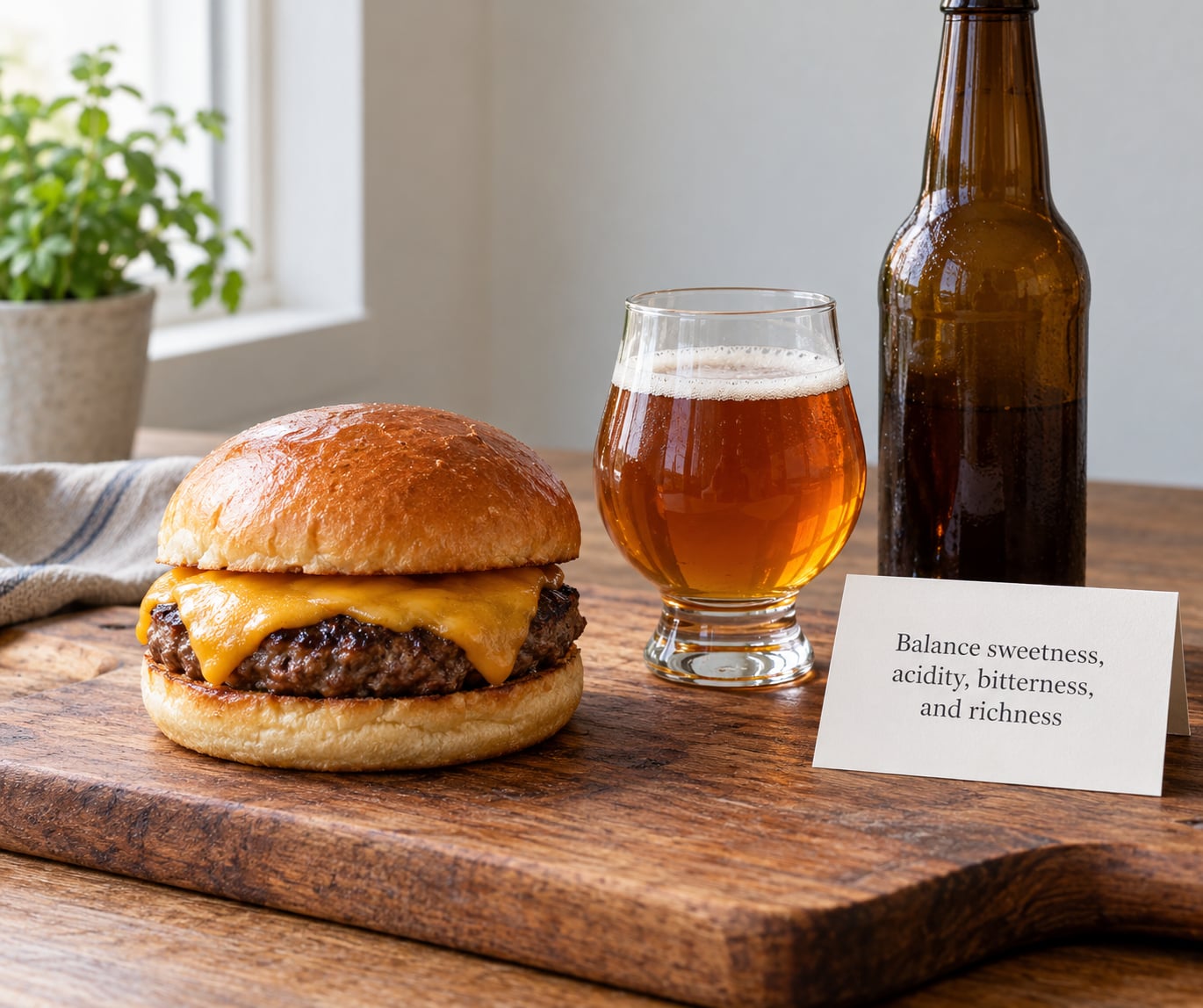
Five moves explain nearly every good beer and burger pairing. Learning to name them makes the rest mechanical.
Cut is carbonation and hop bitterness moving through fat and richness. This is why a pilsner is such a reliable partner for a cheeseburger: it refreshes the mouth between bites instead of sitting on top of them.
Complement means the beer and the burger share a flavor. A malty brown ale against a classic double with cheddar, because the caramel in the malt mirrors the caramel in the seared beef and melted cheese.
Contrast means two opposing flavors balance out. A sour beer against a spicy chicken burger, where the tartness cools the heat. Or a crisp lager against a rich, smoky burger, where the light body resets your palate.
Cleanse is the palate-clearing job carbonation does constantly across a plate of fried or fatty food. It is invisible when it works and very obvious when the beer is flat.
Bridge is a shared ingredient flavor connecting the two. Caramelized onions in the burger and caramel malt in an amber lager. Coffee notes in a stout and dark char on a griddled patty. Bridges are what make a pairing feel obvious once you taste it.
Here is the map from burger to beer style, covering the twelve pairings people ask about most.
| Burger or topping | Beer styles to pour | Why it works | Serve at |
|---|---|---|---|
| Classic cheeseburger, lettuce and tomato | Pale ale, amber lager, ESB | Matching malt and moderate bitterness balance the fat without hiding the beef | 38 to 45 F |
| Bacon cheeseburger | Amber ale, brown ale, porter | Smoky malt and a hint of roast mirror the bacon’s salt and char | 45 to 50 F |
| Blue cheese burger | Porter, stout, brown ale | Roast and bitterness cut the sharpness of the crumbles and the richness of the patty | 50 to 55 F |
| BBQ sauce or brisket burger | Porter, stout, märzen, smoked schwarzbier | Sweet molasses and coffee notes meet caramelized sauce and smoke | 50 to 55 F |
| Pickle and mustard burger | Pilsner, helles lager, kolsch | Brisk acidity and a dry finish handle the sour and the vinegar | 34 to 40 F |
| Spicy jalapeño or habanero burger | Session IPA, pale ale, saison | Hop bitterness and a light body take the edge off the heat without adding more heat | 40 to 45 F |
| Mushroom and Swiss burger | Brown ale, ESB, dunkel | Earthy malt and the nuttiness of Swiss are the same flavor family | 45 to 50 F |
| Black bean or veggie burger | Amber lager, pale ale, weizen | Light body and gentle carbonation keep a softer patty from tasting flat | 38 to 45 F |
| Smoked brisket or bacon-wrapped burger | Barrel-aged stout, porter, rauchbier | Roast intensity matches smoke intensity, and the dryness handles the fat | 50 to 55 F |
| Fried chicken burger | Session IPA, pilsner, cream ale | Clean bitterness and high carbonation break up the crispy coating | 38 to 45 F |
| Griddled patty melt with griddled bread | Vienna lager, amber lager, ESB | Toasty malt matches the griddled bread and cheese crust | 40 to 45 F |
| Burger with hot honey or sweet glaze | Dry stout, bitter IPA, farmhouse ale | Perceived bitterness cuts residual sweetness instead of adding to it | 45 to 50 F |
Read across a row rather than down a column. The “why” column is the part that generalizes: whatever the topping is doing, you want a beer doing the opposite job or the same job at a lower volume.
Use the cooking method and toppings as tiebreakers
When two styles both seem reasonable, the cooking method decides it. A burger seared hard on a cast iron grate wants a beer with roast or char character, because the beer mirrors the crust. A burger cooked gently on a flat griddle, with no crust, wants something brighter and more aromatic instead.
A fried or breaded burger is almost entirely about crunch and fat, so the tiebreaker is carbonation. The crisper the beer, the better it works. A beer that has gone flat from sitting in a warm cooler will taste like nothing next to a fried chicken burger.
Tangy toppings push toward tart or acidic beer. Pickles, pickled onions, and a vinegar-based barbecue sauce all make a lager with a sharp, snappy finish the natural answer. Sweet toppings push the other way, toward dryness and bitterness, since anything sweet poured alongside sweet food just makes everything sweeter.
Check how to pair beer with burgers in three bites
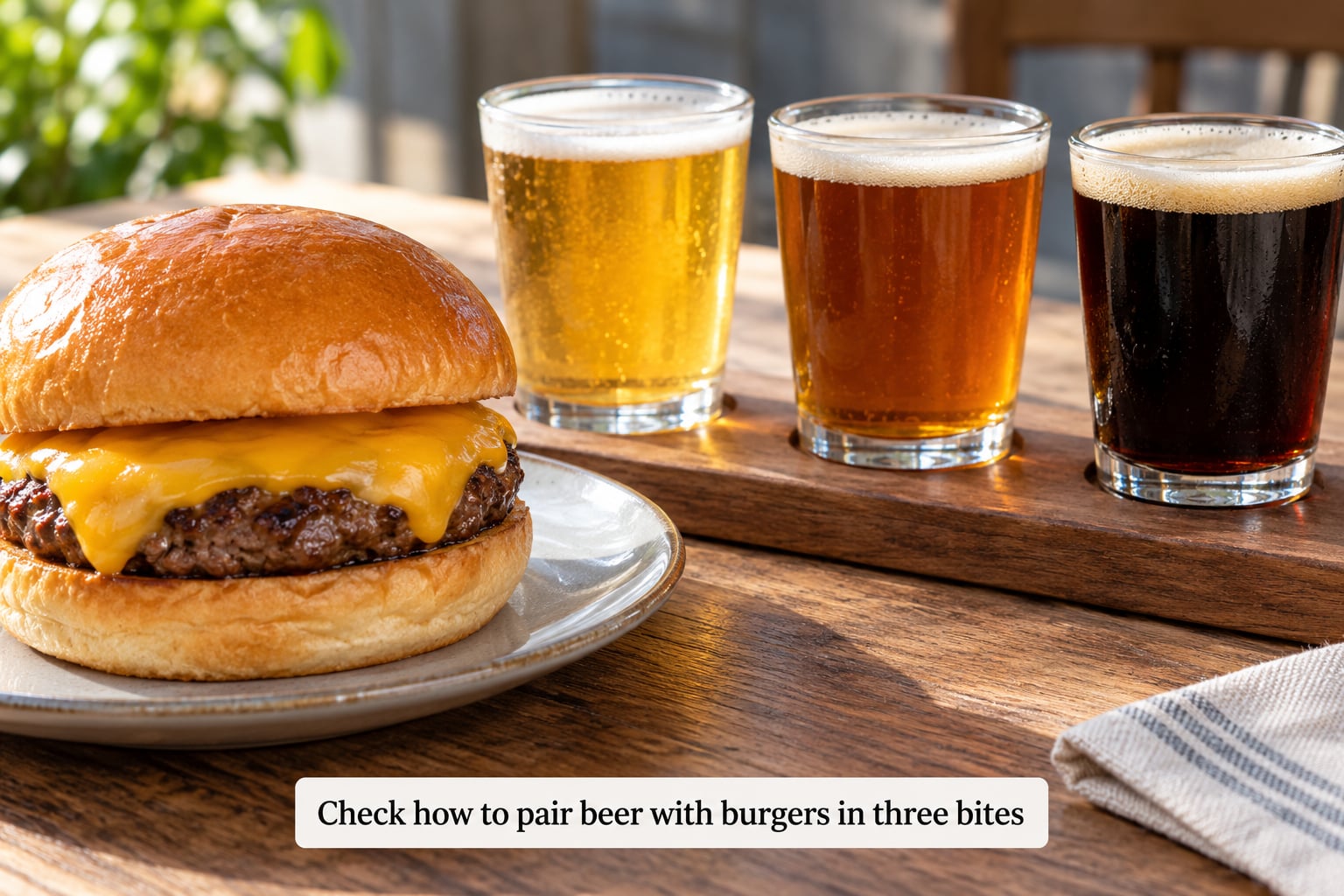
Taste the beer alone first, before any burger is involved. Note whether it is crisp or soft, light or heavy, and whether the finish is dry or sweet. Without this baseline you cannot tell whether the burger changed the beer or you just got hungry.
Take one bite of the burger, then sip. Pay attention to the moment after the sip. A good match makes the burger taste more like itself, not less, and the beer tastes a little brighter than it did on its own.
Now put the burger down and taste the beer again on its own. This is the part most people skip and it is the most revealing. If the beer tastes thin and watery after a bite, the beer was too light for the burger. If it tastes bitter, astringent, or exhausting, it was too bitter or too hoppy. If it tastes dull and sugary, it was too heavy or too sweet.
One more round is worth it. A pairing that gets better on the second bite usually has some bridge flavor in it. A pairing that gets worse has too much of one thing and you should switch bottles.
Serve both at the right temperature
Serve the beer cooler than the burger. This is the single most common serving mistake at a cookout, and it is easy to fix: put bottles in the cooler twenty minutes before you plan to cook, not when you take the patties off the heat. A burger coming off a hot grill is around 160 F at the patty, and any lager served near that temperature tastes heavy and dull.
Let the cooked patty rest before you build the sandwich. Five minutes under loose foil keeps the juices in the meat instead of on the board. A burger eaten straight off the grill is drier, and a dry burger makes even a good beer taste thin.
Choose styles that stay balanced at temperatures people can actually reach from an ice chest. Pale ales and lagers are forgiving. Very hoppy pale ales turn aggressively bitter once they warm past cellar temperature, and that bitterness gets amplified by a fatty patty rather than softened by it.
On food safety, ground beef and ground chicken should reach 160 F internally, ground poultry 165 F, and whole cuts of beef 145 F with a three-minute rest. Use a thermometer, not the color of the juices.
Common Pairing Mistakes and How to Fix Them
Choosing a heavily hopped IPA for a rich blue cheese burger. The bitterness and the cheese’s sharpness fight each other and both end up worse. Move to a porter or a brown ale: roast instead of resin. There is a place for IPAs with burgers, mostly as a lighter session IPA with a spicy or heavily seasoned patty, but a double IPA next to blue cheese is a fight nobody enjoys.
Pouring a very sour beer at a plain cheeseburger. Acidity is not automatically refreshing. When the burger has no acid of its own, a puckering sour just makes the whole bite feel curdled. Save the sours for pickles, pickled onions, hot sauce, or a spicy chicken burger where there is something to balance.
Matching a sweet beer to a sweet burger. A hazy IPA with a hot honey glazed patty doubles the sweetness and leaves nothing to cut through it. Go dry instead, with a dry stout or a bitter, dry pale ale.
Ignoring the condiments. Pickles, mustard, and barbecue sauce change the pairing more than the beef does. Read the condiment label on the bottle before you read the burger.
Serving beer too warm. Warm beer flattens carbonation and exaggerates alcohol. If a bottle has been sitting on the counter through the burger cook, it is past its window. Ice it or pour something else.
Matching by color. A golden burger does not need a golden beer, and a black burger does not need a black beer. Color tells you nothing about flavor. Weight and bitterness are what matter.
Ignoring freshness. Homebrew forum threads raise this constantly, and they are right. An old beer tastes cardboard-flat next to a fresh burger, and no style choice repairs it. When in doubt about a bottle’s age, skip it and open another.
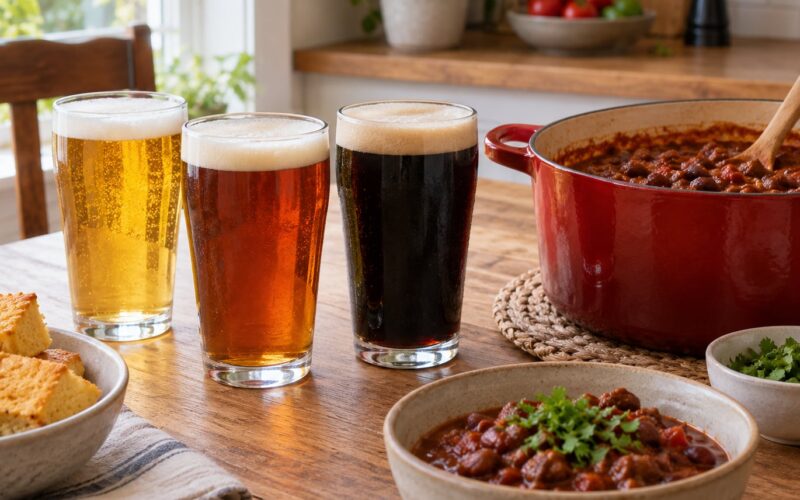
Serving only one beer to a mixed group. The actual cookout problem is not the perfect pairing, it is the guest who does not drink pale ale. Put out two or three easy options: a pilsner or helles, an amber lager or amber ale, and one darker option such as a porter. You can build a three-beer flight on the same table, serve small pours of each with the burger, and let people decide. Pour order runs light to dark so the stronger flavor does not shut down the lighter beers.
Frequently Asked Questions
What beer goes best with a classic cheeseburger?
A pale ale or amber lager is the most reliable answer, and an ESB or amber ale works if you want more body. The goal is a beer with moderate bitterness and enough malt to sit beside the fat without smothering the beef. Carbonation is doing most of the work, cutting through the patty and the melted cheese between bites. Avoid very hoppy or very sour beers, which fight the richness instead of clearing it.
Should a burger beer be lighter or stronger than the burger?
Match the range, not the volume. A plain patty with lettuce and tomato wants a light, crisp beer like a pilsner or weizen. A double bacon cheeseburger wants body, so go amber ale, brown ale, or porter. Two aggressive things rarely improve each other, so a heavily seasoned burger calls for a beer with malt and roast weight rather than a beer pushing harder on bitterness.
What beer pairs with a spicy burger or hot sauce?
A session IPA or a balanced pale ale is the standard answer because hop bitterness takes the edge off capsaicin without adding more heat. A saison or farmhouse ale also works, since its dryness and peppery character cut through chili oil. Keep the beer cold and the ABV moderate, since alcohol amplifies the burn. Save heavy stouts for a smoky burger, not a hot one, or the roast will read as more heat.
Does a sour beer work with hamburgers?
Yes, but only when the burger has something to balance. Sour ales, lambics, and berliner weisse shine next to pickles, pickled onions, vinegar-based barbecue sauce, or a spicy chicken burger, where the acidity cools heat and refreshes a fatty bite. On a plain cheeseburger with no acid of its own, a sharp sour can make the whole bite taste curdled instead of fresh. Match the acidity to the condiment.
How do you keep beer from tasting too warm beside a hot burger?
Put bottles in the cooler before you start cooking, not after the patties hit the grill. A burger coming off a hot grate is around 160 F, and a lager served near that temperature tastes heavy and dull. Serve pale ales and lagers in the mid 30s to mid 40s Fahrenheit, and put out a second round from the cooler rather than refilling warm bottles. Cold beer and hot food is the pairing you actually want.
Conclusion: Start With the Topping
When you learn how to pair beer with burgers, the whole decision comes down to two questions. What is the burger’s dominant flavor, and what do you want the beer to do about it: complement it, cut it, or contrast it. Name the topping, pick a beer of comparable weight with the right bitterness or acidity, then taste the beer again after a bite to check your work.
When you are out of time or out of options, a crisp pilsner or helles with almost any burger will not embarrass you. When you have thirty seconds and a bottle of amber ale, you can do considerably better. This guide was updated for 2026, and the pairing method has not changed much since the first cookout.