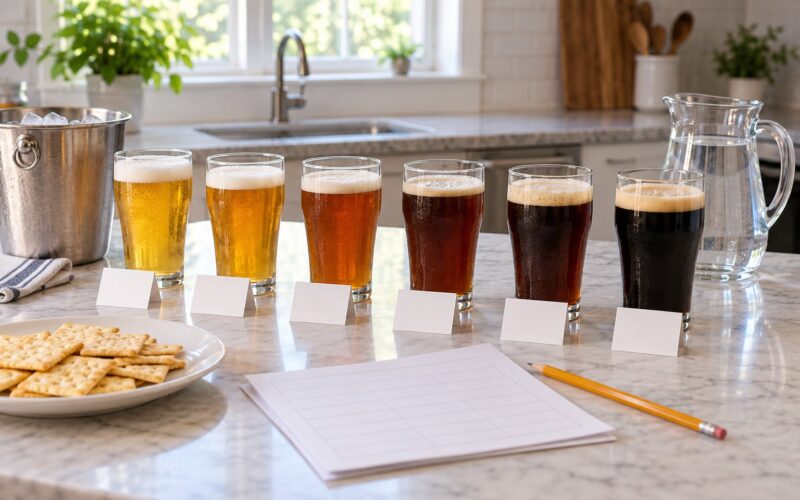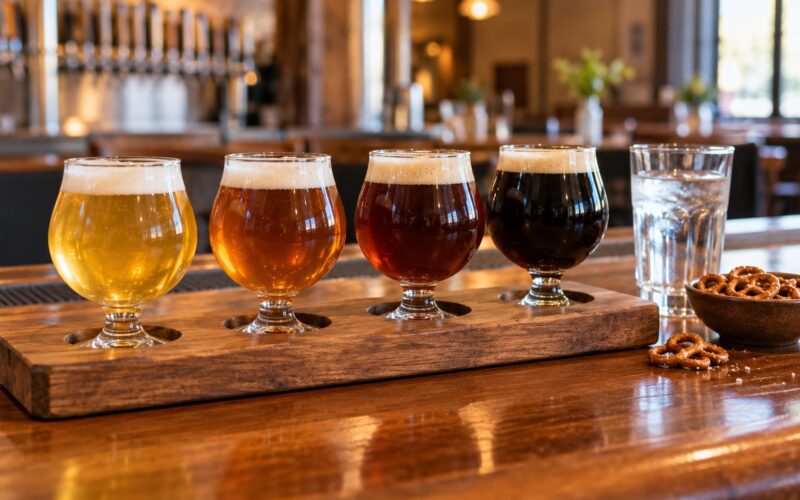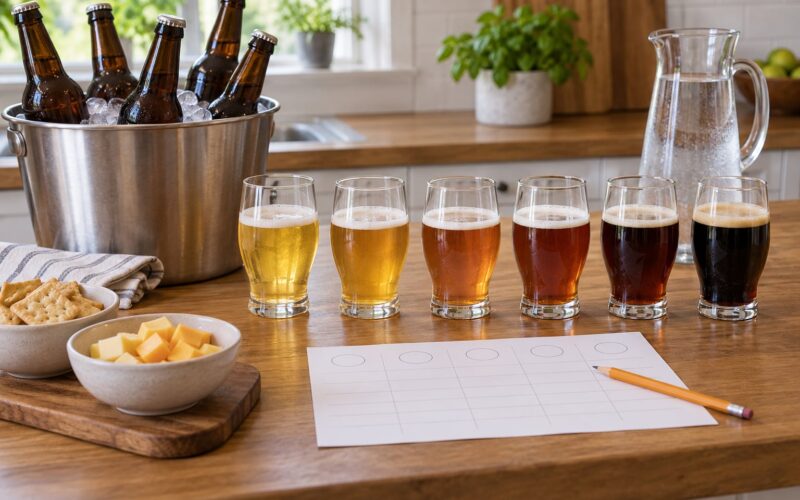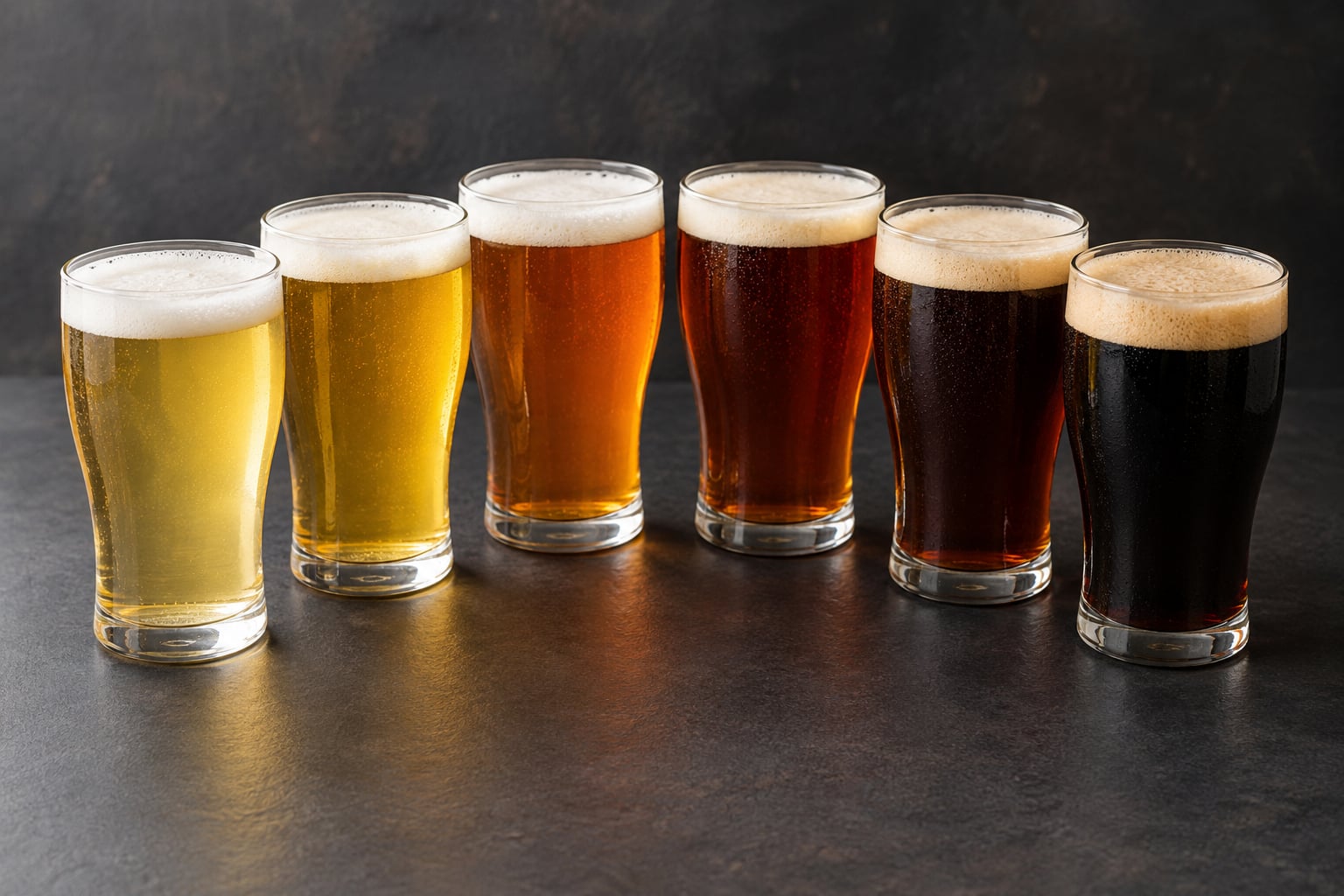
SRM stands for Standard Reference Method, and what SRM color scale means in beer is simple: it is the brewing industry’s standard way of describing how dark a beer is. The American Society of Brewing Chemists adopted it in 1950, and it runs from about 2 for a pale straw lager up to 40 and beyond for near-black stouts. Higher number, darker beer. That is the whole idea.
The part that trips people up is assuming the number predicts what the beer tastes like, or that a brewery picks it to impress you. It does neither. A 40 SRM imperial stout can be a delicate, drinkable cup of coffee and char, and a 6 SRM pale ale can taste like battery acid. Read it as a color reference, and the number is genuinely useful.
If you’ve ever squinted at a tap list wondering whether 35 IBUs and 22 SRM describes something you want to order, this guide should settle it. We’re covering what the scale measures, what every band looks like, how to read the number off a menu or bottle, and how SRM sits next to IBU, ABV and OG on a brewery spec sheet.
Table of Contents
- What SRM Color Scale Means in Beer
- How the SRM Color Scale Works
- What the SRM Numbers Look Like in Practice
- What SRM Color Scale Means in Beer for Each Style
- Why Beer Color Can Look Different From Its SRM Number
- How to Read a Beer’s SRM Rating
- Three Tap List Examples
- SRM Next to IBU, ABV and OG
- What Changes SRM in Homebrewing
- How to Measure SRM at Home
- Converting Between SRM, Lovibond and EBC
- What SRM Does Not Tell You
- Frequently Asked Questions
- What is SRM in beer?
- Are SRM and Lovibond the same?
- How do I convert Lovibond to SRM?
- What does EBC mean in brewing?
- What SRM should I expect for common beer styles?
- Does a higher SRM mean more hops or better beer?
- Conclusion: Start With the SRM Range
What SRM Color Scale Means in Beer
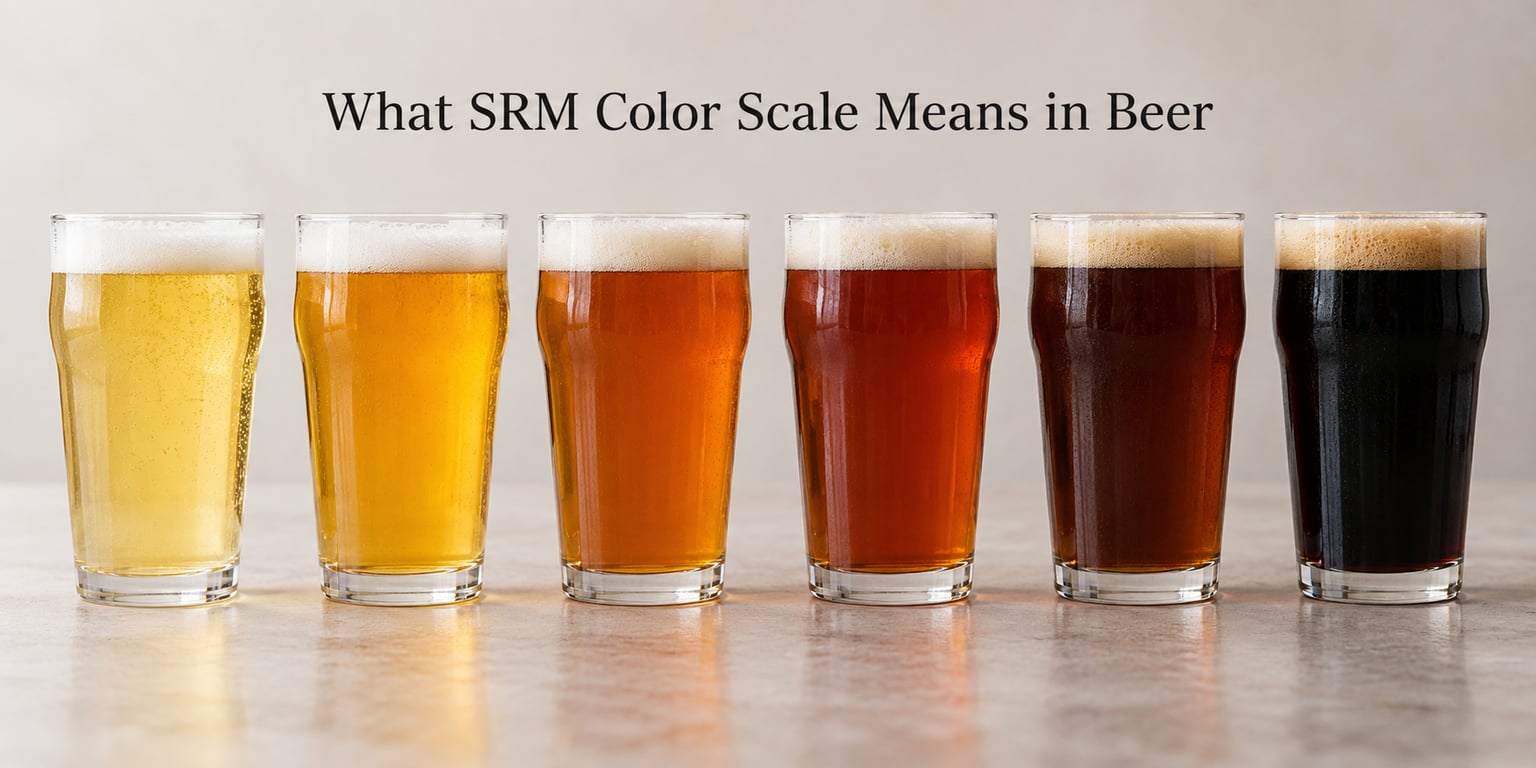
To put it plainly: the SRM color scale means a measurement of darkness, on a logarithmic scale from roughly 1 to 40 and beyond, where each number corresponds to a named shade of beer. It was standardized by the American Society of Brewing Chemists (ASBC) in 1950, and a higher SRM number always means a darker beer, never a stronger or better one.
Concretely, an SRM value comes from how much blue light at 430 nanometres a beer absorbs when a beam passes through a one-centimetre sample. Shine light through beer, measure the drop in intensity, take the logarithm of that absorption and multiply by 12.7. Everything else on this page is downstream of that one measurement.
It works as a shared language for the same reason IBU does. A brewer specs a batch against a target, a competition judge scores it against the style guidelines, and a drinker on a tap list uses it to predict the general character of the beer before committing.
How the SRM Color Scale Works
Long before SRM, malt was graded by eye against tinted glass standards. Joseph Lovibond built a tint scale for that in the 1880s, and it survived as the Series 52 Lovibond scale still printed on malt spec sheets. The American industry needed something better for finished beer, so a standards group worked up a spectrophotometric method that became the ASBC method in 1950.
Beer absorbs light unevenly. The wavelengths around 430 nm, in the blue-violet range, get swallowed most readily as a beer’s color deepens. Measuring absorbance there gives a clean, repeatable number that doesn’t depend on who’s holding the glass.
The logarithmic part matters more than it sounds. Going from 2 SRM to 4 SRM is a big visual jump, pale straw to pale gold. Going from 36 SRM to 38 SRM is nearly invisible. A linear scale would bunch every dark beer into one useless column, so the SRM scale stretches out the light end where human eyes are most sensitive.
Two things follow from that. First, small differences at the pale end matter and small differences at the dark end don’t. Second, once a beer goes properly dark, it’s very hard to measure precisely without diluting it, because you run out of light to measure.
What the SRM Numbers Look Like in Practice
Here’s the canonical ladder. These are the twelve named color bands most reference charts use, and they’re worth learning because they’re the vocabulary used in style guidelines and judging sheets.
| SRM | Color name | Styles that usually live here |
|---|---|---|
| 2 | Pale straw | Pilsner, pale lager, light bock |
| 3 | Straw | Pilsner, Hefeweizen, session lager |
| 4 | Pale gold | German pils, Belgian witbier |
| 6 | Deep gold | Pale lager, blonde ale, Kolsch |
| 9 | Pale amber | Amber lager, pale ale, bitter |
| 12 | Medium amber | IPA, amber ale, English bitter |
| 15 | Deep amber | IPA, amber ale, Vienna lager |
| 18 | Amber-brown | Bock, doppelbock, strong ale |
| 20 | Brown | Bock, porter, munich dunkel |
| 24 | Ruby brown | Porter, brown ale, english brown ale |
| 30 | Deep brown | Stout, schwarzbier, american porter |
| 40 | Black | Oatmeal stout, imperial stout, barleywine-aged |
What SRM Color Scale Means in Beer for Each Style
The same ladder maps onto style guidelines, where SRM appears as a range rather than a single number. Treat those ranges as expectations, not pass-fail limits. A 9 SRM hefeweizen is unusual, not defective.
| Style | Typical SRM range | What drives the color |
|---|---|---|
| Pilsner | 2-7 | Pale malt, low roast |
| Pale lager | 2-10 | Pale malt, light kilning |
| Hefeweizen | 4-8 | Wheat, pale malt |
| Amber lager | 8-18 | Munich and caramel malts |
| Pale ale | 8-14 | Caramel and crystal malt |
| IPA | 6-14 | Caramel malt for balance |
| Bock | 8-25 | Munich, caramel and dark malts |
| Porter | 8-25 | Chocolate and brown malt |
| Stout | 25-60 | Roasted barley |
| Schwarzbier | 15-50 | Roasted malt plus dark specialty malt |
| Imperial stout | 50-80 | Heavy roast, long boils, sometimes aged |
Why Beer Color Can Look Different From Its SRM Number
An SRM reading is standardized. The beer in your hand is not. Lighting alone can shift what you see by a surprising margin, which is why the BJCP’s own guidance puts expected visual error at roughly 15 percent in daylight and around 20 percent under tungsten bulbs.
Glass shape does more than people expect. A tall narrow tulip shows a deep column of beer and reads darker than the same beer in a wide-rimmed snifter. Hold two glasses of identical beer side by side in different glassware and I’d bet on the wrong one every time.
Temperature shifts things too. Cold beer looks duller and slightly darker, and it releases less carbonation as it warms. A hazy or unfiltered beer scatters light and looks lighter and more opaque than a crystal-clear beer of the same color, because that haze scatters every wavelength at once.
Then there’s the head, the pour and the background. A thick rocky head hides the top of the glass, foam casts a milky veil, and holding a beer up against a dark bar wall or a white napkin changes the number you think you see. Viewing angle matters, too: a beer held at a steep angle can read a full shade lighter than the same beer held level.
None of this makes SRM useless. It makes it a measurement of the liquid under stated conditions, not a promise about your eyes on a Tuesday night.
How to Read a Beer’s SRM Rating
In other words, what SRM color scale means in beer comes down to one variable only: how dark the liquid is. It is not a measure of anything else, which is why it sits on a tap list next to four other numbers rather than replacing them.
Reading SRM is mostly pattern recognition. Find the number, find the band on the ladder above, and decide whether the style that number sits in matches what the style guidelines say should happen.
Three Tap List Examples
A pale lager listed at 4 SRM. That’s pale gold, firmly inside the pilsner and pale lager range. Expect crisp, light, clean fermentation character with almost no roast or caramel. Nothing surprising there.
An IPA listed at 8 SRM. Pale amber, which is normal for a hop-forward beer. Caramel or crystal malt is doing the color work here, and it usually means a touch of malt sweetness underneath. The SRM tells you nothing about how many IBUs are coming.
A stout listed at 38 SRM. Near-black by the standards of the ladder, sitting at the bottom of the stout range. Expect roasted barley flavors at full strength, and expect the glass to look opaque. This is also where measuring starts to get difficult, because there’s so little light getting through.
One habit worth building: read the SRM, the style and the ABV together. A 40 SRM beer at 5.8 percent and a 40 SRM beer at 12 percent are not remotely the same drinking experience, and the color number is identical in both cases.
SRM Next to IBU, ABV and OG
Brewery spec sheets and recipe posts bundle four numbers together, and people read them as one blob. They’re four independent measurements, and they answer four different questions.
| Number | What it measures | What it does not measure |
|---|---|---|
| SRM | Darkness of the finished beer | Hue, hop aroma, bitterness, strength, quality |
| OG | Density of wort before fermentation | How strong the beer ends up, on its own |
| IBU | Hop-derived bitterness in the finished beer | Hop aroma, which is a completely separate compound story |
| ABV | Alcohol by volume in the finished beer | Color, bitterness, or anything about the recipe |
Answering the common “what is SRM and IBU in beer” question directly: SRM is color, IBU is bitterness, and neither one predicts the other. Plenty of 60 IBU IPAs sit at 6 SRM, and plenty of 8 IBU amber ales sit at 18.
What Changes SRM in Homebrewing
Color comes from the grain bill and from what happens to the wort afterward. Base malts like pale malt and Pilsner sit low, Munich sits a bit higher, and the big jumps come from kilned specialty malts: crystal adds deep amber, chocolate and roasted barley push toward black.
Then the processing steps start adding color of their own. The Maillard reaction kicks in during the boil and darkens wort as it concentrates. Longer boils run darker. Mash pH shifts the balance too, and different yeast strains leave finished beer at slightly different shades depending on how they metabolize wort sugars.
Adjuncts like caramel and roasted barley can be added late in the boil, where they contribute color with very little flavor. Filtration and settling matter as well, since suspended yeast and protein haze can lighten or muddy a finished beer’s appearance noticeably.
Homebrew recipe software predicts finished color with a two-step calculation. First, MCU for each grain is its weight in pounds multiplied by its color in degrees Lovibond. Then those totals get summed and divided by gallons of water in the batch to get total MCU, and the Morey equation applies a correction for the volume lost to grain absorption and evaporation. Dan Morey published the formula in 1995 in Brewing Techniques, and it’s been the backbone of recipe prediction ever since.
Everyone who homebrews eventually notices the same thing: software predictions run light in practice, sometimes by ten SRM or more on dark beers. Roast level, boil concentration and yeast strain all push past what the equation accounts for. Predicted color is a starting point for a recipe, not a promise about the glass.
How to Measure SRM at Home
You have three practical options, and each one has a different level of precision.
A printed color chart. The BJCP Color Guide is the reference instrument most people trust, and for good reason. The judge-facing protocol is specific: hold the beer in a 5 cm path against a white background, view it in 6500 K daylight rather than under a tungsten lamp, let any foam settle or remove it, and match the body of the beer to the closest swatch. Repeat at different points in the glass in case the beer is stratified.
A spectrophotometer. This is the accurate version, and it’s how the ASBC method actually works. Measure absorbance at 430 nm through a 1 cm cuvette of clear, de-gassed, filtered beer, multiply the absorbance by 10 for SRM. It’s fast, repeatable, and it’s the only method that produces a number you can compare against a published spec. Filtering matters: turbidity above roughly 1 EBC turbidity reading will drag the result dark.
Side-by-side against another beer. Grab a bottle of something whose color you know and pour them next to each other. This is the least precise option and the most useful one at a bar. You’ll reliably tell a 6 SRM pale beer from a 30 SRM stout, and you’ll never reliably tell 30 from 32.
Dark beers need one extra step. Once you get past roughly 20 SRM, dilute a measured sample with distilled water, read it, then multiply back by the dilution factor. The catch is that dilution results get nonlinear at the dark end, so keep the dilution modest and read several steps rather than guessing at one.
Converting Between SRM, Lovibond and EBC
European beer uses EBC, the European Beer Color scale, which measures at 530 nm instead of 430 nm. The conversion is simple: EBC equals SRM multiplied by 1.97, so 10 SRM is about 19.7 EBC.
You’ll also see a factor of 3.94 quoted by some brewing sources. That’s a real discrepancy rather than a typo, and the commonest explanation is that the two figures come from methods operating on different wavelength conventions. Where a brewery prints an EBC figure on a bottle, the 1.97 multiplier is the one that holds up against European reference data.
Lovibond is the odd one out. For light beers, degrees Lovibond and SRM are close enough to be treated as interchangeable in casual conversation. Above about 10, they diverge sharply, and treating them as the same number is the single most common color mistake made in homebrewing recipe planning. A malt listed at 300 Lovibond is not a 300 SRM beer.
What SRM Does Not Tell You
SRM measures darkness. That’s it. Everything below is outside the number.
- Hop bitterness. IBU covers this, and a pale IPA can be aggressively bitter while an amber porter barely registers.
- Hop aroma. Aroma comes from volatilized hop oils and has no relationship whatsoever to color.
- Sweetness. Residual sugar and caramel malt both read as color without telling you anything about sweetness.
- Alcohol strength. A 4.5 percent pilsner and a 9 percent doppelbock can share an SRM band.
- Carbonation. A flat and a sparkling beer of identical color read identically on the scale.
- Freshness. Lightstruck beer, oxidation and stale grain all stay the same color.
- Flavor and aroma. Dark color in a stout signals roast. Pale color in a pilsner signals nothing at all about the crispness waiting for you.
- Quality. Brewers say it constantly, and forum threads say it more: a beer can hit its SRM target perfectly and still be bad.
One genuine nuance worth keeping: drinkers do report that color primes expectations. A glass that looks dark gets judged as roasty and warming before the first sip, and a pale one gets judged as clean and sharp. That’s a real perceptual effect. It is not a measurement, and it tells you nothing about what’s actually in the glass.
Frequently Asked Questions
What is SRM in beer?
SRM stands for Standard Reference Method, the beer color scale adopted by the American Society of Brewing Chemists in 1950. It rates darkness on a logarithmic scale running from about 1-2 for pale straw up to 40 and beyond for near-black stouts. A higher number means a darker beer. It says nothing about bitterness, strength or quality.
Are SRM and Lovibond the same?
Not above about 10 SRM. For light beers the two numbers are close enough that people treat them as interchangeable, which is where the trouble starts. A malt listed at 300 degrees Lovibond will not produce a 300 SRM beer. When reading a malt spec sheet, remember Lovibond describes the grain, while SRM describes the finished beer.
How do I convert Lovibond to SRM?
There isn’t a reliable direct conversion, which is why the two get confused. Below roughly 10 they sit close together, so many brewers substitute one for the other in early recipe planning. Above that the gap widens quickly. A better approach is to sum the weight in pounds times degrees Lovibond for each grain to get MCU, then apply the Morey equation to predict finished SRM.
What does EBC mean in brewing?
EBC stands for European Beer Color, the European counterpart to SRM. It measures absorbance at 530 nanometres instead of 430, so the numbers run higher. The standard conversion is EBC equals SRM multiplied by 1.97, which puts a 10 SRM beer at roughly 20 EBC. If a bottle from Europe prints an EBC figure, that is what it converts from.
What SRM should I expect for common beer styles?
Pilsner usually sits between 2 and 7 SRM. Pale ales and IPAs land around 6 to 14. Porters run roughly 8 to 25, amber lagers about 8 to 18, and bocks fall between 8 and 25. Stouts start near 25 and climb to 60, while imperial stouts reach 50 to 80 and go nearly opaque. These are style expectations rather than strict limits.
Does a higher SRM mean more hops or better beer?
No to both. Higher SRM means darker, and darkness comes mostly from roasted and kilned grain, not from hops. Hops contribute no color at all; bitterness is measured separately in IBU. As for quality, brewers regularly produce beers that nail their SRM target and still taste flat, because color is a single attribute among many.
Conclusion: Start With the SRM Range
Take the SRM range from the style guidelines, then check the beer’s listed number against it. If a pilsner says 4, you’re looking at pale gold and a light, clean drinking experience. If an imperial stout says 60, you’re looking at something nearly black and intensely roasted. Now pair that with the IBU and ABV sitting next to it on the tap list, and you have a usable picture of the beer before the first sip.
The number is a color reference, nothing more. Color influences how you expect a beer to taste, but it doesn’t deliver flavor, bitterness or balance on its own.