The short version: both are hop-forward ales, but an India Pale Ale is brewed with more hops, more bitterness and usually more alcohol than a pale ale. A pale ale keeps a noticeable malt backbone, while an IPA lets hops take over the glass. Everything else on a tap list is variation within those two ideas.
That is roughly 45 words of answer, and it holds up most of the time. It also leaves out the part that actually confuses people at the bar: the line between the styles is drawn by convention, not by law, so plenty of modern commercial beers sit in the gap between them.
Table of Contents
- IPA vs Pale Ale at a Glance
- What Is the Difference Between an IPA and a Pale Ale?
- Both styles are ales
- Hop Character and Bitterness
- Why IBU numbers mislead you
- Malt, Color, Body, and Carbonation
- Hops vs Pale Ale’s Hop-to-Malt Balance
- Which Should You Choose?
- Glassware and serving temperature
- A note on the style names
- Frequently Asked Questions
- Is a pale ale just a milder IPA?
- Is Blue Moon an IPA?
- Which is more bitter, and is an IPA always stronger?
- What ABV and IBU ranges should I expect?
- Is one of them healthier or lower in calories?
- How do I tell which style a beer on a tap list is?
- Conclusion
IPA vs Pale Ale at a Glance
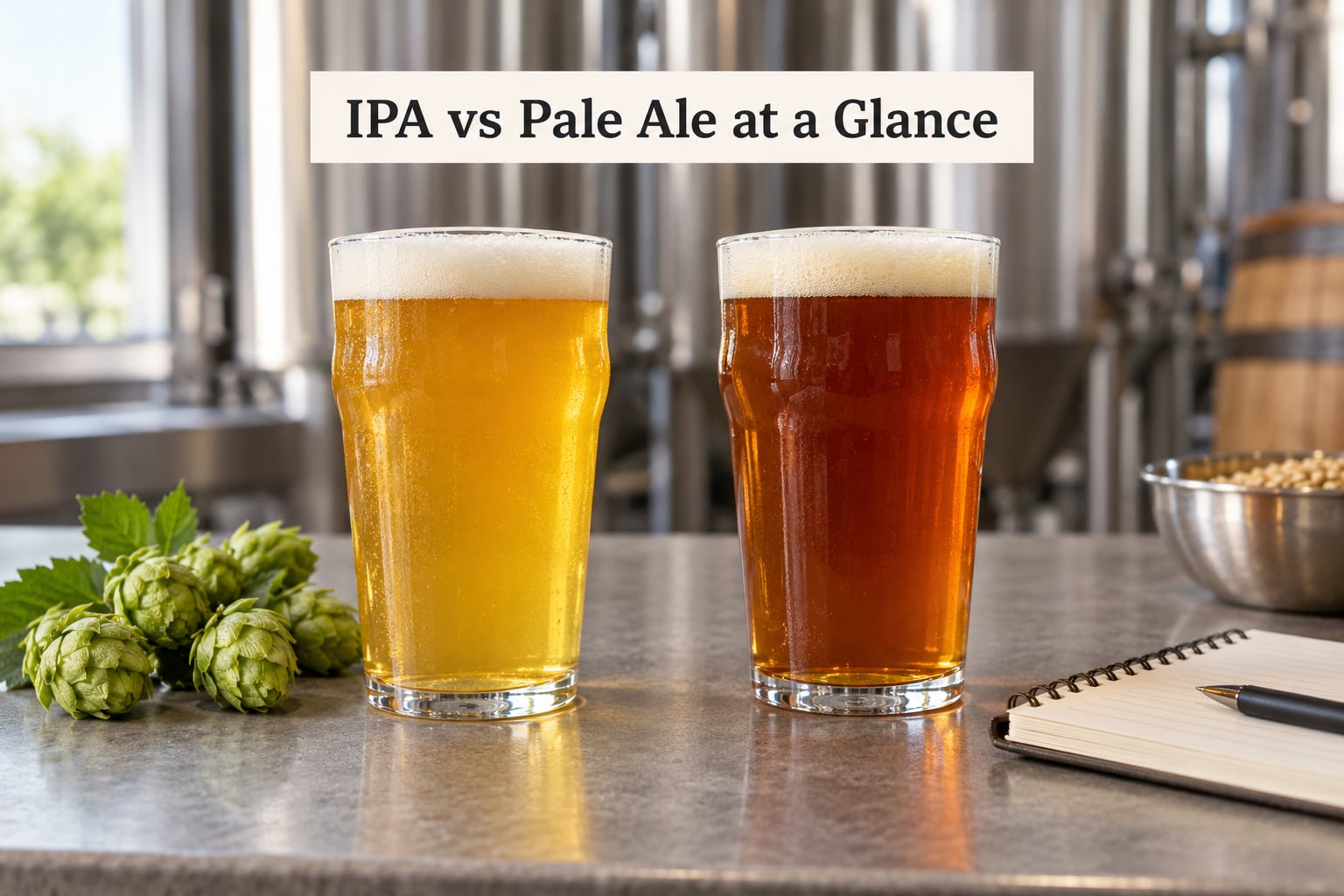
| Category | Pale Ale | India Pale Ale |
|---|---|---|
| Core idea | Balanced ale where hops and malt both register | Hop-forward ale where hops are the point |
| Typical ABV | 4.5 to 6.2 percent | 5.5 to 7.5 percent |
| Typical bitterness | Roughly 30 to 50 IBU | Roughly 40 to 70+ IBU |
| Hop character | Grassy, floral, citrus or pine, moderate | Resinous, tropical, dank or juicy, intense |
| Malt role | Caramel, biscuit, bread or honey stays noticeable | Simple pale malt floor, often drier |
| Appearance | Gold to copper, usually clear | Gold to deep amber, hazy styles are cloudy |
| Body | Medium, easy-drinking | Medium to full, sometimes slick and dry |
| Sessionable | Often, especially English examples | Only session IPAs, which sit near pale ale strength |
| Best for | Beginners, weeknight dinners, shared bottles | Hop fans, spicy food, long tasting flights |
| BJCP 2021 category | 18A American Pale Ale, 18B English Pale Ale | 21A American IPA, 21B English IPA, 21C Hazy IPA |
Those ranges come from how the style is brewed and judged, not from a single rulebook that every brewery follows. Where the numbers help is describing what you are likely to taste.
What Is the Difference Between an IPA and a Pale Ale?
A pale ale is an ale of noticeable but restrained hop flavor over a malt base you can still taste. An IPA takes the same ingredients and pushes the hops and the alcohol until hop character is the loudest thing in the beer.
Both come from the same family tree. Pale ale is an older idea, and India Pale Ale was literally a pale ale made for export to India, heavily hopped partly for flavor and partly because unrefrigerated sea voyages rewarded stability. American brewers later pushed that style further during the craft boom of the 1980s and 1990s, and the version of IPA most people drink today descends from that push.
So the IPA vs pale ale difference is a difference of degree that became a difference of category. Ask ten brewers where the line sits and you will get ten answers, which is why you sometimes see a heavily hopped beer labeled as a pale ale and a gentle one labeled as an IPA.
Both styles are ales
Neither style is fermented with the cooler bottom-fermenting yeast used for lager. That detail matters mainly because it rules out the most common mix-up: a pale lager or a blonde ale is not a pale ale, even though the word pale is doing very different work in the two names.
Hop Character and Bitterness
Hop character is the biggest practical difference between the two styles, and bitterness is the part people measure badly.
A pale ale usually shows hops as a supporting flavor: grassy, floral, lightly citrusy or a clean pine note. The bitterness sits in the background and usually finishes soft enough that you notice it only after the beer is gone.
An IPA foregrounds hops instead. Expect more aroma straight off the pour, more resinous or grassy grip in the finish, and a bitterness that some drinkers describe as bitterness and others describe as grapefruit pith or pine. West Coast examples lean clear, dry and sharply bitter. Hazy examples trade sharp edges for a cloudy, juicy, almost pulpy hop flavor that reads sweeter than the numbers suggest.
Why IBU numbers mislead you
IBU measures how much bitterness came from hops, and it does not measure how bitter the beer tastes. A hazy IPA can register modest IBU and taste intensely hoppy because suspended yeast and proteins soften the perceived bite while the hop oils stay aromatic. That mismatch between a printed number and your tongue is one of the most common reasons people say a beer is mislabeled.
Homebrewers often use the bitterness-to-gravity ratio, roughly 0.7 for a pale ale and 0.85 for an IPA, as a better technical signal than IBU alone. You will not see that printed on a tap handle, but it explains why two beers at the same IBU can feel completely different.
Malt, Color, Body, and Carbonation
Malt is where the pale ale earns its name and its balance. Grain bills for pale ales usually include some crystal or caramel malt, which adds toffee, biscuit crust or honey sweetness that keeps the hop bitterness from taking over.
IPA grists tend to be simpler: pale two-row malt with a light specialty addition, sometimes oats or wheat for texture in hazy styles. The result is a drier, thinner malt floor, which lets a large hop charge read as pure flavor instead of as one note fighting another.
Color is not a style marker, whatever the names suggest. Pale ales run from pale gold to copper, and IPAs span that range plus everything darker, including black IPAs that are closer to a porter in color. Body and carbonation vary more by brewery than by label: a hazy IPA can be soft and low in carbonation while a West Coast IPA from the same brewery is bone dry and heavily carbonated.
Hops vs Pale Ale’s Hop-to-Malt Balance
The clearest way to taste the difference is to hold the balance in your mouth. In a pale ale, both halves stay in the conversation. Swallow and you still get the malt.
In an IPA, hop intensity is allowed to become the main event, and the malt steps back to a supporting role. That is not a flaw in either style. It is two different design intentions, and the beer is more interesting when you can tell which one you are drinking.
Three profiles come up constantly when people compare the styles, mostly because they are the usual source of confusion:
- American pale ale vs American IPA: the American pale ale is the ancestor, medium-bodied with caramel malt and moderate American hop flavor. The American IPA is that idea scaled up: drier, more bitter, more aromatic.
- English pale ale vs English IPA: English pale ales are maltier, softer and often lower in alcohol, with earthy and herbal hops. English IPAs are stronger and fruitier, with spicy, peppery English hop character. Modern American IPAs are usually stronger than either.
- Hazy IPA vs pale ale: the hazy IPA reads as fruit juice to newcomers because cloudiness mutes the perceived bitterness. Underneath, it is an IPA by recipe and by how it was brewed.
If you are ordering from a bar list and cannot tell which is which, session IPAs are the trap in both directions. At 3.2 to 4.6 percent ABV they are brewed toward pale ale strength, but many are hopped like IPAs, so they land squarely in the overlap.
Which Should You Choose?
Choose a pale ale if you are new to craft beer, you like to taste malt, or you are drinking something with dinner that should not fight the food. Choose an IPA if you actively want more bitterness, more aroma and a stronger sense of hops, especially with spicy or rich food where a mild pale ale would disappear.
Here is how I would break it down at the bar:
- First beer at a new place: start with a moderate American pale ale. You learn what hops taste like without a lesson in bitterness tolerance.
- You want big flavor with barbecue, tacos or curry: go for an American IPA or a hazy IPA. The bitterness and aroma hold up against heat and fat.
- Long afternoon, more than one drink: an English pale ale or a session IPA. Low alcohol keeps the second and third round tasting like the first.
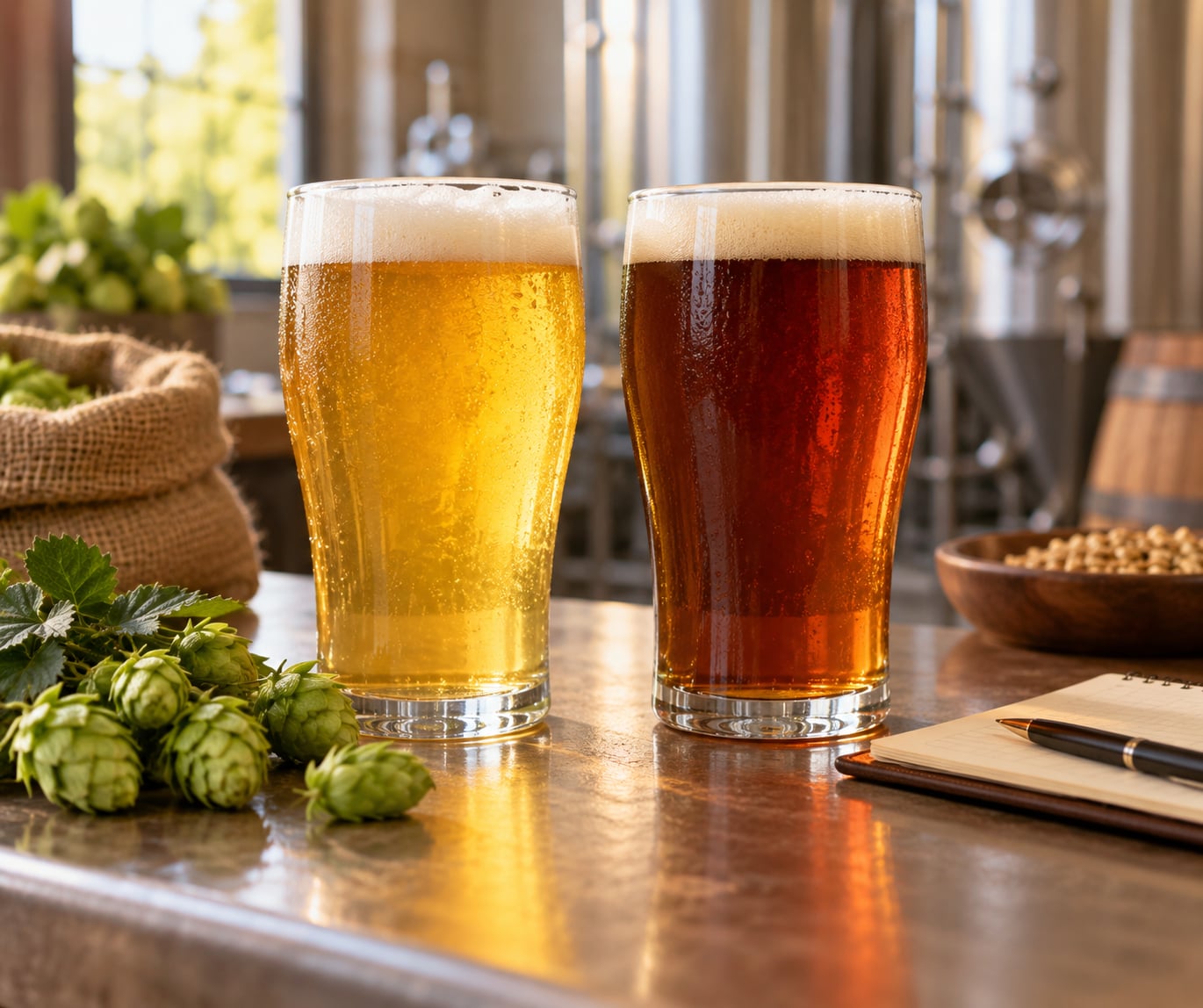
- Tasting flight of several beers: put a pale ale next to an IPA. The contrast teaches you more than either one alone.
- You do not like bitter beer: start with a blonde ale or a session IPA, not a pale ale. Those are usually the gentlest hop entry points.
Glassware and serving temperature
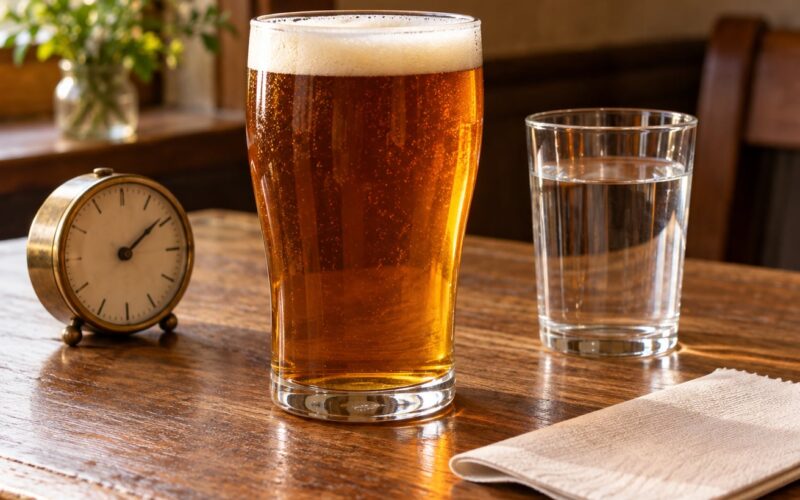
No competitor in this space bothers to mention it, so: pour both styles into a stemmed tulip or a nonic pint, not a shallow mug, because the narrowing bowl keeps the aroma where your nose can find it.
Serve pale ales around 40 to 45 degrees Fahrenheit, cool enough to be refreshing and warm enough to hold aroma. IPAs sit slightly cooler, 38 to 45 degrees, because chilling mutes perceived bitterness and lets delicate hop aroma come through. If a beer tastes sharper than you expected, it may simply need to be colder.
A note on the style names
Breweries label for the shelf as much as for the recipe. Beers get marketed as IPAs to signal intensity and price, and pale ale became a way to signal approachability. If the numbers on the can matter to you, read the ABV and the hop description rather than trusting the style line.
Frequently Asked Questions
Is a pale ale just a milder IPA?
Not exactly. A pale ale is not a diluted IPA; it is a different recipe intention. Pale ales use more caramel and crystal malt for balance and stay lower in alcohol and bitterness. IPAs use a simpler, drier grist, more hops added late in the brew, and usually more alcohol. Treat them as neighbors rather than a strong and weak version of the same beer.
Is Blue Moon an IPA?
No. Blue Moon is a Belgian-style wheat ale, brewed with unmalted wheat and orange peel, and it is not an India Pale Ale. It is not a pale ale either, despite the pale gold color. Wheat ales tend to taste soft, citrusy and slightly spicy, with very low perceived bitterness, which is a completely different profile from either style in this guide.
Which is more bitter, and is an IPA always stronger?
An IPA is generally more bitter, typically 40 to 70 or more IBU against about 30 to 50 IBU for a pale ale. Stronger is less reliable. Alcohol strength and bitterness are set separately in the recipe, so you can find a strong pale ale and a low-alcohol session IPA. Read the ABV on the can if strength matters to you.
What ABV and IBU ranges should I expect?
Pale ales usually land between 4.5 and 6.2 percent ABV with roughly 30 to 50 IBU. American IPAs typically run 5.5 to 7.5 percent ABV with about 40 to 70 or more IBU, and double IPAs go higher still. English pale ales and session IPAs sit at the lower end of those ranges. Hazy IPAs can look mild and taste strong at the same time.
Is one of them healthier or lower in calories?
There is no meaningful health difference between the two styles. Calories and carbohydrates track alcohol content and residual sugar rather than style, so a 7 percent double IPA carries more of both than a 5 percent pale ale. The larger practical difference is how much you drink: a 5.5 percent session IPA is easier to overdo than a 7.5 percent IPA you notice quickly.
How do I tell which style a beer on a tap list is?
Look for the ABV and the hop description. Higher alcohol plus words like citrus, pine, tropical, resinous or hazy usually means IPA. Lower alcohol plus biscuit, caramel, toast, honey or herbal notes usually means pale ale. If the list has neither, ask the bartender for the style, and if the answer is vague, order something else and move on.
Conclusion
So the IPA vs pale ale difference comes down to how much hop character the brewer let loose and how much malt stayed in the glass. Start with a pale ale if you want balance and a visible malt backbone; start with an IPA if you want stronger bitterness and bigger aroma. Buy one of each, taste them side by side, and the line stops being abstract in about two minutes.