To calculate keg PSI for desired carbonation you need two numbers: the volumes of CO2 you want dissolved in the beer, and the actual temperature of that beer inside the keg. Find those two on a carbonation chart and read across, or run them through the published formula, and you get a gauge pressure you can set on your regulator.
That is the whole method. The reason it feels murky is that forums quote everything from 10 psi to 40 psi as correct, and they are not contradicting each other; they are describing two different jobs, carbonating and serving.
Cold beer holds more gas than warm beer, which is the single idea behind every number on the chart. Get that one concept straight and the rest is lookup work. These figures come from the ASBC-derived force carbonation charts and Palmer’s How To Brew, and they still hold in 2026.
Table of Contents
- What You Need
- Step-by-Step: How to Calculate Keg PSI for Desired Carbonation
- 1. Choose the carbonation level for your beer
- 2. Measure the beer temperature accurately
- 3. Find the pressure for that temperature
- How to calculate keg PSI for desired carbonation with the formula
- Adjust for altitude
- 4. Set the regulator and connect the keg
- 5. Let the beer carbonate and test the result
- Common Mistakes
- Frequently Asked Questions
- How much PSI should I use for a keg?
- Does the beer need to be colder to carbonate?
- Can I use the same keg pressure for every beer style?
- How long does it take for a keg to carbonate?
- Should I reduce pressure before serving a keg?
- Is it safe to turn a CO2 regulator to the maximum?
What You Need
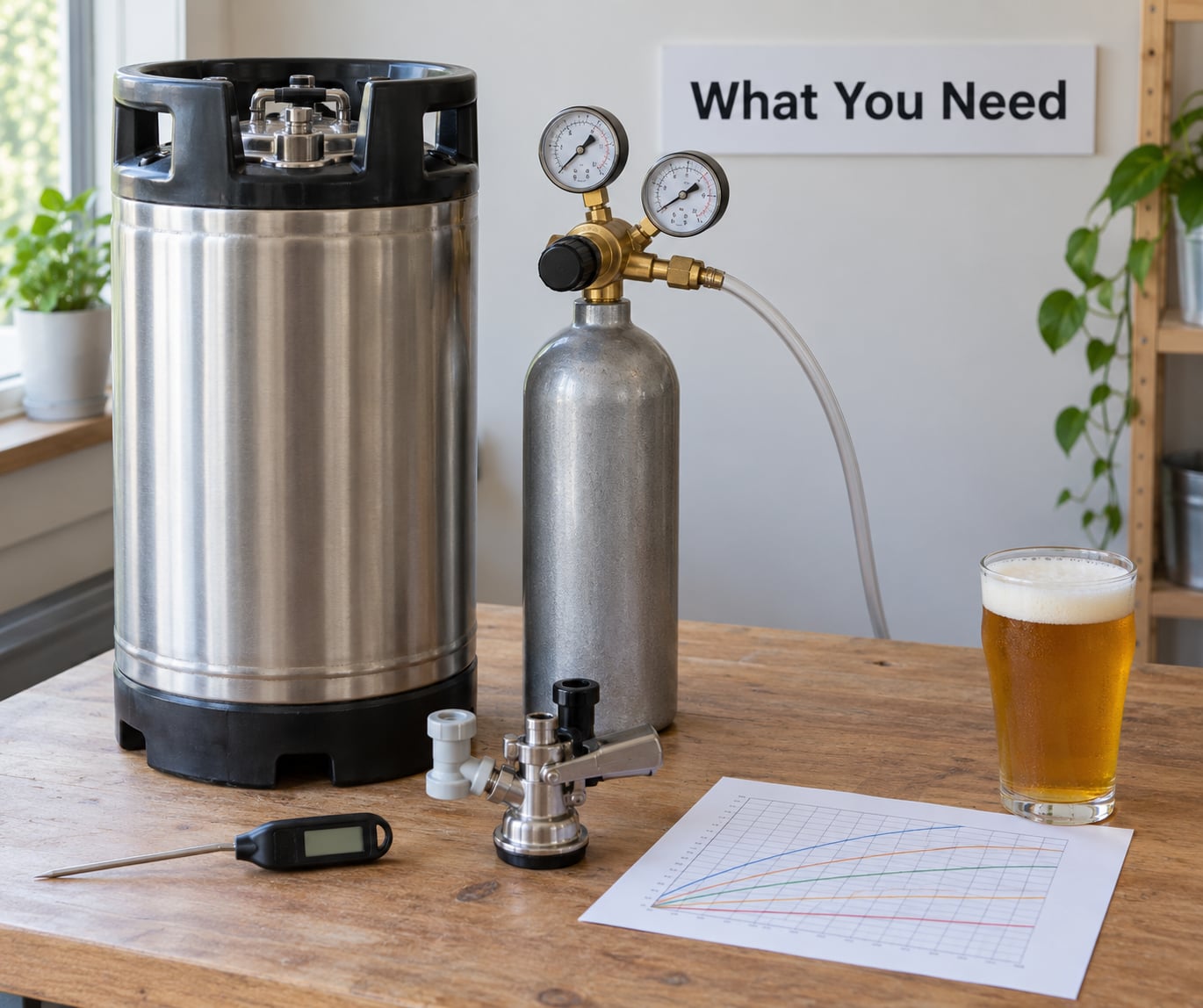
Six things, and two of them are data rather than hardware.
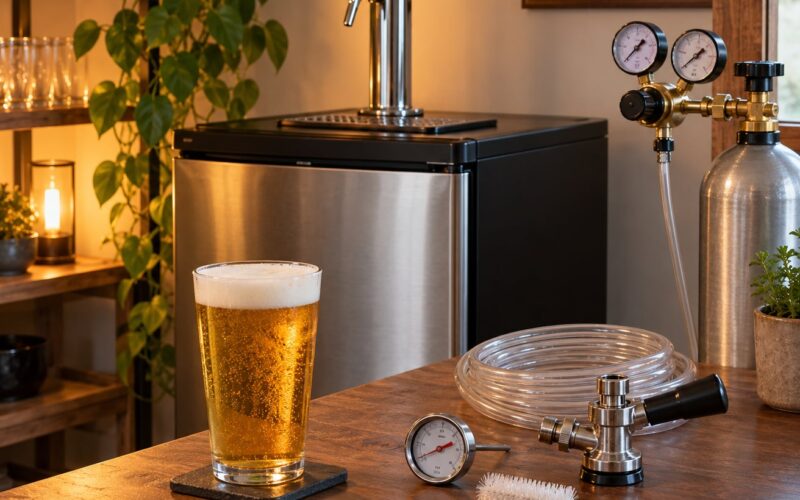
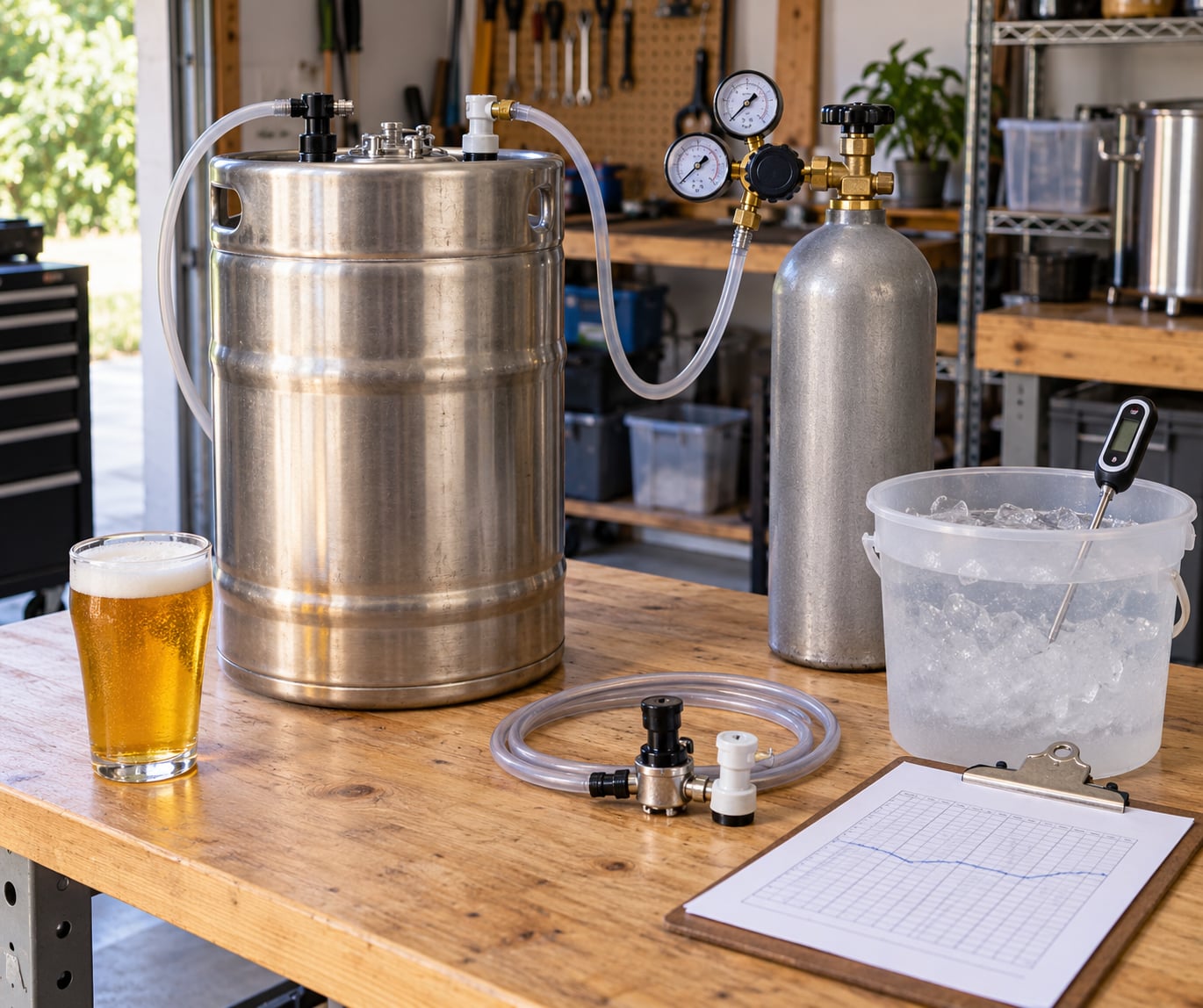
- A working regulator — a two-gauge model shows cylinder pressure on one side and the outlet pressure you are setting on the other. A single-gauge unit makes this job guesswork.
- A CO2 cylinder that is heavy enough to hold pressure for days, not just an afternoon.
- A thermometer that reads the liquid, not the air. A fridge dial or a thermostat is not enough; an inexpensive digital probe in a party bucket of ice water is enough to calibrate one.
- A keg, coupler and gas line rated for the pressure you plan to use.
- A target in volumes of CO2 for the style you brewed.
- A carbonation chart, either printed or on your phone, plus your local barometric pressure if you brew above roughly 1,000 feet.
The chart is the part people skip, then wonder why their keg tastes flat. Everything below is lookup work once you have those six.
Step-by-Step: How to Calculate Keg PSI for Desired Carbonation
1. Choose the carbonation level for your beer
Carbonation is measured in volumes of CO2, which simply means how many cubic feet of gas at standard conditions sit dissolved in one cubic foot of beer. A 2.5-volume beer holds 2.5 cubic feet of CO2 per cubic foot of liquid. Style sets the target, and the table below covers most brewing territory.
| Beer style | Target volumes of CO2 |
|---|---|
| British ales, Scotch ales, Irish reds | 1.5 to 2.0 |
| Dry stout, porter | 1.5 to 2.0 |
| Oatmeal stout, sweet stout | 2.0 to 2.5 |
| English pale ale, American brown ale, Belgian strong dark | 2.0 to 2.5 |
| Pale ale, India pale ale, pilsner, saison | 2.5 to 3.0 |
| American wheat, hefeweizen, dunkelweizen | 2.5 to 3.5 |
| Berliner weisse, gose, lambic | 2.5 to 3.5 |
| German wheat beer, high-gravity weizen | 3.3 to 4.5 |
If you also track strength in your brew log, how to calculate ABV at home sits next to this same step in most brewers’ notebooks, and the two numbers together describe most of what a finished beer is.
Pick a single number rather than a range before you move on. Homebrewers who leave it at “somewhere between 2 and 3” end up guessing at the regulator.
2. Measure the beer temperature accurately
Measure the liquid in the keg, not the air in the fridge. A keezer set to 38 F on its dial can hold beer at 42 F, and that four-degree gap is roughly a 1.5 psi difference in the final result. Plenty of flat kegs on the internet are flat for exactly this reason.
The cleanest routine is to drop the probe into the keg through the spear or into a sample of the beer drawn from the same vessel, then read the number once it has stopped moving. Cold crashing to 35 F or below before you connect the gas shortens the wait and makes the calculation more accurate, because a colder target needs a more precise pressure.
Colder always means higher pressure for the same result. A beer you want at 2.5 volumes needs about 10.5 psi at 38 F but closer to 9.3 psi at 35 F and 11.6 psi at 40 F. If your answer is wrong by a pound or two, check this number first.
3. Find the pressure for that temperature
Read the table below at the row for your measured temperature and the column for your target volumes. Values are gauge pressure at sea level, with bar and kPa for metric regulators.
| Beer temperature | 1.5 volumes | 2.0 volumes | 2.5 volumes | 3.0 volumes |
|---|---|---|---|---|
| 30 F (-1 C) | 3.0 psi / 0.21 bar | 5.1 psi / 0.35 bar | 7.3 psi / 0.50 bar | 9.5 psi / 0.66 bar |
| 35 F (2 C) | 4.0 psi / 0.28 bar | 6.6 psi / 0.46 bar | 9.3 psi / 0.64 bar | 12.0 psi / 0.83 bar |
| 38 F (3 C) | 4.6 psi / 0.32 bar | 7.5 psi / 0.52 bar | 10.5 psi / 0.72 bar | 13.5 psi / 0.93 bar |
| 40 F (4 C) | 5.2 psi / 0.36 bar | 8.3 psi / 0.57 bar | 11.6 psi / 0.80 bar | 14.8 psi / 1.02 bar |
| 45 F (7 C) | 7.0 psi / 0.48 bar | 10.9 psi / 0.75 bar | 14.9 psi / 1.03 bar | 18.9 psi / 1.30 bar |
| 50 F (10 C) | 9.0 psi / 0.62 bar | 13.5 psi / 0.93 bar | 18.1 psi / 1.25 bar | 22.6 psi / 1.56 bar |
| 55 F (13 C) | 11.0 psi / 0.76 bar | 16.3 psi / 1.12 bar | 21.6 psi / 1.49 bar | 26.9 psi / 1.85 bar |
| 60 F (16 C) | 13.2 psi / 0.91 bar | 19.4 psi / 1.34 bar | 25.5 psi / 1.76 bar | 31.6 psi / 2.18 bar |
How to calculate keg PSI for desired carbonation with the formula
If you would rather compute than look up, the published regression behind these charts is:
PSI = 3.0957 – (0.50242 x T) + (0.00344 x T squared) + (V x slope correction factor)
T is temperature in Celsius and V is your target volumes of CO2. The slope correction factor is the small adjustment that accounts for beer holding less CO2 than pure water at the same temperature. Using water-based Henry’s Law constants gives numbers a fraction of a pound off the empirical beer data, which is why calculators and printed charts disagree by a few tenths of a psi.
Here is what that looks like for five popular styles, all measured at 38 F.
| Beer | Target volumes | Regulator setting at 38 F | Method |
|---|---|---|---|
| American pale ale | 2.5 | 10.5 psi (0.72 bar) | Set and forget, 10 to 14 days |
| Pilsner | 2.5 to 3.0 | 10.5 to 13.5 psi (0.72 to 0.93 bar) | Set and forget, 10 to 14 days |
| Dry stout | 1.5 to 2.0 | 4.6 to 7.5 psi (0.32 to 0.52 bar) | Set and forget, 7 to 10 days |
| American wheat | 2.5 to 3.5 | 10.5 psi, bump toward 15 psi only if needed | Set and forget, 10 to 14 days |
| Kegged soda or seltzer | 3.5 to 4.5 | 16 to 20 psi | Burst, 24 to 48 hours |
Soda carries far more gas than beer because sugar and cold temperature shift the equilibrium, which is why a seltzer recipe from a brewing forum lands in the 30 to 40 psi range for a day or two and then drops.
Adjust for altitude
Charts assume sea-level barometric pressure. Your regulator gauge reads pressure above whatever the atmosphere is doing outside, so at altitude you need more gauge pressure to reach the same absolute pressure. The common working rule adds roughly 2.6 psi at 5,280 feet, which turns a 2.5-volume target at 38 F from about 10.8 psi at sea level into about 13.4 psi in Denver.
Below a thousand feet, ignore this entirely. Washington sits under a hundred feet, and a one-degree change in the barometer will never register on a homebrew keg.
4. Set the regulator and connect the keg
Connect the gas line and coupler to the keg first, with the cylinder valve off and the outlet valve or bonnet cracked to vent the line. Then set the regulator and open the cylinder. Doing it in the other order means venting a line that is already pressurised, which is how people get a face full of frost.
Set the outlet gauge to the number you calculated and nothing more. Sanitize the coupler and neck before connecting, and check for leaks with soapy water at the gas post, the coupler body and the ball-lock cam. Leaks at the coupler are the quiet cause of a week of waiting that produces flat beer, and the coupler is the one joint most brewers forget to check.
Stay inside the equipment’s ratings. Ball-lock couplers are commonly rated around 30 psi, pin-lock couplers lower, and cheap gas posts and swivels vary widely. A safety relief valve on the cylinder side limits how much damage a stuck regulator can do.
Never point a pressurized gas line at your face or eye, and never use a damaged or frozen line. If you hear the coupler rotate or see foam at the seals, shut the cylinder and depressurise before touching anything.
5. Let the beer carbonate and test the result
There are two methods, and they answer different problems. Set-and-forget holds the equilibrium pressure for the calculated days. Burst carbonation pushes well above it briefly to shove gas in faster, then drops to equilibrium.
| Factor | Set and forget | Burst carbonation |
|---|---|---|
| Pressure | Calculated equilibrium PSI | 25 to 30 psi |
| Time at 38 F | 10 to 21 days | 24 to 72 hours |
| Agitation | Not required | Gentle roll of a chilled keg helps |
| CO2 consumed | Moderate over many days | Heavy and fast |
| Risk | Flat beer if you forget it | Gushing beer if you forget to drop it |
Whichever you pick, write the drop-down pressure on a strip of tape on the keg. The single most common burst-carbonation failure is a brewer who leaves the keg at 30 psi through a party and wonders why the first pour is all foam.
To test without opening anything, draw a pint into a clean glass after a day on gas and let it sit for a minute. A tight persistent head and a sharp bite at the back of the throat mean under-carbonated; a head that climbs the glass and never settles means too much gas. You can also crack the coupler briefly and listen, since an under-carbonated keg hisses briefly and then goes quiet, while a fully carbonated one holds pressure at the gas post with nothing to spare.
One step most guides skip: pair the calculated pressure with your beer line. Serving pressure and line resistance are a matched set, and a correct pressure with the wrong line pours like a gusher.
| Serving pressure | Approximate beer line length |
|---|---|
| 2 to 3 psi | 2 to 4 feet |
| 5 to 6 psi | 6 to 8 feet |
| 8 to 10 psi | 10 to 13 feet |
| 12 to 14 psi | 15 to 18 feet |
The calculation gets you a number on a gauge. The line length is what decides whether that number feels right in the glass.
Common Mistakes
Using the fridge dial instead of the beer. Thermostat readings and liquid temperatures routinely differ by several degrees. Drop a probe in and take the reading, then recalculate. This is the most common reason for flat beer.
Confusing the pressure you carbonate at with the pressure you serve at. They can be the same at a long line and very different at a short one. Carbonation pressure sets the gas in the beer; serving pressure must match your line so the pour behaves.
Setting pressure above the equipment rating. Couplers, gas posts and cheap ball-lock valves fail at their rated limit, not above it. Stay at or under the lowest rating in the chain, which for most home setups is the coupler or post.
Forgetting to drop burst pressure. Set the burst pressure, set a timer, and drop to the equilibrium setting the moment it goes off. A note on the keg is more reliable than memory.
Not leak checking before waiting a week. A leaking coupler or gas post bleeds pressure quietly. Soap and water on the gas post and coupler body before you walk away.
Mixing units. Convert temperatures rather than eyeballing them: Celsius equals (F – 32) divided by 1.8. For regulators, 1 psi is about 0.069 bar, so a metric gauge reading 0.7 bar is roughly the same as 10 psi on an imperial one.
Ignoring a keezer that warms up. A garage keezer drifting to 50 F changes a 10.5 psi setting into an under-carbonated keg. Either fix the beer down cold and serve it cold, or raise the regulator to match the warm reading. Never carbonate warm and serve cold; the extra gas in solution comes out as foam at 38 F.
Frequently Asked Questions
How much PSI should I use for a keg?
For most ales at 38 F, 2.5 to 3.0 volumes of CO2 needs 10.5 to 13.5 psi of gauge pressure. British ales and stouts at 1.5 to 2.0 volumes need only 4.6 to 7.5 psi. Measure the actual beer temperature first, because the same target at 40 F needs about 1.1 psi more than at 38 F.
Does the beer need to be colder to carbonate?
Colder beer holds more CO2, so it needs higher pressure for the same result, and it reaches that result faster. A keg cold crashed to 35 F or below usually finishes in 7 to 10 days at the equilibrium pressure, where a 45 F keg takes 3 to 4 weeks. Warm beer also lets dissolved gas escape as foam when you serve it cold.
Can I use the same keg pressure for every beer style?
Not if you care about the result. A dry stout at 1.5 to 2.0 volumes needs under 8 psi, while a German wheat beer at 3.3 to 4.5 volumes needs 15 to 20 psi. One setting for everything means either a flat stout or a foaming wheat. The style table takes about a minute to read.
How long does it take for a keg to carbonate?
Set-and-forget at the equilibrium pressure takes 10 to 21 days at 38 F, and up to a month if the kegerator runs warm. Burst carbonation at 25 to 30 psi takes 24 to 72 hours. Both assume the coupler is sealed and leak free. Line pressure stabilises long before the beer is fully saturated, so judge by taste, not by the gauge.
Should I reduce pressure before serving a keg?
Yes if you burst carbonated, and generally yes if your serving pressure is lower than your carbonation pressure. A gas post cracks easily, so a keg at 12 psi will pour happily at 4 psi with a matching line. Keep the pressure up only when you want maximum carbonation in the glass at a high serving pressure.
Is it safe to turn a CO2 regulator to the maximum?
Not on equipment rated below that maximum. Couplers, gas posts and swivels have published pressure ratings and they fail at or near those numbers. Most home ball-lock setups are the limiting component at around 30 psi, so never exceed the lowest rating in your gas path, and keep a safety relief valve on the cylinder side.
Start by measuring the temperature of the beer rather than trusting the keezer dial, pick one target number of volumes for your style, and read the two values off the chart. Set the regulator to that figure, seal the coupler, and write the pressure on the keg so future you remembers what it was supposed to be.