Dry yeast vs liquid yeast for homebrew comes down to logistics rather than beer quality. Dry yeast is the right default for most homebrewers: it costs less per batch, keeps for years in the fridge, and needs no starter and no rehydration. Liquid yeast is worth the extra money when you are chasing a specific strain, cloning a commercial beer, or brewing a Belgian or German style that has no dry equivalent. The form you buy matters far less than how many cells you pitch.
Having brewed with both formats across enough batches to have an opinion, the honest take is that the difference between them is mostly about logistics. Once you correct for pitching rate, a properly pitched dry batch and a properly pitched liquid batch of the same strain land in the same neighborhood.
Table of Contents
- Dry Yeast vs Liquid Yeast for Homebrew at a Glance
- What Is the Difference Between Dry and Liquid Yeast?
- A terminology note worth having
- Fermentation Performance and Reliability
- Flavor and Beer-Style Differences
- Shelf Life, Storage, and Handling
- Cost, Packaging, and Convenience
- Which Should You Choose?
- Choose dry yeast if you are brewing your first batch
- Choose dry yeast if you brew infrequently
- Choose liquid yeast if you are cloning a commercial beer
- Choose liquid yeast if the style has no dry equivalent
- Choose liquid yeast if you plan to propagate
- Choose dry yeast if budget is the constraint
- Frequently Asked Questions
- Do I need to rehydrate dry yeast before pitching?
- Do I need a yeast starter if I use dry yeast?
- Why does dry yeast seem to ferment faster than liquid yeast?
- How long does each type of yeast last?
- Is liquid yeast worth the extra cost?
- Can I use dry yeast for a Belgian witbier or a lager?
Dry Yeast vs Liquid Yeast for Homebrew at a Glance
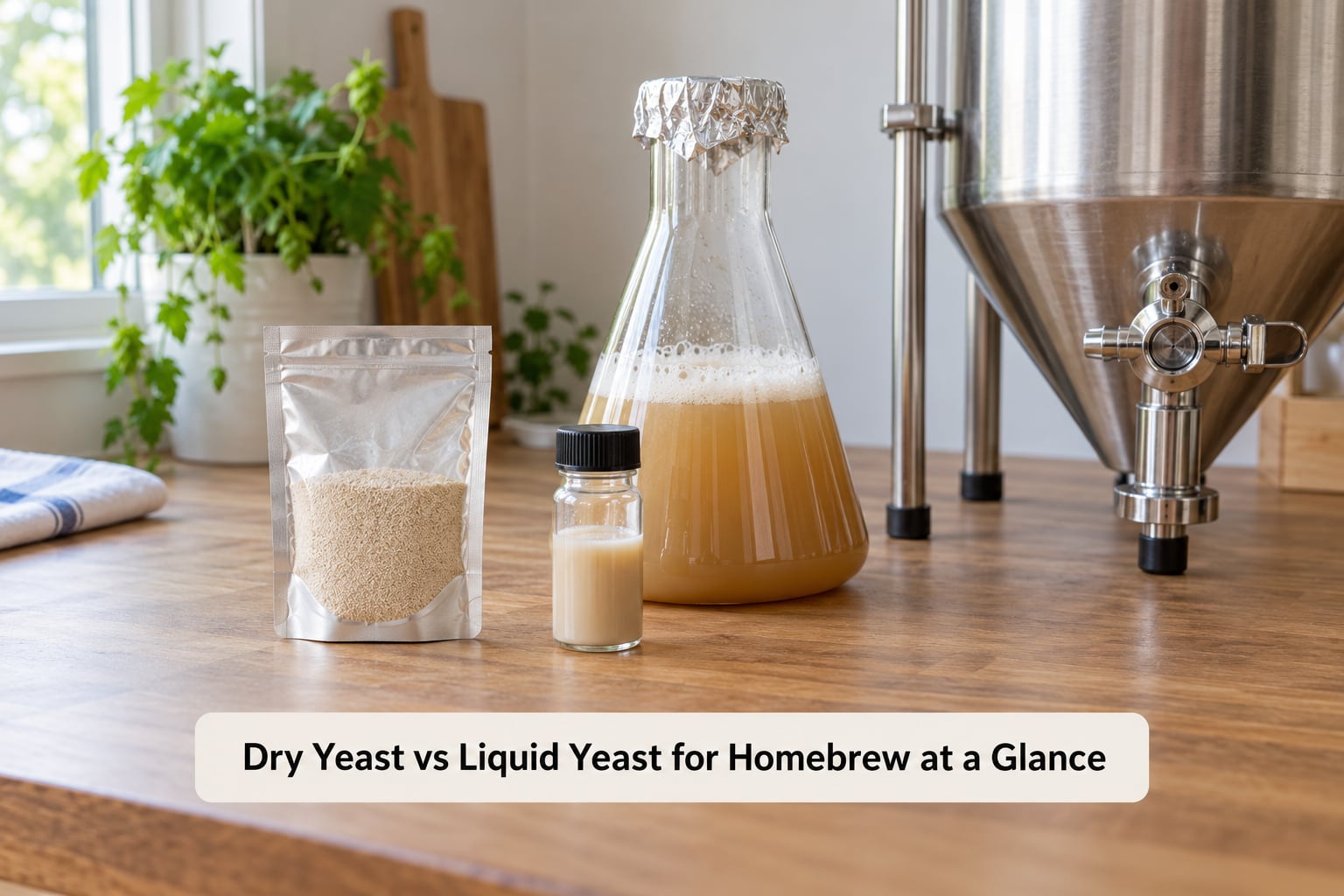
| Factor | Dry yeast | Liquid yeast |
|---|---|---|
| Format | Vacuum-sealed foil sachet | Vial, smack pack, or yeast slant |
| Cost per batch | Lower | Roughly two to three times higher once you add starter yeast and DME |
| Shelf life sealed | Two years or more refrigerated | Best used within three to six months refrigerated |
| Viability loss over time | Near zero, cells are dormant not dying | Roughly 2 percent per month from the best before date |
| Starter required | No, for most gravities | Yes, for anything above about 1.060 |
| Rehydration | Optional, many brewers skip it | Not applicable, already hydrated |
| Cell count available | Around 100 billion per sachet | Roughly 60 billion in a fresh vial, less as it ages |
| Strain selection | Dozens of house strains | Hundreds of named lab strains |
| Shipping sensitivity | Nearly none | Must stay cold, warmth is a deal breaker |
| Propagating and repitching | Possible but uncommon | Standard practice, yeast cake can be washed and reused |
| Best for | Beginners, infrequent brewers, high attenuation ales, budget builds | Clone brewing, competition entries, farmhouse and specialty styles |
What Is the Difference Between Dry and Liquid Yeast?
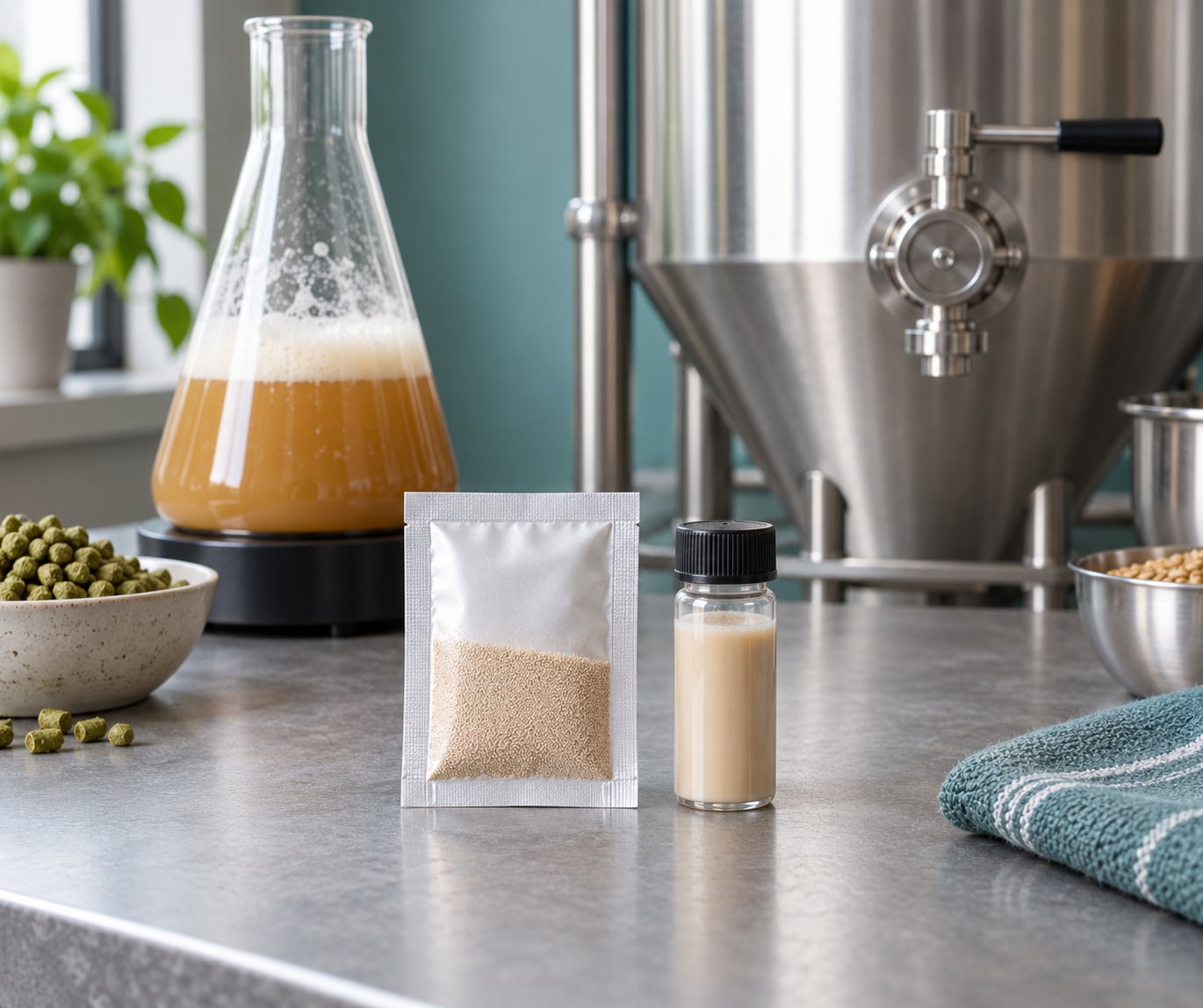
Dry yeast is a brewing strain that has been dried and vacuum-sealed into a sachet. Liquid yeast is the same kind of organism, a Saccharomyces strain, suspended live in wort inside a plastic vial or smack pack. Both turn wort sugar into alcohol and flavor compounds; the difference is packaging, cell count per unit, shelf life and how much brew day prep each one asks of you.
Both pitch into the same wort and produce the same finished beer, provided the cell count lands where it should. That is why the format is a logistics decision more than a quality decision.
A terminology note worth having
Bread yeast and brewing dry yeast are not the same product, and the overlap causes real confusion. Active dry yeast and instant dry yeast are baking terms: active dry must be proofed in warm water, instant does not. Commercial brewing dry yeast such as the Fermentis and Lallemand ranges behaves closer to instant, which is why direct pitching works so well with it. If you are comparing dry yeast vs liquid yeast for homebrew, set the bread aisle aside entirely.
Fermentation Performance and Reliability
Dry yeast usually wins the race to first signs of fermentation. Liquids often look slow for the first 12 hours or more, then catch up. The homebrewing community has largely explained this away, and the explanation is well supported.
As one experienced poster put it on Homebrew Talk, the reason dry yeast seemingly takes off faster is that manufacturers developed a method giving the yeast all the sterols it needs to begin replication immediately. Without loaded sterols, a cell must spend wort oxygen building acetyl-CoA from fatty acids before it can divide, and that is work liquid yeast does on the first pitch. Dry yeast skips it, which is also why a first dry pitch can show slightly more esters than a comparable liquid pitch.
None of that settles which one finishes better. Reliability comes down to pitching rate, and the same forum thread puts it bluntly: the pitching rate of a beer likely has more effect on the flavor of the beer than using liquid or dry yeast to achieve that pitching rate. Pitching onto a reused dry cake might mean well north of a trillion cells, against roughly 60 billion for a fresh vial. The vigorous fermentation belonged to the cell count, not the packaging.
Temperature sensitivity follows the same split. Liquid yeast is a living culture in liquid, so a warm shelf or a hot delivery turns it into a slow starter you cannot test before pitching. Dry yeast is dormant, indifferent to a week in a warm car, and ready when you are.
Attenuation and flocculation come from the strain, not the format. Read the specs on the packet and pick the numbers you need: high attenuation for a dry, crisp finish, mid-range flocculation if you want yeast to drop out of a bright beer.
Flavor and Beer-Style Differences
Does dry yeast vs liquid yeast change how the beer tastes? Sometimes, but less than people expect, and never for a predictable reason. Split batches brewed with the same strain at matched pitching rates tend to show a small mouthfeel difference and a small shift in fruit notes. Several brewers report no appreciable difference at all, and that matches what I have seen.
Where a real difference shows up, it usually comes from under-pitching rather than from the format itself. An under-pitched batch makes heavy esters and fusel alcohols regardless of what came in the packet. Fix the cell count and the format stops mattering.
Strain selection matters far more than packaging. If you want pepper and clove, a Belgian strain in a vial is the only path. There is no dry sachet that gives you a proper witbier, a genuine German lager character, or abbey ale complexity, and chasing those flavors with a neutral American house strain is a losing move.
There is one honest caveat in the other direction. Competition-focused brewers deliberately stay with liquid for the range of finished-beer character they can get, and they say so. Two award-winning brewers writing in Brew Your Own stated they always use liquid yeast and find the variety of styles and quality of the finished beer superior to dry, at least for now. That is a professional practice built on liquid strain access, not a claim that a dry batch cannot be made properly.
If you want to settle it on your own system, split a batch, pitch two matched halves at the same rate, and taste them side by side blind. That experiment takes one afternoon and beats every argument on the internet.
Shelf Life, Storage, and Handling
Dry yeast keeps for two years or more in a sealed sachet in the fridge, and its viability barely moves. Nearly all cells survive because they are dried out rather than metabolically idle, which is why r/Homebrewers point out that you do not lose dry yeast viability with time the way you do with liquid.
Liquid yeast is a countdown. Refrigerated, it is at its best within three to six months of the best before date, and viability drops by roughly 2 percent per month from there. Read the date printed on the vial and buy the newest one on the shelf. A warm shipment or a week in a hot cupboard finishes it, and there is no home test for whether a vial is still healthy.
Once opened, dry yeast is a single-use packet and the remainder loses activity faster than the sealed date implies, so store it sealed and cold. Liquid yeast, by contrast, is meant to be propagated. Pour off a vial into a flask, build a starter, and keep the settled yeast cake in a sterile jar in the fridge for future batches. That repitching flexibility is a genuine advantage of liquid yeast and something dry yeast rarely offers.
Cost, Packaging, and Convenience
Liquid yeast costs more per pack than dry yeast, and the gap widens once you account for the starter. A 1 to 2 litre DME starter adds the dried extract, a stir plate or spoon, 24 to 48 hours of waiting, and your attention on a night you would rather spend sleeping.
The community tip worth taking: it is better to double-pitch dry than to rush a starter that has not had time to grow and decant properly. That single move removes the starter cost and the main reliability complaint about dry yeast at once.
On packaging, dry sachets produce no plastic and are sized for a five gallon batch, so the waste is a used foil packet. Liquid vials are plastic, single-use if you are not propagating, and ship in insulated boxes with cold packs because the contents must stay cold in transit.
There is also a hidden cost in time. A UK homebrewer described dry yeast as streamlining brew day by removing the night-before prep and the starter step entirely. For someone who brews once a month or less, that removed evening is worth more than any flavor difference.
Which Should You Choose?
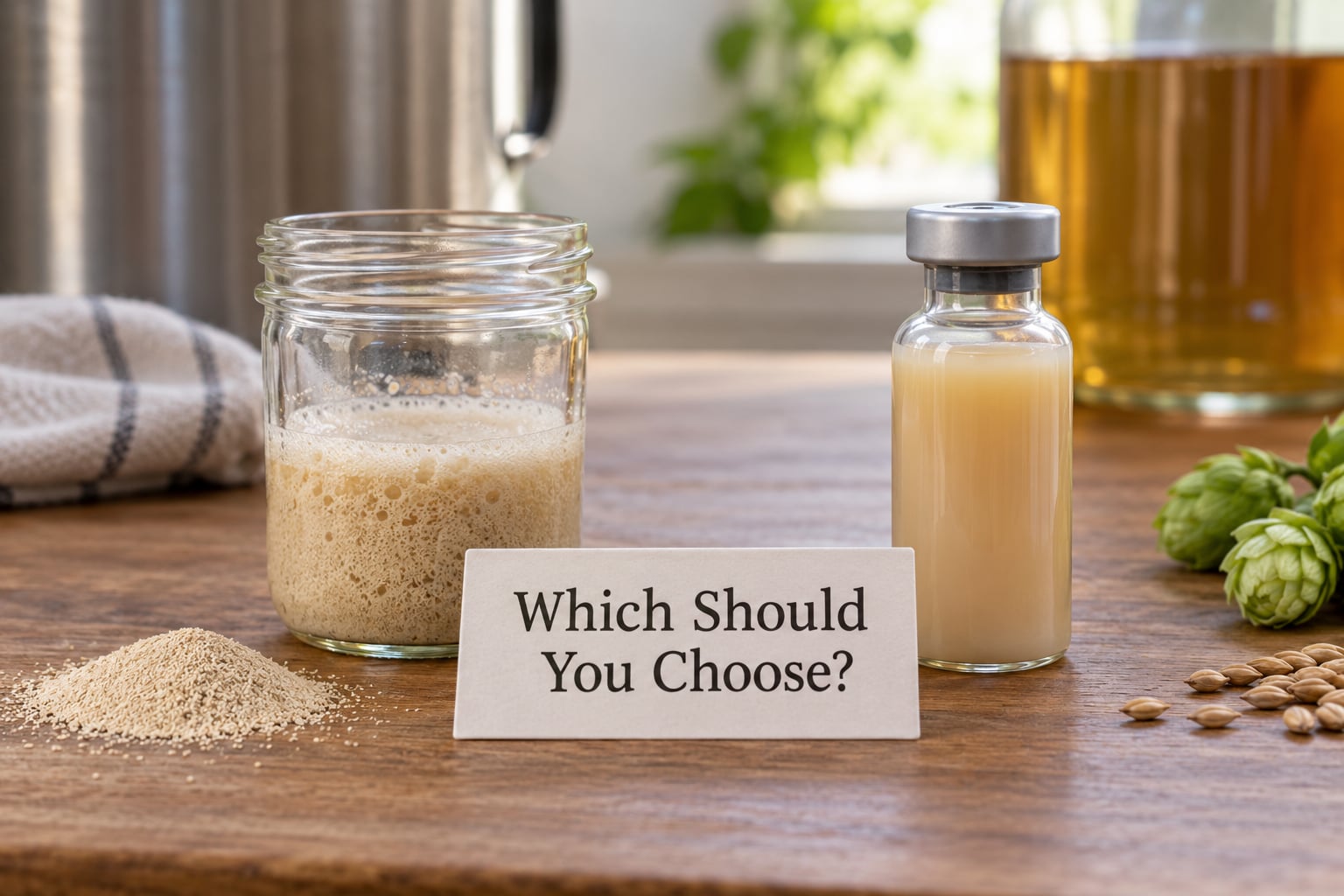
Pick based on what you are actually trying to do, not on which form is supposed to be better.
Choose dry yeast if you are brewing your first batch
No starter, no rehydration, no cold chain, and a packet you can buy whenever you remember. You learn the rest of the process without adding a second failure point on brew day.
Choose dry yeast if you brew infrequently
A sachet left in the fridge is still good a year later. A vial bought with good intentions and forgotten is a wasted purchase and an under-pitched batch.
Choose liquid yeast if you are cloning a commercial beer
Strain identity is the whole point. If a brewery’s yeast is what makes the beer taste like that beer, you need the actual strain, and you need enough of it for a pitch of that gravity.
Choose liquid yeast if the style has no dry equivalent
Belgian witbier, abbey and Trappist styles, farmhouse and Brett-driven beers, German lagers with real character, and high-gravity imperial ales all live in the liquid catalog.
Choose liquid yeast if you plan to propagate
Building up a yeast bank and repitching cake after cake is straightforward with liquid and awkward with dry.
Choose dry yeast if budget is the constraint
The gap per finished batch is the widest of any ingredient decision you make, and dry yeast closes it entirely.
Frequently Asked Questions
Do I need to rehydrate dry yeast before pitching?
No, not with modern brewing dry yeast. Fermentis and Lallemand both state that direct pitching performs as well as rehydration. If you want the extra insurance, sprinkle the sachet into a small amount of cool wort or water, wait 15 to 20 minutes, then add it to the fermenter. Rehydration costs you a few minutes and buys very little.
Do I need a yeast starter if I use dry yeast?
For most homebrew gravities, no. One sachet carries roughly 100 billion cells, which covers a standard five gallon batch up to about 1.060. Above that, or for a lager pitched cold, build a starter or double-pitch two sachets. Forgetting a starter is the more common mistake than forgetting to rehydrate.
Why does dry yeast seem to ferment faster than liquid yeast?
Because dry yeast manufacturers load cells with the sterols they need to start dividing immediately, while liquid yeast must build those compounds from wort oxygen during the first hours of fermentation. Dry yeast also arrives with a higher cell count per package. The visible difference is real, but it reflects preparation, not final beer quality.
How long does each type of yeast last?
A sealed dry sachet keeps two years or more refrigerated, and its cells stay essentially dormant rather than dying, so viability barely shifts. Liquid yeast in a vial is best used within three to six months of its best before date, losing roughly 2 percent viability per month. Once it has been shipped warm, treat it as spent.
Is liquid yeast worth the extra cost?
Only when strain choice or control justifies it. For cloning a named commercial strain, brewing a Belgian or farmhouse style with no dry equivalent, or entering a competition, the premium buys access and headroom. For a straightforward American ale, the money buys packaging and a starter, not better beer.
Can I use dry yeast for a Belgian witbier or a lager?
Not if you want the style’s defining character. Witbier needs a strain that produces pepper and clove phenols, and German lagers need genuine low temperature fermenting strains. Dry options exist for clean lagers that ferment cool, but the expressive versions of both styles are liquid-only choices.
If you brew again this month, buy a dry sachet, pitch it straight into cooled wort, and stop worrying about the format entirely. Move to liquid yeast the day you want a strain your local shop does not stock in a foil packet, and build a proper starter when you do.