If you want to calculate ABV at home, you need two gravity readings and one subtraction. Take the original gravity before you pitch yeast, take the final gravity once fermentation has gone quiet, then work out the difference and multiply by 131.25. The whole thing takes about ten minutes of actual work, spread across the life of the batch, and a standard brewing hydrometer is enough gear to do it.
Here is a quick worked answer before the detail: a beer that started at 1.050 and finished at 1.010 fell 0.040 gravity points. 0.040 multiplied by 131.25 gives you an estimated 5.25% ABV. That is the whole method in two numbers.
Table of Contents
- What You Need
- Step-by-Step: How to Calculate ABV at Home
- 1. Choose the Method and Take Your Reading
- 2. Measure the Original Gravity
- 3. Measure the Final Gravity
- 4. Calculate ABV with the Gravity Formula
- 5. Check the Result and Account for Common Limits
- 6. Use a Refractometer or Brewery Calculator When Appropriate
- Common Mistakes
- Frequently Asked Questions
- What does ABV stand for?
- Is 40% ABV the same as 80% proof?
- What is the difference between ABW and ABV?
- Can I calculate ABV with a refractometer?
- How do I calculate ABV if I never took an original gravity reading?
- How accurate is a homebrew ABV calculation?
- Conclusion
What You Need
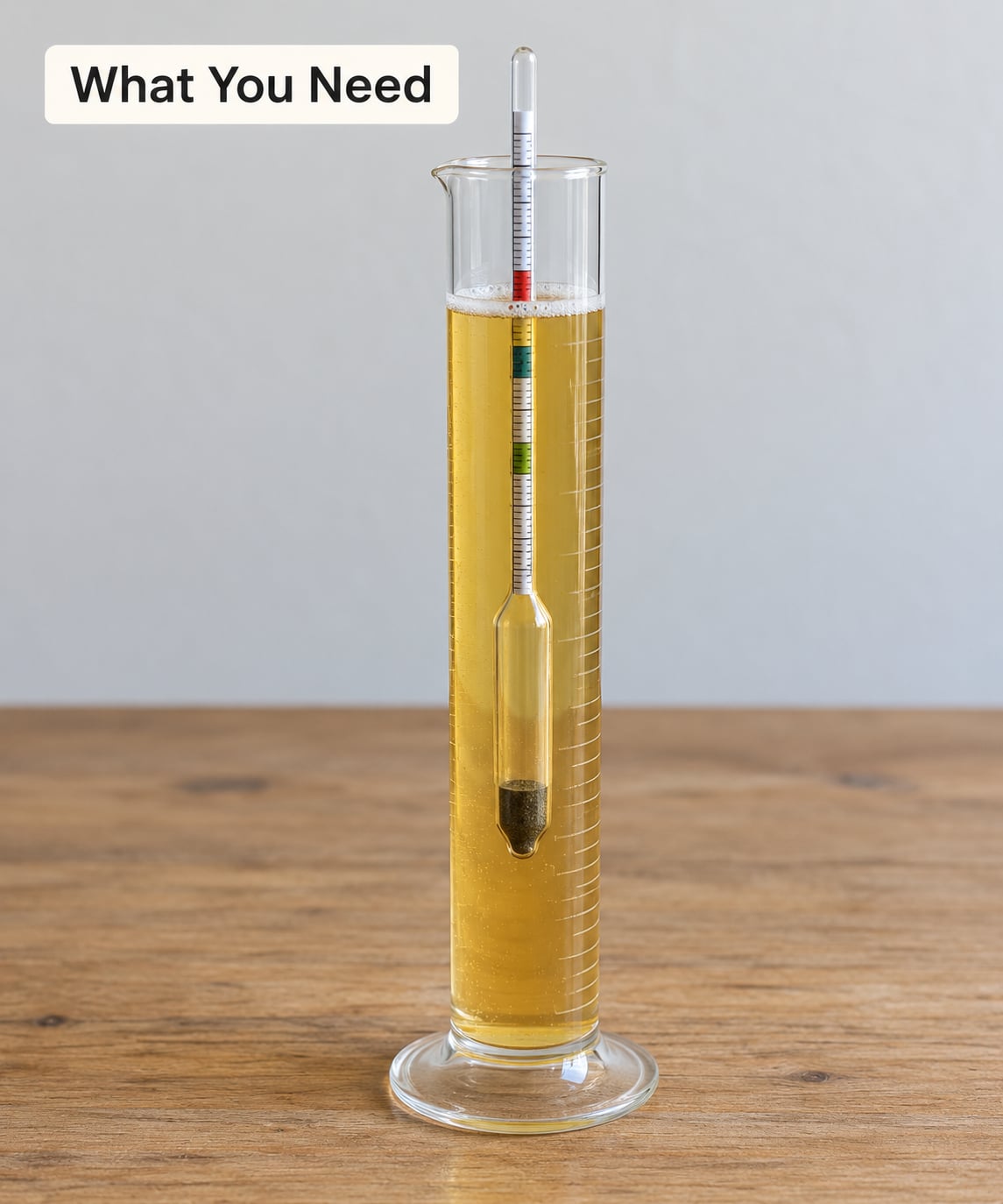
Two reliable routes exist for calculating ABV at home, and both come back to gravity readings. The gravity method needs a fermentable sample, a hydrometer or refractometer, a vessel deep enough to float the hydrometer, a sanitized sample jar or cylinder, a thermometer, and your beer’s original and final gravity values. That is the setup for the method that gives you the most accurate home result.
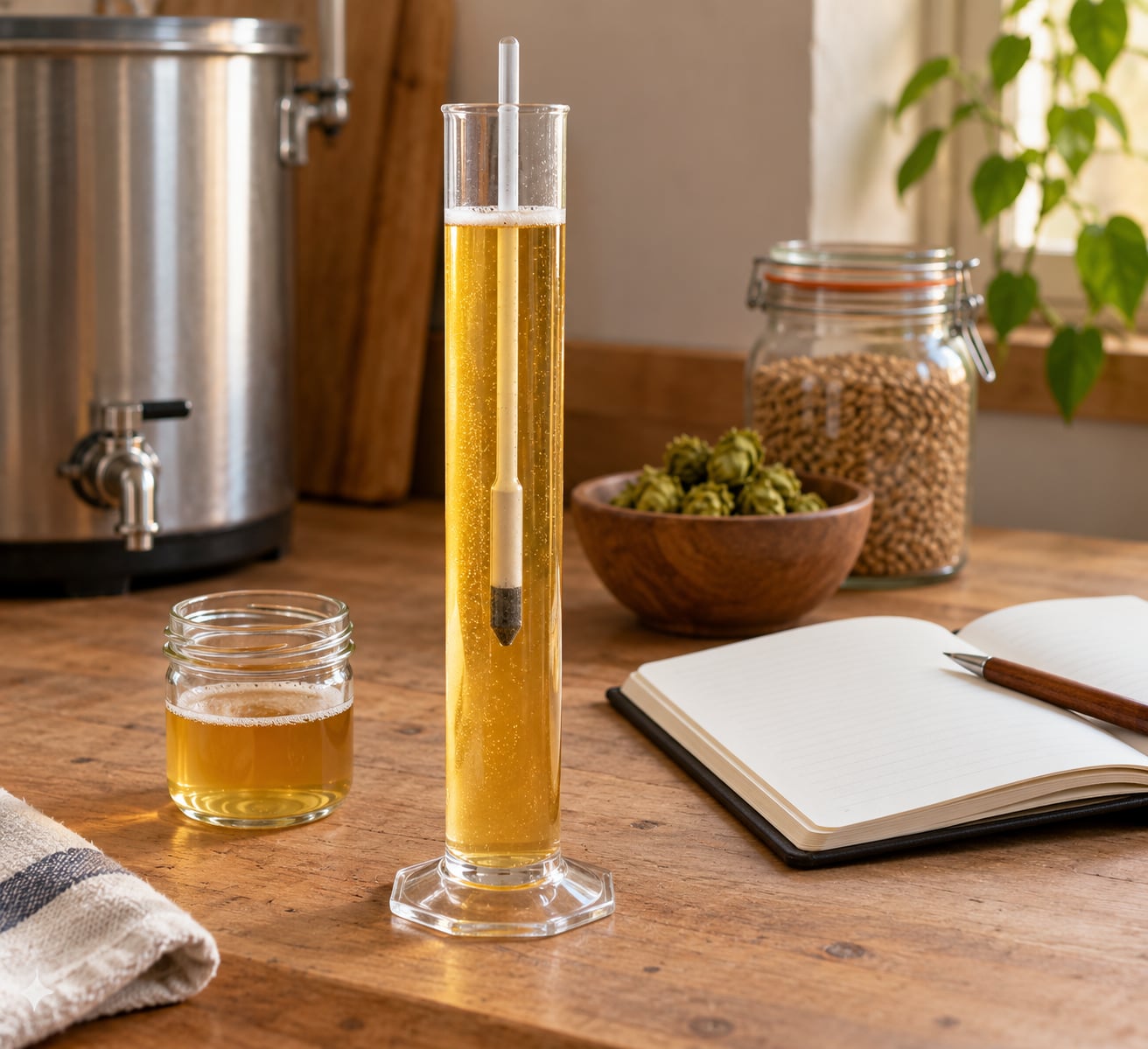
A brewing hydrometer is the tool most people already own, and a plastic test jar with a rubber stopper is the classic companion to it. The hydrometer reads specific gravity, a ratio of a liquid’s density to the density of water, which is why a wort that is full of dissolved sugar sits lower in the water than plain water would.
A refractometer is fast and accurate enough for tracking progress, and it is genuinely handy mid-fermentation when you do not want to open the fermenter. It reads a line of light rather than floating anything, so there is no sample to lose. Once fermentation starts, though, alcohol changes how the light refracts without changing the sugar much, and the reading drifts high. That is why the plan below is built around the hydrometer, with the refractometer handled separately at the end.
Step-by-Step: How to Calculate ABV at Home
The most accurate home result comes from comparing original gravity with final gravity, so start there. Low-alcohol drinks such as beer are well within the range a standard brewing hydrometer handles, which is usually 0.990 to 1.120 on the specific gravity scale.
1. Choose the Method and Take Your Reading
Fill the sample jar about two-thirds full with your beer. Lower the hydrometer in gently and give it a spin so it settles upright without touching the sides or the bottom, because any contact with the wall reads falsely high.
Wait for the liquid to stop moving, then read at eye level where the bottom of the curved surface, the meniscus, meets the scale. Most brewers read the bottom of the meniscus rather than the edges, and using the same convention for both readings keeps the error from doubling.
Note the temperature of the sample too. Most hydrometers are calibrated to read correctly at 60°F, and an uncorrected warm reading on wort skews the gravity a little high. If your hydrometer carries a printed correction table or a marked temperature scale, apply the adjustment before you write the number down. Whatever you do, use the same instrument and the same units for both readings.
2. Measure the Original Gravity
Take the original gravity reading before fermentation begins, when the wort or unfermented beer still sits at its starting concentration. This is the number everything else depends on, and there is no second chance to get it once yeast is working.
Fill the jar with wort straight from the kettle or before pitching, correct for temperature, and record the value to at least three decimal places. Write 1.050, not 50 or 1050. Read 1.042 as one point zero four two, and a common beginner error disappears: treating the reading as 1042 produces a nonsense answer in the thousands of percent.
Avoid taking the OG reading after dilution with extra water, or after fermentation has already started, since both quietly change the number you are trying to capture.
3. Measure the Final Gravity
Wait for the practical endpoint of fermentation: the gravity has held steady across two or three readings taken a couple of days apart. A recipe’s stated finish time is a hint, not a guarantee, and many brewers find their batches still moving well past it.
Draw the sample from the fermenter with a siphon, wine thief or turkey baster and take the reading from the top liquid rather than the bottom of the vessel. Sediment is packed yeast and undissolved protein, and a jar with a layer of it in the bottom will give you an FG that is lower than reality and an ABV that is overstated.
Confirm the beer has stopped before you calculate anything. Reading FG on a beer that is still fermenting produces an alcohol figure that is too low, and that is the single most common reason a homebrew seems weak.
4. Calculate ABV with the Gravity Formula
The formula is ABV = (OG − FG) × 131.25. Subtract the final gravity from the original gravity, then multiply the difference by 131.25.
Using the example above: original gravity 1.050, final gravity 1.010. The difference is 0.040. Multiply that by 131.25 and you get 5.25, so the estimated alcohol is 5.25% ABV.
This calculation assumes decimal specific gravity readings such as 1.050. If your hydrometer reports in gravity points instead, where the same reading appears as 50 rather than 1.050, the result comes out roughly 1.0525%. That is why the decimal has to stay in play, and why the difference of 0.040 has to be 0.040 and not 40.
The 131.25 constant comes from a 105 multiplier that yields alcohol by weight, then a conversion factor of roughly 1.25 for volume. It traces back to the standard homebrewing reference literature and it holds well for ordinary beer. Above roughly 1.060 original gravity, denser worts read low by this method, and the fuller ASBC formula gives a better number.
5. Check the Result and Account for Common Limits
The formula gives an estimate, not a laboratory measurement, and several things push the answer around. Temperature correction done badly, a premature FG reading, dissolved carbon dioxide still clinging to the liquid, unfermented sugar left in the wort, and simple read errors all change the outcome.
Do a quick sanity check against what the style should be. A pale ale in the 4% to 6% range, a session IPA a little under 5%, and a double IPA anywhere from 7% to 9% are all reasonable. That check catches a decimal slip immediately, since a result of 525% or 0.05% is never right. Treat it as a range check rather than a rule, because experimental brews and unusual fermentations do not always land in a style’s typical band.
6. Use a Refractometer or Brewery Calculator When Appropriate
A refractometer gives a fast answer for a young or partly fermented beer, and it is a good tool for watching gravity move week to week. It becomes unreliable once alcohol is present, because ethanol bends light in a way that mimics extra sugar, so the reading appears higher than the true gravity.
You can work around that by entering your true original gravity into an online ABV calculator alongside the refractometer reading, since most calculators that support refractometers have a correction built in. Discard the original gravity reading once fermentation is underway and use the hydrometer instead.
A brewery calculator or a brewing log saves arithmetic errors, and the log is the better habit because it also gives you apparent attenuation for free. Just enter consistent gravity units, whether that is 1.048 or 48, because mixing scales is the most common way a calculator returns a wrong answer.
Common Mistakes
Reading the hydrometer too high is the most common error in the whole process. It usually means the hydrometer was touching the wall, the sample had foam or sediment in it, or the eye was above the liquid line. Read at eye level in a clean jar and the problem disappears.
Measuring sediment pushes the FG down and inflates the ABV. Pour or siphon from the top, leave the jar to sit if you need to, and keep the last inch of liquid out of the sample.
Forgetting temperature correction adds error in one direction only. A warm wort reads heavy, and an uncorrected OG makes the calculated ABV too high.
Taking the final gravity too early is the mistake that costs the most accuracy, because a still-fermenting beer has simply not finished making alcohol yet.
Mixing gravity scales is where beginners get an answer hundreds of times too big. Decide once whether you are working in decimals or in points, and stay in that system from the notebook to the calculator.
Treating the result as lab-exact measurement is worth dropping. Experienced brewers rarely fuss about the third decimal place, because what matters is whether the beer suits its style and tastes right.
Three habits fix most of this. Clean and rinse the jar and hydrometer between batches, take a second reading whenever a number surprises you, and write down both the OG and the FG every single time. Once you have the OG logged, future batches can be compared against it, and that record is worth more than any single calculated percentage.
Frequently Asked Questions
What does ABV stand for?
ABV stands for Alcohol By Volume, the percentage of the total volume of a drink made up of pure ethanol. A beer at 5% ABV contains 5 mL of alcohol in every 100 mL of liquid. It is the standard way beer strength is described on labels and tap lists, and it is what a homebrew calculation gives you.
Is 40% ABV the same as 80% proof?
Yes. Proof is the American and older system, and it is simply double ABV, so a spirit at 40% ABV is sold as 80 proof. The reverse works too: divide proof by two to get ABV. Britain, Australia and much of Europe use ABV, so a bottle labelled 40% ABV and one labelled 80 proof describe the same liquid.
What is the difference between ABW and ABV?
ABW is alcohol by weight, measuring ethanol against the total mass of the drink. ABV measures it against total volume. Alcohol is lighter than water, so a given drink has a slightly higher number by volume than by weight. Multiplying an ABW figure by about 1.25 converts it to ABV, which is where the 131.25 constant in the ABV formula comes from.
Can I calculate ABV with a refractometer?
You can, but only with care. A refractometer is very accurate on wort before fermentation and useful for tracking progress, yet alcohol present in the finished beer bends light and makes the reading look higher than the true specific gravity. For a final gravity, most brewers trust the hydrometer instead. If you use the refractometer, enter your true original gravity into a calculator that applies the alcohol correction.
How do I calculate ABV if I never took an original gravity reading?
Without an OG reading, an exact gravity calculation is not possible, so the answer is an estimate. Measure the current gravity with a hydrometer, estimate the OG from the recipe and its original volume, and run the difference through the formula. Treat the result as approximate rather than precise. A commercial package also offers a fallback, since the maker lists a starting gravity for the batch you brewed.
How accurate is a homebrew ABV calculation?
A careful home measurement is usually good to about plus or minus 0.5%, sometimes 0.3% on a well-made hydrometer reading taken at the right temperature. Temperature, sediment, foam and a premature final gravity all widen that gap. For ordinary homebrewing that is more precision than the beer requires, and it should not change whether you find the batch drinkable.
Conclusion
Start by recording the original gravity before you pitch yeast, and treat that number as the one measurement you cannot take back. Then wait for two or three stable final gravity readings before you calculate anything, and plug both values into ABV = (OG − FG) × 131.25 in decimal specific gravity.
The result is a useful estimate rather than a laboratory figure, so when the number looks wrong, repeat the measurement before you trust it. A second reading usually explains most of the surprise, and if it does not, the temperature and timing are the first two things to check.