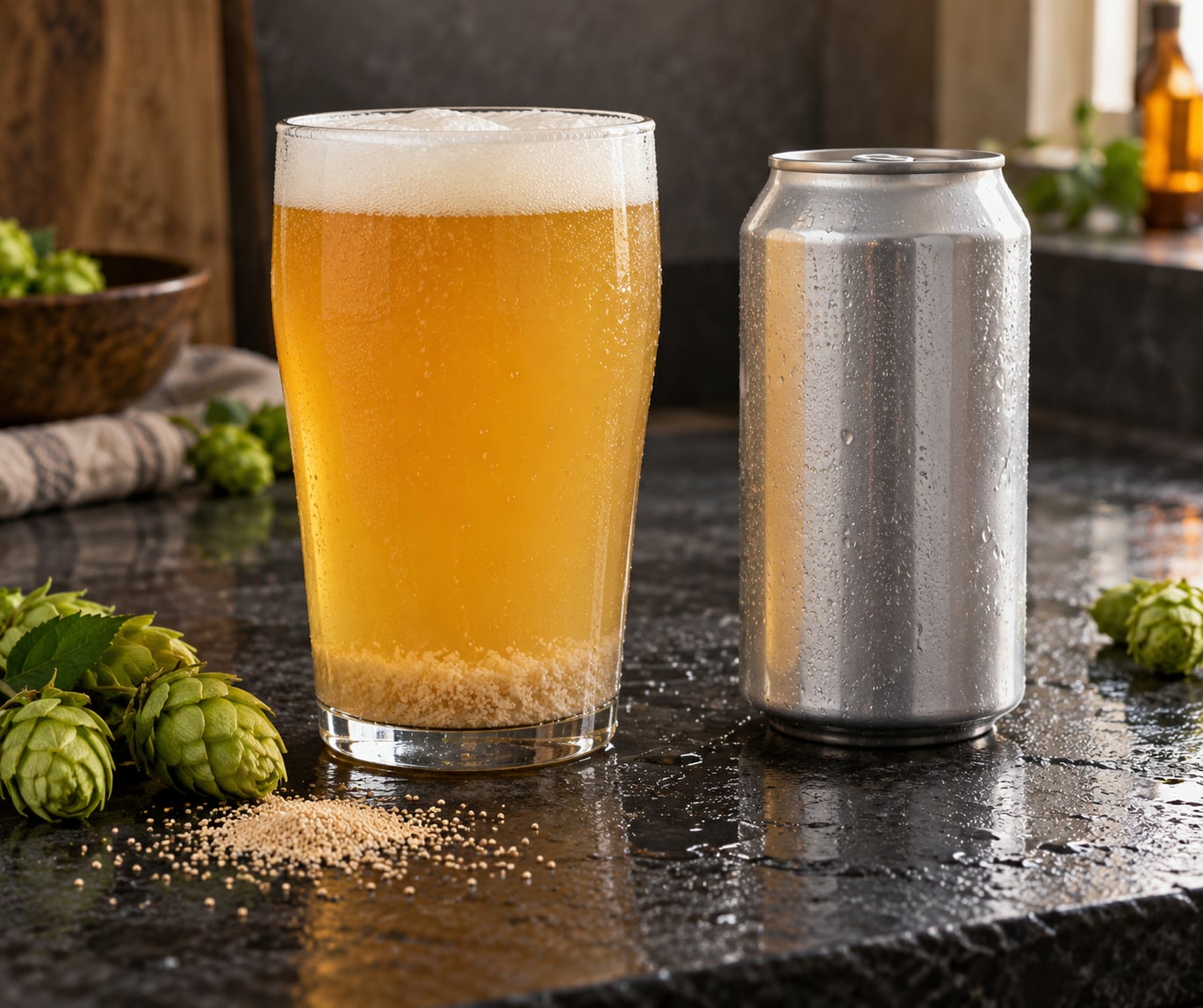
Short answer: unfiltered beer skips the filtration process. After fermentation, most breweries push the beer through filters or a centrifuge to strip out yeast, protein haze and hop debris, which leaves something bright and clear in the can. Unfiltered beer never gets that step, so those same particles stay suspended, scatter light, and eventually settle at the bottom as sediment.
If you have ever held a can up to the light, seen a cloudy swirl, and wondered whether you were looking at something spoiled, that is the normal look of an unfiltered beer. The same word covers a hazy New England IPA, a German wheat beer, and a mainstream lager that puts it on the front of the can as a selling point.
Table of Contents
- What Does Unfiltered Mean on a Beer Can?
- Does unfiltered mean better, worse, or healthier?
- What Is the Difference Between Filtered and Unfiltered Beer?
- Haze vs. floaters: two different things in the same can
- How Does the Brewing Process Make Beer Unfiltered?
- What Does Unfiltered Beer Taste and Look Like?
- Which everyday beers are actually unfiltered?
- Unfiltered vs. hazy IPA: not the same thing
- What Does Unfiltered Mean on a Beer Can During Brewing?
- Does Unfiltered Beer Contain Live Yeast?
- Unfiltered vs. Unpasteurized: Are They the Same Thing?
- Is Cloudy or Unfiltered Beer Spoiled?
- How to Pour and Drink Unfiltered Beer
- Frequently Asked Questions
- Does unfiltered beer mean it has not been fermented?
- Is unfiltered beer higher in calories than filtered beer?
- Is unfiltered beer always better or more natural?
- Does unfiltered beer need to be refrigerated differently?
- Why do some unfiltered beers clear up after sitting in the can?
- Should beer have sediment at the bottom?
- What to Look for on Your Next Beer Can
What Does Unfiltered Mean on a Beer Can?
On a beer can, unfiltered is a process description. It tells you the brewer chose not to run the finished beer through a filtration machine before packaging, so the beer is closer to how it came out of the tank.
Three things typically stay in the beer because of it:
- Yeast cells that never got removed, either because the brewery skipped filtration or because it added fresh yeast at packaging for a bottle-conditioned style.
- Malt proteins that would have been filtered out, and which give the beer a softer, fuller body.
- Hop oils, resins and fine hop debris, especially in beers that were dry hopped after fermentation and in unfiltered pale ales.
None of that means the beer is unfinished or unsafe. It means you are seeing and tasting the beer with fewer things taken out of it. BeerAdvocate community threads on the topic reach the same conclusion repeatedly: sediment in an unfiltered beer is a normal part of the product, not a defect.
Does unfiltered mean better, worse, or healthier?
None of those, necessarily. It is a production method, and there are plenty of filtered beers that are more interesting than unfiltered ones. The honest answer is that unfiltered beers tend toward more aroma, more texture and a shorter window before those hop flavours fade, and some drinkers prefer exactly that while others want a crisp, clear lager.
On health, filtration removes material, not alcohol or calories, so an unfiltered beer is not lighter and not healthier than a filtered one of the same strength. The yeast and protein left in are a negligible amount compared to everything else in a serving. What has genuinely changed is the marketing: unfiltered used to signal a German wheat beer or a farmhouse ale, and it is now a selling point on mainstream lagers as well, so read it as a process note rather than a quality grade.
What Is the Difference Between Filtered and Unfiltered Beer?
Filtering is a clarification and stability step. Beer that gets filtered loses most of its yeast, gets noticeably clearer, and generally keeps longer before flavour starts to fade.
| Factor | Filtered beer | Unfiltered beer |
|---|---|---|
| Appearance | Bright, clear, light passes through | Cloudy or hazy, sometimes with visible bits |
| What stays in | Very little yeast, fewer proteins | Yeast, malt protein, hop oils and debris |
| Mouthfeel | Crisp and clean on the palate | Fuller, softer, sometimes a little syrupy |
| Hop character | Clean bitterness, restrained aroma | Stronger hop aroma, a resinous or oily bite |
| Aroma | Defined and consistent | More aromatic, sometimes fruitier or more dank |
| Stability | Longer shelf life before oxidation | Often a shorter window before hop flavours fade |
| Typical examples | Most macro lagers, pilsners, many filtered ales | Many wheat beers, unfiltered pale ales, unfiltered IPAs |
The trade-off is simple. Filtration buys clarity and shelf life. Unfiltered beer trades a little of both for texture, aroma and a closer match to the beer as brewed.
Haze vs. floaters: two different things in the same can
Beer writers draw a line here. Haze is an even, all-over turbidity, the kind that makes a New England IPA glow like apple juice. Floaters are discrete pieces, usually hop debris or clumps of yeast, that drift around and drop to the bottom.
You can have either without the other. A beer can be perfectly uniform and hazy with nothing at the bottom, or mostly clear with a layer of sediment waiting under the last inch. The Oxford Companion to Beer makes the same distinction: haze refers to evenly distributed turbidity through the body of the beer, while discrete particles appear within it.
How Does the Brewing Process Make Beer Unfiltered?
Filtration happens near the very end of brewing, so most of the process is identical whether a beer ends up filtered or not.
- Fermentation. Yeast converts sugar to alcohol and carbonation, and multiplies along the way. The beer is full of suspended yeast at this stage.
- Conditioning. The beer rests in a tank for days or weeks, which lets yeast and heavy debris drop out naturally and flavours settle down.
- Cold crashing. Some breweries chill the beer to near-freezing to force the yeast out fast. This is the closest thing to filtration some breweries do, and it is not filtering at all.
- Filtration. This is the step unfiltered beer skips. It may be a plate filter, a centrifuge, or a membrane filter, sometimes with a filter aid like silica sol to catch fine protein.
- Packaging. A normal filtered beer goes into the can bright. Unfiltered beer goes in with whatever is still suspended, and that is what you open weeks later.
None of these steps is a safety step. Food safety in brewing comes from controlled fermentation, clean handling and, for most mass-market cans, pasteurisation and sealed packaging. Skipping a cosmetic filter is not the same as skipping any of that.
What Does Unfiltered Beer Taste and Look Like?
Unfiltered is a process, not a style, so it does not promise a particular flavour. That said, the retained material tends to push the beer in a recognisable direction.
Expect more aroma off the top, and a hop character that is less tidy. Retained hop oils give a resinous or oily bite, and coarse-hopping methods can push things toward dank, tropical or citrus notes. Malt protein that a filter would have stripped tends to add body and a soft, rounded mouthfeel instead of a sharp, watery finish.
Visually, expect anything from a faint cloudiness you might miss in a cold fridge to an opaque, juice-like pour. Some cans show a visible layer of pale sediment in the last inch or two. Both are normal.
Which everyday beers are actually unfiltered?
More than people expect. Blue Moon Belgian White and Shock Top are unfiltered wheat ales, which is the classic mass-market example. Weihenstephaner Hefeweissbier and most German wheat beers are unfiltered by tradition. Saison Dupont, a lot of farmhouse ales, and many unfiltered pale ales from British breweries follow the same approach.
Stella Artois Unfiltered is the one that tends to surprise people, since the flagship Stella is a filtered lager. Different product, same process note. Check the back of the can rather than guessing from the brand, because within a single brewery the same beer can exist in both filtered and unfiltered versions.
Unfiltered vs. hazy IPA: not the same thing
This is the most common mix-up going around, and the two words describe different things. Unfiltered means the beer skipped a filter. A hazy IPA is a style decision, where the brewer loads up on hops after fermentation to create that opaque, juice-like appearance, and the beer may or may not have been filtered afterwards.
| Factor | Unfiltered | Hazy IPA | Clear IPA |
|---|---|---|---|
| What the word describes | A process step that was skipped | A deliberate style | A deliberate style |
| Source of the cloudiness | Yeast, malt protein, hop debris | Hop oils and proteins from heavy post-fermentation hopping | Minimal, because the beer is clarified |
| Hop intensity | Can be gentle or enormous | Usually very high, soft and tropical | High, sharp and resinous |
| Typical example | German Hefeweissbier, unfiltered pale ale | New England IPA | West Coast IPA |
They overlap constantly. A New England IPA is often unfiltered too, so the labels are not in conflict, they are just measuring different things.
What Does Unfiltered Mean on a Beer Can During Brewing?
Almost always, unfiltered refers to what happens after fermentation. Mashing, boiling and fermentation are the same for filtered and unfiltered beer, and the ingredients going in are the same too.
The label term is describing the clarification decision the brewer made on the way to packaging. If a brewery wants a bright beer, it filters. If it wants texture and hop character, or it is imitating a German Kellerbier or Hefeweissbier tradition where unfiltered is the norm, it does not.
One practical note: a can is a closed environment where sediment can concentrate over weeks, while a taproom keg is often poured soon after the beer is brightened in the tank. That is one reason a hazy IPA can taste brighter and cleaner on tap than it does from the same brewery’s canned version.
Does Unfiltered Beer Contain Live Yeast?
Sometimes, yes. But unfiltered and live yeast are two separate claims, and plenty of unfiltered beers contain very little active yeast.
A yeast-starved beer is a good example. The brewery lets the yeast drop out during a long cold rest and then skips filtration entirely, so the beer never went through a filter but also carries almost no yeast in the can. The reason it can still be hazy is protein, not yeast.
Others are deliberately yeast-active. Wheat beers and bottle-conditioned ales are packaged with live yeast and often a priming sugar, so the beer keeps evolving for months in the can or bottle. That is a yeast addition, not a filtration decision, even though the two labels sometimes overlap.
Unfiltered vs. Unpasteurized: Are They the Same Thing?
No, and this is the most common mix-up on beer labels. They describe two completely different steps.
Filtration is physical. A filter catches particles. Pasteurisation is thermal. Heat is applied to the packaged beer to reduce the number of viable microorganisms, which is what lets a can or bottle sit on a shelf and travel without refrigeration.
A beer can carry either label on its own: an unfiltered beer that is pasteurised and sealed is very common, and so is a filtered beer sold unpasteurised in a keg. Because the alcohol and the sealed package already do a lot of the work, many breweries simply don’t pasteurise at all.
Is Cloudy or Unfiltered Beer Spoiled?
Usually not. Ordinary sediment is a pale layer of yeast, protein and hop material sitting flat on the bottom, and normal haze is uniform rather than streaky or clumped. Both are part of an unfiltered beer’s design.
What actually signals a problem looks different:
- An off smell. Sour, nail-polish, acetone or musty cardboard notes are fermentation contaminants, not yeast sediment.
- Mould or a film. A fuzzy pellicle sitting on the surface of an opened can is a pellicle, not a floating hop bit. Discard it.
- Sealed but changed. A can that is bulging, leaking or badly dented along a seam should not be opened.
- Brewery language. Some unfiltered beers are brewed with a best-before date and are meant to be drunk inside a stated window. That is a freshness choice, not a warning that the beer is raw.
HomebrewTalk and The Homebrew Forum threads about white floating sediment are mostly newcomers worrying, and the answers land in the same place: it is krausen remnant or a pellicle, and the distinction is about which surface it is on and how it looks.
How to Pour and Drink Unfiltered Beer
Pouring an unfiltered beer is less fuss than it sounds.
- Don’t shake the can. Shaking does nothing useful here. It just stirs sediment into suspension and gives you a cloudy, flat-tasting glass.
- Let it rest. Ten minutes upright is usually enough for the heavier material to fall back to the bottom.
- Tilt to pour. Tilt the can so the beer leaves the top edge and the sediment stays behind.
- Decide about the last inch. Drink it or don’t, both are fine. Yeast and hop sediment tastes bitter and vegetal, which some people like and others find unpleasant.
- Store it upright. This is why some retailers set unfiltered cans upside down: inverted, the sediment rests against the lid instead of pouring into your glass. The beer is stored the same way regardless.
Fridge temperature matters more than any of this. Keep it cold, drink it fresh, and follow the date and serving instructions printed on the can.
Frequently Asked Questions
Does unfiltered beer mean it has not been fermented?
No. Unfiltered describes one step near the end of brewing, not the whole process. Unfiltered beer is fully fermented, fully carbonated and ready to drink. It simply skipped the filtration step that removes yeast and fine particles, which is why it can look cloudy or have sediment at the bottom.
Is unfiltered beer higher in calories than filtered beer?
Filtering removes material, but it does not change the alcohol or the residual sugar that drives calories. An unfiltered beer with the same alcohol by volume and the same original gravity as a filtered one has essentially the same calories. Sediment at the bottom adds a tiny amount of protein and yeast solids, which is nowhere near meaningful.
Is unfiltered beer always better or more natural?
No. It is a process description, and some drinkers genuinely prefer the clarity and crispness of a filtered lager. Brewing method, yeast strain, hop schedule and water all shape flavour far more than filtration. The word also appears on mainstream lagers as a marketing choice, so it carries no guarantee of craft status or quality.
Does unfiltered beer need to be refrigerated differently?
Not really. Keep it as cold as you would any other beer, ideally in the fridge, and store cans upright so sediment settles to the bottom rather than onto the seal. What does differ is timing: unfiltered beer often has a shorter window before its hop aromas and hop oils fade, so drink it fresher than a filtered equivalent.
Why do some unfiltered beers clear up after sitting in the can?
Sediment keeps settling over time. Yeast cells and heavy hop debris are denser than the beer around them, so they drop to the bottom and compact into a clearer layer above. If the beer was packaged warm and stored cold, that temperature change alone is often enough to knock a lot of it out of suspension in the first few days.
Should beer have sediment at the bottom?
For an unfiltered beer, yes, and it is safe to drink. The layer is usually pale yeast, coagulated malt protein and fine hop material. HomebrewTalk, Homebrew Forum and BeerAdvocate community threads all describe the same routine bit at the bottom of a bottle-conditioned or unfiltered brew. Sour smells, mould or a bulged can are the real warning signs.
What to Look for on Your Next Beer Can
Read the can’s description before you read anything else. If it says unfiltered, the beer skipped the clarification step, so expect a hazier pour and possibly a layer of sediment. Check whether it also says unpasteurized, because that is a different claim about shelf stability, not about clarity.
So if you want the short version to carry in your head: what does unfiltered mean on a beer can is simply that the clarification step was skipped. The haze, the bits and the sediment are all part of that decision, and the beer is fine to drink.