To run a beer trivia night, plan four to six themed rounds of 8 to 12 questions each, give teams one point per correct answer plus a half-point bonus, and keep the whole thing to about two hours with a halftime break in the middle. The trivia is only half the job. The other half is pacing, scoring, and making sure the loudest table does not walk away feeling like the night was rigged.
It is a format most bars could run tomorrow with nothing but index cards and a spreadsheet, and it fills a Wednesday or Thursday that is otherwise dead. This guide walks through the whole process, from picking a night to closing it out safely, with the numbers hosts actually use.
Keep it simple enough that a staff member with two other jobs can execute it, and detailed enough that nothing gets decided in front of a room full of customers.
Table of Contents
- What You Need
- Step-by-Step
- Define the format and audience
- Prepare balanced beer trivia questions
- Easy
- Medium
- Hard
- Set up the room, teams, and scoring system
- Host the questions and keep the energy moving
- Announce winners and close responsibly
- Common Mistakes
- Tips for a Memorable Beer Trivia Night
- Frequently Asked Questions
- How many questions should a beer trivia night have?
- How many rounds work best for a two-hour pub quiz?
- How much should I charge to enter a trivia night?
- How can I run a beer trivia night at home with a few friends?
- How do bar trivia hosts get paid?
- How do I score a large field of teams without errors?
- Conclusion
What You Need
Everything below can be ready in an afternoon. The list matters because the failure mode in a bar trivia night is almost never the questions. It is the missing timer, the printed answer sheet someone forgot to bring, or the host who had no idea which round came next.
- The room. A layout with tables far enough apart that teams cannot read each other’s answer sheets. Count seats before you print anything, and cap registration if the room cannot hold the teams you expect.
- A host. One person whose only job that night is reading questions and keeping time. A bartender doing this between drink orders will lose the room.
- Staff coverage. At least one bartender and one floor person who is not the host and not keeping score.
- Question materials. Printed question sheets for the host, printed answer sheets per team, and a picture round or handout if you use one. Bring ten percent more answer sheets than seats.
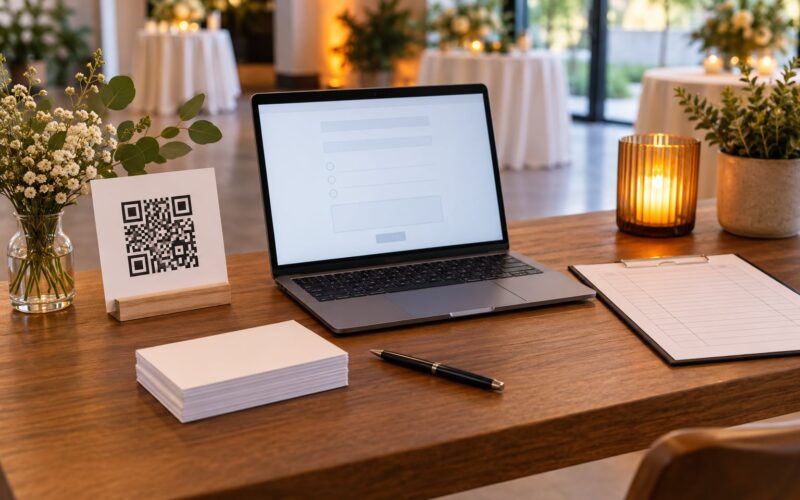
- Answer key and scoring. A printed or on-screen answer key, and one of three scoring methods: paper answer sheets collected at the end of each round, a shared spreadsheet filled in live, or a digital form on phones.
- A timer. A phone on the host stand or a dedicated countdown clock visible to you. Guests should not see the countdown screen.
- Prizes. Decided in advance, with the tiebreaker rule written down and announced at the start of the night.
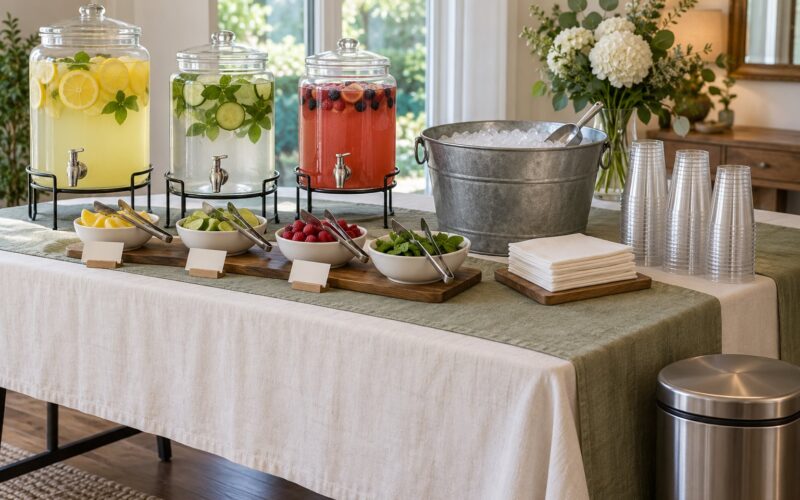
- Non-alcoholic options. Plenty of water, plus at least two zero-proof choices on the same drink list. A trivia night where the only way to participate is to drink turns away exactly the people you want in the room.
- Responsible service notes. Water on tables from the start, no drinking games built into the format, and a clear server handoff for anyone who has had enough. Alcohol by the volume is legal; making a guest feel out of place for not drinking is not a good night.
- Optional beer-pairing elements. A small flight tied to a round, a brewery representative giving a two-minute talk between rounds, or a signature drink special for the night.
Step-by-Step
Define the format and audience
Decide what kind of night this is before you write a single question. General pub trivia pulls in the widest crowd. A beer-focused format builds loyalty with the people who already know your list. A brewery-themed night works well when a release is on tap that week. Pick one and say it out loud in your promotion, because a night advertised as “beer trivia” that turns out to be movies and geography is how you get one bad review and a thin second week.
Most venues that run this weekly settle on a predictable frame. Plan for 4 to 6 rounds, 8 to 12 questions per round, a 15-minute halftime, and a total runtime of 90 to 120 minutes. Score each correct answer at one point, and offer a half-point bonus question in most rounds. That formula comes from the pub quiz tradition and it works because it is easy to explain in ten seconds and impossible to argue about later.
Know your room. A room of beer geeks will happily chew through a hard stout or sour round. A mixed Tuesday-night crowd needs easier questions early so small teams do not spend twenty minutes staring at a blank sheet and leave. If you cannot be sure, open with an easy round. You can always raise the difficulty in round three.
Prepare balanced beer trivia questions
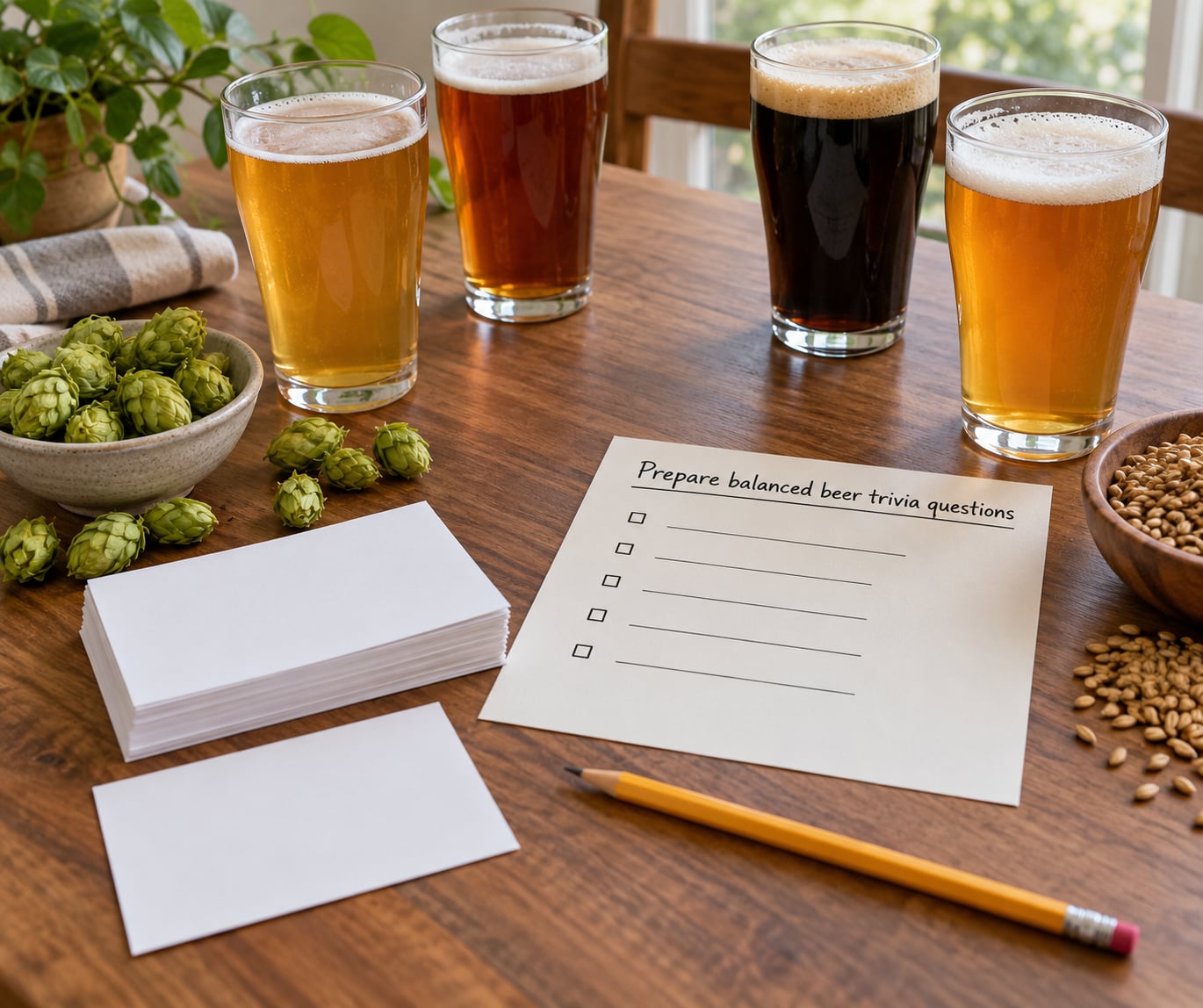
Build a difficulty mix on purpose: roughly 30 to 40 percent easy, 40 to 50 percent medium, and 15 to 25 percent hard. A round that is all hard questions does not make your bar look intellectual, it makes it look unfair, and the team that walks out is often your most knowledgeable regular.
These categories are where beer trivia earns its keep, because general knowledge trivia is something every venue can run. One prompt per category is enough to get you started.
- Core ingredients — What four ingredients does nearly all beer contain?
- Yeast and fermentation — Which species ferments an ale, and which one ferments a lager?
- Hop varieties — Name a traditional European hop used in pilsner.
- Malt and roasting — What gives a stout its near-black color?
- Style families — Is a Baltic porter an ale or a lager?
- Bitterness and strength — What does IBU measure, and what does ABV measure?
- Brewing process — What is wort, and roughly how long is it boiled before fermentation?
- Water chemistry — How do sulfate and chloride minerals change the taste of the finished beer?
- Glassware — Which glass shape suits a Belgian farmhouse ale?
- Serving and pairing — Which style is traditionally served at cellar temperature, and what food suits it?
- Beer culture and history — Which country’s breweries shaped the pilsner style?
- Local scene — Which nearby brewery opened first, and what is it best known for?
- Label and branding — Which brewery is behind a well-known Irish stout with a harp on the can?
- Oddball styles — Which German style is brewed with wheat, and often includes coriander?
- Beer measurement — What does a “barrel’s worth of capital” have to do with the word bitter?
Here are 18 questions with answers you can lift straight into a round. Check every one against a second source before you use it. Trivia questions that turn out to be wrong do more damage than questions that are merely hard.
Easy
- What are the four main ingredients in almost all beer? Barley (or another grain), hops, yeast, and water.
- Which yeast ferments an ale? Saccharomyces cerevisiae, a top-fermenting yeast. Lagers use the cold-fermenting relative Saccharomyces pastorianus.
- After which city is the pilsner style named? Plzen, in the Czech Republic.
- What does IBU stand for? International Bitterness Units, a scale for hop-derived bitterness.
- Which three traditional European hops are still used in pilsner brewing? Saaz, Hallertau, and Spalt from the Czech region, and Tettnang from Germany, commonly described together as the noble hops.
- What is the German word for wheat beer? Weizen, as in Hefeweizen.
- What does BJCP stand for? The Beer Judge Certification Program, which trains and certifies beer judges.
Medium
- Is a Baltic porter an ale or a lager? A lager. It is a cold-fermented, higher-alcohol interpretation of a porter.
- Which German state is gose associated with? Saxony, where the style is brewed with wheat, coriander, and a distinctly salty character.
- Which American hop variety became a signature ingredient in late-2000s American IPAs? Citra, known for intense citrus and tropical character.
- What is the difference between two-row and six-row barley? The number of rows of grain kernels along the head, which affects the malting character.
- How do sulfate and chloride affect beer flavor? Sulfate-forward water sharpens bitterness and dryness; chloride-forward water rounds it out and supports malt sweetness.
- What is wort? The sweet, unfermented liquid produced by mashing grain and straining it, which becomes beer after yeast is added.
- What does a brewer read to measure the strength of the wort before fermentation? Original gravity, expressed in degrees Plato or specific gravity.
- What is a braggot? A fermented drink made from a blend of beer and mead, usually with added honey.
Hard
- What is a cicerone? A person formally trained in beer, and also a historical unit of hops equal to about one and a half liters.
- What is a decoction mash? A traditional step in which a portion of the mash is boiled out and returned to the main mash to develop malt character.
- What does a beer style actually define, according to most style guidelines? The committed yeast strain and the resulting fermentation character, not the color, which varies with roasting.
- What is lagering? The cold conditioning step after fermentation, during which yeast and other compounds settle and the beer clarifies.
Fact-check everything. Generative tools will hand you a confident, well-formatted question with a wrong answer underneath, and your audience is exactly the kind of people who will catch it.
Set up the room, teams, and scoring system
Give teams of one to four the best default, and cap at eight so one large group cannot dominate. Solo players deserve a spot rather than a hint to go find friends. Keep the table plan simple: teams seated in a horseshoe or in rows all facing the same direction, so nobody has to crane around a pillar.
Choose your scoring method before the night, tell teams which one you are using, and write the tiebreaker rule on the answer sheet. Paper sheets scored round by round are the most reliable option because a lost phone cannot ruin the night. A shared spreadsheet filled in live scales better past about a dozen teams. A digital form on phones is fastest but depends on everyone having a phone, a network, and the willingness to stop texting.
Here is a run of show that fits a two-hour window:
- 0:00 to 0:15 — Sign-up, team names on the board, house rules, tonight’s prizes.
- 0:15 to 0:30 — Round 1, first and easiest questions.
- 0:30 to 1:00 — Rounds 2 and 3.
- 1:00 to 1:15 — Halftime, order pickups, brewer or guest chat.
- 1:15 to 1:55 — Rounds 4, 5, and 6.
- 1:55 to 2:05 — Score sweep, tiebreaker question, winners announced.
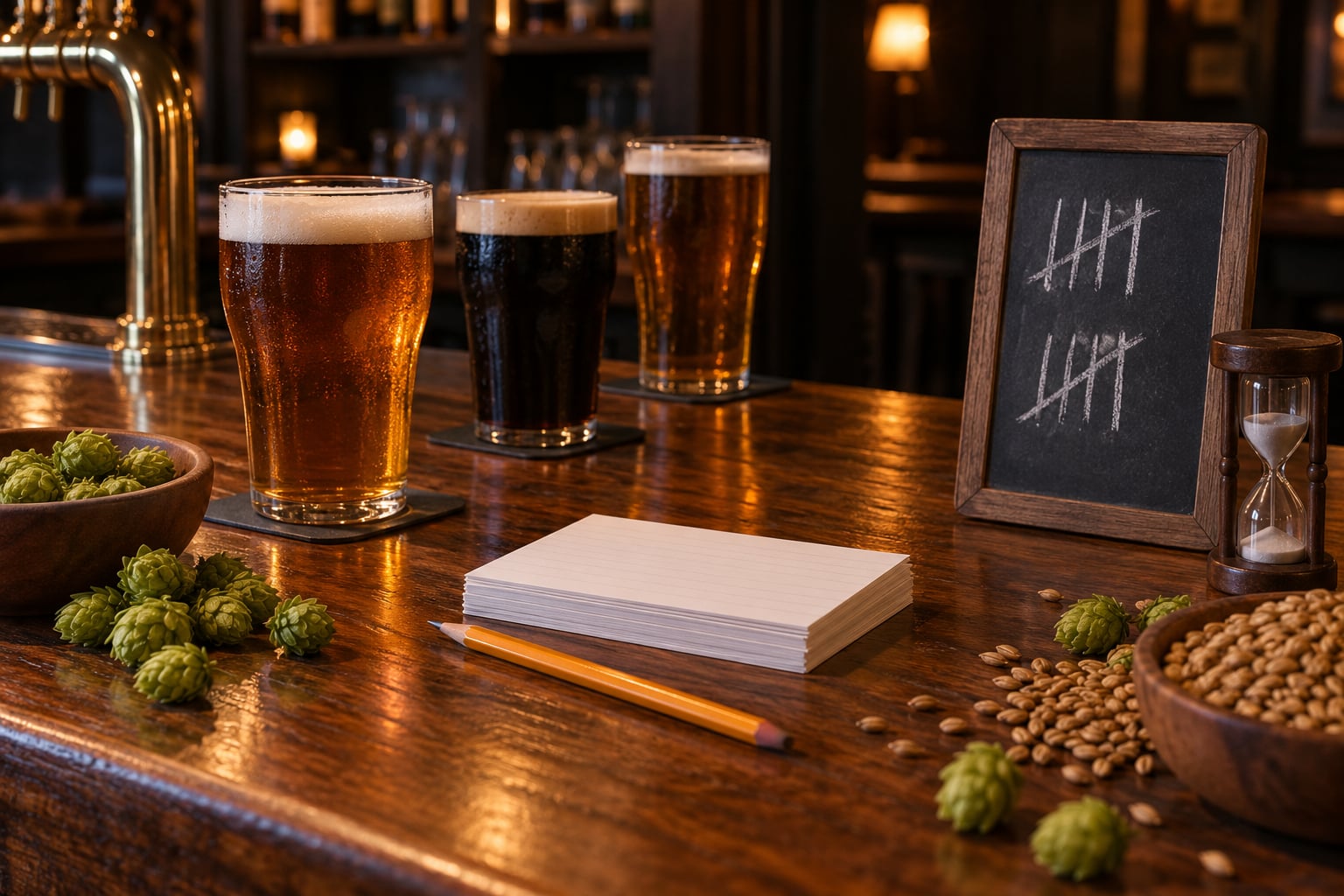
Hang a sign-up sheet or a tablet at the door, and put the current standings on a whiteboard or chalkboard where everyone can see. Visible standings create the tension that keeps a team writing down round three.
Host the questions and keep the energy moving
How to run a quiz night well comes down to pace. Most hosts land on one to two minutes per question, which fills about two hours including breaks. Read each question twice. If nobody writes anything down, you have either asked it too fast or written it so vaguely that the team is waiting for you to finish the sentence before they can answer it.
Give context in small doses. Twenty seconds about why a pilsner is a lager or what a noble hop is makes the question feel like it belongs in a beer bar rather than a classroom. Keep it under half a minute though. The second you explain more than the question needs, you have taken the guesswork away and half the room gets annoyed.
Have a rule for disputes before you need it. The standard is simple: the answer that matches the answer key as written, and a clarification offered immediately when a question turns out to be wrong. Never adjudicate in the moment out of sympathy for a team that is behind. Hosts who run thin nights rather than cancel them tend to be right. An awkward night with nine people beats an empty room and a cancellation post, and several of those nine will come back the following week.
Halftime is fifteen minutes and it is useful. It clears glasses, resets the noise level, and gives the floor staff a chance to catch up. Use it for a two-minute brewery talk or a quick beer-and-food pairing suggestion if the kitchen wants the plug.
Announce winners and close responsibly
Verify the top three scores before you say any name out loud. Handing a prize to the wrong team in a room where everyone has been tracking the whiteboard is the kind of moment a trivia regular will bring up for a year.
Prize value matters less than you think. A bar tab, a drink ticket, or a growler of a beer that just came off the tap outperforms a trophy every time with this crowd. Recognise the other teams too, because a night that congratulates only first place is a night people return to once and then quietly stop coming to.
Make the close count. Announce the next night’s time and theme before people put their coats on, thank the non-drinking players by name if the crowd was mixed, and get water onto the tables rather than waiting for someone to ask. The team that won should not be the last ones standing.
Common Mistakes
- Ambiguous questions. “Which hop is used in pilsner” has three correct answers and one disappointed team. Fix: one unambiguous answer per question, and check every item against a second source before the night.
- Uneven difficulty. Three hard questions in a row empties out the middle of the room. Fix: aim for 30 to 40 percent easy questions and open with them.
- Too many rounds. Nine rounds turns a fun night into a shift. Fix: 4 to 6 rounds, 8 to 12 questions each, hard stop at two hours.
- Unclear scoring. Rules invented after the tie happens look like favoritism every time. Fix: publish the scoring method and tiebreaker rule at the start of the night and hold to them.
- Poor space planning. Teams crammed together end up sharing answers and then arguing about it. Fix: seat capacity first, cap registration to match, and do not let large squads fill every table.
- A beer-only crowd. A quiz that assumes everyone is drinking loses the designated drivers, the people on medication, the pregnant guests, and the half of the room under legal drinking age. Fix: make zero-proof and water options as visible and as plentiful as the beer, and never tie a question to drinking a pint.
- The same two categories every week. Repeat round rosters get stale fast. Fix: rotate categories so no two consecutive nights feel the same.
Tips for a Memorable Beer Trivia Night
- Build one round around your own taps. A “guess the beer from the description” round using glasses from your current lineup is free content that competitors cannot copy.
- Teach local history in the questions. Which nearby brewery opened first, which neighborhood is known for a specific style, which local event draws the biggest crowd. Regulars love proving they know their own city.
- Use one picture round, not two. Glassware silhouettes, malt grain comparisons, hop cones, label design eras, and brewery signs all work. Showing a mystery beer in a plain glass and asking for the style works even better, provided the pour is legal for the venue and the answer is unambiguous.
- Give teams good names to argue over. Suggest a name when a table has not chosen one by halftime. It is a small thing that gets a table talking to other tables.
- Run one bonus question per round. A half point, no downside, and it gives the trailing team something to chase.
- Ask two questions that are hard to look up mid-round. Everyone in the room can open a search engine. Tasting notes, label histories, and descriptions of a local scene cannot be Googed at speed.
- Announce the theme a week ahead. Oktoberfest, a release party, IPA day, a stout month. A named theme gives people a reason to bring a specific team.
- Close the loop afterwards. Post the winner photos, send the standings to everyone who came, and ask one question at the end of the night about what they want next. Trivia regulars are loyal in a way karaoke crowds rarely are, and that loyalty is built on being recognized week after week.
Frequently Asked Questions
How many questions should a beer trivia night have?
Plan for 40 to 60 questions across a full night. A standard setup is 4 to 6 rounds with 8 to 12 questions in each round, which fills 90 to 120 minutes at roughly one to two minutes per question. If you are running a shorter event, three rounds of 10 questions works well. Write extra questions as backups, because a dispute or a slow first half tends to eat into the buffer you thought you had.
How many rounds work best for a two-hour pub quiz?
Four to six rounds is the sweet spot, with a 15-minute halftime in the middle. Four rounds feel relaxed and suit a mixed crowd. Six rounds keep regulars engaged and reward teams who pace themselves, as long as each round stays under 15 minutes. Eight or more rounds usually drags, and the last two get answered on phones under the table rather than shouted at the host.
How much should I charge to enter a trivia night?
Most successful bars run it free, because the room pays through drinks, food, and the people who come back the following week. A small per-player entry often goes straight to the host as a tip and is easy to explain. If you test an entry fee, tie it to a drink special or a minimum spend rather than charging for the right to play. Raising an obstacle to walk in is the fastest way to shrink a weekly crowd.
How can I run a beer trivia night at home with a few friends?
Drop the ceremony. Three rounds of 10 questions, one sheet of paper per team, and a phone timer is plenty. Print or paste the answer key, score it at the end, and have the winning team pick the music for the rest of the evening. A home version works best with a flight of beers that matches the round, so the tasting and the quiz point at the same thing.
How do bar trivia hosts get paid?
Three common models. A host works for the venue for a flat fee per night. A trivia company supplies the host, questions, and materials and takes a cut of the entry fees or a flat monthly rate. Or a knowledgeable staff member runs it for tips from the players, which is popular in smaller rooms. Whatever the model, the host needs a written answer key, a run of show, and clear rules so disputes do not land on them.
How do I score a large field of teams without errors?
Use one spreadsheet with a column per team and a row per question, and update it after every round rather than at the end. Ten teams is easy by hand. Past fifteen, a shared spreadsheet updated live saves an hour and prevents the 9:58 p.m. scramble. Announce the tiebreaker rule at the start, show standings on a board everyone can see, and double-check the top three before you announce a winner.
Conclusion
Start with three things this week: lock the night and the start time, write one round of 10 beer questions with an answer key, and pick the prizes. Everything else in this guide is refinement on top of those three decisions.
Then run it thin. The crowd arrives a few weeks at a time, the format settles once the regulars know the rhythm, and the questions get better faster than you expect. Keep the room welcoming for people who are not drinking, keep the pace moving, and the same tables will be back the following Thursday before the rest of the week is over.