Updated for October 2026
Hop varieties are named cultivated cultivars of the hop plant, Humulus lupulus, and each one differs along five measurable axes: botanical lineage, growing origin, alpha acid percentage, beta acid percentage, and essential oil profile. Practically, that means every variety has a bitterness ceiling, an aroma character, and a set of beer styles it suits. Updated for October 2026, this guide explains what those axes mean, which varieties beginners are most likely to meet, and how to choose between them.
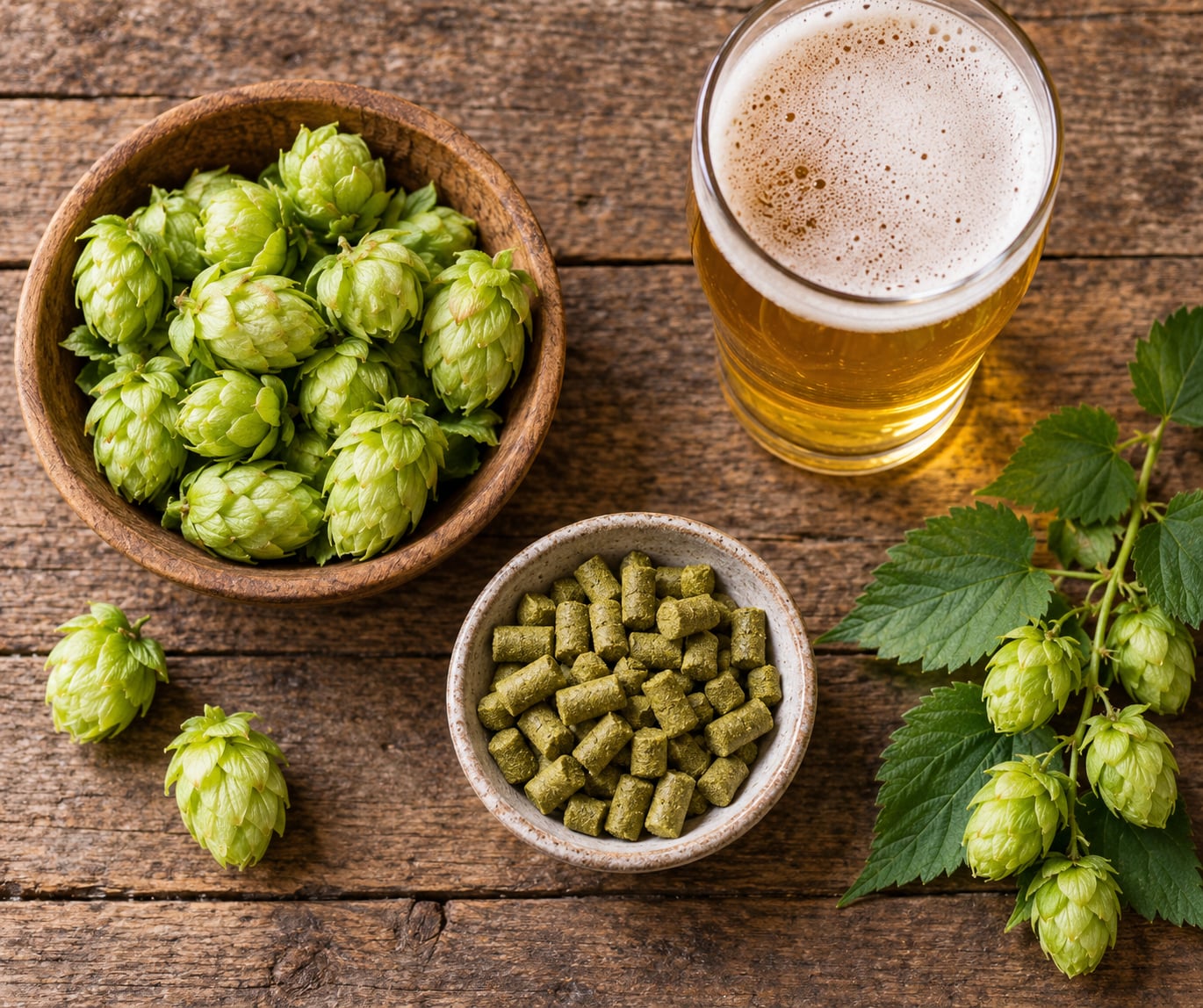
Hops are the cone-shaped female flowers of a climbing vine in the hemp family. Every green cone you see is packed with tiny yellow lupulin glands, and those glands hold two very different sets of chemistry: bitter acids and aromatic oils. Almost every difference between hop varieties traces back to how much of each one that plant makes, and in what ratio.
That question comes up constantly on homebrew forums, and it usually arrives in the form of a puzzle: a recipe calls for a variety the brewer cannot get, or two IPAs taste strangely similar when everyone expected them to taste different. Once you know which axis you are actually looking at, the puzzle gets much easier to solve.
Table of Contents
- What Are Hop Varieties and How Do They Differ?
- The five axes along which hop varieties differ
- What Makes One Hop Variety Taste Different?
- Harvest timing and kiln drying
- Storage, harvest year, and oxidation
- Product form changes the expression, not the variety
- Where new hop varieties come from
- A short history of hops in beer
- Cascade, Centennial, Citra, and Other Popular Hop Varieties
- Citrus and pine — the American workhorses
- Tropical fruit — the modern aroma wave
- Resin, pine, and earth — the bittering-leaning Americans
- Floral, earthy, and herbal — English and Continental
- Noble spice — the lager tradition
- Southern hemisphere — tropical and pine, with edge
- Which Hop Variety Is Best for Bitterness Versus Aroma?
- How Do American, English, German, and New Zealand Hops Compare?
- What Are the Main Hop Aroma and Flavor Families?
- Why modern IPA hops can start to taste the same
- How Do You Choose the Right Hop Variety for Your Beer?
- Substituting a variety you cannot buy
- How to actually taste the difference yourself
- Frequently Asked Questions
- What are some common American hop varieties?
- What are the four noble hops?
- What can I use as a substitute for Magnum hops?
- What is the 3:30-300 rule for beer?
- Does the hop variety determine how bitter a beer tastes?
- How much does harvest year and storage affect hop flavor?
- Conclusion
What Are Hop Varieties and How Do They Differ?
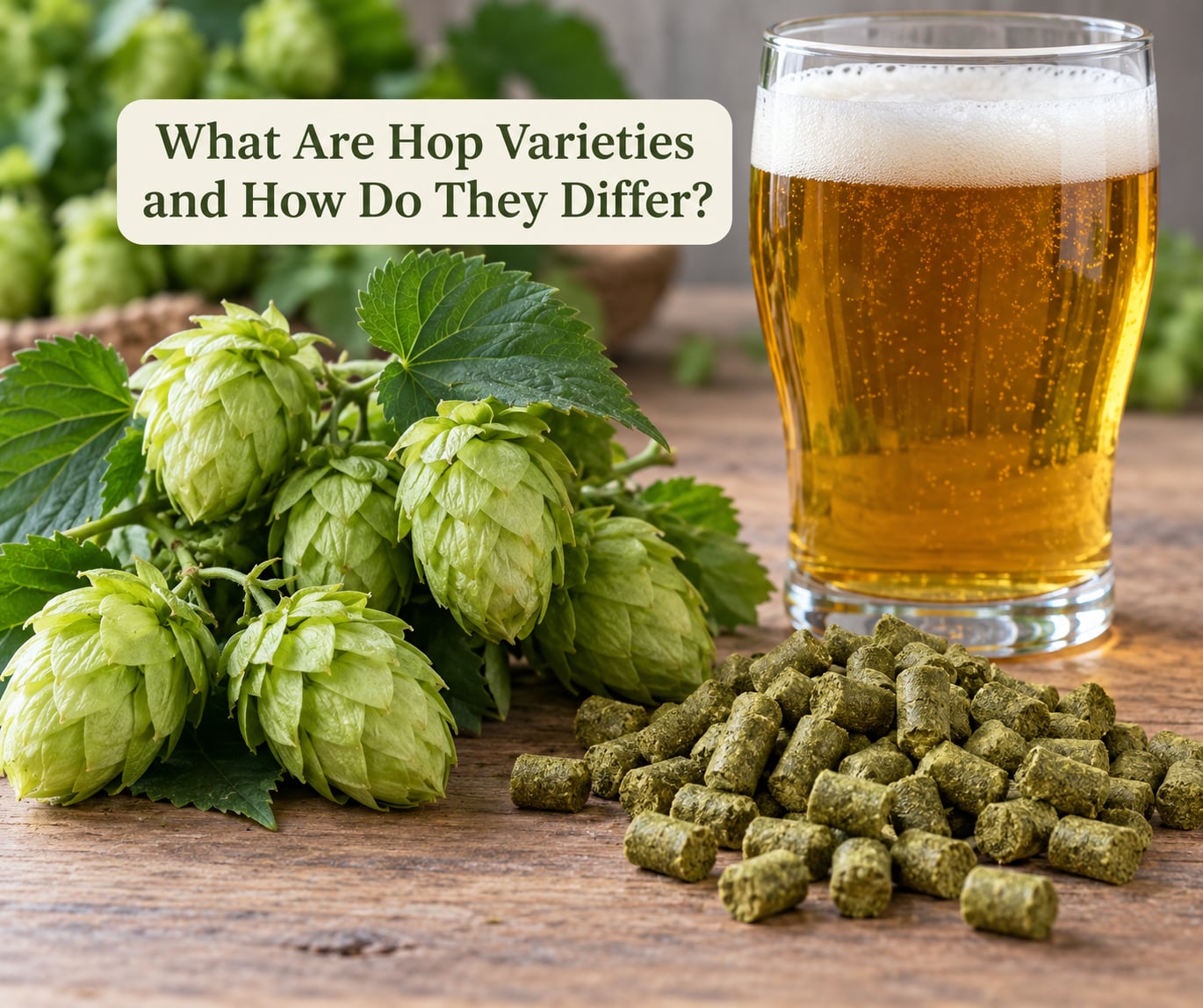
A hop variety is a named, bred population of hop plants that comes reasonably true when grown from rhizome or seed, carries its own consistent chemistry, and was given a name a breeder is willing to put on a sack. Over 150 named varieties are registered or in commercial circulation, and new ones keep arriving because breeding programs keep crossing plants with different parents and different growing conditions.
When someone asks what are hop varieties and how they differ, the useful answer is not a catalogue of names. It is a framework, because the names change every few years and the axes do not. Two varieties differ along five measurable dimensions, plus one functional one.
The five axes along which hop varieties differ
- Botanical lineage and parentage. Nearly every modern cultivar descends from a small number of parents. Brewer’s Gold, a 1930s American variety, is behind a surprising share of the American breeding program, and Cluster and Fuggle show up repeatedly in European pedigrees. Lineage predicts aroma more reliably than it predicts alpha acid.
- Growing origin and terroir. Latitude, day length, soil, and harvest window shape a plant’s chemistry. The same variety grown in the Yakima Valley and in a wet English garden will not produce identical cones. This is why hop suppliers list the growing region on the sack, and why a region gives you a rough expectation of flavor family.
- Alpha acid percentage. This is the bittering potential, measured as a percentage of the dried cone’s weight. It is the number a brewer uses for IBU math, and it shifts year to year within a variety, which is exactly why reputable suppliers print the current crop figure on the label instead of quoting a permanent number.
- Beta acid percentage. The less-famous cousin of alpha acid. Beta acids barely isomerize, so they add little bitterness on their own, but they carry aroma character and they matter during the boil, when part of them convert into isomerizable alpha acids. A share of your measured bitterness comes from that conversion, depending on the variety and the boil length.
- Essential oil profile. The volatile fraction, typically making up somewhere around a tenth of the dried cone’s weight. This is the aroma and flavor layer: myrcene for resin and green, humulene for woody and earthy, caryophyllene for black pepper and spice, farnesene for citrus peel, linalool and geraniol for floral. The blend of these is the single biggest reason two hops smell and taste different.
The sixth, functional axis is how brewers group them for use: bittering hops, aroma hops, and dual-purpose hops. That label describes a hop’s practical behavior in a kettle, not its quality.
| Axis | What it measures | What it changes in the glass |
|---|---|---|
| Alpha acid % | Weight of bitter acids in the dried cone | Bitterness, and how much hop you need to get it |
| Beta acid % | Related acids that barely isomerize | Aroma character, and extra bitterness formed during the boil |
| Essential oils | Volatile terpene blend | Aroma and flavor: citrus, pine, resin, spice, floral, fruit |
| Lineage | Parent plants of the cultivar | Which aroma family you are likely to land in |
| Origin | Where the crop was grown and dried | A predictable range of character, all else equal |
| Brewing use | Bittering, aroma, or dual-purpose | How you dose it and when you add it |
What Makes One Hop Variety Taste Different?
Genetics set the ceiling. Everything after that can push a hop up or down inside that ceiling, which is why a Cascade cropped early and stored badly in a warm room can taste flatter than a Cascade treated well.
Harvest timing and kiln drying
Pickers have a narrow window, and the decision inside it matters. Harvested on the early side, cones carry more grassy, green, vegetal notes and slightly softer acids. Picked later, the plant has had more sun, so resin and fruit develop and the alpha acid figure climbs. Drying is equally sensitive: too slow and the plant oxidizes, too hot and the volatiles cook off.
Storage, harvest year, and oxidation
This is the reason two packets of the same variety can taste different, and it is the one forum readers ask about most. Fresh hops are grassy and bright. Stored badly or too long, they turn papery, flat, and faintly cardboard-like, because the essential oils oxidize and the remaining alpha acids degrade. Buy from a supplier who prints the harvest year, store sealed and cold, and buy a quantity you will use inside a year. If a bag smells like an empty paper bag, the aroma hop you paid for is already gone.
Product form changes the expression, not the variety
Whole cone, T90 pellet, T45 pellet, lupulin-rich pellet, hop hash, and extract are all the same plant material in different packaging, and they behave differently. Pellets are more consistent and far less bulky, but the milling step costs a little volatile oil. Lupulin-rich pellets concentrate the oily fraction, so the same dose by weight tastes bigger and goes further, which trips up anyone who transfers a recipe across formats without recalculating. Whole cones are fussier in a kettle and can carry more plant material into the wort. Extracts and hop oil are concentrates for large batches, where consistency matters more than character.
Keep this separate in your head. A variety is a plant. A product form is a delivery mechanism. Confusing the two is why people think “Citra pellets” is a flavor in itself.
Where new hop varieties come from
If you started brewing ten years ago and your recipe sheet has not changed since, the list of names you know is out of date. That is worth understanding, because it explains why the shelf keeps looking different every season.
A new variety starts as a cross between two or more parent plants, grown from seed, and it takes several years to evaluate for yield, disease resistance, alpha acid stability, and aroma. Some breeders release selections publicly, which is why names like Citra, Mosaic, and Amarillo eventually show up in catalogs everywhere. Others keep their selections proprietary for a period, selling them only to contracted breweries under a code. When a variety finally gets a marketing name, that is often the moment most homebrewers hear about it.
Coded names are not a different species. Something labeled with a breeder code and a number, such as an experimental lot, is a real variety with real chemistry that simply has not been renamed for general sale yet. When you taste one of those and it reads as something you recognize, you are not imagining it. The flavor is real, and a lot of the most talked-about modern aroma hops started life exactly this way.
A short history of hops in beer
Hops are a relatively late addition to brewing. For centuries, beer was flavored with herbs and roots, and hopped beer was regarded as a foreign novelty.
Beer records in early medieval Europe mention hops being used alongside other plants, and by the twelfth and thirteenth centuries German growers were cultivating them properly. In 1412 hopped beer appeared in an English court record, which suggests English adoption began well after continental practice rather than before it.
The Bavarian purity law Reinheitsgebot of 1516 formalized the German approach of brewing with hops rather than with the gentler herb blends, and that tradition is why noble hops became the signature of lager. English brewing later went the other way, in 1710 Parliament restricted English bittering hops to English-grown ones, a rule that still shapes the English varieties and their distinctly earthy profile today.
Cascade, Centennial, Citra, and Other Popular Hop Varieties
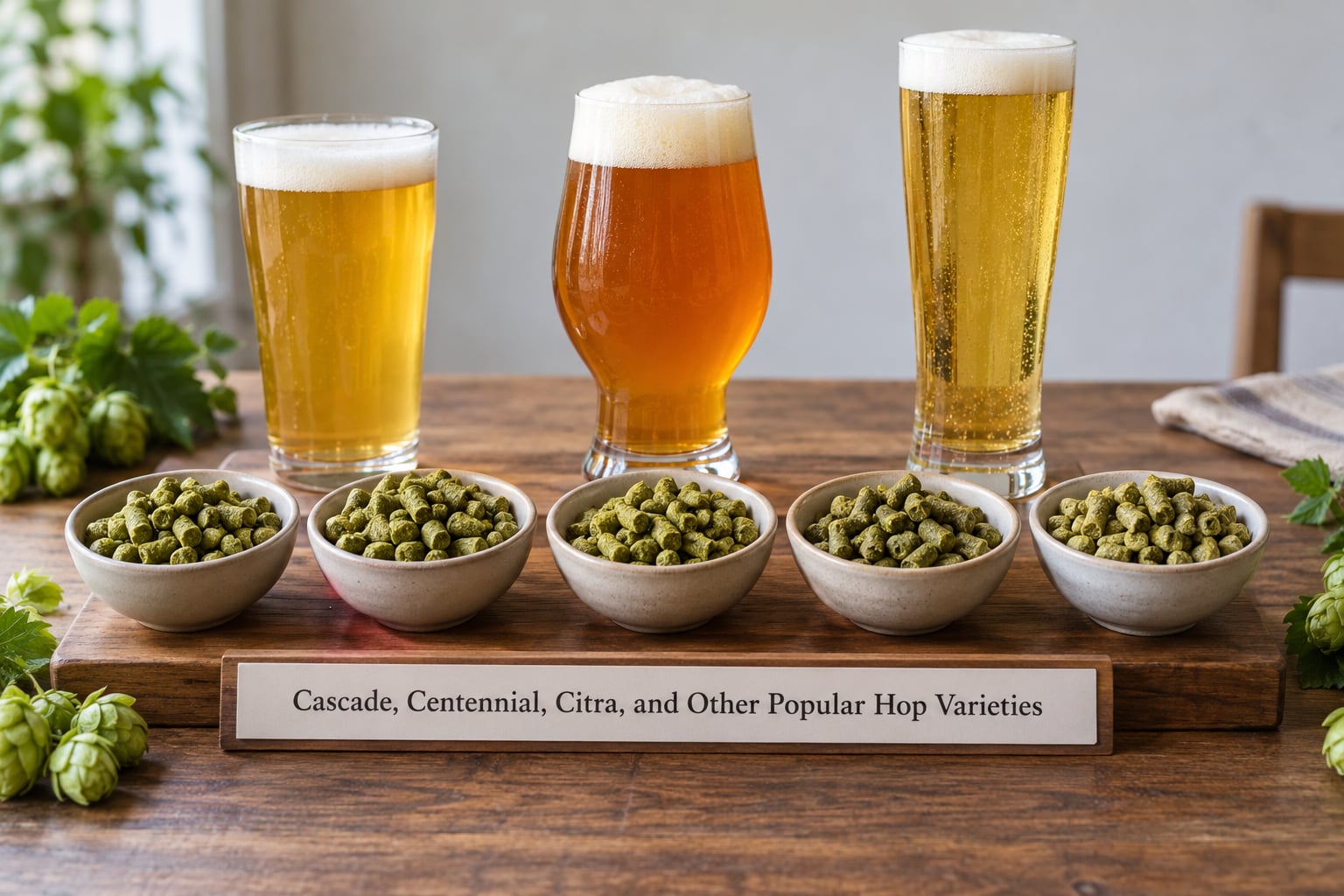
Grouping varieties by sensory profile beats memorizing names in alphabetical order. The names change; the families hold.
Citrus and pine — the American workhorses
Cascade sits at roughly 5 to 7 percent alpha acid and became a reference point for American aroma. It brings grapefruit, lemon, and a floral lift, and it is closely associated with the American pale ale of the 1980s. It takes bittering additions gracefully too, which makes it genuinely dual-purpose.
Centennial, around 9 to 12 percent alpha, is the pine-and-grapefruit hop of the early craft era. It is a little earthier and more resinous than Cascade, and it still shows up as the bittering hop in a classic American pale ale.
Simcoe, roughly 12 to 15 percent, is stickier and heavier: orange sap, pine resin, a herbal edge. It is a perennial favorite in American brewing, and brewers reach for it partly because it plays well beside other varieties rather than dominating them.
Tropical fruit — the modern aroma wave
Citra, around 10 to 14 percent alpha, is widely used as an aroma hop and shows up in pilsner, pale ale, and IPA alike. It reads as lychee, mango, and grapefruit, and unusually for a modern aroma hop, its character survives the kettle well enough to matter even in early additions.
Mosaic, roughly 10 to 13 percent, layers blueberry, mango, and a light dank resin note on top of a Citra-like tropical base. Strata, Nectaron, Belma, Riwaka, Idaho 7, and Cashmere all sit in this family, each tilted a few degrees differently.
Resin, pine, and earth — the bittering-leaning Americans
Chinook and Columbus (sold in some markets as Tomahawk) run high, around 12 to 16 percent, with a heavy pine, resin, and sticky-sweet character. Magnum is one of the higher-alpha commercial varieties, commonly sold in the 12 to 15 percent range, and is used almost purely for clean bitterness because it contributes very little aroma. Warrior, Summit, and Northern Brewer occupy similar clean-bittering territory at slightly lower alpha.
Floral, earthy, and herbal — English and Continental
Fuggle (about 4 to 6 percent) is the old English standard: herbal, woody, mildly earthy, and mild enough that it disappeared into beer for decades. East Kent Goldings, Willamette, and Challenger are its more aromatic cousins, all riding somewhere between floral, honey, and garden greenery. On the Continent, Styrian Goldings and Perle lean floral and spice, while Northern Brewer covers both German and American breeding lines.
Noble spice — the lager tradition
The four noble hops are Hallertau (usually Hallertau Mittelfruh), Saaz, Tettnanger, and Spalt. Noble is a category, not a quality tier or an award. It describes four traditional Central European landrace varieties that share a mild, smooth, floral-and-spice signature and relatively low alpha acid, typically 3 to 5 percent. That gentleness is the whole point: it flavors a pilsner without wrestling the malt.
Southern hemisphere — tropical and pine, with edge
Galaxy, Nelson Sauvin, Riwaka, and Nectaron come from New Zealand, and Australian selections push further into the tropical end. Nelson Sauvin is the famous one: white wine, lime, and a peppery edge that reads more like Sauvignon Blanc than like beer.
Which Hop Variety Is Best for Bitterness Versus Aroma?
Bitterness is made by alpha acids, and aroma is made by essential oils. High-alpha varieties were selected to convert more of the first; low-alpha varieties were selected for their oil profile. But variety alone does not decide how bitter a beer tastes, and this is where most beginner recipes go wrong.
Three factors move the needle far more than the name on the sack. Dose is the big one: a hop at high alpha in a small dose and a hop at low alpha in a large dose can deliver the same IBU. Timing decides how much survives: a 60-minute addition isomerizes alpha acids into bitter iso-alpha acids and boils off most of the aroma, while a whirlpool or dry hop addition keeps volatile character and contributes almost no bitterness. Style and gravity set the target, because a 20 IBU pilsner and a 60 IBU double IPA are both correct.
Here is the arithmetic in plain terms. One ounce of a 12 percent alpha hop added for 60 minutes in a 5 gallon batch delivers roughly 20 to 25 IBU once you account for typical kettle efficiency. So a 40 IBU pale ale needs about two ounces of that same hop in that same window, and a 20 IBU pilsner needs roughly one. This is why a bittering hop like Magnum is dosed by weight and recalculated against the current crop, while flavor hops are dosed by timing.
| Category | Typical alpha acid | Best used for | Examples |
|---|---|---|---|
| Bittering | 12 to 16 percent | Early kettle additions, clean bitterness | Magnum, Warrior, Summit, Columbus, Chinook |
| Dual-purpose | 6 to 11 percent | Both kettle and late additions | Cascade, Centennial, Perle, Styrian Goldings, Northern Brewer |
| Aroma | Historically 3 to 7 percent, though many modern aroma hops run 10 to 14 percent | Whirlpool, cold side, dry hop | Citra, Mosaic, Simcoe, Galaxy, Nelson Sauvin, Strata, Nectaron |
| Noble | 3 to 5 percent | Lager and German-style spice | Hallertau, Saaz, Tettnanger, Spalt |
Matching varieties to styles follows from that. A Bohemian pilsner wants noble hops at low doses for bittering plus a late Hallertau or Saaz addition for floral lift. An English ESB wants East Kent Goldings or Target for earthy floral bittering with no sharp hop bite. A West Coast IPA wants a high-alpha resinous hop like Simcoe or Columbus for bittering and a late charge of Citra or Amarillo for citrus. A New England IPA wants almost all late addition, heavy dry hop, and a soft resinous bittering base like Mosaic or Strata underneath. A stout can be bittered with a high-alpha hop because roast malt overwhelms hop aroma anyway.
How Do American, English, German, and New Zealand Hops Compare?
Region is a rough predictor, not a guarantee. Two American hops can taste nothing alike, and a New Zealand selection can look like an American one on paper. Treat the table as a starting expectation, then taste.
| Region | Typical aroma profile | Representative varieties | Usual bitterness range | Styles you meet them in |
|---|---|---|---|---|
| American (Yakima Valley, Willamette Valley, Idaho) | Citrus, pine, resin, tropical fruit, sometimes dank | Cascade, Centennial, Citra, Mosaic, Simcoe, Amarillo, Chinook, Magnum, Strata, Idaho 7 | 5 to 15 percent, from aroma through clean bittering | American pale ale, West Coast IPA, hazy IPA, porter and stout |
| English (Kent, East Kent, Worcestershire) | Earthy, herbal, woody, floral, honey | Fuggle, East Kent Goldings, Willamette, Challenger, Target, Progress, Styrian Goldings | 4 to 9 percent, mostly dual-purpose | English bitter, ESB, mild, brown ale, porters |
| German and Czech (Hallertau, Tettnang, Spalt, Saaz) | Mild floral, spicy, herbal, clean | Hallertau Mittelfruh, Tettnanger, Spalt, Saaz, Perle, Mandarina Bavaria | 3 to 6 percent, low and gentle | Bohemian pilsner, German lager and pilsner, Kolsch, Altbier, Bock |
| New Zealand and Australia (Nelson, Riwaka, Tasmania) | Bright tropical fruit, white wine, lime, pepper | Nelson Sauvin, Riwaka, Galaxy, Nectaron, Motueka | 5 to 14 percent, heavily weighted to aroma use | New World pilsner, single-hop IPA, hop-forward pale ale |
The practical takeaway is that English and Continental hops deliver flavor alongside bitterness, which makes them forgiving to use. American and New Zealand hops tend to be louder in the aroma department and often need a separate bittering variety behind them.
What Are the Main Hop Aroma and Flavor Families?
Descriptors are shorthand, not labels that switch on and off. Almost every hop shows two or three notes at once, and processing changes which ones survive. Still, families are how brewers talk, and learning them makes a shelf of unfamiliar varietals readable at a glance.
- Citrus. Lemon, orange, grapefruit peel. Built largely on farnesene and related compounds. Cascade, Centennial, Amarillo, and Columbus are the obvious examples.
- Tropical fruit. Mango, lychee, passion fruit, peach, melon, white grape. Linalool and related terpene alcohols do much of the work. Citra, Nelson Sauvin, Mosaic, Galaxy, Strata, and Riwaka all live here.
- Floral. Rose, jasmine, lavender. Hallertau, Saaz, Tettnanger, Spalt, and Styrian Goldings. This is the family that reads as refined rather than loud.
- Pine and resin. Fresh-cut pine, sticky sap, woody resin. Humulene and myrcene dominate. Simcoe, Chinook, Columbus, and the American super-alpha family.
- Spice. Black pepper, clove, peppery heat, sometimes chili. Caryophyllene is the main compound. Noble hops show it gently; Nelson Sauvin and Strata show it sharply.
- Earthy and herbal. Moss, damp cellar, garden greenery, hay. Fuggle, Target, Progress, Challenger, and English Goldings varieties.
- Dank and resinous. Waxy, sticky, cannabis-adjacent, sometimes described as green. This is a modern American marker and it comes from heavy resin fractions.
Why modern IPA hops can start to taste the same
Descriptor fatigue is a real complaint among homebrewers, and it has a cause. A wave of modern American and New Zealand varieties was bred from related parentage under similar conditions, which means they share large fractions of the same terpene profile. When several describe themselves as tropical fruit, your palate genuinely is being asked to separate small differences against the same backdrop.
The way through is to stop reading generic descriptors and start isolating the distinguishing note. Strata leans peppery and grape-forward. Belma pushes strawberry and cherry, which is why it turns up in farmhouse ales and Belgian styles as often as in IPAs. Idaho 7 gives blackberry and a distinct orange edge. Nectaron carries pineapple with a heavier dank resin underneath. Mosaic sits between blueberry and pine. Compare those against a single reference hop you already know well, such as Citra, and the differences come back into focus.
How Do You Choose the Right Hop Variety for Your Beer?
Work through it in this order, and the choice usually makes itself.
- Name the style first. A pilsner at 22 IBU and a pale ale at 40 IBU need different hops for different reasons. Decide the bitterness target before you touch a variety list.
- Pick the aroma you actually want to smell. One sentence, written down: “grapefruit and pine” or “floral and spicy” or “mango and lychee.” This keeps you from buying six hops because six sounded good.
- Separate your bittering hop from your flavor hop. Even a dual-purpose hop works better if you give each job its own variety. A high-alpha clean bitterer plus an aroma variety chosen for character is a simpler recipe than one hop asked to do everything.
- Check the alpha acid figure on this crop’s sack. It is not a permanent number. Recalculate your weight from the current figure rather than copying a recipe that assumed last year’s crop.
- Start small on the aroma side. Dry hop and whirlpool additions fail quietly by being too strong, and you cannot take aroma back once it is in the beer.
- Recalculate when you change product form. Moving from T90 pellets to lupulin-rich pellets at the same weight by ounces is a significant increase in hop character.
If you brew more than one batch, a simple two-variety recipe works well: pick your style’s traditional bittering hop for the first 60 minutes, then pick one aroma variety for the last 15 minutes of the boil plus a dry hop. That structure gives you a clean baseline and a clear variable, so you can hear the difference rather than guess at it.
Substituting a variety you cannot buy
Recipes call for hops that go out of crop or that you simply cannot find, and homebrewers ask about swaps constantly. Two substitution rules cover almost every case.
Lineage swaps work best because related plants share chemistry. Magnum, Columbus, Warrior, Summit, and Northern Brewer all descend from the same bittering-leaning American line, so any of them will cover for Magnum without changing the beer much. Fuggle, Willamette, and Styrian Goldings share English heritage and can cover for one another at similar doses. Citra and Mosaic are close cousins in character, so either can stand in for the other, with Mosaic running slightly heavier and less bright.
Flavor-family swaps work when you accept a small change. Swap a tropical hop for another tropical hop and you will not notice much; swap it for a resinous hop and you will. The practical approach is to match the aroma family first, then correct for alpha acid if the hop is doing bittering work.
For any bittering swap, do the math instead of matching ounces. Multiply the weight your recipe calls for by the ratio of the two alpha acid figures. A recipe calling for 1.5 ounces of a 14 percent Magnum needs about 1.6 ounces of a 13 percent Columbus, so the weight barely moves and the result stays close to the intended IBU. Leave the aroma hop alone during a bittering swap, since substitutes are chosen for what they do not bring to the beer.
One substitution is worth flagging. Amarillo and several other American varieties are bought for aroma, and kettle heat drives off much of what you paid for. If a recipe calls for Amarillo and you swap in a hop that also depends on late addition, keep the timing. Changing variety and timing at once is how a substitution ends up tasting wrong and getting blamed on the hop you chose instead.
How to actually taste the difference yourself
You can learn a lot before you ever boil a batch.
The sniff test. Open a bag, smell it, and write three words. Do this for every variety on your shelf and revisit the list after a few weeks. You will notice raw hop aroma is far more floral and green than the same hop in finished beer, which is exactly the gap forum brewers complain about. The list tells you what to look for in the glass rather than promising what you will smell in the bag.
The hop tea. Steep about 30 grams of one variety in a liter of water at roughly 70 degrees Celsius for several minutes, then strain. Do the same with a second variety, taste them side by side, and take notes. This is the fastest way to learn whether a hop reads as pine or as fruit for you personally, and it costs nothing but a few minutes and a strainer.
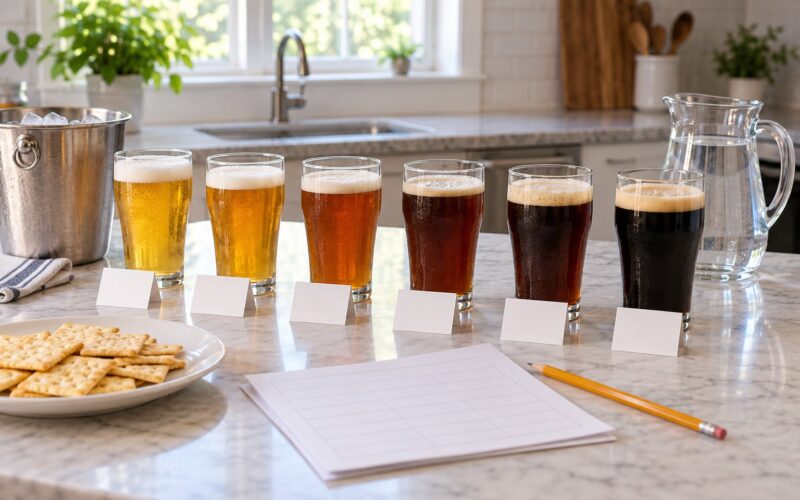
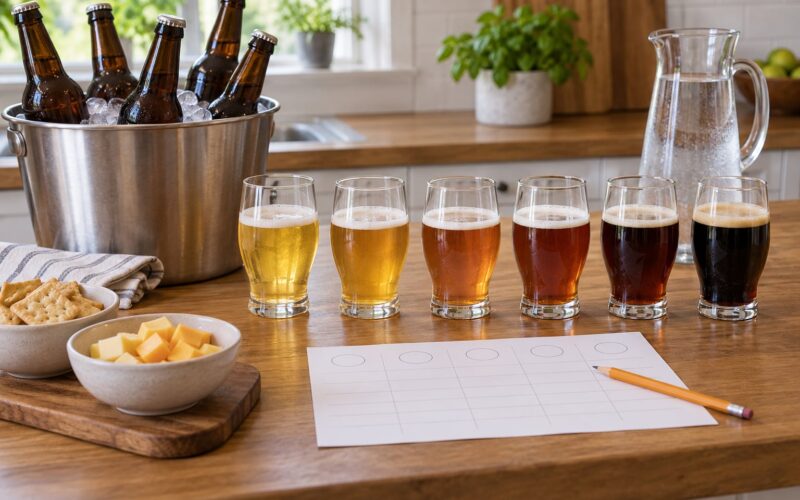
The split batch. Brew one batch and split the wort before hopping, giving each half a single different variety in the whirlpool. You get two finished beers from the identical base, which removes every other variable. This is the only method that honestly answers what a variety tastes like in beer, and it is the one experiment that homebrew forums consistently rate as worth the effort.
Frequently Asked Questions
What are some common American hop varieties?
The most common American hop varieties are Cascade, Centennial, Citra, Mosaic, Simcoe, Amarillo, Chinook, Columbus, Magnum, and Warrior. Cascade and Centennial are dual-purpose workhorses known for grapefruit and pine. Citra, Mosaic, and Simcoe dominate modern American IPA aroma with tropical fruit and resin. Chinook, Columbus, and Magnum supply clean bitterness. For a beginner, Cascade for bittering plus Citra for dry hop covers a wide range of American beer styles.
What are the four noble hops?
The four noble hops are Hallertau (usually Hallertau Mittelfruh), Saaz, Tettnanger, and Spalt. Noble is a category rather than a quality tier, and it describes traditional Central European landrace varieties with relatively low alpha acid, typically 3 to 5 percent, and a mild floral and spicy character. That gentleness is why they dominate pilsner and German lager, where hops support the malt instead of competing with it.
What can I use as a substitute for Magnum hops?
Warrior, Columbus (Tomahawk), Summit, and Northern Brewer all work as Magnum substitutes for clean bittering, since Magnum adds bitterness and almost no aroma. To swap by weight, divide the weight your recipe calls for by Magnum’s alpha acid figure, then multiply by the substitute’s alpha acid figure. Keep the aroma hop unchanged during a bittering swap, because substitutes are chosen for what they do not bring.
What is the 3:30-300 rule for beer?
The 3:30-300 rule is a hop quantity guideline from the Beer Judge Certification Program, not a hop variety rule. For a five gallon batch, it suggests roughly 3 ounces of hops for every 0.030 of starting gravity above 1.000, so a 1.030 beer gets about 3 ounces and a 1.060 beer about 6 ounces. Variety still decides flavor, and your real target should come from the style you are brewing.
Does the hop variety determine how bitter a beer tastes?
Not on its own. Alpha acid percentage sets the bitterness ceiling, but dose, addition timing, and target gravity decide how much of that ceiling you reach. Variety matters most for flavor and aroma character rather than for bitterness level. A well-dosed low-alpha aroma hop and a smaller dose of a high-alpha bittering hop can land at the same IBU while tasting nothing alike.
How much does harvest year and storage affect hop flavor?
More than most brewers expect. Essential oils oxidize with age and with heat exposure, and stale aroma hops taste papery and flat rather than bright. Buy from suppliers who print the harvest year, keep hops sealed and cold, and use them within a year. Two packets of the same variety from different years, or stored differently, can taste noticeably different in finished beer even though the variety name is identical.
Conclusion
Hop varieties differ first in chemistry and then in the glass. Alpha acids set how much bitterness a hop can give, essential oils decide whether that hop reads as citrus, pine, spice, floral, or earth, and everything from harvest timing to storage decides how much of it survives into the finished beer. Which hop varieties and how they differ, then, is less about the name on the sack and more about the job you give it in the kettle.
Start with one familiar variety in the role you already understand, brew a second batch with a contrasting one, and split the wort so the base beer is identical. Taste them side by side, note three words for each, and you will understand hop varieties faster than any chart can tell you.