If you’re asking why is my homebrew flat, the honest answer is that it’s usually one of two things: the beer hasn’t finished carbonating yet, or something in the packaging let the CO2 escape. Temperature and elapsed time explain the majority of flat batches, so check those two before you blame your yeast, your caps, or your priming sugar.
Flat beer is the default homebrew complaint, and most of it is under-conditioned rather than broken. That distinction matters, because one calls for patience and the other calls for a specific change. Here’s how to work out which one you have.
Table of Contents
- Quick Diagnosis: Why Is My Homebrew Flat?
- How to Tell Which Kind of Flatness You Have
- Why Did My Homebrew Stop Fermenting?
- Why Did My Bottles or Keg Not Carbonate?
- What Gravity Reading Tells You About Fermentation
- Why Does My Flat Homebrew Taste Bad?
- Why Does My Homebrew Go Flat After Opening?
- How to Fix Flat Homebrew Without Ruining the Batch
- How to Prevent Flat Beer in the Next Batch
- Frequently Asked Questions
- Can I fix beer that is already packaged but flat?
- How long should homebrew take to carbonate?
- Does temperature affect why my homebrew is flat?
- Can I add more priming sugar after packaging the beer?
- When should I discard a batch of homebrew?
- Conclusion
Quick Diagnosis: Why Is My Homebrew Flat?
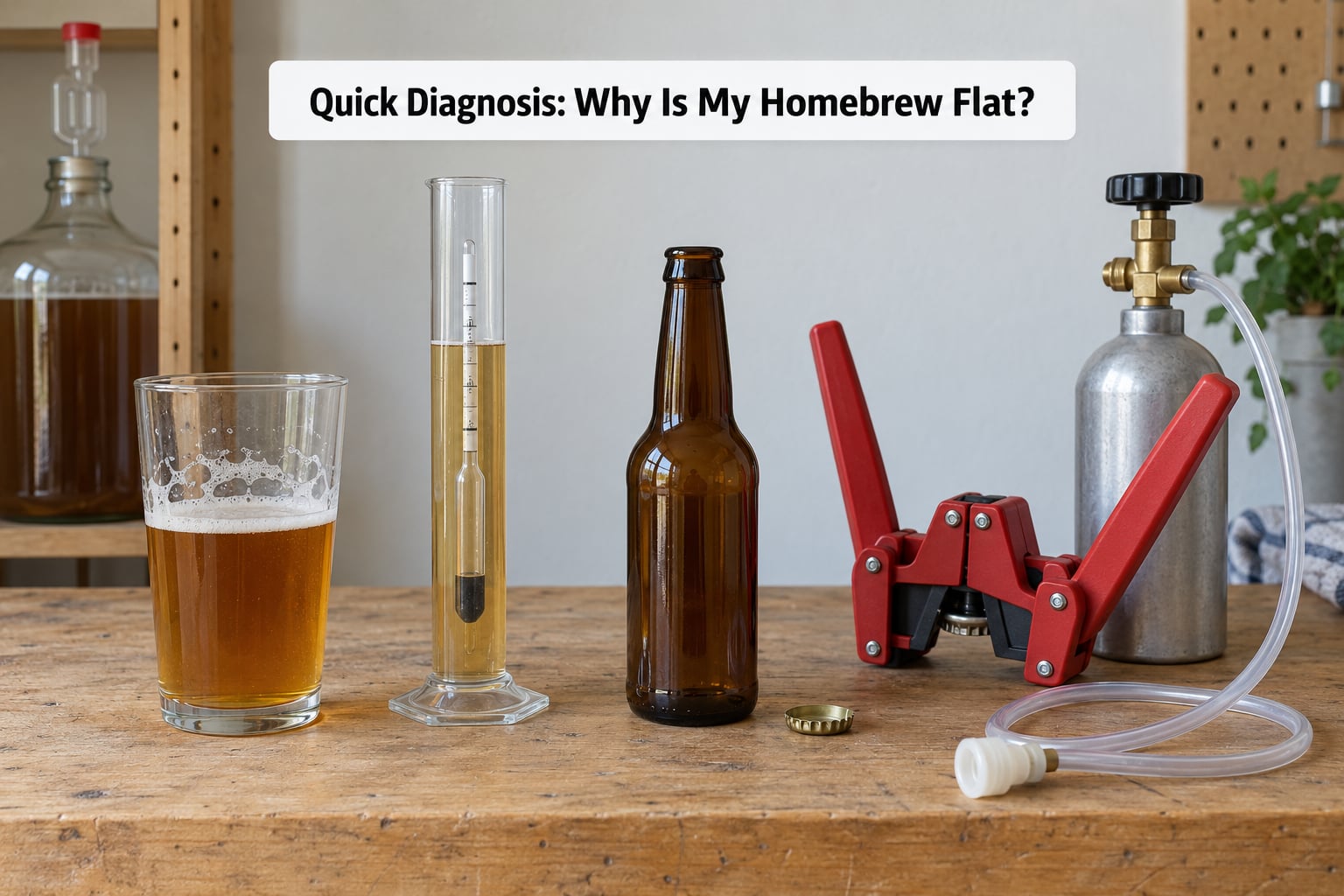
Flat homebrew is almost always one of five things: not enough priming sugar, no viable yeast left at bottling, caps that leak CO2, conditioning temperature too low, or simply not enough conditioning time. Check the temperature and the number of weeks first, because those two explain most flat batches before any equipment is at fault.
Before you change anything, answer four questions in order:
- How long has it been since you packaged it? Under two weeks at room temperature, the beer is almost certainly just young.
- What temperature has it been sitting at? Below 65°F (18°C), carbonation slows sharply.
- Did you take a final gravity reading before packaging? If the reading was still moving, the beer was bottled early.
- Is the problem in bottles or in a keg? The two have almost nothing in common beyond the word CO2.
Here are the eight causes, ranked by how often they turn out to be the answer, with the test that confirms each one.
| Cause | How to confirm it | Fix |
|---|---|---|
| Not enough conditioning time | Under 3 weeks packaged at 70-75°F (21-24°C) | Wait. A week at warm temperature usually does it |
| Conditioning temperature too low | Bottles stored in a cellar or fridge below 65°F (18°C) | Move to 70-75°F (21-24°C) and wait again |
| No viable yeast at bottling | Long fermenter phase, no new yeast pitched, no sediment in bottle | Pitch 1-2g of fresh dry yeast at packaging next time |
| Under-priming | Priming weight was guessed rather than calculated for OG and bottle volume | Recalculate; 2.2-2.5 volumes of CO2 is the usual target |
| Fermentation never finished | Gravity still dropping, or stuck well above the expected final gravity | Finish the fermentation before packaging anything |
| Closures leaking | Some bottles flat and others fine, worn swing-top gaskets, screw caps, loose crimp | Inspect the capper and liners, replace gaskets, re-cap or transfer |
| Packaged cold or unstable | Bottled straight from a cold crash or before gravity stabilised | Let the beer warm and stabilise, then package |
| Keg pressure and temperature | Low gauge pressure, warm serving fridge, coupler seal weeping | Set pressure for the serving temperature and check the coupler |
How to Tell Which Kind of Flatness You Have
Flatness is not one condition. It splits into three, and each one points somewhere different.
No carbonation at all. The pour is dead from the first sip, the glass has no lasting head, and the beer tastes like slightly sweet wort. This is a yeast, priming sugar, or time problem, or the bottles never got warm enough to matter.
Carbonation that fades. The first glass is decent and the second is thin. That points at a seal, not at the recipe. CO2 is escaping through a cap, a gasket, or a leaking coupler, and the beer is slowly losing what it made.
Right amount of fizz, wrong beer. You get a three-finger head that collapses fast and a taste that is thin, sour, or papery. That is not a carbonation fault at all. The CO2 is there; the fermentation produced a beer nobody wants to drink.
There is a quick home test that settles the first two cases in about thirty seconds. Pour a bottle into a 330-500ml plastic soft drink bottle, cap it, shake, and open it outside. A healthy carbonated beer pushes foam and spray. A flat one barely sighs. Do it over a sink or outside, and don’t do it with homebrew strong enough to be above 8% ABV, where the pressure release can be violent.
Why Did My Homebrew Stop Fermenting?
No viable yeast at packaging is the root cause behind a large share of permanently flat beer, and it usually starts before the bottles ever appear.
The common version is a long primary. Let a wort run three or four extra weeks in the fermenter, hit your expected final gravity, and then package it with the yeast already exhausted and flocculated into a brick at the bottom. The priming sugar gets added, and nothing eats it. A homebrewer asking about an English bitter that was left three weeks in the fermenter and then bottled was told exactly this on Homebrew StackExchange: the yeast had nothing left to give.
Other ways to arrive at the same dead end:
- An inactive starter. A yeast packet dumped straight into wort from the packaging, or a starter pitched long before brew day, is a coin flip. You want visible activity within 24-72 hours of pitching.
- Over-pitching. A very large pitch on low-original-gravity wort makes the yeast go dormant fast, and a healthy-looking ferment can stall a few days later when it needs a second dose of sugar.
- Pitch temperature. Pitching hot ale yeast well above its range shocks it. Cold pitches, especially on clean ales, can leave a slow ferment that never gets going properly.
- Nutrient shortfall. A simple-sugar wort or a very high-gravity wort gives the yeast nothing to build cell walls from. Yeast nutrient at pitching, and again as fermentation slows, is cheap insurance.
- Contamination. A lactobacillus or acetobacter infection shows up as a sharp, fizzy, sour edge, sometimes with a thin acetic tang and haze that will not clear.
Gravity is the honest instrument here. Take a reading three days after the last visible activity. If it has not moved by more than a point or two, fermentation is not finished, and bottles will not fix that. If it has been stable for a week and sits far above where your yeast should have taken it, the ferment went stuck.
Why Did My Bottles or Keg Not Carbonate?
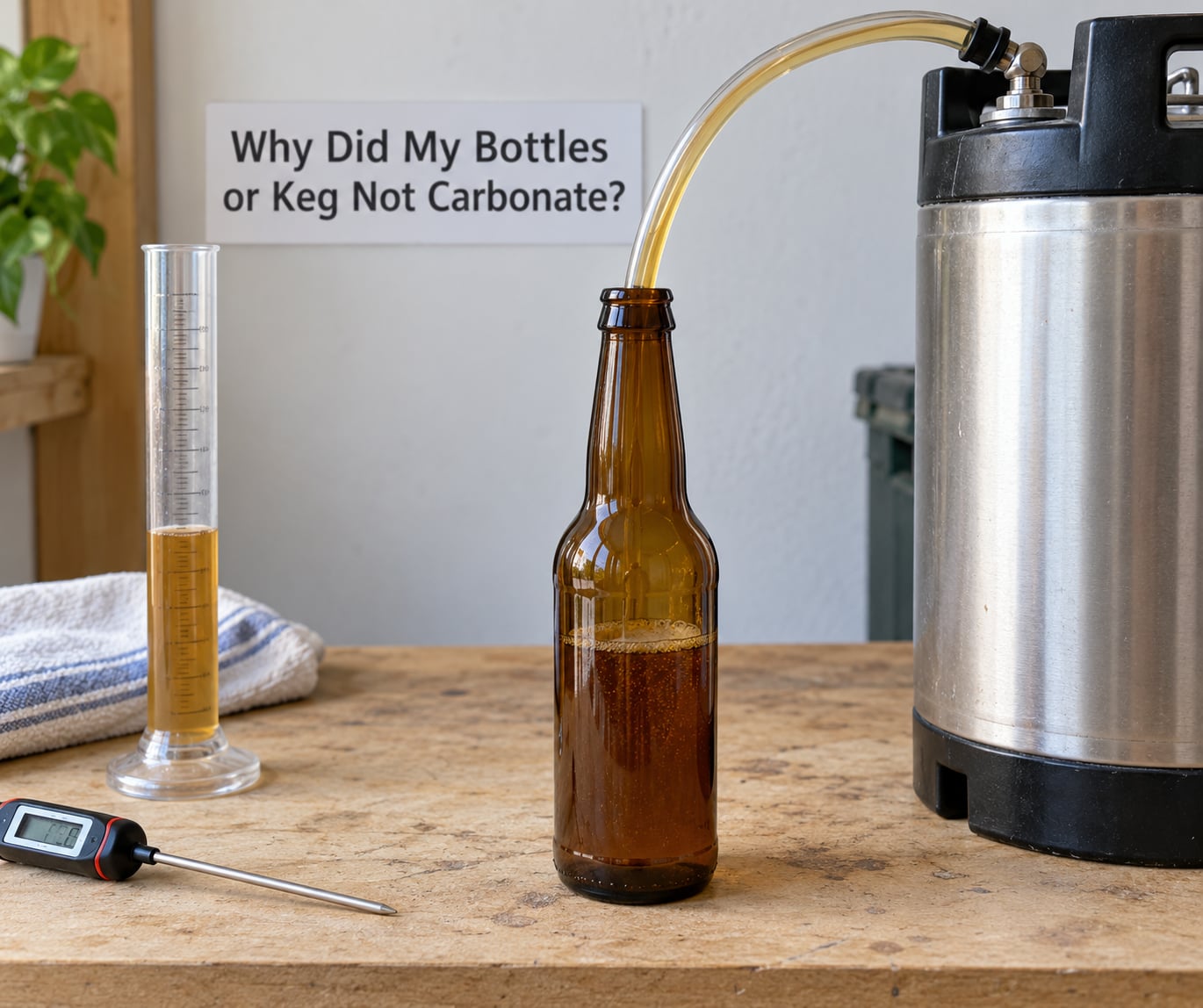
If the gravity readings were fine, the problem moved downstream to packaging, priming, or temperature.
Under-priming is the most common packaging-side fault. Priming sugar is a calculation, not a spoonful: the number depends on your original gravity, your final gravity, and the size of the container. Standard calculators assume about 4 ounces of priming solution per 12-ounce bottle, and carb drops are simply a pre-dosed version of the same number. Getting the volumes-of-CO2 target wrong by a full point shows up as beer that never quite gets bite.
Residual sugar in the wort eats headroom too. If the ferment left more unfermented sugar than expected, that sugar competes with your priming sugar for the yeast’s attention and the finished beer can taste thin and cider-like while still sitting flat.
Cold bottles are a quiet killer. Beer packaged straight out of a cold crash and moved to a warm shelf absorbs CO2 more slowly in the first days, and yeast near the bottom of a cold bottle can stay dormant long enough that conditioning never really starts. Give the packaged beer a day or two warm before you judge anything.
Closures leak for boring, ordinary reasons. A worn swing-top gasket, a screw cap, a crown cap that was not crimped flat enough, a capper set to the wrong pressure, or a cap applied to a wet or soapy bottle will all bleed CO2. The tell is a batch where some bottles are flat and others are fine, or where a bottle that gushed when opened had visibly loose foil. The same thing shows up on the keg side with a coupler seal that has grit under it.
For a keg, three variables do most of the work: pressure, temperature, and time. Beer served cold at a pressure set for warmer beer comes out flat, because the same pressure holds less CO2 in solution at 38°F (3°C) than at 68°F (20°C). Conversely, pressure set too high for a warm keg gushes and foams, and the beer is never actually flat. A keg that pours a great first pint and then goes flat as a pancake is a different problem again: the line and coupler are letting gas escape, and the fix is the coupler seals, not the regulator.
Mini-kegs with CO2 cartridges fail the same way. A cartridge that has been sitting partly used, or a coupler that is not fully seated, gives a burst of fizz at the start and flat beer for the rest.
What Gravity Reading Tells You About Fermentation
Two numbers explain most of what a gravity reading is telling you: apparent attenuation, which is how much of the sugar your yeast actually ate, and stability, which tells you whether it is done eating.
Apparent attenuation is (OG – FG) divided by OG. A healthy ale yeast on a normal wort lands somewhere between 75% and 80%. Much lower and the yeast stalled; much higher and the ferment went further than it should have, usually because of a very warm ferment or a mash that left more fermentable sugar than you planned. That over-attenuated case matters for carbonation, because there is less left in the bottle for priming sugar to work with.
Stability is the boring test that catches the most problems. If the reading has not changed over two or three days, the fermentation is finished. If it is still moving, packaging it means packaging an unfinished beer that will drop in the bottle.
| Starting gravity | Expected final gravity | Apparent ABV | Conditioning time at 70°F (21-24°C) |
|---|---|---|---|
| 1.030 session pale | 1.007 | about 3.0% | 1-2 weeks |
| 1.040 pale ale | 1.009 | about 4.1% | 2 weeks |
| 1.050 amber | 1.011 | about 5.1% | 2-3 weeks |
| 1.060 strong ale | 1.013 | about 6.2% | 3-4 weeks |
| 1.070 IPA | 1.015 | about 7.2% | 3-4 weeks |
| 1.080 barley wine | 1.018 | about 8.1% | 4-6 weeks |
| 1.090 strong | 1.020 | about 9.2% | 2-3 months |
Two limits show up in this table. Higher gravity takes longer, and the timing spread widens fast. Experienced brewers on HomebrewTalk put stouts and porters at six to eight weeks and a 1.090 Belgian strong at three months, while a low-gravity pale ale can be there in a fortnight. Very strong beers also hit an attenuation ceiling: yeast that finished a 12% to 14% fermentation is largely incapable of restarting in the bottle, which is why an over-attenuated barley wine often never carbs no matter how much priming sugar you use.
Why Does My Flat Homebrew Taste Bad?
Flatness gets blamed for a lot of flavours it did not cause. A flat beer simply cannot carry aroma, so anything wrong underneath tastes worse than it would at proper carbonation.
Thin, watery, papery flavours usually mean an unfinished or over-attenuated ferment, or a mash that left too little body behind. A sharp, solvent-like or nail-polish edge points at acetaldehyde from a stressed or young ferment, and it often fades as the beer ages. Green apple with a fizzy tongue-prickle is also acetaldehyde, and a vinegar sour with persistent haze is more likely infection than a carbonation issue.
Buttery or slick diacetyl is a different problem, one of bacterial contamination or a slow mash. Cardboard, wet paper, or sherry notes are oxidation from too much oxygen exposure, and no amount of priming sugar will remove them. If a beer foams heavily during packaging and then tastes flat when opened, the likely sequence is that it was never finished, went into bottles with live yeast, and the CO2 you see is only a second fermentation that never finished properly.
None of those are fixed by more CO2. They are fixed at the fermenter.
Why Does My Homebrew Go Flat After Opening?
Every bottle of beer has a limited number of openings in it, and losing fizz across them is normal. What is not normal is losing it in a single pour.
CO2 sits in the headspace above the liquid and comes out of solution to equalise pressure. Each time you crack a cap, that equilibrium resets at a lower level. A capped bottle in a fridge will still have a lot of gas available; a bottle that has been warm, shaken, and opened twice will not.
Fast, unexpected losses come from a handful of places. A cap that was never fully seated, a damaged crown liner, a gasket that has gone hard, a cap applied over a soapy or wet bottle mouth, or a bottle that was stored on its side with the closure sitting against wet beer. In a partly full bottle the headspace is large relative to the liquid, so it loses pressure quickly.
Keep it cold and keep it capped. Cold beer holds CO2 in solution, and every time you reseal, the gas that was lost has to be replaced on the next pour. Homebrew that has been open for a week in a warm room will taste flat no matter how it was packaged.
How to Fix Flat Homebrew Without Ruining the Batch
Work in this order and change one thing at a time, so you know which step did the work.
- Confirm the beer is finished. Take a gravity reading. If it moved in the last three days, stop and let it finish. No amount of priming sugar rescues an unfinished ferment.
- Decide what the beer is packaged in. Unpackaged in a fermenter, you have full control. In glass, you have very little.
- If it is still in the fermenter, calculate the priming sugar properly. Target 2.2 to 2.5 volumes of CO2, adjust the target down slightly for a style that should drink lightly, and dissolve the sugar in a little boiled and cooled wort before adding it. Dry sugar added straight to the bottom of a fermenter can sit on yeast and leave a slug of sweetness.
- Package it cold and clean, then move it warm. Package at serving temperature, cap properly, and get the bottles to 70-75°F (21-24°C) within a day.
- If it is already bottled, do not add sugar. This is the one rule worth breaking your own plans over. Sugar added to bottled beer ferments unevenly, produces gushers, and can build enough pressure to push caps off or burst bottles. Put the bottles back where they are and let the yeast that is already in there finish its work.
- Confirm there is yeast in the bottle. A 12-ounce bottle that shows a thin ring of sediment at the bottom had yeast. A perfectly clear bottle often did not.
- If it is a keg, force carbonate it. Chill fully, then pressurise to about 12 PSI for an ale served at 38-40°F (3-4°C), and leave it alone for two or three days before tapping. Turn the pressure down if it gushes.
If a bottle is genuinely empty of carbonation and has no live yeast, there is no safe home fix. Move that beer to a keg, force carbonate it, and accept that the result will taste thinner than a properly conditioned bottle.
How to Prevent Flat Beer in the Next Batch
Seven habits cover nearly every flat batch I have seen come through a brew day.
- Make a healthy starter. A 24-48 hour starter pitched at the right temperature is the cheapest insurance in homebrewing.
- Pitch at the temperature your yeast actually wants. Check the strain, not the packet’s marketing.
- Feed the ferment. Yeast nutrient at pitch and again as high-gravity fermentation slows down.
- Watch gravity, not the airlock. Package on two or three stable readings, not on the absence of bubbling.
- Save a sachet. Drying out a spare packet of yeast and pitching 1-2g at bottling costs almost nothing and removes the single most common cause of dead flat bottles.
- Do the math on priming sugar. Bottle volume and original gravity, calculated rather than eyeballed, and dissolved in wort before it goes in.
- Condition warm and store cold. 70-75°F (21-24°C) while the beer is carbing, refrigerator temperature once it is done.
Sanitation sits underneath all seven. A contaminated batch tastes wrong whether or not it ever gets carbonated, and no amount of patience fixes it.
Frequently Asked Questions
Can I fix beer that is already packaged but flat?
Sometimes, and the answer depends on what state it is in. If the beer is still in the fermenter, add correctly calculated priming sugar and package it properly. If it is already bottled, do not open it and add sugar: the result is uneven carbonation, gushers, and a real risk of caps coming off. Instead, put the bottles somewhere warm, around 70-75°F (21-24°C), and give them another two to three weeks. A keg can always be force carbonated.
How long should homebrew take to carbonate?
Three weeks at 70°F (21-24°C) is the floor for a normal-gravity ale, not a deadline. A session pale ale is usually drinkable in one to two weeks. A 1.070 IPA wants three to four, a 1.080 barley wine wants four to six, and stouts and porters often take six to eight. A 1.090 strong can take two to three months. Gravity sets the work, temperature sets the speed.
Does temperature affect why my homebrew is flat?
More than almost anything else. CO2 dissolves into beer faster and holds far better at warm temperature, and yeast packaged near the bottom of a cold bottle stays dormant. Bottles stored in a cellar or a refrigerator below 65°F (18°C) can sit flat for months. Move them to 70-75°F (21-24°C) and wait. Once the beer is properly carbonated, move it to refrigerator temperature for drinking.
Can I add more priming sugar after packaging the beer?
No. This is the most common bad piece of advice floating around homebrew forums and it carries a genuine safety risk. Sugar added to bottled beer ferments unevenly, so some bottles come out flat and others gush, and enough pressure can push caps off or burst bottles. If bottles are already sealed, the only move is to give them time and warmth. Change your priming calculation for the next batch instead.
When should I discard a batch of homebrew?
Discard it when the flavour fault cannot be aged out. A vinegar sour with a persistent haze or a thin, fizzy, acetic edge at every pour is a bacterial infection and will not clear. Beers that are simply young, or under-carbonated, or show a faint green apple note from a young ferment are worth keeping: give them time at 70-75°F (21-24°C) and re-taste before you give up on them.
Conclusion
Start with four things in this order: take a final gravity reading, check the temperature the beer has actually been sitting at, inspect the packaging, and test the carbonation level with a shake in a plastic bottle. If the gravity is still moving, wait. If it is stable and the beer is cold, warm it up and give it more time. If it is stable, warm, and still flat, the fault is a closure or a priming calculation.
Change one thing at a time. Your next batch is a better teacher than any troubleshooting guide, because you will finally know which change did the work.