Dry hopping means adding hops to beer during or after fermentation rather than adding them to boiling wort. It is how you get fresh, expressive hop aroma in an IPA, a pale ale or even a Pilsner without pushing the bitterness any higher. The short answer on timing: add the hops late in fermentation or right at the start of conditioning, hold them in contact for three to seven days, and keep the beer cold.
Most homebrewers land somewhere in that window, and most of the arguments you will read online are really arguments about the edges of it. This guide covers the technique, the hop choices, the dosage math and the handful of mistakes that turn a good dry hop into a grassy one.
Table of Contents
- What Is Dry Hopping and When to Do It?
- How Does Dry Hopping Change Beer?
- Which Hop Varieties Work Best for Dry Hopping?
- When Should You Dry Hop Beer?
- During active fermentation, for biotransformation
- In the last two to three days of fermentation
- Right after fermentation finishes
- In the keg, at packaging
- How Much Hop Should You Use for Dry Hopping?
- How Do You Dry Hop Without Making Beer Bitter?
- Should You Dry Hop Beer Cold or Warm?
- Dry Hopping vs. Wet Hopping and Other Hop Additions
- Common Dry Hopping Mistakes
- How to Tell When Dry Hopped Beer Is Ready
- Frequently Asked Questions
- Can I dry hop before fermentation is finished?
- How long should hops stay in beer during dry hopping?
- Does dry hopping add bitterness to beer?
- What are the best hops for dry hopping?
- Should I remove hops before packaging beer?
- Can I dry hop any beer style?
- Start With a Small, Late Addition
What Is Dry Hopping and When to Do It?
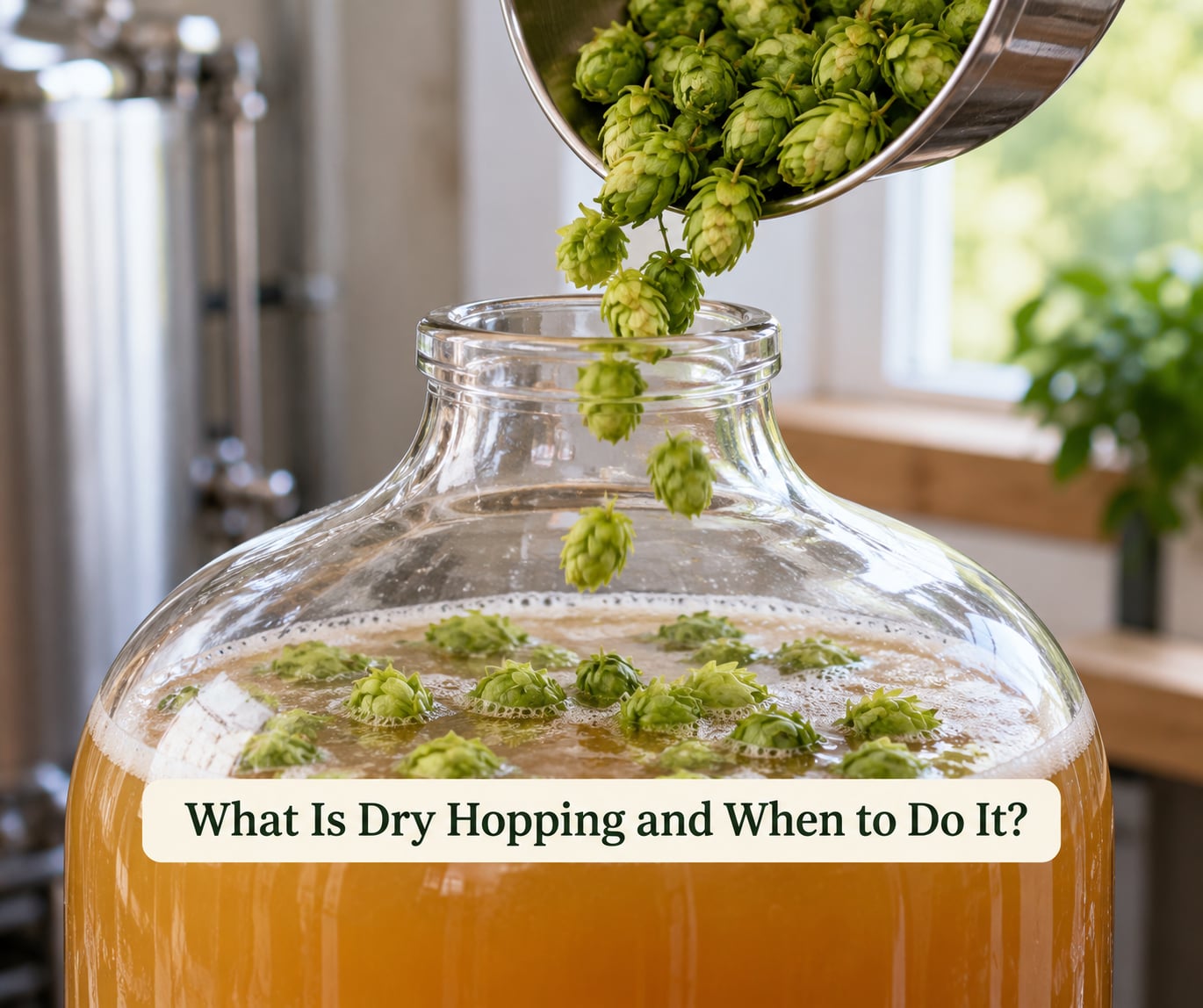
Boiling hops for sixty minutes gets you bitterness. Alpha acids in the lupulin convert to iso-alpha acids in the wort, and the kettle takes a bitter, resinous charge and hands you IBUs. Almost everything aromatic in that same hop cone boils away in the process.
Dry hopping is the opposite trade. You skip the boil entirely and let the hops sit in finished or nearly finished beer, where the essential oils and terpenoids stay volatile and dissolve straight into the cold liquid. Little iso-alpha acid forms, so bitterness barely moves, but the grapefruit, pine, floral and tropical notes arrive in full.
The practical timing answer: most people dry hop during the last few days of active fermentation or during the first several days of post-fermentation conditioning. Earlier than that and you get less clean extraction, more hop material in the beer, and a bigger oxygen risk. Much later and you are squeezing aroma out of a beer that is already packaged.
That is also why dry hopping is not only an IPA technique. A Pilsner dry hopped with a small charge of Saaz at the end of fermentation tastes like a Pilsner with a floral lift, not like a hop bomb.
How Does Dry Hopping Change Beer?
It helps to separate three things people all call hop flavor. Bitterness is perceived through iso-alpha acids and tastes harsh at the back of the tongue. Hop aroma is the volatile fraction that rises to your nose, and hop flavor is the middle ground, closer to taste and mouthfeel, drawn from the same oil fractions as aroma.
Boiling extracts bitterness efficiently and aroma poorly. Dry hopping does the reverse. The same oil that would have flashed off in the kettle dissolves into cold beer, and cold water is a good solvent for those terpene and sesquiterpene compounds.
Whirlpool and flameout additions sit in between. They capture some aroma, but the beer is still near boiling, so a good share of the volatiles is gone before you ever turn the tap. Post-fermentation additions capture the most aroma and the least bitterness of any option.
One more wrinkle. Hops added while yeast is still active do something extra: yeast metabolizes certain hop compounds and converts them into other aroma molecules. Scott Janish’s 2003 work on this biotransformation is the reference most brewers cite, and it is the main reason New England IPA fans like an early charge in a cold, active fermenter.
Which Hop Varieties Work Best for Dry Hopping?
Match the variety to the aroma you are chasing, since the extraction profile is the same mechanism for every hop. Citrus-forward varieties such as Citra, Simcoe and Amarillo give you grapefruit and orange peel. Tropical fruit varieties like Galaxy, Nelson Sauvin and Mosaic lean toward lychee, mango and pineapple. Pine and resin come from the American C hops and their descendants, and Saaz, Spalt and Tettnang deliver the floral, spicy, herbal note that lager drinkers expect.
Then consider the format. T90 pellets release their oils fast and give the most punch per ounce, which makes them the default homebrew choice. T-45 pellets and Cryo hops use concentrated lupulin, so a much smaller weight delivers the same aroma, useful when you care about yield or want to avoid straining out hop material. Whole cones extract more slowly, taste gentler and need longer contact. Plugs sit between pellets and cones. Hop oil is potent and inconsistent, and I would only reach for it when a recipe calls for it by name.
Freshness matters more than the variety list. Oils break down in storage, so buy in small amounts, keep the package sealed and cold, and use what is within a year of packing. A fresh Saaz beats an old Citra every time.
When Should You Dry Hop Beer?
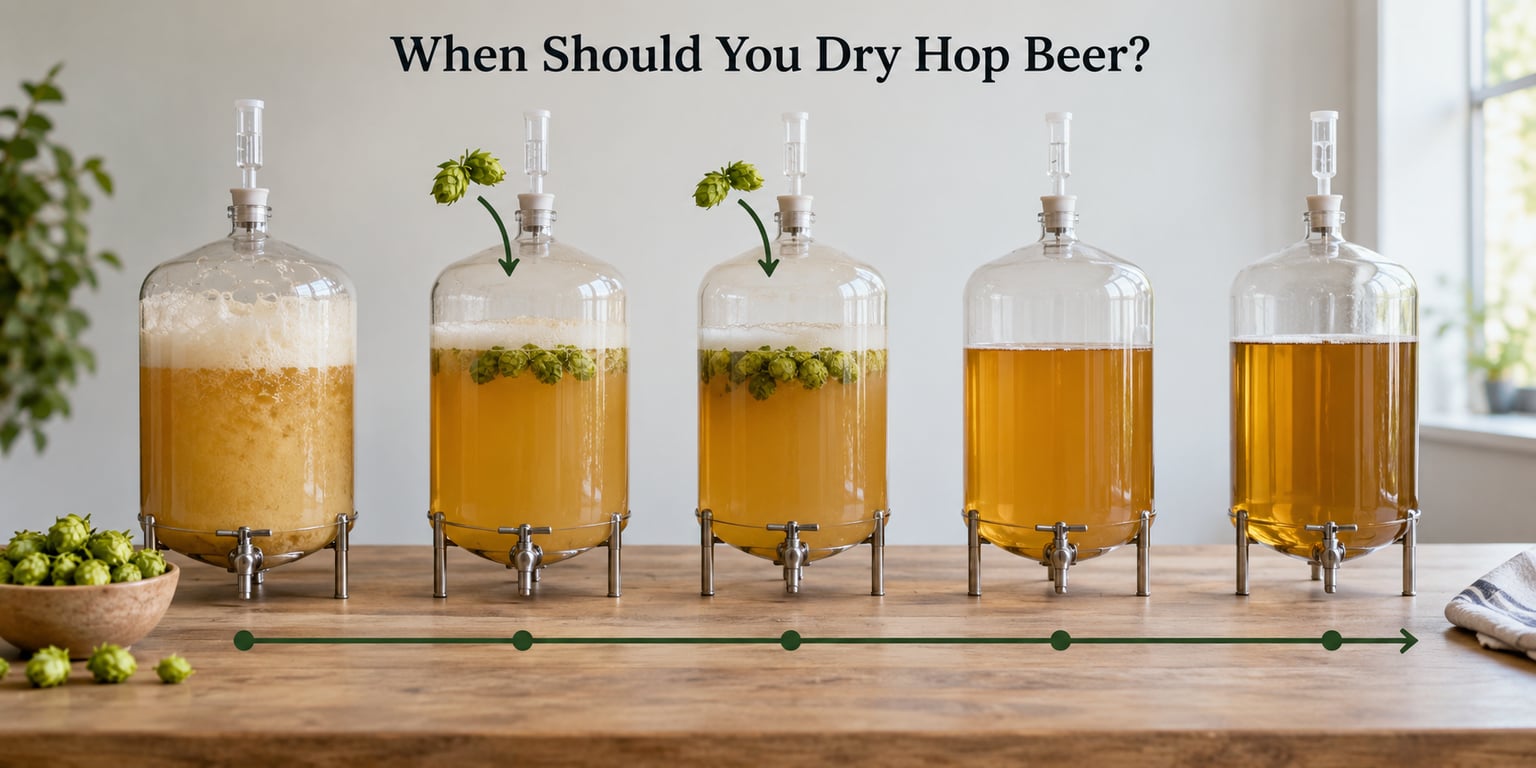
There are four defensible moments, and the right one depends on whether you are chasing yeast-driven aroma transformation or maximum raw hop aroma.
During active fermentation, for biotransformation
Add the charge two to four days after fermentation starts, while the yeast is still visibly active, usually somewhere around day three. The fermenting beer gives you a natural carbon dioxide blanket that pushes oxygen away from the surface, and the yeast converts hop compounds into fruitier ones. It is the standard New England IPA move, and it costs you more hop material in the vessel.
In the last two to three days of fermentation
Once high kräusen is dying down but gravity is still settling, the beer is cold, clean and still protected by CO2. A split charge here, part of the total weight now and the rest when fermentation stops, is the schedule that shows up most often in homebrew forums.
Right after fermentation finishes
This is the cleanest option and the easiest to reason about. The beer is cold, it has a stable gravity, and the only variable is contact time. You trade away biotransformation and the CO2 blanket, and you gain predictable extraction and far less material in the fermenter.
In the keg, at packaging
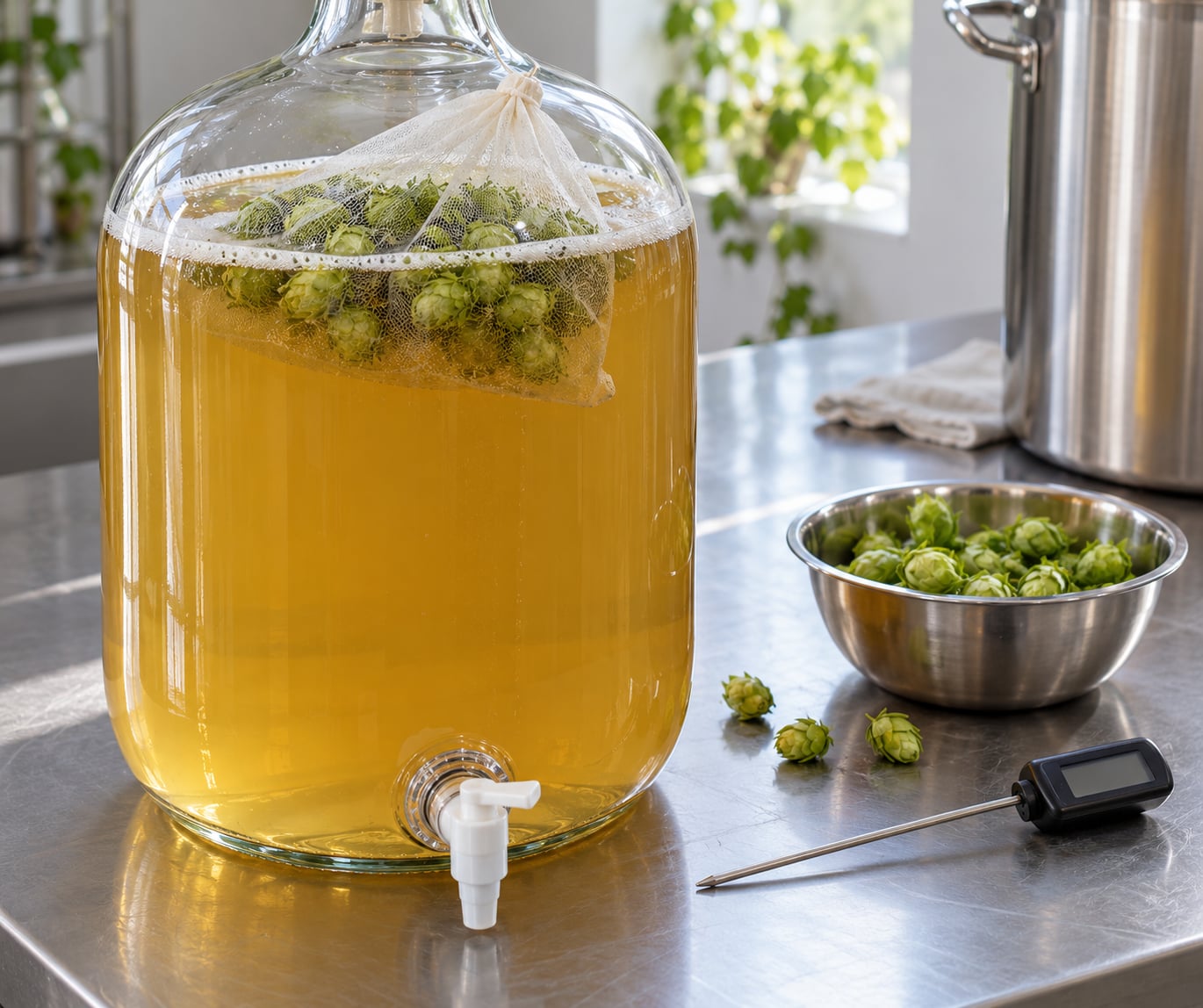
Add hops in a mesh bag or hop sock when you transfer to the keg and leave them for three to seven days before serving. The aroma is the freshest you will get because the beer is packaged and protected the whole time. Keep the gas pressure modest, since CO2 strips aroma out of solution faster than you would like.
Here is the same plan as a decision table:
| Stage | Temperature | Contact time | Amount per 5 gal | Best for |
|---|---|---|---|---|
| Active fermentation (day 2 to day 4) | 66 to 70 F | 5 to 10 days | 3 to 5 oz | NEIPA, hazy IPA, biotransformation character |
| Late fermentation (last 2 to 3 days) | 66 to 70 F | 4 to 7 days | 1.5 to 3 oz | Split charges, hop-forward pale ales |
| After fermentation, during conditioning | 38 to 45 F | 3 to 5 days | 1 to 2.5 oz | Cleanest extraction, low risk |
| In the keg at packaging | 35 to 40 F | 3 to 7 days | 1 to 2 oz | Freshest aroma, before serving |
How Much Hop Should You Use for Dry Hopping?
Dose by style, then by how you feel about the beer sitting on a big pile of plant material. Roughly 0.5 to 1 oz per 5 gallons suits an American pale ale, 1.5 to 2 oz suits a standard IPA, and 2.5 to 4 oz suits a double IPA or a hop-heavy NEIPA. Pilsner and Kölsch sit at the low end, usually half an ounce to an ounce of a noble variety.
Unit conversions settle most arguments. One ounce per 5 gallons is about 1.5 g/L, so 2 oz per 5 gallons is about 3 g/L, 4 oz is about 6 g/L, and the 1.1 oz per gallon that often gets quoted is roughly 8 g/L.
Returns fall off sharply past that point. Research from Dr. Tom Shellhammer put the efficient ceiling for dry hopping at about 1.1 oz per gallon, and beyond it you are mostly adding material that absorbs beer, clogs your transfer lines and makes the batch harder to get clear. The extra aroma is real but small, and the trub and yield loss are not.
Start conservative on your first batch. If the aroma lands light, add more hops or extend contact next time rather than overshooting, because you cannot take hops back out after packaging.
How Do You Dry Hop Without Making Beer Bitter?
Bitterness is rarely the real risk with a cold dry hop. The bigger problems are oxygen, material and time. A tight process looks like this.
Sanitize the vessel, the mesh bag or hop sock and any tubing before anything touches the beer. Purge the receiving vessel with carbon dioxide if you can, close the valve, then crack the lid and dump the charge in so the gas blanket stays over the beer. Seal it and gently swish the vessel to wet the hops so they do not float in a dry mat on top.
Always work from a closed vessel or a closed transfer. Oxygen is what does real damage here: fresh beer exposed to air turns papery, cardboard-like and dull within days, and no amount of hop aroma hides it.
Decide when to remove the hops rather than letting them sit because it is easy. Three to five days is enough for pellets, five to seven for whole cones. Beyond a week you invite green, vegetal notes, and any bitterness you do pick up shows up as a dry, astringent finish rather than a clean hop bite.
You do not have to dump yeast to dry hop. If you harvest or blow off first, transfer the beer to a clean vessel with enough headspace and add the hops there; otherwise just keep them in a bag in the fermenter.
Should You Dry Hop Beer Cold or Warm?
Cold. Conditioning at 38 to 45 F slows the yeast, keeps oxidation risk down and gives you a stable base, and then dropping the beer to around 39 F after the addition is the standard way to keep yeast from picking up residual sugars from the hops. That unwanted restart of fermentation is called hop creep, and it is the reason a beer can drop several gravity points and finish a full point or more above your original gravity after you thought it was done.
Warm dry hopping exists, but it is deliberate. Brewers who add hops at 60 to 66 F while yeast is still active are chasing biotransformation and the softer, rounder profile that goes with it, and they accept the higher risk of hop creep and hop material in the beer.
Do not add dry hops to warm, actively fermenting beer unless that is the method you set out to use. On a finished batch, cold is the safer and more aromatic choice.
Dry Hopping vs. Wet Hopping and Other Hop Additions
Wet hopping is dry hopping’s opposite: you add hops to wort during the boil, so the hops soak up liquid and swell rather than floating on a dry surface. The extraction profile is not really different, because water is the solvent either way. What changes is flavor, since wet hopping pulls in more of the plant’s polyphenols and gives the beer a smoother, silkier body. Some brewers also use it to stretch a tight hop budget.
Whirlpool hops go into the wort right at the end of the boil. You get some aroma, a little more bitter resin, and a hop character that sits between a kettle hop and a dry hop.
Post-boil or flameout additions are a smaller version of the whirlpool, dropped into hot wort once the flame is out.
Hopping during fermentation is the other dry-hop method: hops into the primary fermenter while the beer is still going. More extraction of aroma than a post-fermentation charge, more oxygen exposure, and a beer that is harder to get clear.
A short way to choose: wet hop for body and extract efficiency, whirlpool for middle-ground aroma, dry hop for pure aroma and no added bitterness.
Common Dry Hopping Mistakes
Adding too much on the first try. The fix is to halve your charge and keep it there. Aroma gets lost in carbonation faster than most people expect, and you can always add more on the next batch.
Using old hops. Pellets pressed two or three years ago have lost most of their oils. Buy small, buy recent, and store the package sealed and cold.
Adding a full charge on day one of fermentation. You bury the beer in plant material before it has produced a protective CO2 blanket, and you end up with hop dust in the bottom of the fermenter.
Pouring hops into an open carboy. Even a few seconds of sloshing air is enough to flatten a clean-tasting beer. Transfer first, or use a closed vessel.
Leaving hops in indefinitely. Ten days of cold contact is where grassy and vegetal flavors start showing up, and they do not fade in the bottle. Set a reminder for your removal date.
Treating every variety as interchangeable. A charge of Nelson and a charge of Saaz at the same weight are two completely different beers. Pick the aroma you want, not just the alpha acid number.
How to Tell When Dry Hopped Beer Is Ready
Stable gravity before a dry hop does not mean the beer is finished, so check again after the contact window. Pull a small sample, let it sit for a minute so the carbonation settles, and taste it. You want hop aroma that reads clearly and a finish that stays clean.
Watch for the failure flavors. A green, celery-like note means too much time in contact or too much warm contact. Dry, papery astringency at the back of the throat usually means the charge was too heavy. Papery, cardboard, caramel-like notes with no hop aroma at all point at oxygen rather than hops.
If aroma is still faint, you have options: extend conditioning a couple of days, add a small second charge in a bag, or plan a hop addition in the keg. If the beer tastes green, package it anyway and let it age; grassy notes fade with time while hop aroma fades too, so decide whether you have enough clean malt and body underneath to wait.
Package after removing the hops, and give it a week or two in the keg before serving if carbonation is still finishing.
Frequently Asked Questions
Can I dry hop before fermentation is finished?
Yes, and plenty of brewers do it on purpose. Adding hops two to four days into an active fermentation lets yeast transform hop compounds into fruitier aromas, which is the approach behind most New England IPAs. The cost is more hop material sitting in the fermenter and a bigger risk of hop creep later. If you want the cleanest extraction with the least fuss, wait until fermentation has slowed and then hop.
How long should hops stay in beer during dry hopping?
Three to seven days covers almost every homebrew. Pellets give up their aroma in about a day or two, so three to five days is usually plenty. Whole cones are slower and can use the full week. Past a week, green and vegetal flavors start creeping in, and those get worse in the bottle rather than better. If you are in a hurry, dry hop in the keg for three days before serving.
Does dry hopping add bitterness to beer?
Barely. Bitterness comes from alpha acids converting to iso-alpha acids, and that conversion needs heat, so a cold dry hop produces almost none of it. What you can pick up in a heavy charge is a dry, astringent bitterness from hop polyphenols, which is different and usually unwanted. Keep the charge moderate, keep the beer cold, and the bitterness level of your finished beer will be essentially where you left it.
What are the best hops for dry hopping?
It depends on the aroma you want rather than on one universal variety. Citra, Simcoe and Amarillo give citrus. Galaxy, Nelson Sauvin and Mosaic give tropical fruit. Saaz, Spalt and Tettnang give the floral, herbal character that belongs in Pilsner and Kölsch. T90 pellets are the most reliable starting format, and freshness beats everything else: recent hops will always outperform a better variety that has been sitting for two years.
Should I remove hops before packaging beer?
Yes. Pull the bag or sock out after three to seven days and package the beer without it. Hop material left in a keg keeps releasing small amounts of plant character, and it clogs lines and pickups over the next several months. The practical habit is to set a calendar reminder for your removal day the moment you make the addition, because nobody remembers the date two conditioning racks later.
Can I dry hop any beer style?
Almost any beer can take a dry hop, and plenty of non-hop styles benefit from a small charge. Pilsner, Helles, Kölsch and Saison all take a modest noble or spicy hop addition well. Stouts and porters tolerate a small amount too, usually in the fermenter rather than the keg. The styles where dry hopping is wrong are rare: very light-bodied ales and anything where you specifically want zero hop aroma.
Start With a Small, Late Addition
If you have never dry hopped before, do this on your next batch. Wait until fermentation has visibly slowed, add one to two ounces of a fresh hop in a mesh bag, seal the vessel, and leave it cold for three to five days. Then pull the hops, package, and taste it over the next couple of weeks.
Write down what you used and what you got. If the aroma was thin, add a half ounce more next time or extend the contact by a day. If it was green, cut the time, not the variety.
Timing and quantity are what actually make dry hopping work, not any secret technique. Get those two numbers right for your own taste and you can adjust from there for the rest of 2026.