To plan a company happy hour, work through eight things in a fixed order: define the purpose, lock the guest list and headcount, set a per-person budget, pick a date three to four weeks out, choose the venue, pre-select food and drinks, send invitations with a firm RSVP deadline, then run a short day-of plan. Most of the planning happens in the first three steps, and every hour you spend there saves you money later.
A company happy hour is an optional after-work social that a business pays for, usually running 90 minutes to two hours in the early evening. It costs a fraction of a team dinner or an offsite, and it builds the informal relationships that make day-to-day collaboration easier. Give yourself three to four weeks of lead time and the whole thing takes maybe six hours of actual work, spread out.
Table of Contents
- What You Need
- Step-by-Step: How to Plan a Company Happy Hour
- 1. Define the Purpose and Guest List
- 2. Set the Date, Time, and Budget
- 3. Choose a Venue and Drink Format
- 4. Build the Food and Drink Plan
- 5. Send Invitations and Set Expectations
- 6. Confirm Logistics and Run the Event
- Common Mistakes
- Quick Tips for a Memorable Company Happy Hour
- Frequently Asked Questions
- How much should you budget per person for a company happy hour?
- How far in advance should you book a company happy hour?
- How do I stop a company happy hour from turning into a second dinner?
- What to wear to a company happy hour?
- Is it legal for a company to serve alcohol at a happy hour?
- How do you include remote employees in a happy hour?
- How long should a company happy hour last?
- Conclusion
What You Need
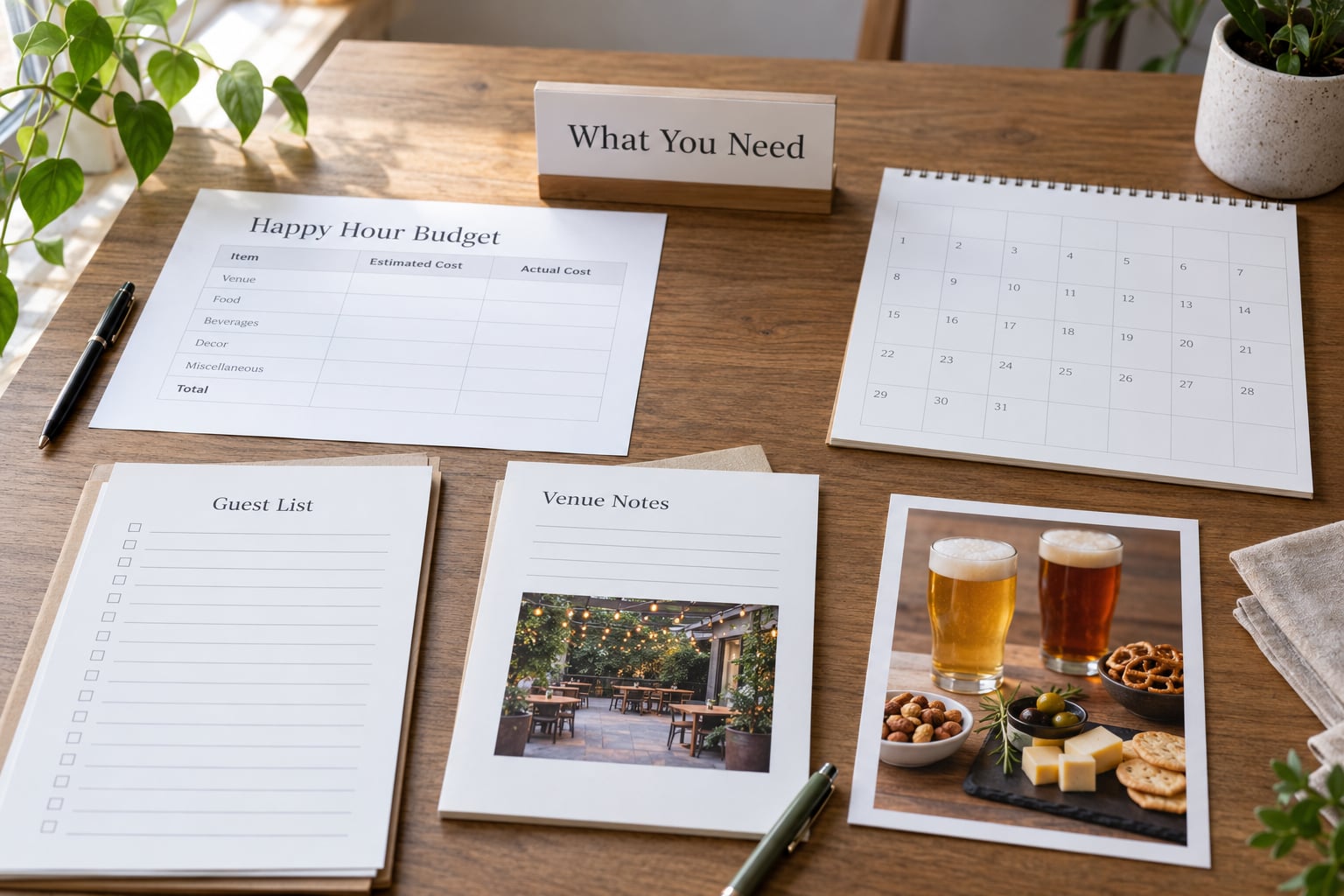
You can plan a company happy hour with nothing more than a spreadsheet, a guest list and a phone. These eight items are what you should have settled before you start calling venues.
| Planning essential | What it looks like |
|---|---|
| Purpose | One sentence on why the event exists: welcome new hires, celebrate a quarter, or just build routine |
| Guest list | Who is invited, whether the whole company or one team, and whether guests or partners can come |
| Date and time | A weekday in the 5 to 7 p.m. window, checked against shifts and time zones |
| Budget | A per-person ceiling plus a contingency you do not plan to spend |
| Venue criteria | Vibe, capacity, accessibility, transit, restrooms, noise, minimum spend |
| Invitation details | RSVP method, deadline, dress expectations, drink policy, plus-one rules |
| Food and drink plan | What is pre-ordered, what is bar-ordered, and the non-alcoholic lineup |
| Accessibility and dietary needs | Step-free entry, step-free restrooms, labeled vegetarian, vegan and gluten-free options |
One item people skip is the responsible-hosting contact. Name the person who has handled the tab, the venue questions and any ride home, and tell everyone at the company who that is. It removes a dozen awkward messages on the night.
Step-by-Step: How to Plan a Company Happy Hour
The order below matters more than the individual tasks. Purpose first, because it decides headcount and venue. Headcount second, because every budget number and venue quote depends on it. Invitations last, because you cannot describe an event you have not booked.
1. Define the Purpose and Guest List
Write down the goal of the event in one sentence before anything else. A new-hire welcome needs a different setup from a quarter-end celebration, and the sentence tells you later whether the evening actually worked.
Then decide who is actually invited. Whole-company events take more planning money and more coordination, while a department mixer is easier to fill and easier to talk in. Most teams do better with a smaller room.
Estimate attendance using last year’s sign-ups or a rough headcount, then plan for roughly 80% of that turning up. Underestimating turns a good evening into a table with three people at it.
Set the RSVP deadline at least ten days before the event, and be specific about whether a response is optional or required. If attendance matters for the booking, say so plainly: “Please RSVP by the 14th so we can finalize the headcount.”
2. Set the Date, Time, and Budget
Thursday or Friday between 5 and 7 p.m. is the most reliable window for a work happy hour. It sits after most workdays without eating into family evening plans, and it leaves guests free to stay for two hours and go home.
Avoid Mondays. People arrive drained from the week, and Friday afternoons get cut short by people heading out of town. If you have shift workers or staff on call, pick the window where the most people are actually free and accept a smaller crowd.
Build the budget by starting from the per-person number finance signed off on, then splitting it into shares rather than guessing at the end.
| Budget tier | Where the money goes | Best for |
|---|---|---|
| Lean | A drink ticket or capped bar tab, one passed appetizer round, a casual bar or beer garden | Teams of ten or fewer, office events, casual drop-ins |
| Standard | Two hours of bar service, pre-ordered appetizers, a reserved section or small private room | Most company events with 15 to 60 guests |
| Premium | Full buyout or private room, a food spread, a brewery tour add-on or a hosted tasting | Milestones, client entertaining, larger teams that want something memorable |
Hold back about 10% of the total as contingency for tax, service charges and the one appetizer tray that shows up unannounced. Tell the venue the bar is capped, because a company card with no cap is the fastest way to blow a budget in one evening.
Ask every venue about minimum spend, service charges, gratuity, corkage fees, overtime rates and cancellation terms before you sign anything. These line items, not the menu prices, are where corporate event costs hide.
3. Choose a Venue and Drink Format
Match the venue to the purpose and the budget, not to what looks nicest on Instagram. A taproom or brewery suits a casual, beer-focused crowd with room to talk, a restaurant private room suits a smaller formal group, and a rooftop suits a summer crowd in a warm climate.
| Venue type | Vibe | Works best for | Watch out for |
|---|---|---|---|
| Neighborhood bar or beer garden | Casual, loud, easy | Large teams, drop-in format | Noise makes conversation hard, limited food |
| Brewery or taproom | Relaxed, local, food-friendly | Beer-focused groups, new hires, summer evenings | Limited non-alcoholic options, peak-hour queues |
| Restaurant with a private room | Controllable, quieter | Groups of 15 to 40, milestone events | Minimum spend, service charge on top |
| Rooftop | Scenic, social | Warm-weather celebrations | Weather backup, no indoor fallback |
| Office or home | Cheapest, most flexible | Small teams, hybrid groups, remote staff | You handle cleanup, glassware and licenses |
| Full venue buyout | Private, no competition for space | Big teams that would otherwise be split across rooms | Highest cost, needs a firm headcount |
For a taproom, ask how many taps they rotate and whether they run a food menu during the hour you want. Beer-focused venues often have short tap lists and strong kitchens, which is a good trade for a crowd that plans to stay two hours.
Visit the place if you can, ideally at the hour you’re booking. A bar that feels great at 7 p.m. on a Tuesday can be loud, dim and packed an hour earlier than you expected.
4. Build the Food and Drink Plan
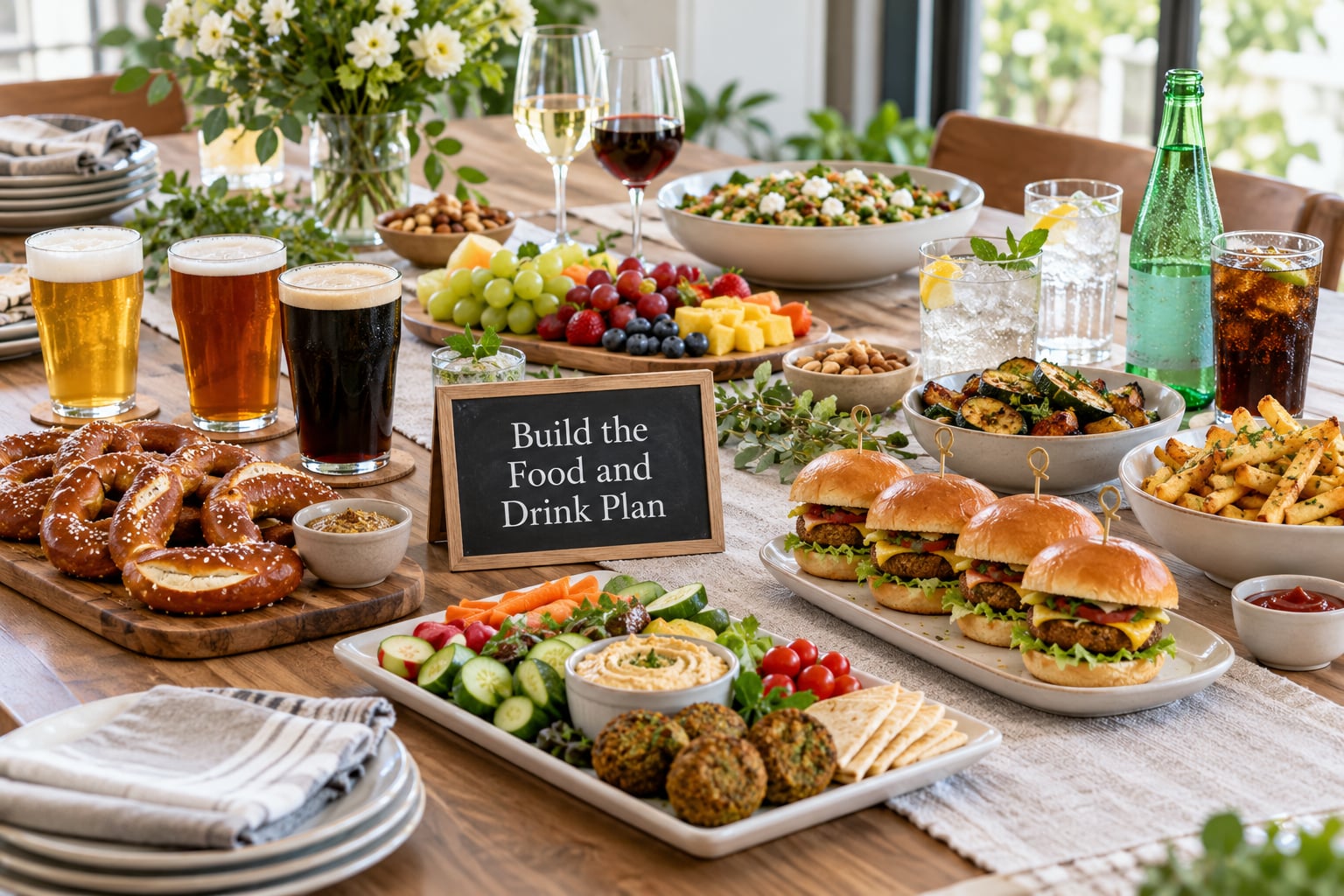
Pre-order the food instead of letting guests order a la carte. The decision gets made once, in daylight, instead of every time somebody opens the menu on the night. If you are figuring out how to plan a company happy hour, this is the step that saves the most money.
As a rule of thumb, plan on three to four small bites per person for a two-hour event. Two pieces of one thing per hour of drinking is a safer target than one enormous plate, because people eat less once they have a drink in hand.
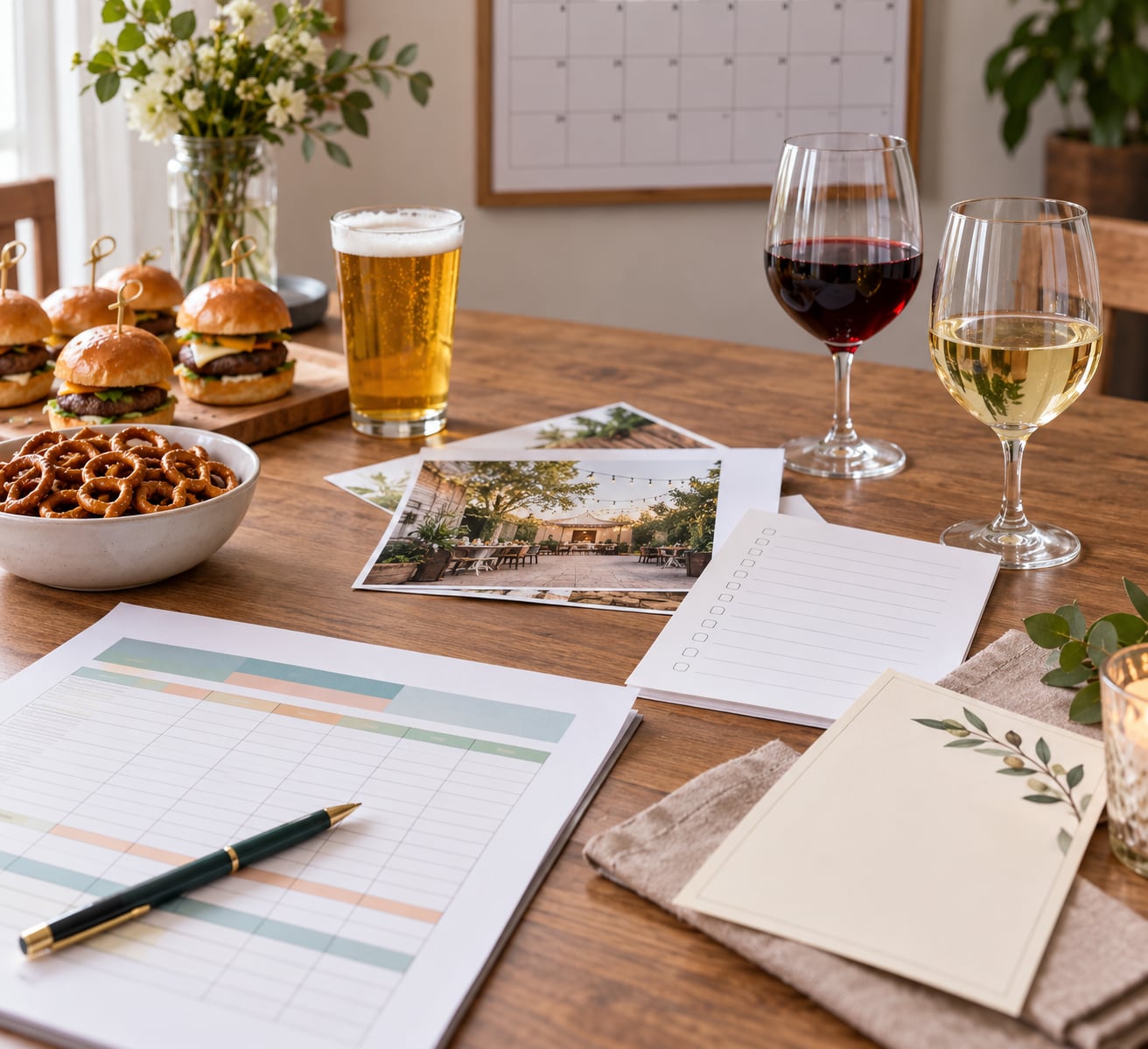
Beer and food pair naturally here. Pretzels and sliders suit a lager or pale ale, a charcuterie board holds up against a hoppier IPA, and fries with a heavier-bodied beer are a classic pairing. A brewery kitchen menu usually does this better than a generic bar menu.
Build the drink list so nobody has to make a decision about whether they are allowed to be there. Include beer, wine, one cocktail option, coffee, sparkling water, soft drinks and at least one good non-alcoholic option on the same printed menu, not on a separate sheet. Someone who does not drink should not have to ask.
For food safety at buffets and passed trays, keep hot food at 140°F or above and cold food at 40°F or below, use small trays that get refilled often instead of one large tray sitting out, and toss anything perishable that has been out more than two hours. That is the standard catering guidance, and it matters most in warm weather.
5. Send Invitations and Set Expectations
Send the invite three weeks out and the reminder one week out. More than one in three people forgets an event they said they would come to, so the second message is not optional.
A working invite template:
Subject: Team happy hour on [date], 5:30 to 7:30 p.m. at [venue]
Hi everyone, we’re doing a casual happy hour on [date] at [venue] and I’d love to have you there. No agenda and no speeches.
Where: [venue name and street address]
When: [date], 5:30 to 7:30 p.m.
Food: appetizers are covered by the company. Dinner is on your own afterward, so please don’t plan to eat a full meal here.
Drinks: the first round is covered, and the bar is capped after that. Non-alcoholic options are on the same menu.
Dress: whatever you wear to work. Nobody is arriving in a suit.
Getting there: [transit and parking details]. Rideshare codes are [link].
Access: the venue has step-free entry and restrooms. Reply to me if you need anything else to take part.
Please RSVP by [date] so I can finalize the headcount. This is optional, and no explanations needed if you can’t make it.
That block does most of the work in advance: it says the event is optional, it says dinner is not included, it caps the drinks, it covers dress code, transportation and accessibility, and it gives you a date for the headcount.
Say clearly whether guests can come. A plus-one line needs a deadline too, since each one changes the final count. Tell remote teammates what you are doing to include them before they ask, such as shipping a delivery credit or setting up a shared video call during the same hour.
6. Confirm Logistics and Run the Event
The final week is confirmation, not decisions. Walk the countdown in order and nothing should surprise you.
| When | What to do |
|---|---|
| Three weeks out | Fix purpose, guest list, budget and date; start venue calls |
| Two weeks out | Sign the venue agreement, confirm the minimum spend, bar cap and food pre-order |
| Two weeks out | Send invitations with the RSVP deadline |
| One week out | Collect RSVPs, order food, check accessibility and transit details again |
| Three days out | Send the final headcount to the venue, confirm the tab cap in writing, brief the bar on drink and food limits |
| Day before | Print or send the name list, confirm the responsible-hosting contact, order water and non-alcoholic supplies if the venue is not covering them |
| Day of | Arrive 30 minutes early, greet arrivals yourself, keep an eye on the tab, close it before leaving |
On the night, stand near the door for the first fifteen minutes. Arriving to an empty room is the fastest way to empty a room.
Then check three things on a loop: the food is restocked, the non-alcoholic options are as visible as the beer, and nobody is on their own in a corner if they would rather be talking to someone. Introduce two people at a time if the group looks stiff. Small acts of hosting do more than any theme.
Close the tab before you leave the building and get an emailed receipt. Settling the bill at the table turns the host into a cashier for the last ten minutes of the evening.
Common Mistakes
Booking the venue before you know your numbers. Minimum spends and headcount requirements make a venue quote meaningless without an estimate. Get a rough count first, even if it changes later.
Letting the food be a la carte. This is the single most common way a happy hour turns into a second dinner. Pre-order a set menu or passed appetizers and tell guests in the invite that dinner is not covered.
Vague invitations. An invite that says “team happy hour, details to follow” produces a low RSVP rate and a confused room. Send the address, the end time and the drink policy the first time.
Leaving transportation unsaid. If alcohol is part of the event, tell people how they are getting home. Offer a rideshare code, name the nearest garage or transit stop, and name a designated driver option. Check with HR and your insurer about your policy on company-sponsored alcohol before the day, since rules and coverage vary by state and employer.
Treating non-drinkers as an afterthought. Mocktails on the printed menu, not a separate list. Tea, coffee and water in the same sightline as the beer. Nobody should have to announce they are not drinking.
Spending the full budget. The leftover 10% is not savings, it is what keeps a quiet evening from becoming a problem on someone’s card statement. Treat the cap as a real limit.
Quick Tips for a Memorable Company Happy Hour
Give it a light theme, not a costume. A seasonal beer flight, a regional tour or a decade of music sets the tone without turning it into a performance. Anything that requires people to pretend to be someone else gets skipped.
Put one conversation starter on the table. A card with three questions on it does more for a quiet group of ten than any icebreaker game.
Keep one seat in the room alcohol-free by design. A table of people who are not drinking is not an inconvenience to plan around, it is the most useful table in the room.
Ask for two pieces of feedback the next day, not a survey. A single message asking what people liked and what to skip next time gets you more than a form.
Decide the next event before you leave the venue. A monthly rhythm beats a heroic quarterly effort, and it keeps the happy hour from feeling like a special occasion nobody planned for.
Frequently Asked Questions
How much should you budget per person for a company happy hour?
Most company happy hours fall into three tiers. A lean event covers a drink ticket or capped bar plus one round of appetizers. A standard event covers two hours of bar service and pre-ordered appetizers in a reserved space. A premium event adds a private room or buyout plus a fuller food spread. Add 10% for tax, service charges and overruns, and set a hard cap on the bar before the event starts.
How far in advance should you book a company happy hour?
Three to four weeks works for most venues and gives you time to collect RSVPs. Booking six to eight weeks out is worth it for a private room, a rooftop, a brewery tour or any late-spring and summer date. Holiday season and end-of-year events need longer, often two to three months. Send invitations three weeks before the event regardless, with the reminder a week before.
How do I stop a company happy hour from turning into a second dinner?
Pre-order the food and put it in the invitation. Tell guests that appetizers are covered and dinner is on their own, which gives them a reason to leave by seven and meet friends afterward. A capped bar helps too, because food is no longer riding on the same order. Keep the food line item separate from the drink cap when you talk to the venue.
What to wear to a company happy hour?
Business casual, and closer to whatever you wore to work that day than to a dinner out. Smart casual button-downs, clean jeans and loafers are all fine. Nobody should need to buy an outfit for a work happy hour, and nobody should arrive in a suit. If the venue is dressier, say so in the invitation so people are not surprised either way.
Is it legal for a company to serve alcohol at a happy hour?
Rules vary by state and city, and by employer policy. Most venues hold the general licensing requirements and can serve alcohol when a company hosts an event on their premises, but some states limit the number of hours or require permits. Check your HR or legal team’s rules first, confirm whether drinks are taxable as a non-cash compensation benefit, and get a certificate of insurance if your employer requires one.
How do you include remote employees in a happy hour?
Offer two versions of the same event rather than forcing remote staff to sit through the office evening. Set up a short video call during the same window with a shared drink or snack, send a delivery credit so everyone is having the same thing at the same time, and keep any activity short. Rotation works better too, alternating between office and remote so no one group is always the guest.
How long should a company happy hour last?
Ninety minutes to two hours is the working range. Ending at a set time, with a closing note announced twenty minutes beforehand, is what keeps it a happy hour rather than an evening that overruns into dinner. Put the end time in the invitation so people can plan their evening around it, and treat it as a real deadline rather than a suggestion.
Conclusion
Start with four actions this week: write the one-sentence purpose, build the guest list and estimate headcount, set the per-person ceiling finance approved, and pick a date in the 5 to 7 p.m. window. Then call three venues and ask about minimum spend, service charges and pre-ordered food before you commit to anything.
Once the venue is booked, the invitation does most of the remaining work. Say the event is optional, say when it ends, say what the company covers and what it does not, and say how people are getting home. Get that out three weeks before the day and the evening takes care of itself.