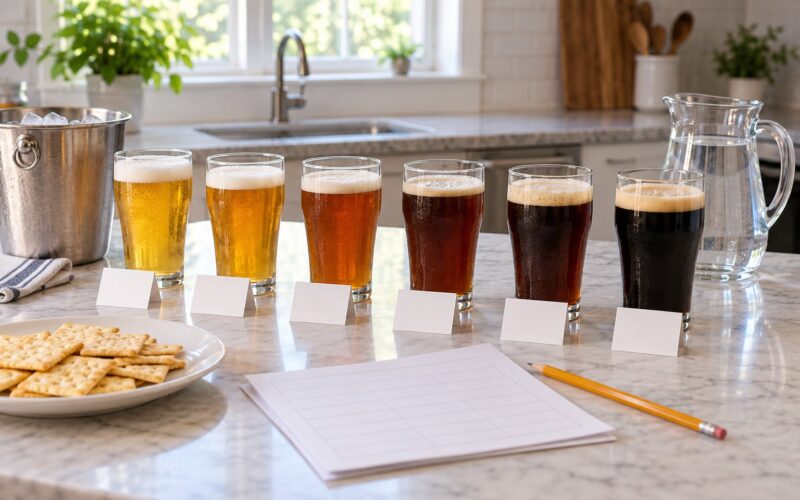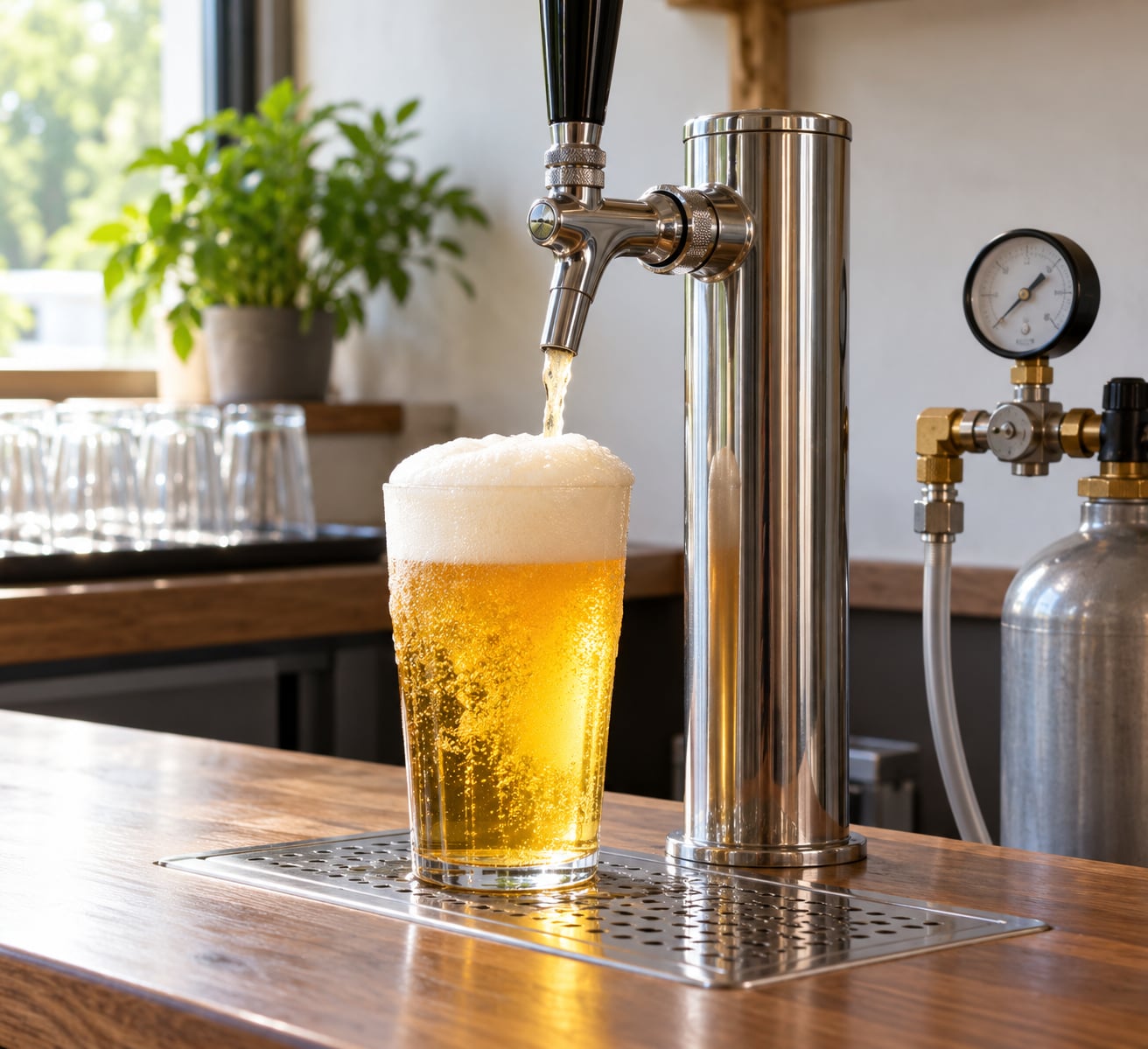
If you are wondering why is my draft beer too foamy, the answer is usually an imbalance somewhere between the keg and the glass: the beer is warmer than it should be, the CO2 pressure is higher than the line can absorb, the line is too short or too wide, or somebody poured too hard into a glass that was not quite clean. Sometimes the beer itself is fine and you are looking at a style that is supposed to carry a big head, like a wheat beer or a nitro stout.
Most people notice it as wasted beer. You pull a pint, two thirds of it is foam, and the glass you are left holding is mostly air. That is worth understanding, because foam is not decoration. It is carbonation that escaped before it reached you, and it carries aroma out with it.
I have pulled a lot of bad pints, and in almost every case the fix was small: a clean glass, a slower pour, or letting the first head sit for ten seconds before topping it off. This guide walks through what is actually happening in the glass, the causes worth diagnosing, how style changes the picture, and what to change at the tap versus what to hand off to a brewery or a technician.
Table of Contents
- Why Is My Draft Beer Too Foamy?
- What Makes Draft Beer Create Foam?
- Carbonation level
- Nucleation sites
- Proteins and malt character
- The glass and the pour
- What Causes Too Much Foam in Draft Beer?
- How Beer Style Changes the Head
- How to Fix a Too-Foamy Draft Beer
- Control the pour and let the first head settle
- Clean the glass properly
- Check temperature with a thermometer
- Lower serving pressure in small steps
- Verify line length and diameter
- Deep clean the lines and coupler
- Fix an over-carbonated keg by venting it
- How to Tell Whether the Problem Is Beer or Equipment
- When Is a Draft Beer Head Normal?
- Frequently Asked Questions
- What to do when beer is too foamy?
- How do I tell if draft beer is bad?
- How do I pour draft beer without too much foam?
- Why is my draft beer coming out foamy?
- How do I fix an over carbonated keg?
- When should I ask a brewery or repair professional for help?
- Conclusion: Start With the Pour and the Glass
Why Is My Draft Beer Too Foamy?
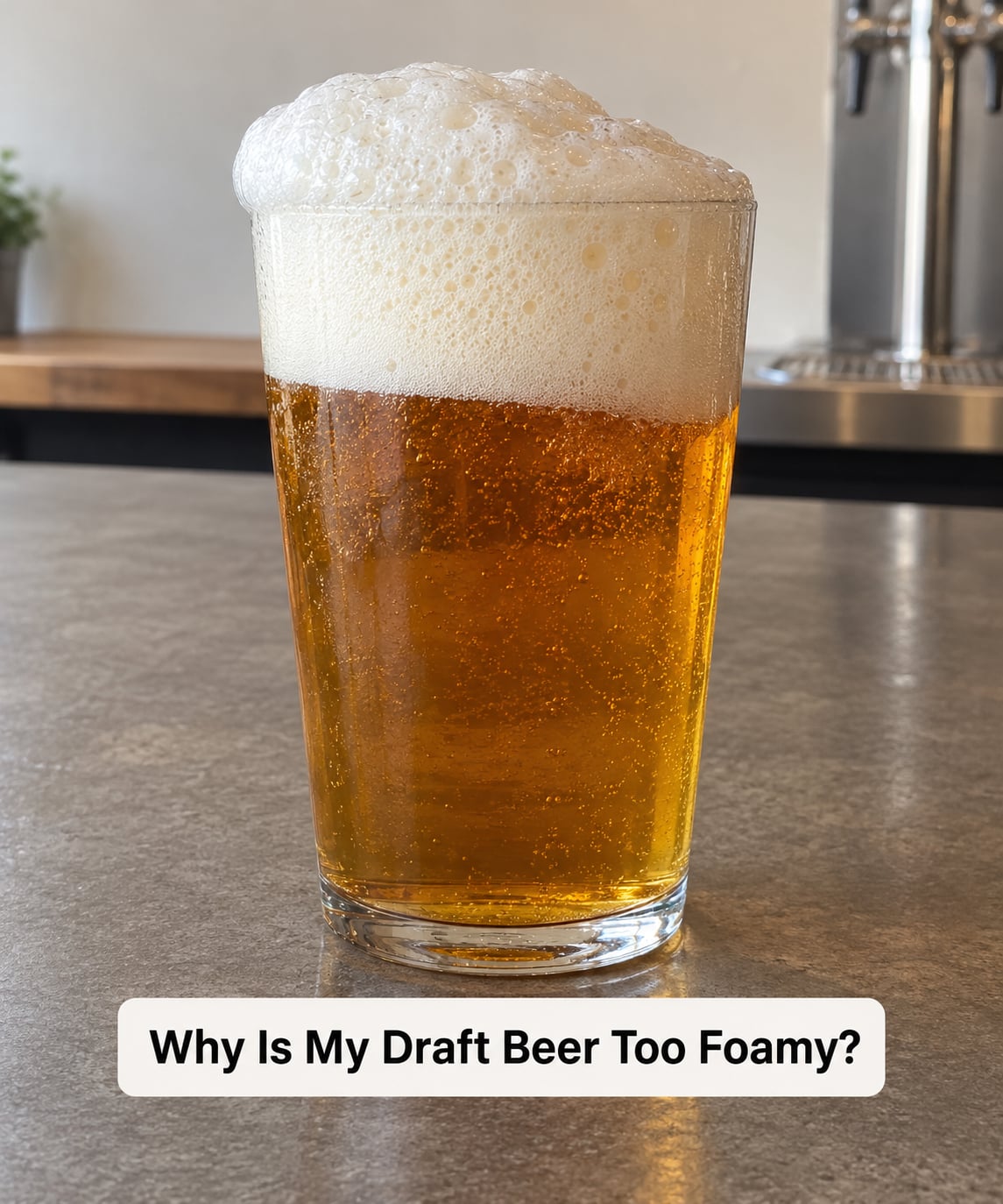
Excess foam in draft beer comes down to gas that broke out of solution before the beer reached your glass. Carbon dioxide stays dissolved in cold beer under pressure. Push that beer somewhere warmer, or push it somewhere with more pressure than it was built for, and the gas comes looking for an exit. It finds one at the faucet, and it turns the pour into a head.
It helps to separate two different problems. Temporary foam is the first surge of bubbles when a pour starts, which is normal and usually settles within a minute. A persistent head is different: it keeps rebuilding itself, it never drops, and it eats into the volume you actually drink. That second one is a system problem, not a pouring problem.
Quick check: pour a glass, wait a full minute, and see what happens. If the head collapses and leaves clear beer underneath, you are looking at normal first-pour foam. If the beer is still mostly foam a minute later, something upstream is wrong.
What Makes Draft Beer Create Foam?

Foam forms when CO2 comes out of solution, finds a surface to grab onto, and builds a bubble structure that the beer is strong enough to hold up. Four things decide whether you end up with a thin cap or a five inch monster.
Carbonation level
How much CO2 is dissolved in the beer, measured in volumes of CO2. A lager might sit around 2.4 to 2.6 volumes. A heavily carbonated pale ale or a bock can reach 3.0 or higher. More gas in solution means more gas looking for a way out.
Nucleation sites
CO2 does not form bubbles in midair. It needs a rough surface to latch onto, and that is what the experts in the homebrew forums mean by nucleation points. A scratched glass, a worn gasket, a rough coupler interior, or a tiny burr in the faucet all give bubbles a place to start.
Proteins and malt character
Proteins from wheat, oats, and heavy malt help foam cling to the glass walls instead of sliding down. That is why a hefeweizen holds a thick head for the whole glass while a clean pilsner drops to a finger of foam in seconds.
The glass and the pour
Pouring down the side of a tilted glass aerates the beer deliberately and produces a big head. Pouring beer onto an existing head, fast and from height, does the same thing faster. A rinse-washed glass still carrying detergent or a trace of oil will foam when a dry glass would not.
What Causes Too Much Foam in Draft Beer?
Here are the causes worth diagnosing, in rough order of how often they turn out to be the problem, with the symptom that gives each one away.
- Beer that is too warm. Serving above the usual 36 to 38 degree range is one of the most common culprits. Warm beer cannot hold as much carbonation, so the excess gas comes out in the glass. The head looks cottony and never fully settles. A glass that frosts well within a minute is usually fine, so put a thermometer on the keg rather than guessing from the pour.
- Too much CO2 pressure. Direct-draw systems typically run around 12 to 14 PSI, long-draw systems lower. Serving a keg well above its carbonation set point pushes gas the beer never needed. On a long-draw system, blended gas exists precisely so you can serve lower CO2 pressure while keeping carbonation up, which cuts foaming. If your foam problem appeared the week the gauge was swapped, look here.
- A line that is too short or too wide. Line resistance is what slows a pour down to roughly 2 ounces per second. Homebrew forum regulars point out constantly that the tubing in a lot of bundled kegerator kits is around 8mm inside diameter and only a few feet long, which does almost nothing to slow the beer down. The standard answer is tubing with a 3/16 inch inside diameter, often somewhere in the 5 to 10 foot range depending on pressure and temperature.
- Dirty lines and couplers. Beer stone and biofilm create billions of nucleation sites. The Brewers Association guideline of cleaning draft lines every 14 days is the reference most of the industry works from, with an alkaline cleaner for organic buildup and an acid cleaner for beer stone.
- Over-carbonation from too much time at pressure. A keg left hooked up at high pressure absorbs CO2 steadily. The r/TheBrewery thread on this describes a brewery batch carbonated to 2.9 volumes that foamed on every keg, which is exactly the pattern of a keg that has been sitting too long at too many PSI.
- A first-pour foam from a warm faucet. On home setups where the faucet sits outside the cooled box, the shank and faucet tube come up to room temperature quickly. The beer sitting in that warm metal comes out gassy, then the next pull from the cold line is fine. On HomebrewTalk the fix people land on is a tower cooling fan and insulating the inside of the tower cap.
- Hardware problems. A worn gasket, a failing check valve, or a dip tube O-ring that leaks lets gas into the beer stream. The dip tube one is sneaky, because it shows up late: one homebrewer on a forum traced a long-standing last-pint foam problem to dip tube O-rings and grime on the keg posts after a decade of trouble-free tapping.
- Pouring technique. Not an equipment fault at all, and still the most common reason a bar guest says the beer was foamy.
One pattern deserves its own note, because it confuses people for months. Foam that only shows up on the last few pints of a keg usually means gas is entering where it should not be, most often at the dip tube or the coupler, rather than a pressure setting problem. Another pattern is foam that appears on an infrequent-pour system because bubbles collect in the tubing between pulls and get carried into the next glass. Commercial breweries describe this one plainly: infrequent pours mean the CO2 has time to come out of solution inside the line.
How Beer Style Changes the Head
Before you start adjusting anything, make sure you are not trying to fix a beer that is behaving correctly. A two inch head on a Hefeweizen is right. The same head on a dry-finished pilsner means something is off.
| Beer style | Typical carbonation | What the head should look like |
|---|---|---|
| Pilsner and light lager | About 2.4 to 2.6 volumes | A thin white cap that settles within a minute |
| Standard pale ale | About 2.3 to 2.6 volumes | One to two fingers of off-white foam, quick settling |
| IPA | About 2.2 to 2.6 volumes | A rocky head is common; hop bitterness makes foam look dense |
| Hefeweizen and wheat beer | About 2.4 to 2.8 volumes | Thick, persistent, cloudy white head that clings to the glass |
| Stout and porter | About 2.2 to 2.4 volumes | Creamy tan head, moderate and slow to fall |
| Nitro stout | Nitrogen charged | Dense cascading head, tight bubbles, long settle |
| Belgian ale or Tripel | About 2.5 to 3.0 volumes | Large sparkly head from bottle conditioning, normal at 3 volumes |
| Bock or doppelbock | About 2.6 to 2.9 volumes | Firm off-white head that holds well |
The pattern to notice: high carbonation and high protein both build head. Wheat beers and Tripels score on both counts, so a big head is chemistry rather than a fault. A lager scores on neither, so any head beyond a finger is something you should chase.
How to Fix a Too-Foamy Draft Beer
Start with the things you can change in under a minute, then work outward to the equipment.
Control the pour and let the first head settle
Hold the glass at about a 45 degree angle and pour beer gently into the side until the glass is about half full. Let that first head build and fall on its own, which takes roughly ten to fifteen seconds. Then top up by pouring down the inside of the glass wall so the beer runs down the side rather than onto the foam.
Clean the glass properly
Rinse with cold water and a brush, skip the detergent or use a beer-safe powder sparingly, and rinse until the water runs clear with no sheen. A slightly warm glass also holds more gas, so use a cold glass and keep it cold.
Check temperature with a thermometer
Put a probe or an inexpensive thermometer in the keg or coupler and read the actual number. If it is above 38 degrees, cool the keg, check the glycol bath temperature in a long-draw system, and check that the walk-in cooler is holding where it should.
Lower serving pressure in small steps
If you are serving above your target, drop one or two PSI and pull a test pint. Judge it by feel at the faucet, since watching the foam alone can mislead you.
Verify line length and diameter
This is equipment work. Measure the actual length of the beer line and check its inside diameter rather than trusting the label. If the line is wider than 3/16 inch or shorter than the balancing calculation calls for, replacing or re-routing the line is the real fix, not a pressure change.
Deep clean the lines and coupler
Run an alkaline cleaner through the lines and coupler on a regular schedule, follow with an acid cleaner for beer stone, and inspect gaskets, O-rings, and check valves while everything is apart. Disassemble the coupler fully, including the parts that do not come apart easily.
Fix an over-carbonated keg by venting it
Chill the keg for a day or two first, since cold beer holds CO2 in solution better. Then connect the gas and slowly bleed off the pressure until the gauge sits a little above serving pressure, let it settle, and repeat. Homebrewers and brewers agree that cold is the important part of this procedure.
How to Tell Whether the Problem Is Beer or Equipment
Run the diagnosis in this order so you change one variable at a time.
- Pour the same beer into a freshly cleaned glass. If a clean glass behaves differently, you had a glass problem.
- Pour a second glass and wait a full minute. Settling foam is normal. Foam that keeps rebuilding is a system symptom.
- Check the temperature. Read it, do not guess. Above the serving range, fix cooling before touching anything else.
- Read the regulator gauge at the keg. Compare it to what you set. A reading that drifts upward over days points to regulator creep, which means the regulator needs servicing or replacing.
- Test another beer on the same system. If a lower carbonation lager also foams badly, the problem is the system. If only one beer foams, it is the keg.
- Inspect visible fittings. Look at the coupler, shank, and faucet for leaks, corrosion, and residue.
- Watch the pattern across a full keg. Foam only on the last few pints points at the dip tube or coupler rather than at pressure or temperature.
Some of this you can do yourself, some of it is not yours to do. Swapping a faucet, cutting line, or re-routing tubing inside a commercial system is fine for a home kegerator but is usually a job for a brewery tech or a line service company, especially on a system under a service agreement. A glycol system, a blended gas setup, or anything with a leaking refrigerant line belongs with a professional. So does anything involving electrical work on a tower cooler.
When Is a Draft Beer Head Normal?
A good head is judged on four things, not on bubble height alone.
- Style. Compare the head to the style row above. Wheat beers, Tripels, and nitros are supposed to be foam-forward.
- Aroma retention. A tight head traps volatile aromatics and sends them up the glass. If the aroma smells thin and watery, the head was not doing its job even if it looked generous.
- Clarity and color. Over-foamed beer often looks hazy and pale, because the yeast and protein that would give it body are in the foam instead of the glass.
- Drinkability. A one to two finger head on most ales and lagers reads as well carbonated and clean. More than that on a clean-finished beer usually means the gas load is too high.
Foam by itself is not evidence that a beer is bad or that it is over carbonated. Nitrogen-charged stout is served with a large cascading head on purpose. Beer stone in a line looks alarming but tastes fine until it starts affecting flow. Judge on aroma, clarity, and flavor, and use the head as supporting evidence rather than the verdict.
Frequently Asked Questions
What to do when beer is too foamy?
Pour into a clean, cold glass at a 45 degree angle, let the first head build and fall for ten to fifteen seconds, then top up slowly down the side of the glass. If foam keeps rebuilding, check the keg temperature and the serving pressure next. A glass with a detergent trace or a trace of oil will foam when a properly rinsed one does not.
How do I tell if draft beer is bad?
Taste it. Foam is a serving symptom, not a freshness signal, because the same head appears on a great keg and a bad one. Look at aroma, clarity, and flavor instead: a sour or solventy smell, a slimy mouthfeel, or a thin, watery finish point to the beer itself. If a different beer on the same tap foams the same way, suspect the system.
How do I pour draft beer without too much foam?
Start with a cold glass rinsed until the water runs clear with no sheen. Tilt the glass to about 45 degrees and pour slowly into the side until it is half full. Wait for the first head to settle, then pour the rest down the inside wall so the beer runs down the glass instead of onto the foam. Skip pouring from height, which aerates the beer on purpose.
Why is my draft beer coming out foamy?
The most likely causes are beer warmer than its 36 to 38 degree serving range, CO2 pressure above what the beer was carbonated to, a line that is too short or too wide to slow the pour, or lines and couplers coated with beer stone. On home systems, a warm faucet causing first-pour foam is common, and foam that only appears on the last few pints usually points to a dip tube or coupler leak.
How do I fix an over carbonated keg?
Chill the keg cold first, since cold beer holds carbonation in solution. Then connect the gas and slowly bleed pressure off until the gauge sits a little above your serving pressure, let the keg settle, and repeat after a few hours. Serving pressure alone will not fix a keg that absorbed too much CO2, and forcing more gas in makes it worse.
When should I ask a brewery or repair professional for help?
Ask when the fix involves cutting or re-routing beer line, replacing a faucet inside a tower, working on a glycol or blended gas system, or anything with a refrigerant or electrical component. Recurring foam across multiple kegs, a gauge that keeps drifting upward, or a system under a service agreement also belong with a technician. Home kegerator owners can usually handle glassware, temperature, and cleaning themselves.
Conclusion: Start With the Pour and the Glass
If you are still asking why is my draft beer too foamy, work from the cheapest fix upward. Use a properly rinsed cold glass, pour slowly, and give the first head fifteen seconds to fall before topping up. Those three steps solve a surprising share of foamy pints.
If foam keeps coming back, measure the actual temperature and compare it to the style. Then read the regulator and check whether the beer line is doing the resistance job it was supposed to. A last-pint-only foam problem is a coupler or dip tube issue. Leave anything involving glycol, blended gas, refrigerant, or tower electrical work to a brewery tech or line service professional.