How water chemistry affects beer taste comes down to a handful of dissolved minerals and the pH they hold during the mash. Calcium, sulfate, chloride, magnesium, sodium and bicarbonate change how bitterness, malt sweetness and mouthfeel read on the palate, and chlorine or chloramine in tap water can ruin a batch outright. Water is 85-95% of finished beer by volume, so it is the largest single ingredient in the kettle.
Most brewers treat water as background, the way a cook treats a neutral oil. That works until a pale ale tastes harsh and a stout tastes thin, and both problems trace back to the same bucket.
Table of Contents
- What Water Chemistry Does to Beer Taste
- The Minerals That Shape Beer Flavor
- How Water Chemistry Affects Beer Taste by Style
- Why Brewing Water pH Matters
- How Chlorine and Chloramine Change Beer
- Alkalinity, Acidity, and the Malt-to-Hop Balance
- A Practical Water-Chemistry Adjustment Plan
- Troubleshooting Common Beer Taste Problems
- Frequently Asked Questions
- Is distilled water better than tap water for brewing beer?
- Does every beer style need a different water profile?
- Is hard water bad for beer?
- Do homebrewers need a pH meter to adjust brewing water?
- Can brewing salts fix bad-tasting tap water?
- Should I use baking soda to raise brewing-water pH?
- Conclusion: Start with the Water Report
What Water Chemistry Does to Beer Taste
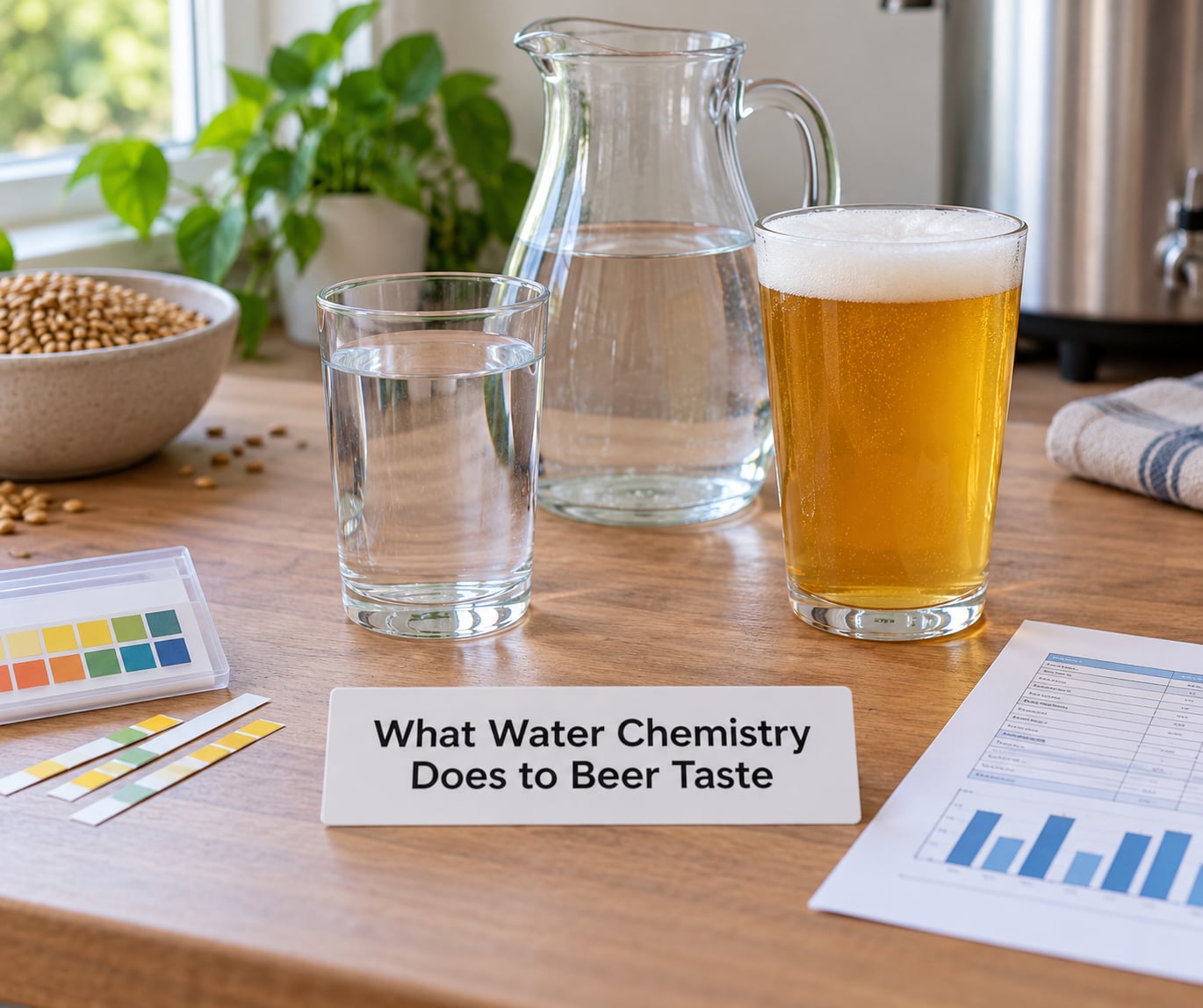
Water chemistry affects beer taste through four things you can measure: the mineral ions dissolved in it, its alkalinity, its pH, and the total dissolved solids left behind. None of those are obvious on the tongue, which is why brewers map them to flavor effects instead of chasing numbers for their own sake.
- Mineral ions interact with malt, hops and yeast at every stage, from the strike water to the glass.
- Alkalinity buffers the mash, holding pH up and blunting the acid character you want from pale malt.
- pH decides how efficiently enzymes convert starch and how much tannin leaches out of the grain husks.
- Residual salts survive fermentation and land in the glass, where sulfate sharpens and chloride rounds.
The practical split is between brewing and flavor. Calcium and pH do their work in the mash, supporting enzyme activity, protein coagulation and efficient starch conversion. Sulfate and chloride mostly stay in the beer and do their work in your mouth, changing how bitterness and sweetness are perceived.
That is why a beer can mash out cleanly, ferment out clean, and still taste wrong. Nothing failed. The water simply leaned the flavor in a direction the style did not want.
The Minerals That Shape Beer Flavor
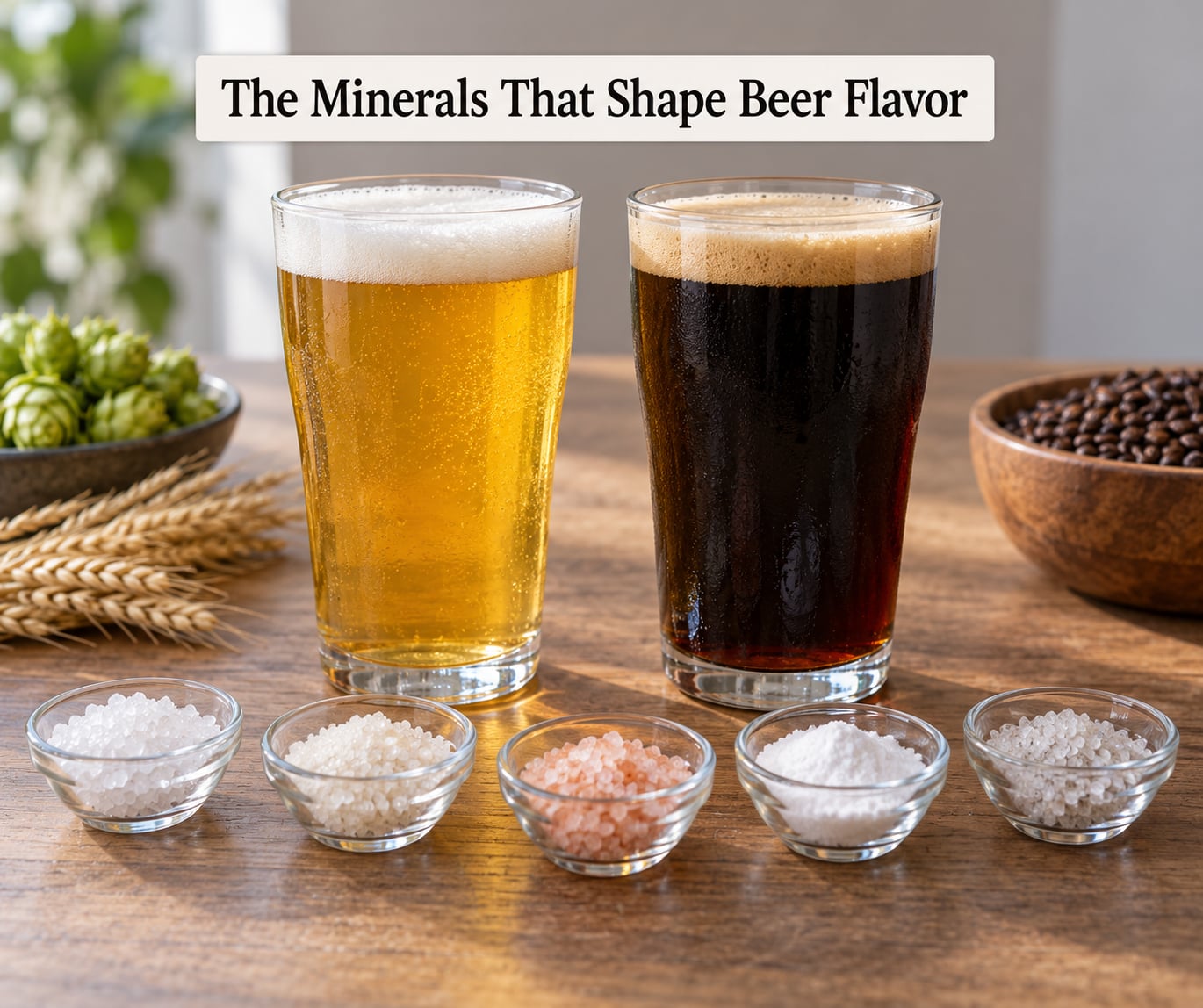
Six ions account for most of what water does to a beer. Here is what each one contributes and where brewers usually land.
| Mineral ion | What you taste | Brewing effect | Useful range (ppm) | Suits |
|---|---|---|---|---|
| Calcium (Ca) | No direct flavor, slight crispness and a firmer mouthfeel | Aids enzyme activity, protein coagulation in the boil and yeast flocculation | 50-150 | Almost every style; the baseline ion |
| Magnesium (Mg) | Sharpens bitterness, can add a mineral or sour edge in excess | Boosts enzyme activity; too much intensifies hop bitterness | 10-30 | Hop-forward ales and pale ales |
| Sulfate (SO4) | Dry, biting, almost metallic sharpness; lifts perceived hop bitterness | Little mash effect; survives into the finished beer | 50-400 | American IPA, pale ale, hop-forward pils |
| Chloride (Cl) | Rounded malt sweetness, fuller and slicker mouthfeel | Softens perception; contributes to body | 50-250 | Stout, porter, brown ale, English bitter, NEIPA |
| Bicarbonate (HCO3) | Flat, neutral; buffers sourness out of the beer | Raises and stabilizes mash pH, which slows enzyme activity | 0-250 | Dark, roasted styles that need pH support |
| Sodium (Na) | Sweet, round, sometimes salty; harsh above about 50 ppm | High sodium stresses yeast and softens water | 10-40 | Use sparingly; check for a softener on the supply line |
Calcium is the workhorse. Too little and enzymes underperform, protein fails to drop out of the wort and the beer can taste flabby or hazy. Too much and the beer turns gummy, since calcium pulls proteins back into solution and adds a chalky astringency. The range above is where trouble starts and stops being a problem.
Sulfate and chloride are the pair brewers argue about most, mostly because they are the two levers that visibly change bitterness. Sulfate exaggerates the bite of alpha acids, so hop-forward styles get a drier, more defined bitterness. Chloride does the opposite, filling in malt sweetness and thickening the finish. Ratios, not absolute amounts, tend to matter more for flavor than most people expect.
How Water Chemistry Affects Beer Taste by Style
Style is where the same water produces completely different beer. The numbers below are starting targets, not rules.
| Style | Sulfate | Chloride | Target mash pH | Alkalinity | Why |
|---|---|---|---|---|---|
| American pale ale | 150-250 | 50-100 | 5.2-5.4 | Low, under 50 | Sulfate-driven bitterness with malt underneath |
| American IPA | 200-400 | 50-150 | 5.2-5.5 | Low, under 50 | Max sulfate makes modern hop aroma read as bitterness |
| NEIPA | 60-120 | 120-250 | 5.3-5.5 | Low to moderate | High chloride ratio keeps the finish soft and pillowy |
| Pale lager or pilsner | Under 50 | 40-100 | 5.2-5.4 | Under 50 | Soft water lets delicate hops and malt stay clean |
| Stout and porter | Under 75 | 100-250 | 5.2-5.5 | 100-250 | Roasted malt supplies its own acidity, so alkalinity is tolerable |
| Wheat beer or hefeweizen | 50-150 | 50-150 | 5.2-5.4 | Low to moderate | Balanced profile keeps the banana and clove esters readable |
The general direction is simple: pale, hop-heavy beer wants sulfate and low alkalinity. Dark roasted beer wants chloride and can accept carbonate. Lagers sit in the middle and punish excess in either direction, since the whole point is a clean, neutral base.
Historically this is where regional water earned its keep. Burton-on-Trent water was high in both gypsum and calcium carbonate, producing the famously dry, bitter pale ales. Pilsen’s soft, low-mineral water let pale lager taste pale. Dublin’s hard water went into stout, and the roasted malt plus high bicarbonate balanced it. You can recreate any of those profiles from distilled water in an afternoon.
Why Brewing Water pH Matters
Three different pH numbers get confused constantly, and keeping them apart makes the whole topic easier.
- Source water pH is what comes out of the tap or the reverse osmosis membrane. It matters less than most people think, because the grist and the malt change it during the mash.
- Mash pH is the one that governs brewing. Aim for 5.2 to 5.6 for nearly all styles, with 5.3 to 5.4 the sweet spot for pale beer.
- Finished beer pH settles around 4.0 to 4.5 after fermentation, and that is normal, not a fault.
Mash pH sits in that range because amylase enzymes, which convert starch into sugar, work best in mildly acidic conditions. Push pH above 5.6 and extraction efficiency drops, protein coagulation during the boil suffers, and tannin from the grain husks leaches out. Pale beer tastes harsh and astringent as a result. Dark beer hides the damage because roasted malts are acidic enough to pull pH back on their own.
Push pH below 5.2 and starch can turn gummy and doughy, because the enzymes lose the ability to break it down completely. This is the sour-beer mistake, and it usually comes from adding too much acid rather than too little.
pH also shifts finished-beer perception. A beer that drops quickly to a lower final pH reads as thin and sharp, because acids dominate the flavor balance. A beer that finishes higher tastes softer and rounder, even when the bitterness units are identical. Aroma volatility rides along too, so a pH shift changes how much hop and yeast character you actually smell at the table.
For a beginner, a decent meter with automatic temperature compensation and 0.01 resolution is enough, calibrated with pH 4 and pH 7 solutions before each brew day. Cheap test strips work for spot checks and are fine for tracking whether a recipe changed, but they are too coarse to chase a specific number.
How Chlorine and Chloramine Change Beer
Chlorine and chloramine are why homebrewers buy distilled water in the first place. Both are oxidizing, and both are potent enough to strip aroma out of a finished beer in a matter of days. Add them to hop oils and the reaction produces chlorophenols, which is where the medicinal, antiseptic, band-aid or cat litter smell comes from. That character is so distinctive that brewers do not usually mistake it for a fermentation problem.
Municipal treatment varies by utility, which is the part that catches people out. A city using chlorine may switch to chloramine without notice, and a single chloramine molecule is far more stable in solution than chlorine, so a technique that worked last year can quietly stop working. If beer from the same recipe started tasting flat or medicinal, a treatment change upstream is worth ruling out first.
Three removal methods cover almost every case, with real trade-offs.
- Boiling drives off free chlorine effectively and does nothing for chloramine. It is free and it also concentrates any dissolved minerals by evaporating water, which can push alkalinity up.
- Carbon filtration strips chlorine and much of the odor, but a basic carbon cartridge is slow against chloramine and can grow bacteria in the housing if left untreated.
- Sodium metabisulfite tablets, sold as Campden tablets, hit chlorine and chloramine in minutes and need no equipment. Adding crushed tablets directly to the hot mash is another option, though that does nothing for sparge water.
Metallic flavor is a separate flag. Chlorine and chloramine produce phenolic, medicinal notes; iron produces a clean metallic taste, and iron is a well-water problem rather than a municipal one. A kettle or a well pump is the usual source. If the beer tastes metallic and the water was properly dechlorinated, look at iron before you touch your recipe.
Alkalinity, Acidity, and the Malt-to-Hop Balance
Alkalinity and pH measure different things, and mixing them up causes most of the bad advice you will read online. pH tells you how acidic a solution is right now. Alkalinity tells you how much acid it takes to move that number. A water can sit at a comfortable pH and still have enough buffering power to fight back once malt is added.
This is what residual alkalinity captures: the alkalinity that survives after the mash, expressed as calcium carbonate. The familiar shorthand is RA below 50 for pale beer, 50 to 85 for medium-bodied styles and 85 or above for dark beer. The practical version is simpler. If your tap water report lists a lot of bicarbonate or carbonate, your mash pH will run high and your beer will come out dull and astringent, and the fix is dilution or acid rather than a change of yeast.
Bicarbonate raises mash pH. Calcium carbonate raises it while adding calcium. Lactic acid lowers mash pH without adding flavor, since it is what sour mash is built on. Phosphoric acid is the sharper option, popular with commercial brewers working with very hard water, and it needs to be added early because phosphate locks onto calcium and forms a mash-time precipitate that also protects hop oils from oxidation. Once that precipitate forms, much of the acid is spent.
For most homebrewers, the cleanest sequence is to reduce alkalinity by dilution with distilled or reverse osmosis water, then fine-tune with a small amount of lactic acid. Acidulated malt does the same job through the grist instead of the water, which is convenient for extract brewers and small adjustments but harder to dose precisely.
What all of this controls is the balance between malt and hops. Bicarbonate-rich water suppresses acid and flattens the difference between a malty beer and a bitter one. Lower pH with modest sulfate makes bitterness sharper and the malt tighter behind it. Chloride on top of that rounds everything off, so a helles ends up clean and a stout ends up creamy, from the same base water.
A Practical Water-Chemistry Adjustment Plan
Here is the process that works whether you are brewing your first all-grain batch or your fiftieth.
- Get a real water report. Your utility publishes an annual water quality report, usually as a PDF, and most regional water authorities post one online. Find it before you buy anything. If you are on a well, you need a full panel including iron, which a municipal report will not cover.
- Decide your source. Distilled and reverse osmosis water give you a blank canvas and full control. Bottled spring water is a gamble, because mineral content varies wildly between brands and lots. Municipal water is fine once you know what is in it and you have removed the chlorine.
- Pick a target for the specific style. Use the table earlier as a starting point. There is no single correct profile, so pick a number and write it down before you start adding anything.
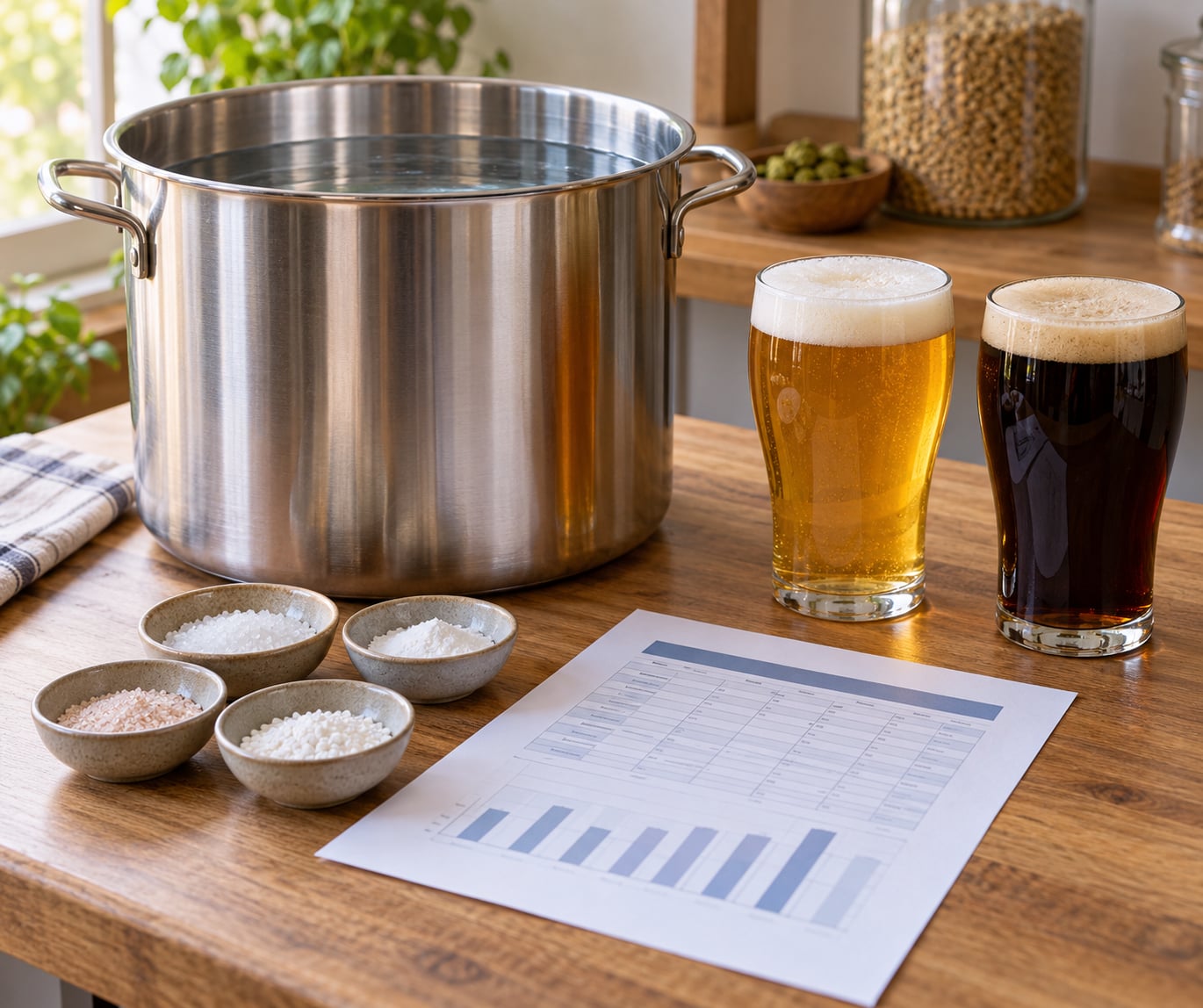
- Add salts to hit the targets. Gypsum adds calcium and sulfate. Calcium chloride adds calcium and chloride. Epsom salt adds magnesium and sulfate. Baking soda adds sodium and alkalinity. Chalk adds calcium and alkalinity but dissolves slowly, so stir it in well. Use plain non-iodized canning salt for chloride when you do not want extra calcium. Iodized salt is harmful to yeast, so keep it out of the kettle.
- Convert to grams for your batch. A water calculator such as Bru’n Water or EZ Water does this in seconds and takes the guesswork out. Working by hand, the rule of thumb is roughly 1 to 2 grams of salt per gallon of finished beer to make a visible change, and you would use several times that for a full mineral build from distilled water.
- Treat the chlorine before anything else. Add crushed sodium metabisulfite tablets according to the chlorine level on your report and wait the stated time. Do this regardless of the rest of your plan.
- Measure mash pH. Calibrate the meter, then take a reading mid-mash. If you are more than about 0.2 off, adjust with a small amount of acid and re-read.
- Brew, taste and record. Write down the numbers you used and what the beer tasted like. Consistency is what makes the next batch better, not the first big adjustment.
The most common mistake is changing everything at once. If you alter the water, the grain bill and the hop schedule in the same batch, you have learned nothing. Fix the water first and hold everything else steady, then change one thing at a time.
For extract brewers the stakes are lower, since the profile comes mostly from the liquid malt extract or concentrate. You still need chlorine-free water, and a light mineral adjustment is usually enough. Save the heavy arithmetic for all-grain.
Troubleshooting Common Beer Taste Problems
Water causes are usually consistent, so taste descriptions map to fixes fairly reliably. The catch is that several other variables can look similar, so check the chemistry before you change a recipe.
| What you taste | Likely water cause | Fix | Also check |
|---|---|---|---|
| Harsh, drying bitterness with astringent finish | Mash pH too high, or sulfate far above chloride | Lower mash pH toward 5.3, add chloride, dilute sulfate water | Oversimplified mash, too much unmalted grain |
| Dull, one-dimensional hops | High alkalinity dulling hop aroma, or chlorine stripping it | Reduce bicarbonate, verify dechlorination | Oxidation, hop age, fermentation temperature |
| Gummy, chalky or astringent malt | Excess calcium, or mash pH below about 5.2 | Cut calcium additions, raise mash pH slightly | Starch conversion, mash schedule, crush quality |
| Metallic or penny-like taste | Iron in well water, or untreated chlorine | Test for iron, treat chlorine with metabisulfite tablets | Kettle or equipment corrosion, old copper fittings |
| Medicinal, band-aid, cat litter note | Chlorophenols from chlorine or chloramine | Metabisulfite tablets, then avoid the source for a batch | Contaminated mash tun, old tubing, plastic fittings |
| Overly sour or thin beer | Mash pH pushed too low by excess acid | Add calcium carbonate or reduce acid dosing | Wort infection, wild yeast, extended open fermentation |
| Flavor that fades over weeks | Low dissolved oxygen combined with chlorine or chloramine | Purge and sanitize lines, dechlorinate water | Oxygen ingress at packaging, warm storage |
Metallic notes deserve one more word. A water report that shows no iron and no chlorine still leaves the possibility of chlorophenols forming in a plastic or rubber part of your system, or copper in the wrong place. When a clean water profile and a metallic beer happen at the same time, replace the cheap tubing before you blame the water again.
And if the same recipe tastes different batch to batch without any water change, look at your grain supplier, your yeast pitch, and your fermentation temperature first. Water problems are usually consistent, which is what makes them frustrating to diagnose once they do shift.
Frequently Asked Questions
Is distilled water better than tap water for brewing beer?
For all-grain brewing, distilled or reverse osmosis water is usually the better starting point because it gives you a blank canvas and full control over the mineral profile. For extract brewing, your tap water works fine as long as it is chlorine-free and low in iron. Municipal water is also fine for all-grain once you have read the utility report and know what you are working with.
Does every beer style need a different water profile?
Not every beer, but most families of beer want different profiles. Hop-forward pale ales and IPAs want high sulfate and low alkalinity. Stouts and porters want chloride and tolerate bicarbonate. Lagers want a soft, low-mineral profile that stays out of the way. If you only brew one style, you only need to learn one profile, and you can refine from there.
Is hard water bad for beer?
Hard water is not automatically bad. It simply means high total dissolved solids, mostly calcium and magnesium, and the effect depends on which part of the beer you care about. Hard water with lots of sulfate suits bitter English pale ales. Very hard water with high bicarbonate pushes mash pH up and makes pale beer harsh. Check the specific ions rather than the hardness number alone.
Do homebrewers need a pH meter to adjust brewing water?
You do not need one to brew decent beer, but you need one to be deliberate about pH. A digital meter with automatic temperature compensation and 0.01 resolution, calibrated with pH 4 and pH 7 solutions, is enough for home use. Test strips are fine for tracking trends across batches but are too coarse to hit a specific mash target.
Can brewing salts fix bad-tasting tap water?
Salts can rebalance a water profile, but they cannot remove contaminants. Sodium metabisulfite tablets handle chlorine and chloramine, and dilution with distilled or reverse osmosis water lowers everything at once. Neither fixes iron from a well, and no amount of gypsum rescues chlorophenols. Treat the water first, then adjust the profile.
Should I use baking soda to raise brewing-water pH?
Baking soda does raise pH, but it also adds sodium and carbonate, and sodium above roughly 50 ppm tastes harsh and salty. It is a small corrective tool, not a foundation. Most brewers get better results by adding calcium carbonate or by diluting alkaline water with distilled water first and then fine-tuning with a small amount of acid.
Conclusion: Start with the Water Report
Water chemistry is the one part of brewing where the fix is fully in your hands, and it takes an afternoon. Start by pulling the annual report from your water utility and looking at chlorine, bicarbonate, calcium, sulfate and chloride. Decide which style you are brewing and pick a target profile for it. Dechlorinate first, because no salt recipe rescues chlorophenols. Then change one thing per batch and write down what you tasted.
Most brewers find that the first adjustment is also the largest one. Fix the water, taste the difference, and the next batch gets easier from there.