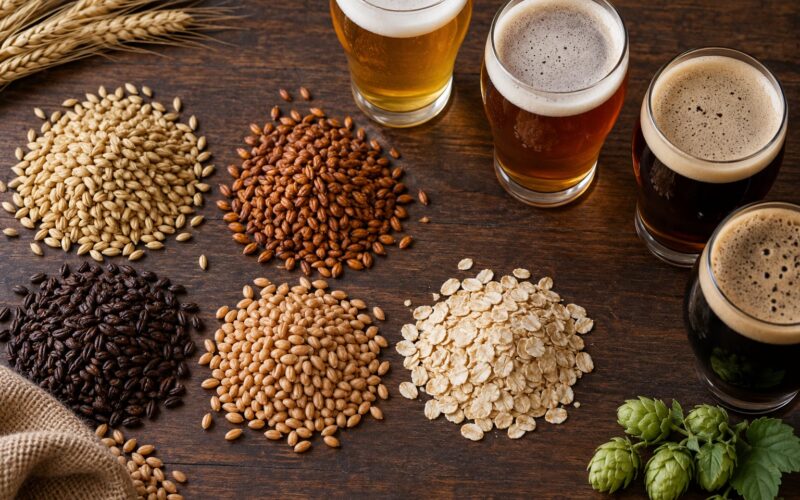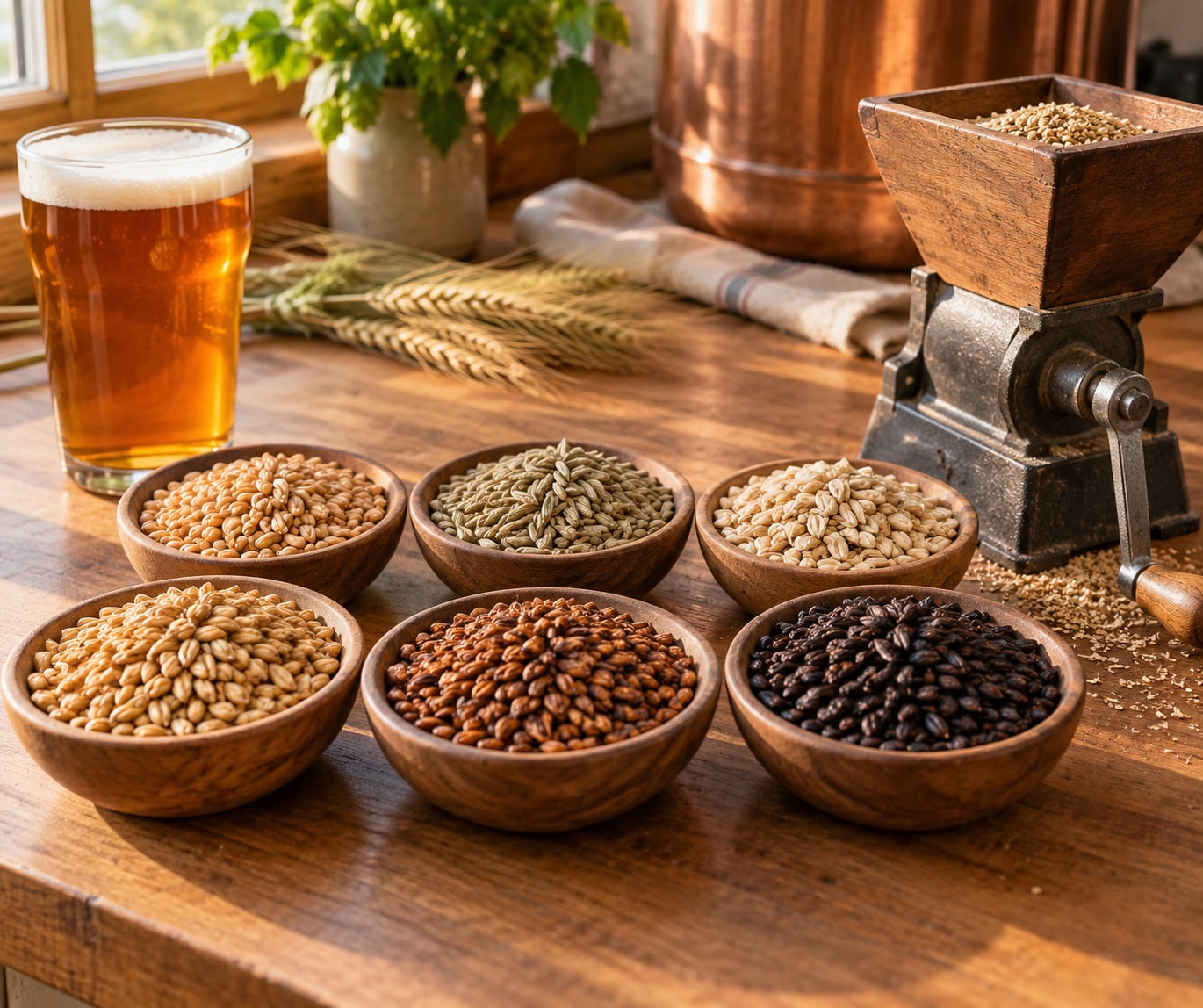
Specialty grains, usually sold as specialty malts, are any grain or malt you add on top of a base malt in a small share of the grain bill, typically 3 to 20 percent, to add color, flavor, body, foam retention, or roast character that the base malt alone cannot deliver. Barley malt still makes up the overwhelming bulk of a beer, and specialty grains are the minority addition that turns a plain single-malt ale into a porter, a stout, or a full-bodied wheat beer.
I’ve built a lot of grain bills over the years, and the mistake I see most often is treating a specialty malt like a flavor boost rather than a structural change. A small swap in the grist changes gravity, pH, mouthfeel and fermentation behavior all at once, so it pays to know what each one actually does before it goes in the pot.
Table of Contents
- What Are Specialty Grains in Brewing?
- How Common and Specialty Brewing Grains Differ
- What Kinds of Specialty Grains Are Used in Beer?
- Crystal and caramel malts
- Roasted grains and malts
- Kilned and toasted malts
- Starchy, husky and specialty-husked grains
- Adjuncts and non-barley grains
- Which Specialty Grain Should You Choose?
- How Do Specialty Grains Change Beer?
- How to Use Specialty Grains Without Overpowering the Beer
- How to Substitute Specialty Grains
- Frequently Asked Questions
- Are specialty grains malted?
- Can specialty grains be used in any beer style?
- How much specialty grain should I add to a homebrew?
- Do specialty grains need to be crushed or mashed differently?
- Are specialty grains always more kilned or roasted?
- Why does my specialty-grain beer taste more bitter or roasty than expected?
- Conclusion: Start with One Specialty Grain
What Are Specialty Grains in Brewing?
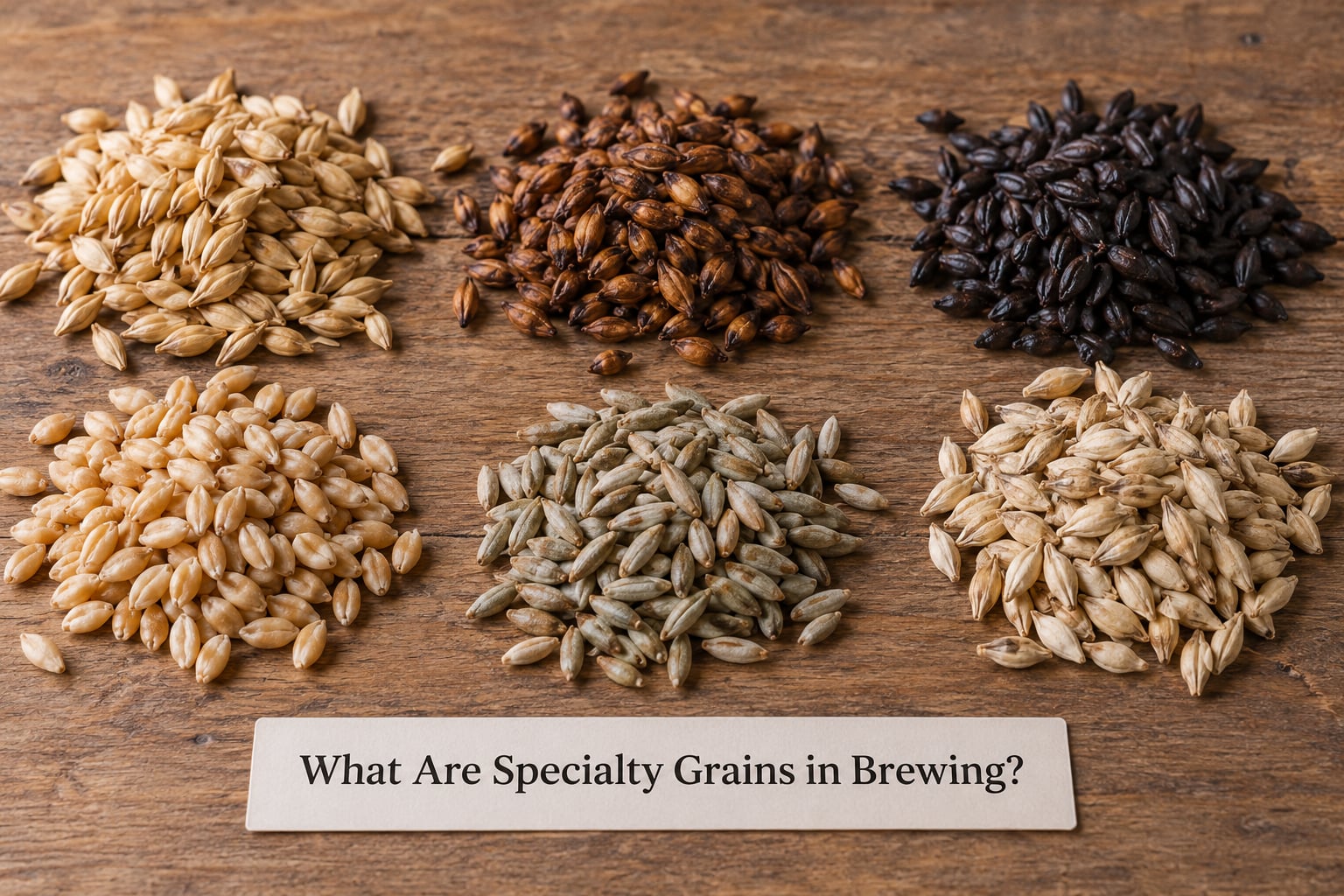
Specialty grains are everything in the mash bill that is not your base malt. They exist to do jobs a single pale malt cannot: deepen the color, add sweetness that ferments out, create a creamy mouthfeel, stabilize the foam, or bring in bread crust and coffee roast notes.
The number printed on the bag matters. Nearly every specialty malt is labeled with its color in degrees Lovibond, or L, and that figure tracks flavor intensity reasonably closely even though it measures color. Crystal 60L is a mid-amber caramel grain; a 350L chocolate malt is a serious roast grain. Brewhouse color also gets reported on the SRM scale for American beer and the EBC scale for European beer, both of which run higher than Lovibond for the same grain.
Specialty malts arrive in a handful of processing states, and that state tells you most of what they will do. Kilned malts are dried to a set temperature and stay relatively unsubtle. Toasted malts get a longer, lower heat and taste of bread and biscuit. Caramel and crystal malts have already had their starch converted inside the hull before roasting, so they contribute sugar and body without needing enzymes. Roasted malts take a hard roast and contribute color, bitterness and acidity in small doses.
How Common and Specialty Brewing Grains Differ
A base malt does the fermentable work, and specialty grains modify the beer around it. The share each one takes in the bill is the clearest way to tell them apart.
| Role | Typical share of grain bill | Main function | Needs mashing? | Flavor contribution |
|---|---|---|---|---|
| Base malt | 70 to 100 percent | Converts starch to fermentable sugar and supplies most of the gravity | Yes, always | Clean, grainy, sometimes honey or biscuit depending on the variety |
| Specialty malt, kilned or toasted | 5 to 20 percent | Adds toasty depth, body and head retention | Yes | Bread crust, biscuit, malt, light caramel |
| Specialty malt, crystal or caramel | 5 to 15 percent | Adds color, unfermentable sweetness, body and foam stability | No, can be steeped | Honey, caramel, toffee, depending on Lovibond |
| Roasted grain or malt | 1 to 15 percent | Adds roast flavor, deep color and mash acidity | Can be steeped, but goes bitter if over-extracted | Coffee, cocoa, burnt toast, char; acrid above its ceiling |
| Adjunct, unmalted grain | 2 to 20 percent | Changes texture, protein content and foam, or thins the body | Yes | Creamy and bready for oats, spicy for rye, neutral for rice and corn |
The practical rule most homebrewers land on: if you use specialty malts at all, keep base malt at 70 percent or higher. Below that, you are no longer adjusting a base beer, you are building a different one, and you should design the whole bill at once.
What Kinds of Specialty Grains Are Used in Beer?
Specialty grains fall into a few families that behave predictably. Learn the family and you can guess what an unfamiliar bag will do.
Crystal and caramel malts
Crystal malts give the best color-per-pound and the most head retention of any specialty grain. They are made by mashing green malt inside the hull, then roasting it, which is why the starch is already converted and why they can be steeped instead of mashed.
Start at the low end. Crystal 10L through 20L adds a honeyed edge to a pale ale, and Crystal 40L to 60L is the classic amber and Irish red building block. Crystal 80L to 120L and Special B are the same idea pushed hard, and they turn cloying fast. Carapils is a crystal type formulated for foam, and dextrin malt adds body without much sweetness.
Roasted grains and malts
Roast adds enormous color from a small amount of grain, which is why commercial brewers use it in low-alcohol and non-alcohol beer where there is no gravity to hide behind. It also lowers mash pH, sometimes sharply, and that acidity can sour a batch if you are not watching it.
Pale chocolate and coffee malts sit around 180 to 260L and are the safest place to start. Chocolate malt runs roughly 325 to 450L, black malt runs 450 to 600L and should be treated as a seasoning rather than a base. Roasted barley is malted, kilned barley put through a roaster, and it gives a coffee character that chocolate malt never quite matches. Dehusked or debittered versions of these grains exist for the brewer who wants the color and the roast without the acrid edge.
Kilned and toasted malts
These are the quiet contributors. Vienna, Munich 10L and 20L, biscuit, Victory, aromatic and melanoidin all add color, body and a bread-crust or toasted note without turning a beer into a caramel bomb. Munich is the backbone of bocks and Märzen, and Victory is the malt that makes a toasted-biscuit IPA taste the way it does.
Starchy, husky and specialty-husked grains
Wheat, rye and unmalted rye are not kilned malts at all; they are unmalted grains with intact husks, and they contribute starch, protein and the husky spice that makes a wheat beer or a rye beer taste like itself. Specialty-husked malts get treatment that reduces the harshness of the husk while keeping some of that character. Smoked malts, often called Rauch malts, add a campfire note that regular kilning cannot.
Dehusking, debittering or husking a roasted grain has the same logic: strip the part of the grain that produces the unpleasant edge and keep the color. Dehusked roasted malt, huskless coffee malt and pearled roasted barley all exist for that reason.
Adjuncts and non-barley grains
Flaked oats, flaked barley, wheat, rye, corn and rice hulls get lumped in with specialty grains because they share the same small share of the bill and the same job of changing texture. Flaked oats and flaked barley add creaminess and a stable head without much sweetness. Rice hulls do the same for very light beers while keeping the gluten down, which matters for gluten-reduced brewing. Corn adds nothing but body lightening, and it is the reason adjunct-heavy lager styles exist.
Here is the reference table worth bookmarking. It is the one I keep coming back to when a recipe calls for something unfamiliar.
| Grain | Category | Color (L) | Flavor | Typical use | Mash or steep |
|---|---|---|---|---|---|
| Crystal 10L to 20L | Caramel | 10 to 20 | Honey, light caramel | 5 to 10 percent | Steep ok |
| Crystal 40L to 60L | Caramel | 40 to 60 | Butterscotch, toffee | 5 to 12 percent | Steep ok |
| Special B, Crystal 80L to 120L | Caramel | 80 to 120 | Dark caramel, molasses | 3 to 8 percent | Steep ok |
| Carapils | Caramel, foam | 3 to 6 | Neutral, creamy | 2 to 5 percent | Steep ok |
| Dextrin malt | Caramel, body | 3 to 5 | Neutral, syrupy body | 3 to 8 percent | Steep ok |
| Vienna | Kilned | 3 to 5 | Toasty, bread crust | 5 to 15 percent | Mash |
| Munich 10L / 20L | Kilned | 10 to 20 | Full malt, bread, gentle caramel | 5 to 20 percent | Mash |
| Biscuit, Victory | Toasted | 2 to 6 | Biscuit, toasted bread | 5 to 15 percent | Mash |
| Aromatic, melanoidin | Highly kilned | 50 to 130 | Honey malt, raisiny | 1 to 5 percent | Mash |
| Pale chocolate, coffee | Roasted | 180 to 260 | Cocoa, dry coffee | 3 to 8 percent | Mash, steep short |
| Chocolate malt | Roasted | 325 to 450 | Dark cocoa, bittersweet | 3 to 10 percent | Mash, steep short |
| Black malt | Roasted | 450 to 600 | Burnt toast, char | 1 to 2 percent in reds, 10 plus in imperial stout | Mash |
| Roasted barley | Roasted grain | 300 to 600 | Coffee, dark grain | 3 to 10 percent | Mash, steep short |
| Dehusked roasted malt | Roasted, dehusked | Varies | Roast with little acrid edge | 3 to 10 percent | Mash |
| Wheat malt, flaked wheat | Unmalted or kilned wheat | 2 to 6 | Bready, soft, spicy | 10 to 30 percent | Mash |
| Rye, unmalted rye | Husked grain | 3 to 6 | Spicy, dry, peppery | 5 to 20 percent | Mash |
| Flaked oats, flaked barley | Adjunct | 1 to 2 | Creamy, silky, neutral | 5 to 20 percent | Mash |
| Acidulated malt | Acidified | 2 to 5 | Sour edge, lowers mash pH | 1 to 5 percent | Mash |
Which Specialty Grain Should You Choose?
Choose by the flavor and color you want in the glass, not by the grain name. Names overlap between maltsters, and a 40L from one malthouse is not always identical to a 40L from another, so the Lovibond number and the style you are brewing matter more than the label.
For an amber ale, Crystal 40L to 60L at 8 to 12 percent with a base of pale ale malt gets you there without a roast grain. For a brown or Irish red, swap to Crystal 60L, add a few percent of Victory or biscuit, and put roasted barley in at 2 to 3 percent.
Porter and dry stout want layering rather than one heavy grain. Pale chocolate for the cocoa base, chocolate malt for depth, and a small percentage of crystal to round it out reads far better than 10 percent of a single 500L black malt. Old forum advice on this is sound: layer two roasts and a little crystal instead of leaning on one aggressive dark malt.
Rye beer is mostly about the rye itself, and 20 to 40 percent rye changes the body and the bite completely. Belgian-style ales are usually a pale base with a light touch of wheat or Vienna, sometimes a small amount of aromatic malt for the honeyed note. Bock and Märzen are Munich-led, with darker Munich in the bock and lighter in the Märzen.
Scotch ale gets its heavy, sweet body from a combination of pale malt, a good share of low-color crystal, and a small amount of roasted barley for depth. Specialty heritage and smoked malts are the last category worth exploring once the basics are automatic; Rauch malt is a flavor in itself rather than an adjustment.
How Do Specialty Grains Change Beer?
Color is the most obvious effect and the least complicated. A pound of crystal moves a beer several SRM more than a pound of anything else, and half a pound of black malt can push a pale base into stout territory on color alone, which is why commercial low-alcohol beer colors its grain bill this way.
Sweetness perception is where beginners get surprised. Crystal malt adds unfermentable sugars, so the beer tastes sweet even as it finishes dry and carbonates hard. Push past roughly 15 percent crystal in the bill and the beer reads cloying and heavy, which is the single most common specialty malt mistake.
Body and mouthfeel come from unfermented carbohydrates and, with oats and flaked barley, from proteins and beta-glucans. The result is the creamy, slick texture in an Irish red or an oatmeal stout. Head retention follows the same compounds, so a few percent of Carapils or crystal visibly improves a beer that goes flat in the glass.
Bitterness and astringency pull the other direction. Roasted grains contain compounds that taste harsh when over-extracted, and tannin from husks turns tea-like when you mash too hot or steep too long. Acidity is the quieter change: dark grains drop mash pH, and in a small volume of low-bicarbonate water that drop can sour the whole batch. Sour brewers use it deliberately with acidulated malt, which lowers mash pH in a controlled way.
Fermentation character changes too. A grist with more unfermentable sugar leaves more residual character, and a wort that starts with a lower pH can make some yeast strains finish differently. Aeration matters more too, since specialty malts raise the wort density above what a simple pale wort needs.
How to Use Specialty Grains Without Overpowering the Beer
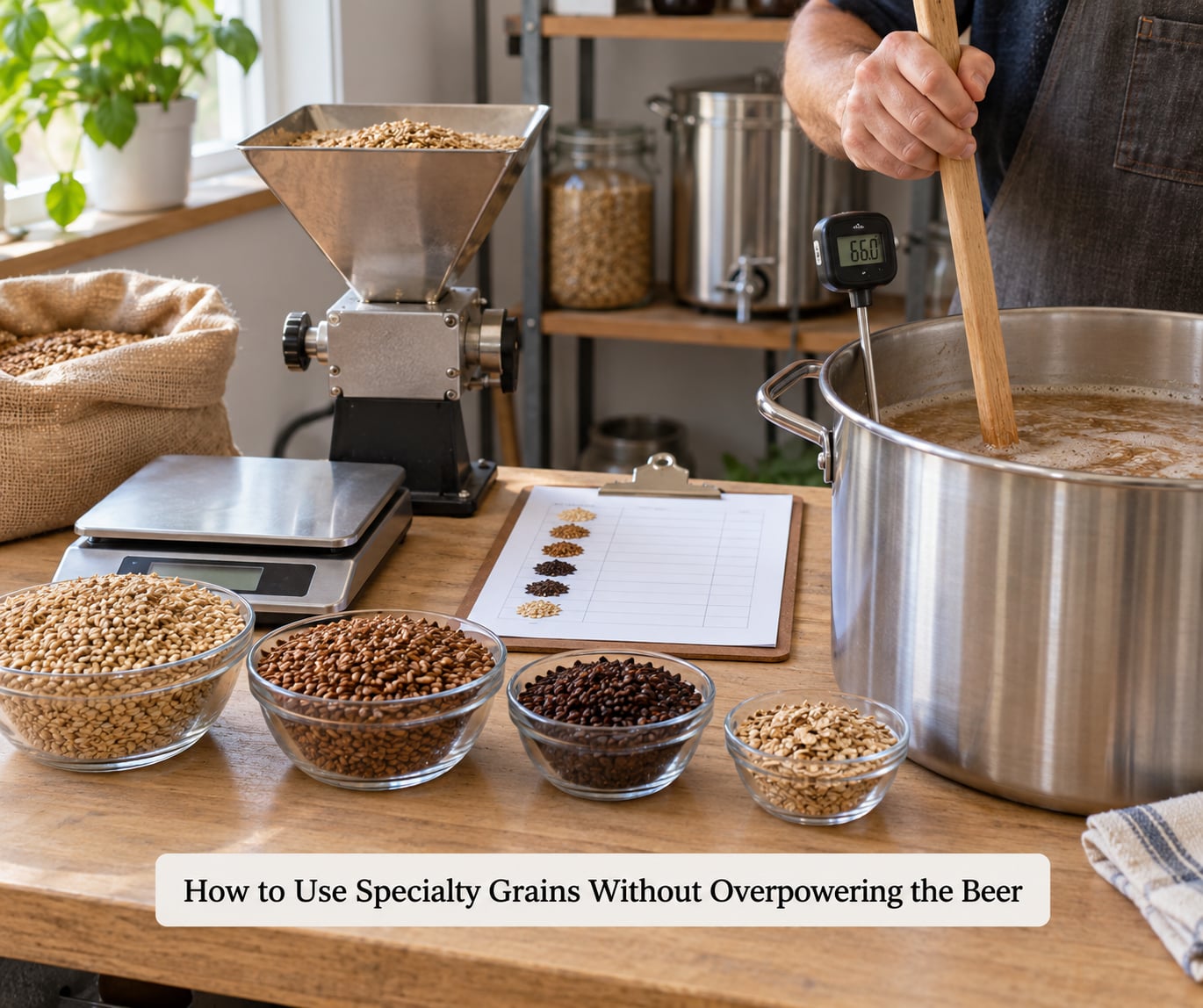
Start with the style, not the grain. Decide the target color in SRM, pick the base malt, and add the smallest number of specialty malts that gets you there. Two specialty malts usually beat five.
For extract brewers, the mash-or-steep decision is the one that trips people up. Kilned malts, wheat, rye, oats and anything with intact starch need enzymes from a base malt, so mashing them means either a partial mash or adding a small amount of dry extract to supply those enzymes. Crystal and caramel malts, Carapils and dextrin malt have already been converted, so they can simply be steeped. Roasted malts sit in between: they can be steeped for flavor, but only briefly and gently.
Steep in roughly a gallon of water at 150 to 170F for 30 to 45 minutes, then pull the bag before it gets astringent. Steeped grain barely moves your original gravity, so plan your gravity around the liquid extract alone. The frequent homebrew question about why recipes use so little water is answered here: less water, less hull contact, less tannin.
For all-grain brewers, crush specialty grain the same day you brew it. A roller gap around 1.0 to 1.15mm is the usual target, and specialty malts are fragile kernels, so crushing them earlier than the base malt is fine and usually helpful. Store malt airtight, cool and dark, and buy smaller bags of the expensive stuff so nothing sits for a year.
Adjust the mash for what you added. Dark and roasted malts lower pH, so if the finished beer was sour or harsh, cut the roast percentage before you cut the yeast or the water profile. If it was cloying, the fix is almost always less crystal, not a different fermentation schedule.
How to Substitute Specialty Grains
Substitution works when you match color and function first, and flavor second. Swapping by name alone is how people end up with a beer that tastes wrong in a way they cannot identify.
| Instead of | Use | What to watch |
|---|---|---|
| Crystal 60L | Crystal 40L plus 2 to 3 percent more, or 60L plus 1 percent Special B | Keeps color up while pulling the heavy caramel back |
| Crystal 20L | Honey malt at half the weight plus 2 percent crystal 40L | Honey malt carries more aroma, less body |
| Special B | Crystal 120L, or 80L plus a small amount of roasted barley | Roast adds bitterness that Special B does not have |
| Chocolate malt | Pale chocolate plus coffee malt | Split the roast across two grains for complexity |
| Roasted barley | Chocolate malt, or Carafa Special at the same weight | Chocolate malt reads more cocoa, roasted barley more coffee |
| Black malt | Roasted barley, or a 2:1 pale chocolate to black malt mix | Black malt replaces color cheaply; roast notes need something else |
| Vienna | Biscuit malt or light Munich | Biscuit is more nutty, Munich is cleaner and fuller |
| Munich 20L | Munich 10L plus 2 percent biscuit | Body stays close, the malt character shifts slightly |
| Flaked oats | Flaked barley, or a small amount of wheat malt for the same silkiness | Both add protein, so body changes only slightly |
| Wheat malt | Flaked wheat | Flaked wheat is huskier and contributes a little more protein |
Two substitutions are genuinely bad ideas. Do not replace a roaster’s base malt with a kilned malt, and do not blend a specialty grain into a beer that has no base malt behind it, because the specialty grain is providing sugars and color that were not part of the design. Also avoid straight one-for-one swaps across categories; a pound for pound replacement of black malt with crystal changes gravity, pH and sweetness all at once.
Frequently Asked Questions
Are specialty grains malted?
Some are, and some are not. Kilned malts like Vienna and Munich, caramel malts like Crystal and Special B, and roasted malts such as chocolate and black are all malted barley. Wheat, rye, flaked oats, flaked barley, corn and rice are unmalted grains, used more as adjuncts for texture and foam. Specialty-husked and dehusked varieties are malted but have had part of the kernel removed.
Can specialty grains be used in any beer style?
Technically yes, practically no. Specialty grains are how a brewer hits a style profile, so adding them means the beer is no longer targeting the style you set out to brew. BJCP style guidelines put practical limits on usage: crystal rarely exceeds 15 percent, chocolate around 10 percent, and black malt is a 1 to 2 percent seasoning in red ales even though imperial stout uses far more.
How much specialty grain should I add to a homebrew?
Keep base malt at 70 percent or more, hold most specialty malts between 5 and 15 percent, and treat roasted grains as a 1 to 10 percent accent. The grain that most often gets misused is crystal: past about 15 percent the beer reads cloying and heavy. If you want a bigger effect, add a second type of specialty malt rather than more of the same one.
Do specialty grains need to be crushed or mashed differently?
Crush them the same way as base malt, ideally fresh on brew day, with a roller gap near 1.0 to 1.15mm. The bigger difference is mashing: kilned malts, wheat, rye and oats need enzymes from a base malt, so they require a mash or a partial mash. Crystal and caramel malts are already converted and can be steeped, while roasted malts can be steeped briefly and gently without turning astringent.
Are specialty grains always more kilned or roasted?
No. Processing a specialty grain harder is one way to make it, not the only way. Crystal and caramel malts are produced by stewing and mashing green malt inside the hull before roasting. Wheat, rye, oats and corn stay unmalted and raw by comparison. Flaked barley and rolled oats are simply rolled, and acidulated malt is treated with lactic acid to lower mash pH.
Why does my specialty-grain beer taste more bitter or roasty than expected?
Roasted grains are easy to over-extract, and over-extraction is the most common cause. Dark malts also lower mash pH, so a grist heavy in chocolate or roasted barley can taste sour and harsh together. Cut the roast percentage rather than the amount of water, mash at a moderate temperature, and if you steep roasted grain keep the steep short and below 170F to avoid pulling tannin.
Conclusion: Start with One Specialty Grain
Pick one specialty grain, pick one job for it, and change one thing at a time. Crystal 40L to 60L is a good first move because it does three jobs at once: color, body and foam retention, without roast or acidity complicating the result.
Keep your base malt at 70 percent or more, add the specialty grain at 5 to 10 percent, brew it, and write down what changed. Then adjust one variable on the next batch. That is faster than any chart, and it is how you actually learn which specialty grains in brewing are worth carrying in your grain bin.