A beer release day is a single date on which a brewery makes one limited beer available to the public, most often only at its own taproom and most often only for that day. What is a beer release day in practice? It concentrates demand into one scheduled event instead of spreading a scarce batch across weeks of on-tap availability, which is why some release mornings draw a line before sunrise.
Three models cover nearly every release you will run into:
- Taproom or brewery event. The beer is poured or bottled on site, usually with a per-person limit and often a line that forms hours before the doors open.
- In-distribution release. The beer goes to beer bars, bottle shops and grocery accounts across a region on one date, then vanishes from the shelf once that shelf’s allocation is gone.
- Retail drop. A small number of bottles go to a handful of stores, sometimes in an online queue, and the whole run sells through in minutes.
Everything else in this guide is a variation on those three, and the vocabulary changes from brewery to brewery. Once you know the mechanics, the whole scene makes a lot more sense.
Table of Contents
- What Is a Beer Release Day?
- Why Do Breweries Hold Beer Release Days?
- What Is a Beer Release Day From the Brewery’s View?
- How Does a Beer Release Day Work?
- What Happens at a Release Event?
- Are All Beers Available on Release Day?
- How Can You Find a Beer Release Near You?
- What Should You Know Before Buying a New Release?
- Beer Release Day vs. a Taproom Keg Release
- Frequently Asked Questions
- Do you need tickets for a beer release day?
- How many bottles can you buy on a beer release day?
- Is a beer release day the same as International Beer Day?
- How early should you arrive for a beer release?
- What happens if a beer release sells out?
- Can you resell beer you buy on a release day?
What Is a Beer Release Day?
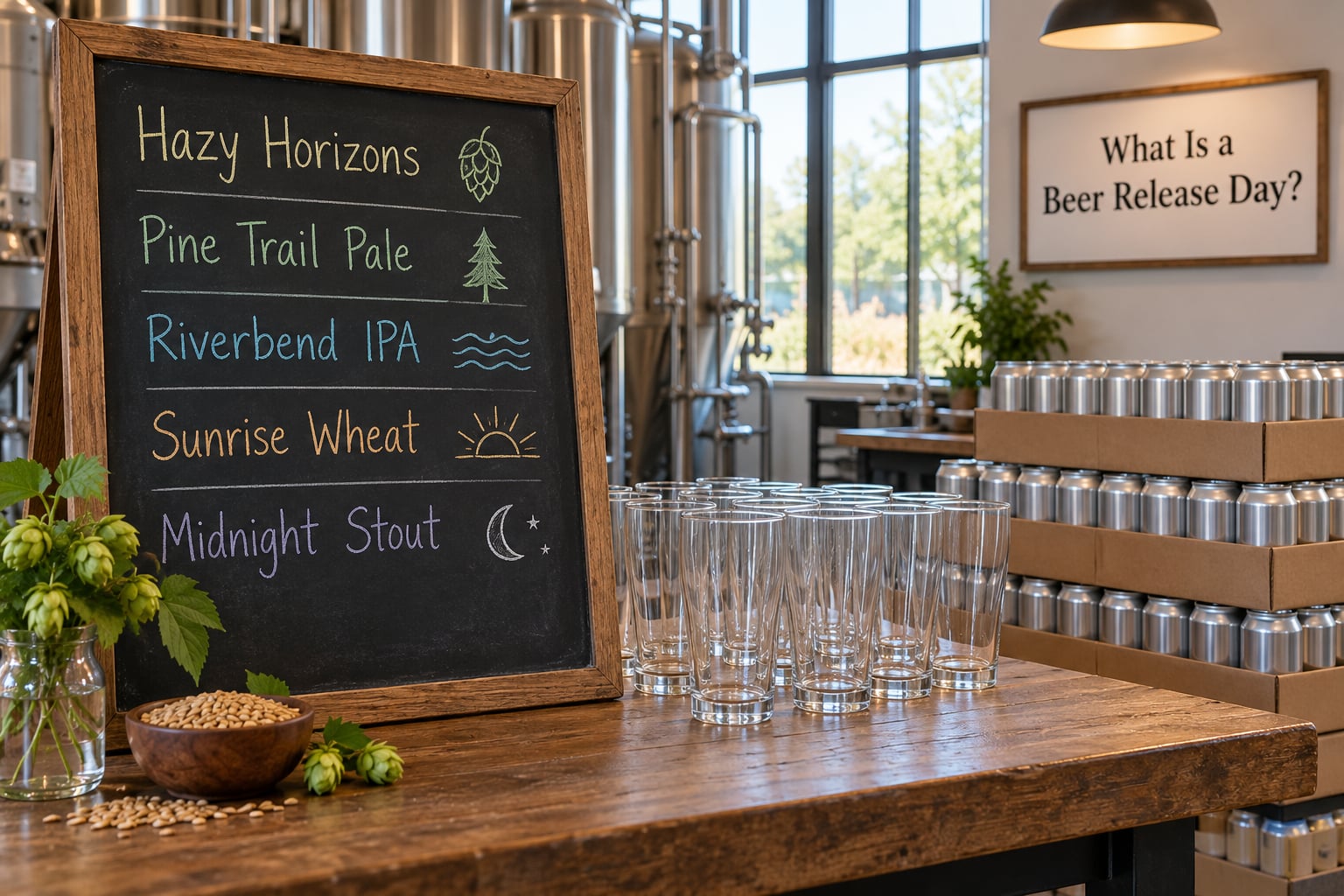
A beer release day is a scheduled launch for one specific beer, held on a date the brewery picks and advertises in advance. The beer is usually produced in a limited quantity, so limiting both the quantity and the window creates the demand that fills a taproom on one morning.
It is worth separating that from three similar-looking things. An ordinary tap appearance is when a beer simply shows up on draft and stays on for weeks, with no event attached. A beer festival is a multi-brewery gathering, usually with dozens of taps and a general admission charge, where no single beer has a launch moment. A general product release is when a beer rolls out to retailers across a market over weeks, the way a new pale ale reaches most shelves.
The release day is different from all three. The beer is usually only available through one channel, the date is fixed, and the interest is concentrated into a short window. Two Floyds’ Dark Lord Day, Cigar City’s Hunahpu’s Day, Russian River’s Pliny the Elder release and Bell’s Oberon Day are all variations on that format, and each one turned a bottle of beer into a date on the calendar.
One caveat worth stating early: there is no industry standard for the term. One brewery might call a whole Saturday of tap takeovers a release day, while a brewery two towns over uses the same words for a single keg that lands on draft that afternoon. The brewery’s own announcement is the only reliable description of what it is actually doing.
Why Do Breweries Hold Beer Release Days?
There is a business reason and a marketing reason, and they mostly point the same way.
Scarcity does the heavy lifting. A beer brewed in a limited batch cannot sit on a shelf indefinitely without losing its interest, so a single date lets a brewery sell a small run hard and move on. It also means a batch gets a reputation that outlasts the beer itself.
Freshness is part of it. Many release-only beers are at their best in the first weeks, and some only really sing after months in a barrel or a cold cellar. Releasing on one day lets a brewery tell people to drink it now rather than let them find it a year later and wonder why it tastes flat.
One-day events also fill a taproom without cannibalising the rest of the list. A regular Friday pour is steady and reliable. A release Saturday is a spike, and a spike brings in people who then stay for a second pint of something the brewer already has plenty of.
And there is the occasion itself. People plan a weekend around a release, bring friends, and often travel for one. That is advertising a brewery cannot buy.
What Is a Beer Release Day From the Brewery’s View?
From the production side, a release day is a scheduling problem. A brewery has a brewhouse, a finite number of fermenters, a packaging line and a staff roster, and a limited batch has to be brewed, conditioned, packaged and delivered to a small number of accounts in a fixed window.
Capacity is the real constraint. A brewery can only put so many bottles on a line in a day, and a taproom can only pour so fast, so the brewer sets a per-person limit to stretch a fixed amount across more people. That limit is not a gimmick; it is the mechanism that decides how the beer reaches the fans who actually want to drink it.
Distribution adds another layer. A limited beer might go to fifty bars, then disappear, or stay in one brewery’s taproom and never leave the building. Some releases never get distributed at all, which is exactly why fans plan a trip around them.
How Does a Beer Release Day Work?
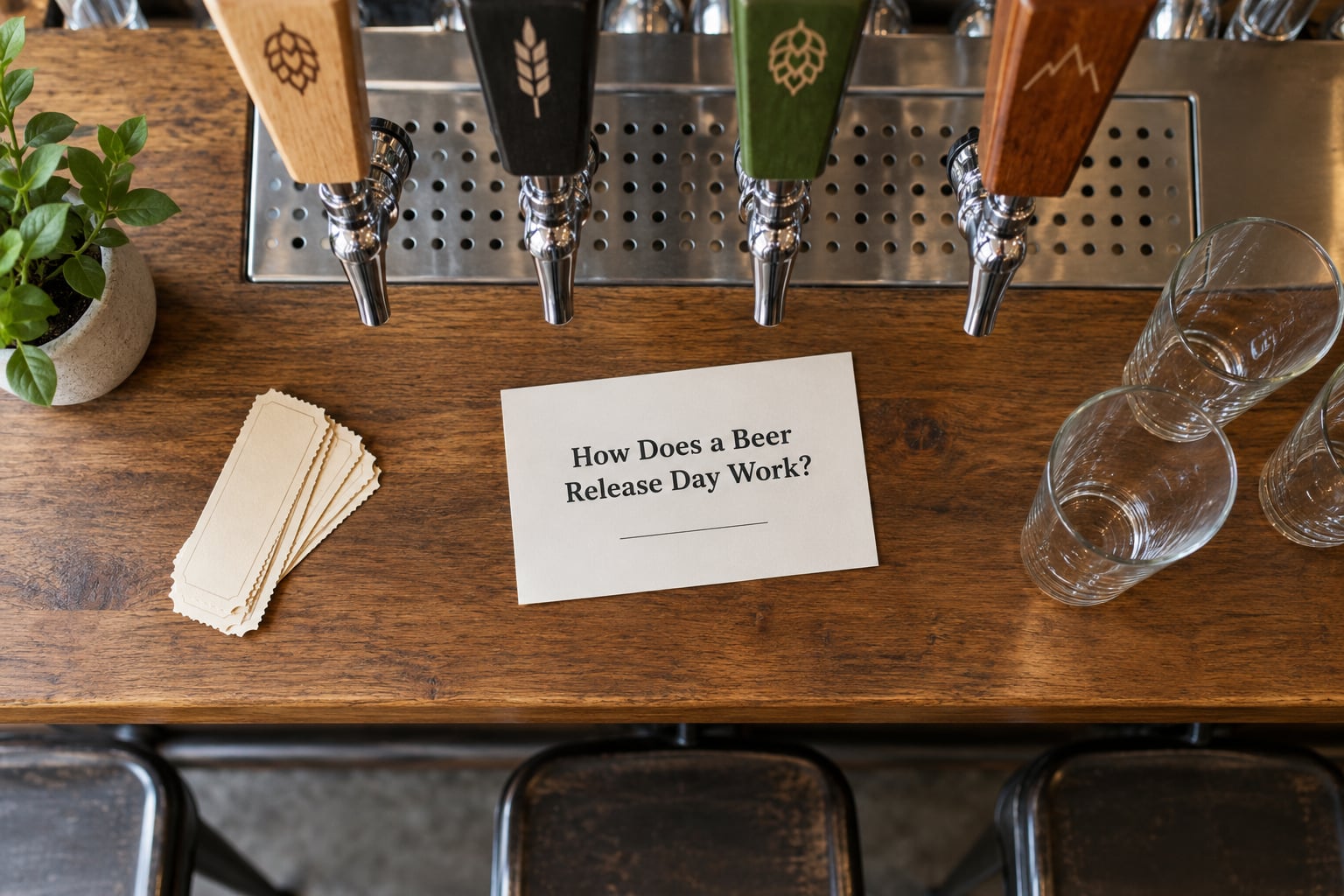
The mechanics are close to the same everywhere, even when the details differ. Here is the sequence a first-timer will usually see.
- Announcement. The brewery posts the date, the beer, the style and the location, usually on its website, its email list and its social accounts. That post is where the per-person limit and any ticket requirement first appear.
- Release details. Opening time, where to park, what ID to bring, how many bottles you can buy, and whether the beer is on draft, in bottles, or both. Some breweries publish nothing beyond the date and let people ask staff on the day.
- Arrival and queue. Lines start early. For a big ticketed event the queue forms hours ahead; for a free taproom drop, forty-five minutes to a couple of hours early is usually plenty. Overnight camping at the brewery is the point of no return, and regulars notice it.
- Purchase. Walk-up sale, wristband system, ticket tiers, member presale, or an online queue for a retail drop. Payment methods vary more than people expect, so check whether the site takes cards, cash or both.
- Sell-out. Most limited releases are gone well before the day ends. Some breweries pour what is left as a draft-only “second chance” or put a small batch back on later, and some just tell you it is gone.
Because procedures vary by brewery and location, treat any detail you read about one release as a hint rather than a rule. Two events from the same brewery can have entirely different entry systems.
What Happens at a Release Event?
Arriving early is normal, so nobody will blink if you are there before the doors. You check in, find out whether the beer is being poured, bottled or both, and wait for staff to start the event. Somebody usually reads the rules out loud, or hands you a card with the limit printed on it.
After that it is mostly a bar with a reason for the crowd. You order the featured beer, and the bartender walks you through it: the style, the ABV, what went into it, whether it is meant to be drunk now or aged. Those two minutes are the most useful part of the whole day if you are new to the brewery, because the same information is scattered across a dozen posts everywhere else.
Availability updates matter more than they sound. Staff will say how much is left, whether a second run is coming, and whether a restock is allowed later in the day. Ask about the beer when the bar is calm rather than in the middle of the rush.
Then you compare. Most release events keep a handful of regular taps running alongside the featured beer, and a session pint of something familiar is often the better value decision. The release is the reason you came, not the only thing on the list.
Are All Beers Available on Release Day?
No, and this trips people up constantly. A release day might be a single beer, a rotating lineup of six, a collaboration brewed with another brewery, or a broader brewery event that happens to be framed as a release. Some breweries build an entire weekend around one beer, with a barrel-aged version, a vintage pour and a merch table attached.
A release also has a distribution arc. It might appear at the brewery on day one, then go to a small list of regional accounts a few weeks later, and then stop. Or it might never leave the taproom. Or the brewery might hold the beer back and put a different batch on tap while the limited version is bottled, which is a good way to end up with a very confusing search result.
So the honest answer to what a release day actually gives you access to is: whatever the brewery said it would, on the date they said it would, through the channel they said they would use. Anything beyond that is a guess.
How Can You Find a Beer Release Near You?
Start with the brewery itself. Release days are almost always announced on the brewery’s own channels first, and the announcement is the only place with accurate hours, limits and admission rules. Sign up for the email list if you can, because a good share of releases never get a second announcement.
Then search the local layer: taproom calendars, beer festival listings, area tourism and events calendars, and the social accounts of nearby breweries. A taproom that hosts a visiting brewer’s release will post it even when the brewing happens somewhere else entirely.
Give the calendar some time. The useful pattern is that breweries announce a release weeks or months ahead for ticketed events, and days ahead for taproom drops. If you are only hearing about a beer the morning of, it is either a surprise keg landing or a smaller event that may not sell out at all.
Before you leave the house, confirm four things: the date and the opening time, the location, the per-person limit, and the ID requirement. Bringing valid ID is not optional at any of these events, and a person who turns up without it will usually be turned away at the door with no exception.
What Should You Know Before Buying a New Release?
Check the style and the ABV first. Release day beer skews toward strong, interesting styles, and a barrel-aged or high-alcohol beer on an empty stomach is a bad start to a morning that will probably involve a line and a limited bottle.
Understand the packaging. Draft, bottles, cans, and mixed-format sets all behave differently. A bottle you can age is worth more to you than a bottle you will open in the parking lot, but a growler or a draft pour is only available at the brewery and only for as long as the keg lasts.
Know what the limit means. A bottle limit is the per-person cap a brewery sets, commonly two, four or six bottles depending on how scarce the batch is. A beer allocation is how a brewery divides a limited batch among the accounts that carry it, so two stores might receive very different numbers of bottles from the same run. A sell-out simply means the run is gone for the day.
Decide what you are actually buying. A first pour is an exploration, not a commitment. If you leave with the per-person maximum every time, you will spend a lot of money on bottles that age badly, and you will be the person making the line longer for the people behind you.
On cost, check the brewery’s own listing rather than a reseller’s. Release beer does circulate on resale forums and marketplaces afterwards at several times the original figure, and a bottle posted at four times the brewery’s price has not become four times better. Buying at the source is the whole point of showing up.
Beer Release Day vs. a Taproom Keg Release
A taproom keg release is a single keg going on draft on an ordinary day, with no event, no line and no announcement beyond a tap handle. A dedicated beer release day is a marketed date with its own rules, sometimes its own ticket, and usually a per-person limit. The first is a beer that arrived; the second is a beer being launched.
The terminology is not standardised, and that is the honest answer to the question. Some breweries call both things a release. Some call only the second one a release and treat keg landings as business as usual. Where the words come from the brewery itself, the definition does too.
One more disambiguation that causes plenty of search noise: a release day is not a beer holiday. International Beer Day falls on the first Friday in August, and National Beer Day in the United States falls on August 1. Those are calendar observances celebrated worldwide or nationally, with no beer attached and no brewery at the centre of them. A release day belongs to one brewery and one beer.
Frequently Asked Questions
Do you need tickets for a beer release day?
Usually not, but it depends on the model. Taproom drops and free brewery events are walk-up, though you queue. Ticketed festivals, bottle-shop drops and large in-distribution launches often require a ticket, a wristband, a member presale or an online queue. The brewery announcement is the only place that tells you which system applies, so read it before you drive anywhere.
How many bottles can you buy on a beer release day?
Whatever the brewery sets, and that number is usually printed on the release announcement. Limits of two, four or six bottles per person are common, and they exist so a small batch gets spread across more fans rather than filling one shopper’s tote bag. Buy the limit, buy less if you like, but do not try to line up twice, and never pay someone in the car park to hold your place.
Is a beer release day the same as International Beer Day?
No. A release day is a single brewery putting one limited beer on sale at a scheduled time, usually at its own taproom. International Beer Day is a calendar observance on the first Friday in August, and National Beer Day falls on August 1 in the United States. Those are days people celebrate beer in general. A release day is a product launch with a bottle limit and a queue.
How early should you arrive for a beer release?
For a free taproom drop, arrive thirty to ninety minutes early and you will be comfortable. Big ticketed events are different, and the queue can form several hours before the doors open. Overnight camping is the line most regulars object to most. If a release is not heavily announced, that often means a smaller crowd, which means turning up an hour early is more than enough.
What happens if a beer release sells out?
Most limited releases are gone before the day ends, and there is no restock unless the brewery says so. Some keep a small amount back for a second pour later, and a few sell the remainder as draft-only once bottles are gone. If you miss out, the honest options are to ask staff whether a restock is planned, sign up for the brewery’s list, and wait for the in-distribution release, which sometimes reaches a wider area later.
Can you resell beer you buy on a release day?
Legally it depends entirely on the state you are standing in, and rules about who can sell alcohol, and where, vary widely. What is not in doubt is that reselling moves a beer away from the fans it was limited for, and breweries that have seen a lot of flogging quietly stop announcing releases. Community advice is consistent on this one: buy what you can actually drink, and treat anything above the brewery’s original price as a bad trade.
Start with one brewery near you. Follow its announcement page and its email list, and when a release lands on the calendar, read the limit and the ID rule before you go. Everything else about the format becomes obvious once you have stood in one of these lines once.